
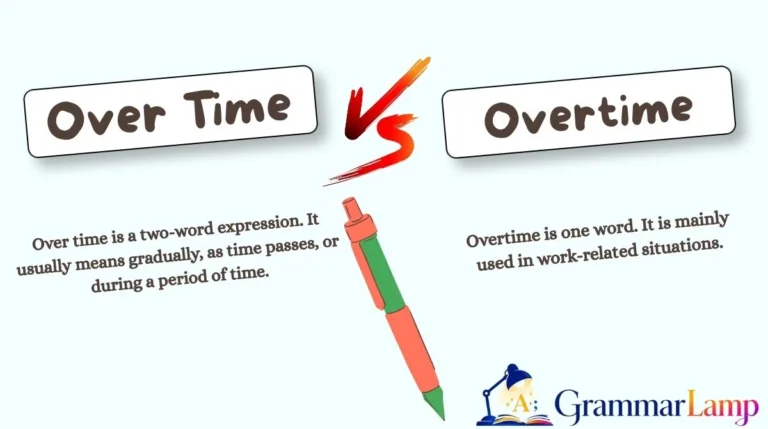
Over time and overtime look almost the same, so it is easy to mix them up. The only visible difference is the space between the two words. However, that small space changes the meaning.
This is a common problem for English learners because both expressions are connected with time.
You may see over time when someone talks about a gradual change, while overtime is often used when talking about extra hours at work.
For example, a person may say, “My English has improved over time.” A worker may say, “I worked three hours of overtime yesterday.”
The good news is that the difference is simple once you understand what each expression means. Over time usually means gradually or during a period of time.
Overtime, written as one word, is mainly a noun or adjective connected with extra working hours or extra pay.
Knowing the difference is useful in emails, conversations, school writing, job-related English, and everyday speech. A small spelling mistake can sometimes change the meaning of your sentence.
By the end of this guide, you will know when to use over time and when to use overtime, how their grammar works, the common mistakes learners make, and an easy trick to remember the difference.
More Useful posts
At the Weekend or On the Weekend? 2026 Guide to British and American English
To Discuss or Discuss About: Which Is Correct? | Easy Grammar Guide 2026
Upmost vs Utmost: Meaning, Difference, and Correct Usage in 2026
Seam vs Seem: Difference, Meaning, Examples & Grammar Rules (2026)
What Does “Over Time” Mean?
Over time is a two-word expression. It usually means gradually, as time passes, or during a period of time.
It describes something that happens little by little rather than happening all at once.
For example:
My English has improved over time.
This means that the person’s English became better gradually as time passed.
Another example is:
People change over time.
This means people may develop different habits, opinions, skills, or personalities as the years pass.
When Should You Use “Over Time”?
Use over time when you are talking about a change, development, effect, or situation that happens during a period.
It can describe things that happen over days, months, years, or even longer periods.
You can often replace over time with phrases such as:
- gradually
- as time passes
- as the years go by
- during a period of time
The exact replacement depends on the sentence.
For example:
Her confidence grew over time.
You could also say:
Her confidence gradually grew.
The basic meaning is similar.
Grammar Rule for “Over Time”
Over time is normally used as an adverbial phrase. It gives information about when or how gradually something happens.
A common sentence pattern is:
Subject + verb + over time.
For example:
The situation improved over time.
You can also put the phrase at the beginning:
Over time, the situation improved.
Notice that over time has two separate words.
Examples of “Over Time”
- My writing skills have improved over time.Your writing became better gradually.
- The old building became weaker over time.Its condition changed gradually.
- People’s tastes can change over time.What people like may become different as time passes.
- She became more confident over time.Her confidence developed gradually.
- The company grew over time.The company became larger during a period.
- You will learn these words over time.You will learn them gradually.
- The color of the wall faded over time.The color slowly became less strong.
- Our friendship became stronger over time.The friendship developed gradually.
A Common Learner Confusion
Many learners see the word overtime and use it whenever they mean “during a period of time.” That is not correct.
For example:
❌ My English improved overtime.
If you mean that your English improved gradually, the correct sentence is:
✅ My English improved over time.
Here, you are not talking about extra work hours. You are talking about gradual improvement.
A useful question to ask yourself is:
“Am I talking about gradual change as time passes?”
If the answer is yes, over time is usually the correct choice.
What Does “Overtime” Mean?
Overtime is one word. It is mainly used in work-related situations.
It usually means extra time that someone works beyond their normal working hours.
For example:
I worked overtime last night.
This means the person worked longer than their normal scheduled hours.
The word can also refer to extra pay for those additional working hours, depending on the context and the rules of the workplace.
For example:
The company pays overtime for extra hours.
Here, overtime is connected with payment for additional work.
When Should You Use “Overtime”?
Use overtime when talking about extra working hours beyond the normal or expected work schedule.
It is especially common in conversations about:
- jobs
- employees
- working hours
- salaries
- wages
- schedules
- workplace policies
- extra shifts
For example:
I have to work overtime today.
The speaker means they have to work extra hours.
Grammar Rule for “Overtime”
Overtime is commonly used as a noun.
For example:
I worked overtime.
It can also appear before another noun as a modifier:
The overtime pay was included in my salary.
Here, overtime describes the type of pay.
Another example is:
He worked several overtime hours this week.
In some varieties of English, especially in workplace contexts, you may also hear work overtime very frequently.
Examples of “Overtime”
- I worked overtime yesterday.I worked beyond my normal hours.
- She gets paid for overtime.She receives extra pay for additional work.
- We have a lot of overtime this month.The workers have many extra working hours.
- My manager asked me to work overtime.The manager asked me to work beyond the normal schedule.
- He worked overtime to finish the project.He worked extra hours because the project needed to be completed.
- The company offers overtime pay.The company pays employees for qualifying extra hours.
- I don’t want to work overtime tonight.The speaker does not want to stay at work longer than usual.
- Overtime can make a busy week even more tiring.Extra working hours can add to a person’s workload.
A Common Learner Confusion
The biggest mistake is using overtime when you actually mean gradually.
For example:
❌ Her skills improved overtime.
If you mean that her skills improved gradually, write:
✅ Her skills improved over time.
But if you say:
She worked overtime to improve her skills.
That is different. It means she worked extra hours.
So, the space between the words is important.
Difference Between “Over Time” and “Overtime”
The main difference is their meaning and grammatical use.
Over time means something happens gradually as time passes.
Overtime usually means extra working hours or the pay connected with those hours.
Comparison Table
| Over Time | Overtime |
|---|---|
| Two words | One word |
| Usually means gradually | Usually means extra work hours |
| Refers to a period or passing time | Usually relates to employment |
| Often works as an adverbial phrase | Commonly works as a noun |
| Used for gradual change or development | Used for additional working time |
| Example: My English improved over time. | Example: I worked overtime. |
| Example: The problem got worse over time. | Example: I received overtime pay. |
Usage Difference
Consider these two sentences:
My English improved over time.
The sentence is about gradual improvement.
Now compare it with:
I worked overtime.
The sentence is about extra working hours.
The meanings are completely different even though the words look almost identical.
Grammar Logic
The space matters because over time is a phrase made from a preposition and a noun.
- over = preposition
- time = noun
Together, they form the phrase over time.
Overtime, on the other hand, is a single word with its own established meaning. In everyday English, it is strongly associated with additional working hours.
Think about these examples:
Technology changes over time.
This talks about gradual change.
Technology workers sometimes work overtime.
This talks about extra working hours.
Sentence Structure Difference
With over time, you can often place the phrase at the end or beginning of a sentence:
Her confidence increased over time.
Over time, her confidence increased.
With overtime, the word often appears with work-related verbs or nouns:
I worked overtime.
She was paid overtime.
Overtime pay is available.
We have too much overtime this week.
The sentence structure gives you an important clue about which expression you need.
Meaning Comparison
A simple way to understand the difference is:
Over time = as time passes
Overtime = extra work hours
For example:
His business became successful over time.
The business developed gradually.
He worked overtime at his business.
He worked extra hours.
One sentence describes change. The other describes work.
Grammar Rules You Must Remember
Rule 1: Use “over time” for gradual change
When something develops, changes, improves, decreases, or gets worse gradually, use over time.
Her pronunciation improved over time.
Do not join the words in this meaning.
❌ Her pronunciation improved overtime.
✅ Her pronunciation improved over time.
Rule 2: Use “overtime” for extra working hours
When an employee works beyond normal working hours, use overtime.
I worked overtime on Friday.
The word is written as one word because it has the specific workplace meaning.
Another example:
The workers were paid overtime.
This means they received additional pay for extra work hours.
Rule 3: “Over time” can describe long-term development
You can use over time for people, relationships, skills, businesses, objects, opinions, habits, and many other things.
His attitude changed over time.
The house became more valuable over time.
She developed better study habits over time.
The idea is always connected to something happening during a period.
Rule 4: Check whether the sentence is about work
If the sentence is about employees staying longer at work or getting extra pay, overtime is probably the word you need.
I have to work overtime tonight.
But if the sentence is about something changing gradually, use over time.
I became more comfortable speaking English over time.
This quick check can prevent most mistakes.
Explore More Posts
Lets vs Let’s (2026): What’s the Difference? Easy Grammar Guide with Examples
Based Out of vs Based In (2026): What’s the Difference? Easy Grammar Guide with Examples
Crews vs Cruise (2026): What’s the Difference? Easy Grammar Guide with Examples
Everything vs Every Thing: Easy Difference, Rules, Examples & Practice (2026)
Common Mistakes Students Make
The reason this pair causes problems is simple: the words look and sound almost the same. Many learners focus on pronunciation and forget that the spelling and meaning are different.
Mistake 1: Writing “overtime” for gradual change
❌ My English became better overtime.
✅ My English became better over time.
The sentence is about gradual improvement, not extra work.
Mistake 2: Writing “over time” when talking about extra work
❌ I worked over time yesterday.
This could be misunderstood because the normal workplace term is worked overtime.
✅ I worked overtime yesterday.
Here, the speaker worked additional hours.
Mistake 3: Confusing overtime pay with time passing
Compare:
The salary increased over time.
The salary gradually became higher.
I received overtime pay.
The person received extra payment for qualifying additional work.
These are two completely different ideas.
Mistake 4: Thinking the space is optional
It is not.
Over time and overtime are not simply two spelling styles for the same word.
Compare:
The situation changed over time.
with:
The employee worked overtime.
Changing the spacing changes the meaning.
Easy Correction Tip
Before writing the word, ask yourself:
“Is this about gradual change?”
If yes, write:
over time
If you are talking about:
extra hours at work
write:
overtime
This one question will solve most problems.
Easy Trick to Remember the Difference
Here is a simple memory trick:
Think: “Time passes” → Over time
If you can replace the expression with gradually or as time passes, use two words.
My English improved over time.
Try replacing it:
My English gradually improved.
The meaning still works.
Think: “Extra work” → Overtime
If you are talking about staying at work longer than usual, use one word:
I worked overtime.
You can remember it like this:
Over time = life changes
Overtime = work hours
For example:
Children grow over time.
But:
Workers may work overtime.
The first sentence is about natural development. The second is about additional work.
Another useful trick is to connect overtime with workplace words such as:
- overtime pay
- overtime hours
- work overtime
- overtime shift
If you see words related to a job, overtime is likely to be correct.
Daily Life Examples
Understanding grammar is easier when you see it in normal conversations.
Example 1: Talking About English
Ali: Your English is much better now.
Hassan: Thanks! I practiced every day, and my English improved over time.
Here, the improvement happened gradually.
Example 2: Talking About Work
Sara: Are you going home now?
John: Not yet. I have to work overtime tonight.
John has to work extra hours.
Example 3: Talking About a Friendship
A: Were you and your friend close when you first met?
B: Not really. We became close over time.
The friendship developed gradually.
Example 4: Talking About Extra Pay
A: Why was your paycheck higher this month?
B: I worked a lot of overtime.
The extra money came from additional work hours.
Example 5: Talking About Skills
Teacher: Don’t worry if you make mistakes.
Student: I know. I think my grammar will improve over time.
The student expects gradual improvement.
Example 6: Talking About a Job
Manager: Can you stay until 9 tonight?
Employee: Yes, but will I get overtime pay?
The employee is asking about payment for extra working hours.
Example 7: Talking About an Old Building
A: Why does this building look different now?
B: It has changed a lot over time.
The building changed gradually.
Example 8: Talking About a Busy Week
A: You look tired.
B: I am. I’ve been working overtime all week.
The person has been working extra hours.
Example 9: Talking About Confidence
A: Were you nervous when you first started speaking English?
B: Yes, but I became more confident over time.
The confidence developed gradually.
Example 10: Talking About Workplace Rules
Employee: How much overtime can I work this week?
Manager: We’ll check the schedule and let you know.
The conversation is about additional work hours.
Practice Section
Choose the correct option: over time or overtime.
1. My pronunciation improved ______.
A. overtime
B. over time
2. I worked three hours of ______ yesterday.
A. over time
B. overtime
3. The old car became less reliable ______.
A. over time
B. overtime
4. My manager asked me to work ______ tonight.
A. over time
B. overtime
5. Their relationship became stronger ______.
A. overtime
B. over time
Answers
1. B — over time
“My pronunciation improved over time” means it gradually became better.
2. B — overtime
The sentence is about extra working hours.
3. A — over time
The car’s condition changed gradually.
4. B — overtime
The manager wants the employee to work extra hours.
5. B — over time
The relationship developed gradually.
More Helpful posts
Compare to vs Compare with: Easy Grammar Guide for 2026
Apportion vs Portion vs Proportion: Meaning, Differences, and Easy Examples (2026)
Case in Point vs Case and Point: Which Is Correct? (2026)
Work Alongside You vs Work Alongside With You (2026): Which One Is Correct in English?
FAQs
What is the difference between “over time” and “overtime”?
Over time means gradually or as time passes. It is used for changes and developments.
Overtime is one word and usually means extra working hours or extra pay for those hours.
For example, “My skills improved over time” and “I worked overtime” have different meanings.
Can “over time” be used in questions?
Yes. You can use over time in questions whenever you are asking about gradual change.
For example:
Can your English improve over time?
You can also ask:
How did the company change over time?
The phrase works normally in both questions and statements.
Can “overtime” be used in questions?
Yes. Overtime is common in workplace questions.
For example:
Do you work overtime?
Will I get overtime pay?
How many overtime hours did you work?
These questions are about extra working hours or payment.
Is “overtime” formal or informal?
Overtime is a normal standard English word. It can be used in both everyday conversation and formal workplace communication.
For example, you may hear “I worked overtime” in casual speech, while a company document may discuss “overtime pay” or “overtime hours.”
Can I write “overtime” instead of “over time”?
No, not when you mean gradually or as time passes.
Write:
My skills improved over time.
Not:
❌ My skills improved overtime.
Use overtime when you mean extra working hours or related pay.
Why do “over time” and “overtime” cause so much confusion?
They look and sound very similar, but they have different meanings. English learners may naturally assume that the space does not matter.
However, the two forms have different grammatical functions and meanings. Remembering over time = gradually and overtime = extra work makes the difference much easier.
Conclusion
The difference between over time and overtime is small in spelling but important in meaning.
Use over time as two words when you mean gradually, as time passes, or during a period. It is useful when talking about changes in people, skills, relationships, businesses, habits, and many other things.
Use overtime as one word when you are talking about extra working hours or payment for additional work. It is especially common in workplace English.
A simple memory trick can help: over time = gradual change, while overtime = extra work.
For example, your English may improve over time, but you may need to work overtime to finish a project.
The best way to remember the difference is to use both expressions in your own sentences.
Once you see them in real situations, the correct form will start to feel natural. Keep practicing, and this small grammar confusion will soon become easy.

Liam Derren is a language writer at GrammarLamp, creating simple, helpful content about grammar, words, and everyday English. He makes language learning clear, practical, and easy to understand.