
Many English learners get confused when they hear people say based out of and based in.
Both expressions seem to talk about a person’s or company’s location, so they often look like they mean exactly the same thing. However, there is a small difference in meaning, style, and usage.
You may hear someone say, “Our company is based in London,” while another person says, “Our company is based out of London.” Which one is correct? Should you use both? Is one more natural than the other?
This question is common because English changes over time. Different countries and workplaces also use different expressions. If you learn the difference, your speaking and writing will sound much more natural.
Understanding these phrases is useful in daily life. You may see them in business emails, company websites, job interviews, travel conversations, news reports, and social media. Knowing when to choose the right expression can help you avoid common grammar mistakes.
By the end of this guide, you will clearly understand what based in means, when people use based out of, which one is better for formal English, and how native speakers use both in real conversations.
You will also find simple grammar rules, plenty of examples, common mistakes, memory tips, and practice exercises to help you remember everything easily.
What Does “Based Out of” Mean?
Simple Definition
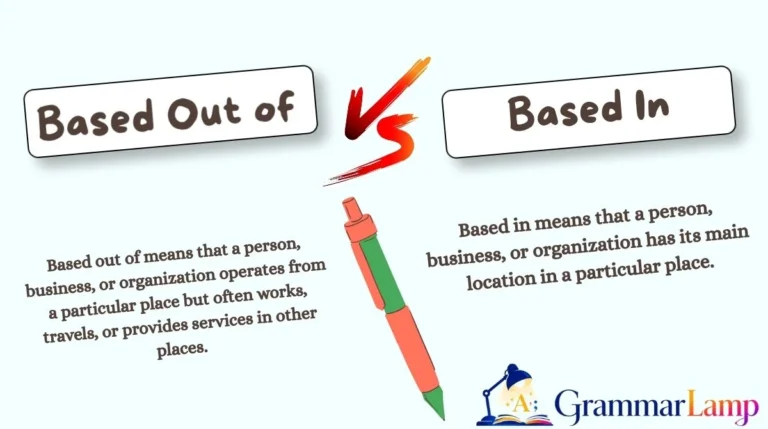
Based out of means that a person, business, or organization operates from a particular place but often works, travels, or provides services in other places.
It is especially common in American English.
Example:
- Our delivery company is based out of Chicago.
This usually means the company’s main office is in Chicago, but its services may cover many other cities.
When to Use It
Use based out of when talking about:
- A company’s headquarters
- A person’s working location
- A business that serves many areas
- Transportation companies
- Sales teams
- Airlines or logistics businesses
Many businesses use this phrase when they want to show both their home location and the fact that they operate elsewhere.
Grammar Rule
Structure:
Subject + be verb + based out of + place
Examples:
- We are based out of Dubai.
- She is based out of New York.
- The airline is based out of Toronto.
- Our sales team is based out of Karachi.
- They are based out of California.
- The company has been based out of Singapore since 2022.
- His office is based out of Islamabad.
- Our drivers are based out of Lahore.
Common Learner Confusion
Many learners think based out of means someone is physically outside the city.
That is not correct.
Instead, it usually means the place is the main operating center.
For example:
“Our company is based out of Dallas.”
This does not mean the office is outside Dallas.
It simply means Dallas is the company’s main base.
What Does “Based In” Mean?
Simple Definition
Based in means that a person, business, or organization has its main location in a particular place.
It is the most common and widely accepted expression in English.
Both British English and American English use it.
Example:
- Google is based in California.
This tells us where Google’s main location is.
When to Use It
Use based in when talking about:
- Offices
- Businesses
- Schools
- Organizations
- Employees
- Artists
- Writers
- Sports teams
It is suitable for both formal and informal English.
Grammar Rule
Structure:
Subject + be verb + based in + place
Examples:
- I am based in Lahore.
- She is based in London.
- They are based in Tokyo.
- Our office is based in Islamabad.
- The company is based in Canada.
- He is based in Germany.
- The charity is based in Nairobi.
- The newspaper is based in New York.
Common Learner Confusion
Some learners think based in means someone never leaves that city.
That is not true.
A person can be based in Paris and travel every week for work.
The phrase simply tells us where their main location is.
Difference Between Based Out of and Based In
Although both expressions describe a main location, they are not always used in exactly the same way.
| Based In | Based Out of |
|---|---|
| Means located in a place | Means operating from a place |
| Common worldwide | More common in American English |
| Best for formal writing | Common in business conversations |
| Focuses on location | Focuses on operations from that location |
| Used in schools, books, news, websites | Often used by companies and businesses |
Usage Difference
Based in simply tells the reader where someone or something is located.
Example:
“Our office is based in London.”
The focus is on the location.
Based out of often suggests that work begins there but extends elsewhere.
Example:
“Our trucks are based out of Dallas.”
The trucks start from Dallas but travel to many cities.
Grammar Logic
Think about the word base.
A base is your main place.
When you say based in, you identify that place.
When you say based out of, you describe that place as the starting point for work or business activities.
Sentence Structure Difference
Based In
Subject + be + based in + location
Examples:
- We are based in Lahore.
- The company is based in Dubai.
Based Out Of
Subject + be + based out of + location
Examples:
- We are based out of Lahore.
- The company is based out of Dubai.
Both are grammatically acceptable, but based in is preferred in formal writing.
Meaning Comparison
Compare these examples:
“Our company is based in London.”
Meaning:
London is our headquarters.
“Our company is based out of London.”
Meaning:
London is our headquarters, and we operate from there to other places.
The difference is small, but many native speakers understand this extra idea.
Grammar Rules You Must Remember
Rule 1: Use “based in” for formal writing.
Correct:
The university is based in Oxford.
Incorrect in many formal contexts:
The university is based out of Oxford.
Rule 2: Use “based out of” mainly for business operations.
Correct:
Our delivery service is based out of Houston.
This sounds natural because delivery services operate across many areas.
Rule 3: Never remove the preposition.
Correct:
She is based in Paris.
Correct:
She is based out of Paris.
Wrong:
She is based Paris.
Rule 4: Use the correct form of the verb “be.”
Correct:
- I am based in Lahore.
- They are based out of Karachi.
- He is based in Rome.
- We were based in Singapore.
Common Mistakes Students Make
Many learners mix these expressions because both mention places.
Here are the most common mistakes.
Mistake 1
❌ Our company is based at London.
✅ Our company is based in London.
Tip:
Cities usually take in, not at.
Mistake 2
❌ I base in Lahore.
✅ I am based in Lahore.
Remember that based is an adjective here.
Always use a form of be.
Mistake 3
❌ The airline is based from Dubai.
✅ The airline is based out of Dubai.
or
✅ The airline is based in Dubai.
Mistake 4
❌ Our office based in Karachi.
✅ Our office is based in Karachi.
Never forget the verb is, am, are, was, or were.
Easy Correction Tips
- Ask yourself where the headquarters are.
- For formal English, choose based in.
- For business operations, based out of can also work.
- Always include the correct form of be.
Easy Trick to Remember the Difference
Here is a simple memory trick.
Think of a Home
Imagine your house.
You live in your house.
So think:
Based in = Home location
Now imagine a delivery truck.
The truck starts from one warehouse and drives everywhere.
That warehouse is where it is based out of.
So think:
Based out of = Starting point for work
This simple picture makes it much easier to remember.
Daily Life Examples
These examples sound natural in everyday English.
- My sister is based in Karachi but travels every month.
- Our company is based in Dubai.
- The airline is based out of Doha.
- We are based in Islamabad, but we have customers worldwide.
- The delivery team is based out of Lahore.
- He is based in Canada now.
- Our sales office is based out of New York.
- The software company is based in Germany.
- She works for a business based in London.
- Their logistics center is based out of Chicago.
Practice Section
Choose the correct answer.
1.
Our company is ______ London.
A) based in
B) based at
2.
The airline is ______ Dubai.
A) based out of
B) based from
3.
She is ______ Paris.
A) based in
B) based on
4.
Our trucks are ______ Houston.
A) based out of
B) based with
5.
Google is ______ California.
A) based in
B) based at
Answers
- A
- A
- A
- A
- A
(FAQs)
1. What is the difference between based out of and based in?
Based in simply tells us the main location of a person or organization. Based out of often suggests that work or business operations start from that location and continue elsewhere. In formal English, based in is generally preferred.
2. Can I use based out of in formal writing?
It is better to avoid it in academic papers, official reports, and formal business documents. Based in is the safer and more widely accepted choice.
3. Is based out of grammatically correct?
Yes. It is commonly used, especially in American English and business communication. However, some style guides still recommend based in for clear and formal writing.
4. Can I use based in for people?
Yes. You can say:
- She is based in London.
- He is based in Singapore.
This simply means that their main work or living location is there.
5. Which expression do native speakers use more?
Native speakers use based in more often in writing. Based out of is also common, especially in American business conversations and logistics.
6. Can these expressions be used in questions?
Yes.
Examples:
- Where are you based?
- Is your company based in Dubai?
- Is your office based out of New York?
All of these are natural depending on the situation.
Conclusion
Understanding the difference between based out of and based in is much easier once you know what each expression focuses on. Based in simply tells us where a person, company, or organization has its main location.
It is the standard choice for formal writing, school assignments, news articles, and professional documents. Based out of, on the other hand, is often used in American English to show that a business operates from a particular place while serving other areas.
In everyday conversations, you may hear both expressions, and both can be correct depending on the context.
The safest choice for English learners is to use based in whenever you are unsure. As your English improves, you will naturally recognize situations where based out of sounds more suitable.
The best way to master these phrases is through regular practice. Read English articles, listen to native speakers, and create your own example sentences. With a little practice, choosing the right expression will soon become second nature.

Liam Derren is a language writer at GrammarLamp, creating simple, helpful content about grammar, words, and everyday English. He makes language learning clear, practical, and easy to understand.
1 thought on “Based Out of vs Based In (2026): What’s the Difference? Easy Grammar Guide with Examples”