
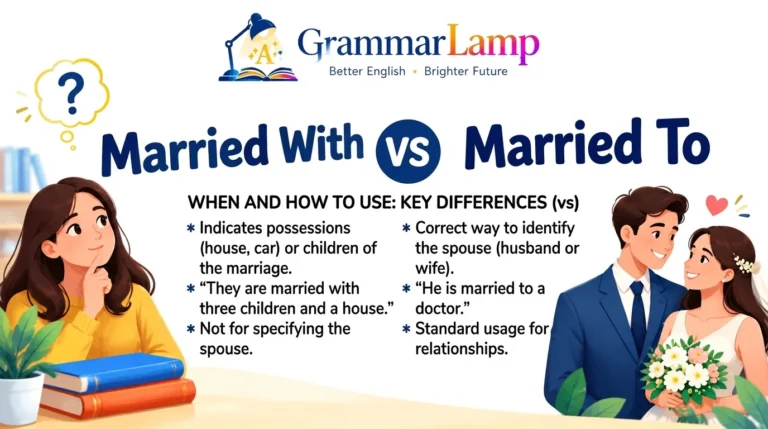
Many English learners become confused when they want to talk about marriage. They may know that the word married is correct, but then they stop and wonder: should it be married to or married with?
This small preposition can change the meaning of the sentence. For example, we normally say, “She is married to Ali,” when Ali is her husband.
We do not normally say, “She is married with Ali.” However, “He is married with two children” can be found in English because with is adding information about his family situation, not naming his spouse.
Cambridge Dictionary itself gives examples of both patterns, including “married to” for a spouse and “married with two children” for an additional family detail.
The confusion often comes from translation. In some languages, one preposition may be used where English needs another. Learners may also notice sentences such as “married with children” and assume that with can be used for a husband or wife too.
The good news is that the main rule is easy. When you identify the person someone is married to, use to. When with adds another detail, especially children, its job is different.
Once you understand that difference, sentences about marriage become much easier to form naturally.
More Useful posts
Case in Point vs Case and Point: Which Is Correct? (2026)
Work Alongside You vs Work Alongside With You (2026): Which One Is Correct in English?
Lets vs Let’s (2026): What’s the Difference? Easy Grammar Guide with Examples
Based Out of vs Based In (2026): What’s the Difference? Easy Grammar Guide with Examples
What Does “Married To” Mean?
Married to is the standard expression used when you want to identify a person’s husband, wife, or spouse.
The basic structure is:
Subject + be + married + to + person
For example:
She is married to Ahmed.
Here, Ahmed is the person she is married to. The word to connects the adjective married with the spouse.
Cambridge Dictionary defines married as having a wife or husband and gives examples such as “How long have you been married to Nicky?” This shows the normal pattern used when the spouse is mentioned.
When should you use “married to”?
Use married to when you name the person someone is married to.
It works with names:
Maria is married to Daniel.
It also works with descriptions:
My sister is married to a doctor.
You can use it with pronouns:
She is married to him.
You can also use it with relationship expressions:
He has been married to his childhood sweetheart for ten years.
Grammar rule
The most useful structure to remember is:
be married to + person
The verb be changes according to the tense and subject:
I am married to John.
She is married to John.
They are married to each other.
He was married to Susan.
How long have you been married to her?
The phrase married to can describe both present and past marriages when the correct form of be is used.
Examples of “married to”
- Sara is married to a university teacher.
- My brother is married to Emma.
- He has been married to her for fifteen years.
- Who is your cousin married to?
- She was married to an engineer before.
- They are happily married to each other.
- David is married to someone he met in college.
- I did not know that she was married to your friend.
Notice the pattern in every example. When a person is being identified as the spouse, to is the natural choice.
A common learner confusion
A common mistake is to think that because two people are together, with should be used.
For example, a learner may say:
She is married with Ali.
But the natural standard form is:
She is married to Ali.
Think about what the sentence is trying to answer.
If the question is “Who is she married to?”, the answer uses to.
She is married to Ali.
The preposition is linked to the relationship, not simply to the idea of being together.
What Does “Married With” Mean?
Married with is different. It is not the normal way to identify the spouse.
Instead, with can introduce an additional fact about the married person’s situation. A very common example is children.
For example:
He is married with two children.
This means:
He is married, and he has two children.
Cambridge Dictionary gives this exact type of structure in its definition of married, including “Smith was married with two children” and “Both her children are now married with children of their own.”
So married with can be grammatical, but its function is different from married to.
When should you use “married with”?
You may see married with when with adds information about children or another accompanying circumstance.
Examples include:
He is married with two children.
She is married with a young daughter.
They are married with three children.
In these sentences, with does not tell us who the husband or wife is. It gives us another piece of information.
Still, in careful formal writing, many speakers prefer:
He is married and has two children.
This version is often clearer and sounds very natural.
Grammar rule
A useful structure is:
Subject + be + married + with + additional information
For example:
She is married with two children.
The part after with is not the spouse. It is additional information connected to the person’s life or family circumstances.
Examples of “married with”
- He is married with two children.
- She is married with a young son.
- My neighbor is married with three kids.
- The man was married with a large family.
- She is married with children and works full-time.
- Both of them are married with children now.
- He is married with a daughter and a son.
- The couple are married with two children.
Again, the important idea is that with is adding something to the description.
A common learner confusion
Many learners see:
married with two children
and think:
married with Ali
should work in the same way.
It does not.
Compare these:
She is married to Ali.
Ali is her spouse.
She is married with two children.
The children are an additional family detail.
The two prepositions are doing different jobs.
Difference Between Married To and Married With
The easiest way to understand the difference is to look at what comes after the preposition.
| Expression | Main use | Example |
|---|---|---|
| married to | Names the spouse | She is married to Ahmed. |
| married with | Adds another circumstance, often children | She is married with two children. |
| married and has | Gives family information clearly | She is married and has two children. |
| get married to | Identifies the person someone marries | She got married to David. |
| marry + person | Active verb pattern | She married David. |
Usage difference
The biggest difference is simple:
Married to = the spouse
Married with = an additional detail
Look at this pair:
John is married to Sarah.
This tells us who John’s wife is.
Now look at:
John is married with two children.
This tells us that John is married and has two children. It does not tell us the name of his wife.
That is why replacing to with with can create a grammar mistake.
Grammar logic
English uses particular prepositions with certain words. You cannot always choose a preposition simply because it seems logical in your first language.
With married, the standard relationship pattern is married to someone.
Cambridge provides examples such as “She is married to a former police officer” and “She’s now happily married to her high school sweetheart.”
At the same time, English can use with to add another part of someone’s situation.
That is why both combinations can appear, but they do not mean the same thing.
Sentence structure difference
Consider:
She is married to Tom.
Structure:
She + is + married + to + Tom
Now:
She is married with two children.
Structure:
She + is + married + with + two children
The first sentence identifies a spouse.
The second sentence adds family information.
Meaning comparison
Imagine someone asks:
“Who is Maria married to?”
You need a person’s name:
Maria is married to David.
Now imagine someone asks:
“Does Maria have children?”
You could say:
Maria is married with two children.
Or, even more clearly:
Maria is married and has two children.
So, when you are deciding between to and with, first decide what information you are trying to give.
Explore More Posts
Crews vs Cruise (2026): What’s the Difference? Easy Grammar Guide with Examples
Everything vs Every Thing: Easy Difference, Rules, Examples & Practice (2026)
All Is vs All Are: Which One Is Correct? Complete Grammar Guide for 2026
At the Weekend or On the Weekend? 2026 Guide to British and American English
Grammar Rules You Must Remember
Rule 1: Use “married to” before the spouse
When the noun after married is the husband, wife, or spouse, use to.
Correct:
She is married to Hassan.
Incorrect:
She is married with Hassan.
The same rule works with names, pronouns, and descriptions.
He is married to her.
My aunt is married to a lawyer.
They are married to each other.
Rule 2: “Married with” does not normally identify the spouse
Do not use with when you are naming the person someone married.
Wrong:
Ali is married with Sara.
Correct:
Ali is married to Sara.
The issue is not that the word with is always impossible near married. The problem is that it cannot replace to when you are expressing the marriage relationship.
Rule 3: “Married with” can add information about children
This is one of the most common valid uses.
He is married with three children.
The meaning is:
He is married and has three children.
However, the clearer version is often:
He is married and has three children.
This is especially useful in formal writing, applications, profiles, and professional documents.
Rule 4: Do not confuse “marry” with “be married”
There is another important grammar point here.
The active verb marry normally takes the person directly:
She married John.
Not:
She married to John.
But with the adjective or passive-style form married, we commonly say:
She is married to John.
Compare:
She married John in 2020.
She has been married to John since 2020.
This small difference helps prevent another common error.
Common Mistakes Students Make
These mistakes usually happen because learners translate directly from their first language or notice with in phrases such as married with children.
Mistake 1: Using “married with” for a spouse
Wrong:
My sister is married with Ahmed.
Correct:
My sister is married to Ahmed.
Why? Because Ahmed is the spouse.
Mistake 2: Thinking “with children” means “with the spouse”
Wrong idea:
If “married with two children” is possible, then “married with John” must also be possible.
It does not work that way.
Two children are additional information. John is the spouse.
So:
She is married to John.
She is married with two children.
Mistake 3: Saying “married to” after the active verb “marry”
Incorrect:
She married to David last year.
Correct:
She married David last year.
Or:
She got married to David last year.
The word marry and the phrase get married have different structures.
Mistake 4: Using “with” simply because two people are together
English does use with for people in many situations:
I live with my husband.
She went with her husband.
He works with his wife.
But those verbs have their own normal patterns.
For the marriage relationship itself, use:
She is married to her husband.
Easy correction tips
Whenever you see married + preposition, ask yourself one question:
Am I naming the spouse?
If yes, use to.
She is married to Daniel.
If you are adding information such as children, with may be possible:
She is married with two children.
For maximum clarity, you can always choose:
She is married and has two children.
That sentence is simple, natural, and very easy to understand.
Easy Trick to Remember the Difference
Here is a simple memory trick:
TO = The person
Think:
Who is she married TO?
Answer:
She is married TO John.
The word to points toward the person who is the spouse.
WITH = What comes along
Think of with as adding something else:
She is married WITH two children.
The children are another part of the family situation.
An even easier classroom trick is:
Person → TO
Extra detail → WITH
For example:
Married to Ali → Ali is the spouse.
Married with two children → two children are additional information.
There is one more useful point. In everyday English, married and has is often the clearest choice when talking about children:
He is married and has two children.
So you do not need to force yourself to use married with every time you mention children.
The goal is not just to follow a rule. The goal is to communicate clearly.
Daily Life Examples
Here are some natural examples you may hear in everyday conversations.
Example 1
A: Is your sister married?
B: Yes, she is married to a doctor.
Here, to a doctor identifies her husband.
Example 2
A: Who is Ahmed married to?
B: He is married to my cousin, Sara.
The question and answer both use to because the topic is the spouse.
Example 3
A: Does your brother have children?
B: Yes. He is married with two children.
A clearer alternative is:
Yes. He is married and has two children.
Example 4
A: I heard that Maria got married.
B: Yes, she got married to her college boyfriend last year.
Here, to identifies the person she married.
Example 5
A: Is your uncle married?
B: Yes. He has been married to my aunt for twenty years.
The phrase married to describes their marriage relationship.
Example 6
A: Is Tom married to Lisa?
B: Yes, they have been married for five years.
Notice that once the spouse is known, you can simply use married without repeating to.
Example 7
A: How old is your teacher?
B: She is forty-two, married, and has three children.
This is a very clear way to give several facts.
Example 8
A: Is your friend married?
B: Yes, he is married to a software engineer.
Again, to introduces the spouse.
Example 9
A: Does your neighbor have kids?
B: Yes, he is married with a young daughter.
Here, with adds information about the family.
Example 10
A: When did they get married?
B: They got married to each other in 2021.
This is another common use of to with get married.
Practice Section
Choose the correct option in each sentence.
1. Sarah is married ___ a doctor.
a) to
b) with
2. My uncle is married ___ three children.
a) to
b) with
3. Who is your brother married ___?
a) to
b) with
4. She married ___ James in 2019.
a) to
b) no preposition
5. They have been married ___ each other for ten years.
a) to
b) with
Answers
1. to — Sarah is married to a doctor.
2. with — Here, with adds information about the three children.
3. to — The question asks about the spouse: Who is he married to?
4. no preposition — The active verb is married James, not married to James.
5. to — The normal expression is married to each other.
A useful practice habit is to read each sentence aloud. When you hear the difference between married to someone and married with children, the pattern becomes easier to remember.
More Helpful posts
To Discuss or Discuss About: Which Is Correct? | Easy Grammar Guide 2026
Upmost vs Utmost: Meaning, Difference, and Correct Usage in 2026
Seam vs Seem: Difference, Meaning, Examples & Grammar Rules (2026)
All the Time vs Every Time: Meaning, Difference, Rules & Examples (2026)
FAQs
What is the difference between married to and married with?
Married to is used when you identify the spouse, such as “She is married to John.”
Married with can add another detail, especially children, as in “He is married with two children.”
The two expressions therefore have different grammatical jobs.
Can we use “married with” for a person?
Normally, no, not when that person is the spouse.
You should say “She is married to David,” not “She is married with David.”
Use with when it adds another circumstance rather than naming the marriage partner.
Is “married with children” correct?
Yes, this construction is found in standard English. Cambridge Dictionary gives examples such as “married with two children.”
However, “married and has two children” is often clearer, especially in formal writing.
Is “married to” formal or informal?
Married to is completely standard English and can be used in both everyday speech and formal writing.
For example, “She is married to a lawyer” is natural in conversation, biographies, forms, and professional writing. Cambridge Dictionary lists this as the normal construction for referring to a spouse.
Can I say “I am married with two children”?
Yes, you can encounter this sentence in English, and it means that you are married and have two children.
For extra clarity, especially in formal contexts, you can say:
“I am married and have two children.”
That version makes the two facts completely separate.
Which is correct: “married to someone” or “married with someone”?
When someone is the husband, wife, or spouse, use married to someone.
For example:
“She is married to Michael.”
Do not replace to with with in this structure. Married with has a different use when it adds accompanying information such as children.
Conclusion
The difference between married to and married with becomes simple once you focus on the meaning of the words after the preposition.
Use married to when you are talking about the spouse:
She is married to Ahmed.
Who is he married to?
They have been married to each other for years.
Use married with when with adds another detail, especially children:
He is married with two children.
However, when you want maximum clarity, “married and has two children” is often a very natural choice.
Also remember that the active verb has a different pattern:
She married John.
But:
She is married to John.
The most useful memory rule is simple: person → married to; additional information → married with.
English prepositions can feel confusing at first, but a few real examples make the pattern much easier. Keep practicing these sentences in everyday conversation, and choosing the correct form will soon feel natural.

Liam Derren is a language writer at GrammarLamp, creating simple, helpful content about grammar, words, and everyday English. He makes language learning clear, practical, and easy to understand.