
Have you ever heard someone say “case and point” and wondered whether it was correct? You are not alone.
This is one of those English expressions that can be confusing because “case in point” and “case and point” sound very similar when people speak quickly.
The good news is that the difference is actually simple. In standard English, “case in point” is the correct expression. It means a clear, relevant example that supports or proves what you have just said.
“Case and point” is a common mistake, not the standard form of the idiom. Major dictionaries such as Cambridge and Merriam-Webster define and use “case in point” in this sense.
This small phrase is useful in everyday English because we often give examples to explain our ideas.
You may hear it in conversations, classes, news reports, business discussions, essays, and presentations.
For example:
“Many students learn better with practice. My younger brother is a case in point.”
Here, the speaker gives the younger brother as a real example of the idea.
By the end of this guide, you will know exactly what “case in point” means, why “case and point” causes confusion, how to use the correct expression naturally, and how to remember it without thinking twice.
4. What Does “Case in Point” Mean?
Simple Definition
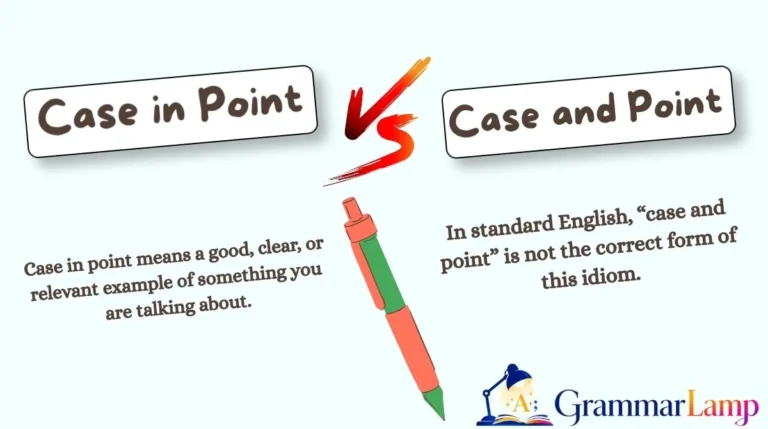
Case in point means a good, clear, or relevant example of something you are talking about.
Cambridge defines a case in point as an example that shows that what you are saying is true or helps explain why you are saying it. Merriam-Webster gives a similar meaning: an illustrative, relevant, or pertinent case.
In very simple English:
Case in point = a good example that proves or supports your idea.
Look at this:
“Online learning can be difficult for some students. My cousin is a case in point.”
The speaker has made a general statement about online learning. Then the speaker gives the cousin as a specific example.
When Should You Use “Case in Point”?
Use case in point when you have already mentioned an idea, situation, problem, or general statement and want to give a specific example.
Common patterns include:
1. A case in point is + noun
A case in point is our school library.
2. … is a case in point.
His success is a case in point.
3. Case in point: + example
Case in point: our sales increased after the changes.
4. As a case in point, + example
As a case in point, several students improved after extra practice.
The phrase often points the listener toward a real example.
Grammar Rule
Case in point is a noun phrase, usually used to refer to an example or situation.
It can come after the verb be:
Her experience is a case in point.
It can also be introduced with a:
This is a case in point.
And it can introduce an example after a colon:
Case in point: he finished the project two days early.
The word “in” is part of the established expression. It should not normally be replaced with “and.” Merriam-Webster specifically notes that “case in point” is the established expression and describes “case and point” as an eggcorn, or a mistaken version created by mishearing or misunderstanding a phrase.
8 Example Sentences
- Her hard work is a case in point.
- My brother is a case in point; he improved after practicing every day.
- A case in point is the new safety system at our factory.
- Case in point: fewer people complained after the company changed its policy.
- The school’s success is a good case in point.
- As a case in point, look at how quickly Sara learned the new software.
- Many old buildings need repair, and this house is a case in point.
- The recent traffic accident is a case in point.
A Common Learner Confusion
Many learners hear “case in point” as “case and point.” This happens easily in fast speech.
The words in and and can sound unclear when a speaker talks quickly. Because both case and point are normal English words, “case and point” may sound logical even though it is not the standard idiom.
That is why listening practice is important. Do not decide that a phrase is correct simply because you hear it often.
5. What Does “Case and Point” Mean?
Simple Definition
In standard English, “case and point” is not the correct form of this idiom.
When people say “case and point,” they usually mean “case in point.” It is a common mistaken version of the expression.
For example:
❌ “Case and point, my brother got a better job after taking the course.”
The standard form is:
✅ “Case in point, my brother got a better job after taking the course.”
Merriam-Webster explains that “case in point” has been used for centuries, while “case and point” is a mistaken form.
Why Do People Say “Case and Point”?
There are a few simple reasons.
First, “in” and “and” can sound similar in rapid speech.
Second, English learners often try to understand phrases word by word. The combination “case and point” may seem logical because and often joins two nouns:
bread and butter
black and white
time and money
So a learner may naturally think:
case + and + point
But case in point is an idiomatic expression. You should learn it as one complete phrase instead of trying to rebuild it from the individual words.
Grammar Rule
For the meaning “a relevant example,” use:
case in point
not:
case and point
This is especially important in formal writing, school assignments, business communication, and professional documents.
What About Examples?
You may see or hear “case and point” in casual speech, social media, or online writing. That does not make it the standard form.
A phrase can be commonly heard and still be considered incorrect in standard usage.
For example:
❌ Case and point, he never listens.
✅ Case in point, he never listens.
8 Corrected Examples
- ❌ Case and point, she arrived late again.
✅ Case in point, she arrived late again. - ❌ His results are a case and point.
✅ His results are a case in point. - ❌ This is a case and point of poor planning.
✅ This is a case in point of poor planning. - ❌ Case and point: the team lost three games.
✅ Case in point: the team lost three games. - ❌ My father is a case and point.
✅ My father is a case in point. - ❌ That incident is a good case and point.
✅ That incident is a good case in point. - ❌ As a case and point, look at this example.
✅ As a case in point, look at this example. - ❌ Her experience is a perfect case and point.
✅ Her experience is a perfect case in point.
One useful detail is that “case and point” does not have a separate standard meaning that you need to learn. For this common expression, the form to remember is “case in point.”
6. Difference Between “Case in Point” and “Case and Point” (Detailed)
The biggest difference is easy:
“Case in point” is the standard expression. “Case and point” is usually a mistaken version of it.
| Expression | Standard English? | Meaning | Example |
|---|---|---|---|
| case in point | Yes | A relevant or clear example | Her success is a case in point. |
| case and point | No, for this idiom | Usually intended to mean “case in point” | ❌ Case and point, he worked hard. |
Usage Difference
Case in point is used when one particular case helps illustrate a general idea.
Example:
“Exercise improves health. My grandfather is a case in point.”
The grandfather is the specific example.
Case and point, when used with this meaning, does not create a different idea. It is simply a mistaken replacement of in with and.
Grammar Logic
The key is that case in point is an established idiom.
You do not choose in because it follows a general rule such as “always use in before point.” You use it because that is the fixed form of the expression.
English has many fixed expressions like this:
by the way
in fact
at once
in general
of course
We usually learn these as complete phrases.
Case in point works the same way.
Sentence Structure Difference
A few common structures are:
Subject + be + a case in point.
Example:
Her story is a case in point.
Or:
Case in point: + example
Example:
Case in point: the company hired five new workers.
Or:
As a case in point, + example
Example:
As a case in point, consider what happened last year.
You should not change the structure to case and point.
Meaning Comparison
There is no useful meaning contrast such as:
case in point = one meaning
case and point = another meaning
Instead, the situation is:
case in point = correct idiom
case and point = common mistake for that idiom
Vocabulary.com also explains that “case in point” refers to a specific example that illustrates the message being discussed, while “case and point” is the mistaken form.
A Helpful Historical Note
The phrase case in point has a long history. Merriam-Webster records its first known use in the 17th century, and its earlier legal use referred to a relevant legal case or precedent. Over time, the expression developed its broader modern meaning: a relevant example.
That history also explains why “in point” may feel strange to modern learners. The phrase has stayed together even though “in point” is not something speakers commonly use by itself today.
7. Grammar Rules You Must Remember
Rule 1: Use “case in point” for a relevant example
When something is a good example of the idea you just mentioned, use case in point.
Many people waste time on their phones. My brother is a case in point.
The brother provides evidence for the general statement.
Rule 2: Do not replace “in” with “and”
For this idiom, in is the correct word.
✅ Her experience is a case in point.
❌ Her experience is a case and point.
Do not let the sound of the phrase trick you.
Rule 3: “Case in point” can follow “a”
When the expression works as a noun phrase, it commonly appears with a.
This is a case in point.
Her story is a case in point.
You may also see:
a clear case in point
a perfect case in point
a good case in point
Rule 4: “Case in point:” can introduce an example
In writing, speakers and writers sometimes use case in point: before giving a specific example.
The new rule has already helped students. Case in point: attendance has improved.
The colon makes the following example easy to recognize.
8. Common Mistakes Students Make
Mistake 1: Writing “case and point”
This is the most common error.
❌ The incident is a case and point.
✅ The incident is a case in point.
Easy tip: Memorize the whole phrase, not the individual words.
Mistake 2: Thinking “and” makes more logical sense
Students often think and means two connected things: case + point.
That sounds reasonable, but idioms do not always follow everyday logic.
For example, we say:
by the way
not:
by the road
The correct phrase is simply the phrase English speakers have established.
Mistake 3: Using “case in point” when no example follows
The expression should connect to an example or relevant case.
Weak:
“I like winter. My case in point.”
Better:
“I think winter is enjoyable. The snowy weather is a case in point.”
The second sentence makes the relationship clear.
Mistake 4: Using it when “for example” would be simpler
Case in point is useful, but you do not need it in every situation.
Compare:
For example, many students prefer studying at night.
and:
Many students prefer studying at night. My brother is a case in point.
The first is a simple introduction to an example. The second specifically points to a person or situation as evidence for an earlier statement.
Mistake 5: Forgetting the connection with the previous idea
The phrase works best when the example supports something already being discussed.
“The new system is much faster. Case in point: yesterday’s report was completed in ten minutes.”
The report is connected to the claim about speed.
9. Easy Trick to Remember the Difference
Here is the easiest memory trick:
“Case IN point” puts an example IN your discussion.
Think of the word in as showing that the example belongs inside the point you are making.
You say:
“People can learn difficult skills with practice. My sister is a case in point.”
Your sister’s story fits in the idea.
Another way to remember it is:
Case = example
In point = relevant to the point
So:
case in point = relevant example
You can also connect it to the phrase “prove my point.”
When you give a case in point, you are giving an example that helps support your point.
Imagine a classroom:
Teacher:
“Regular practice improves English.”
Student:
“My friend Ahmed is a case in point.”
Ahmed is the real example that supports the teacher’s statement.
That mental picture makes the phrase much easier to remember.
And remember one more thing:
Never use “and” simply because you hear it that way.
If you mean “a relevant example,” write case in point.
10. Daily Life Examples (Very Important)
You will often hear this expression in natural conversations and discussions.
1. Talking about school
“Practice really helps students. Sara is a case in point because she improved her grades after studying every day.”
2. Talking about work
“Good communication matters at work. Our last project is a case in point.”
3. Talking about health
“Walking every day can improve your fitness. My father is a case in point.”
4. Talking about money
“Small expenses can become expensive over time. My monthly coffee bill is a case in point.”
5. Talking about technology
“Technology can save us a lot of time. Online banking is a case in point.”
6. Talking with a friend
“You said people can change their habits. Your brother is a case in point.”
7. Talking about travel
“Planning ahead can make a trip easier. Our last holiday was a case in point.”
8. Talking about business
“Customer service can affect sales. This store is a case in point.”
9. Talking about learning English
“Listening practice makes a big difference. Your pronunciation is a case in point.”
10. Using the phrase at the beginning
“The new schedule has made things easier. Case in point: we finished today’s work before lunch.”
Notice that in natural conversation, case in point usually points backward to an idea and then highlights a specific example.
11. Practice Section
Choose the correct expression: case in point or case and point.
1.
“Many children enjoy learning through games. My son is a ______.”
2.
“Case ______: the new system cut the waiting time in half.”
3.
“Her success is a good ______.”
4.
“Case and point, our sales increased.”
5.
“Small changes can have big results. This project is a ______.”
Answers
1. case in point
Many children enjoy learning through games. My son is a case in point.
2. in
Case in point: the new system cut the waiting time in half.
3. case in point
Her success is a good case in point.
4. Incorrect — use “case in point.”
Case in point, our sales increased.
5. case in point
Small changes can have big results. This project is a case in point.
A good practice habit is to say the full phrase aloud several times:
case in point
Repeating the complete expression helps your brain store it as one natural unit.
12. FAQs
What is the difference between “case in point” and “case and point”?
Case in point is the standard English expression. It means a relevant or clear example that supports an idea. Case and point is usually a mistaken version of the same phrase, not a separate standard idiom.
Can we use “case in point” in questions?
Yes, it can appear in a question, although it is more common in statements. For example:
“Can you give me a case in point?”
This means:
“Can you give me a relevant example?”
The question is grammatical and natural.
Is “case in point” formal or informal?
Case in point is neutral and slightly more common in careful speech and writing than in very casual conversation. You can use it in essays, presentations, workplace communication, and everyday discussions. For very simple conversation, “for example” may sound more natural.
Is “case and point” ever correct?
For the ordinary idiom meaning “a relevant example,” you should use case in point. Case and point is generally treated as a mistaken form of the expression rather than the standard phrase.
Why do people say “case and point”?
The most likely reason is that case in point can sound like case and point when spoken quickly. Learners may also assume that and joins the two nouns. Because all three words are normal English words, the error can be difficult to notice when listening.
Can I replace “case in point” with “for example”?
Sometimes, yes. Both can introduce examples, but they are not always identical in style. For example is a general way to give an example, while case in point usually points to a particular example that supports or illustrates a statement already made.
Conclusion
The main thing to remember is very simple: case in point is the correct standard expression when you mean “a relevant or clear example.”
For example:
“Exercise can improve your health. My grandfather is a case in point.”
The phrase connects a general idea with a specific example.
Case and point is usually a mistaken version caused by the way case in point sounds in quick speech. Even though you may hear it from native speakers or see it online, it is better to avoid it in careful English, especially in school, work, and professional writing.
The easiest memory trick is:
Case IN point = an example that fits IN the point you are making.
Try using the phrase in your own sentences. The more you hear and use case in point, the more natural it will feel.
When you are unsure, remember just four words:
Relevant example = case in point.

Liam Derren is a language writer at GrammarLamp, creating simple, helpful content about grammar, words, and everyday English. He makes language learning clear, practical, and easy to understand.
1 thought on “Case in Point vs Case and Point: Which Is Correct? (2026)”