
Some English words sound exactly the same but have completely different meanings. They can also have different spellings and uses.
Waive vs wave is a good example of this common English problem. Both words have the same pronunciation, but they do not mean the same thing. Using the wrong word can change the meaning of a sentence and sometimes make your writing confusing.
For example, imagine that a school allows a student to skip a particular fee. You might say, “The school decided to waive the fee.” However, if you want to greet someone by moving your hand, you would say, “I waved at my friend.”
Although these two words sound alike, their meanings are very different. One is often used when someone gives up a right, rule, fee, or requirement. The other usually describes moving your hand, an object, or something back and forth.
This difference is important in everyday conversations, emails, schoolwork, business writing, and formal documents. You may also see both words in news reports, legal papers, and online messages.
The good news is that learning the difference is not difficult. Once you understand what each word means and how it works in a sentence, you can choose the correct spelling with confidence. You will also learn common mistakes, simple memory tricks, and practical examples that make these words easier to remember.
More Useful posts
Case in Point vs Case and Point: Which Is Correct? (2026)
Work Alongside You vs Work Alongside With You (2026): Which One Is Correct in English?
Lets vs Let’s (2026): What’s the Difference? Easy Grammar Guide with Examples
Based Out of vs Based In (2026): What’s the Difference? Easy Grammar Guide with Examples
What Does “Waive” Mean?
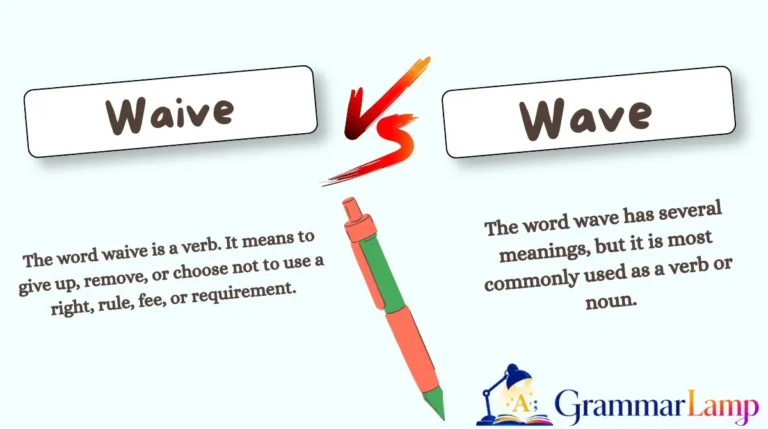
The word waive is a verb. It means to give up, remove, or choose not to use a right, rule, fee, or requirement.
When someone waives something, they decide that it is not necessary to have or follow it in a particular situation. Sometimes, a person gives up something they are allowed to claim. In other situations, an organization decides not to collect a payment or enforce a rule.
For example, imagine that a bank normally charges a fee for a particular service. However, the bank decides not to charge you. You can say:
“The bank agreed to waive the fee.”
This means the bank decided not to collect the money.
Similarly, a school may waive an entrance requirement for a student, or a customer may waive their right to make a claim.
When Should You Use Waive?
Use waive when talking about giving up or removing something that someone has a right to use, receive, demand, or enforce.
Here are some common situations where this word is used:
1. Waiving a fee
A company may decide not to charge a customer a particular amount of money.
Example: The hotel agreed to waive the cancellation fee.
2. Waiving a right
A person may choose not to use a right that they normally have.
Example: She decided to waive her right to an appeal.
3. Waiving a rule or requirement
An organization may decide that someone does not need to follow a particular requirement.
Example: The university may waive the language test requirement.
4. Waiving a payment
A business or service provider may decide not to collect money that is normally due.
Example: The manager agreed to waive the late payment charge.
Grammar Rules for Waive
Waive is a regular verb. This means you can add -d to make its past form and past participle.
Its main forms are:
- Base form: Waive
- Third-person singular: Waives
- Present participle: Waiving
- Past tense: Waived
- Past participle: Waived
Common sentence patterns:
- Waive + noun
- Decide to + waive + noun
- Agree to + waive + noun
- Have/has + waived + noun
For example:
- The company will waive the fee.
- The manager waives the charge for loyal customers.
- They are waiving the registration cost.
- The school waived the admission requirement.
- The bank has waived the extra payment.
Notice that the word usually takes an object. The object tells us what is being given up or removed.
8 Examples of Waive in Sentences
- The university agreed to waive the application fee for poor students.
- The company decided to waive the extra charges this month.
- You can request the bank to waive your service fee.
- The teacher may waive the homework requirement for students who were absent.
- He chose to waive his right to appeal the decision.
- The hotel manager waived the cancellation charge after hearing our situation.
- The government decided to waive certain taxes for small businesses.
- The customer asked the company to waive the late payment fee.
In each sentence, the word describes giving up, removing, or not enforcing something.
Common Learner Confusion About Waive
Many learners confuse this word with wave because both have the same pronunciation. However, their meanings are not connected.
A useful point to remember is that waive often appears in formal situations. You may see it in banking, education, business, legal documents, insurance policies, and customer service.
For example, if a company says, “We will waive the delivery fee,” it means you will not have to pay that fee.
It does not mean that the company will move its hand or make a greeting.
What Does “Wave” Mean?
The word wave has several meanings, but it is most commonly used as a verb or noun.
As a verb, wave means to move your hand, arm, or another object from side to side or up and down. People often wave to greet someone, say goodbye, or get another person’s attention.
For example:
“I waved at my brother when he arrived.”
This means you moved your hand to greet him.
As a noun, a wave can mean a movement of water in the sea or ocean. It can also describe a sudden increase in something, such as a wave of excitement, heat, or visitors.
For example:
“A large wave hit the beach.”
Here, wave refers to moving water.
When Should You Use Wave?
Use wave when you are talking about movement, greetings, signals, or water in the sea.
Here are some common situations:
1. Greeting someone
People often move their hands to greet friends, family members, or other people.
Example: I waved at my friend from across the street.
2. Saying goodbye
You can wave your hand when someone is leaving.
Example: She waved goodbye to her parents.
3. Getting someone’s attention
Moving your hand can help another person notice you.
Example: He waved his hand to call the waiter.
4. Talking about ocean water
A wave is a moving body of water that rises and falls.
Example: A huge wave reached the shore.
5. Describing a sudden increase
The word can also describe a large number of things happening or arriving around the same time.
Example: A wave of customers entered the store.
Grammar Rules for Wave
Wave can work as both a verb and a noun. Its grammar depends on how you use it.
As a regular verb, its forms are:
- Base form: Wave
- Third-person singular: Waves
- Present participle: Waving
- Past tense: Waved
- Past participle: Waved
Common verb patterns:
- Wave + at + person
- Wave + to + person
- Wave + goodbye
- Wave + object
Examples:
- I wave at my neighbors every morning.
- She waves to her teacher.
- The children are waving goodbye.
- He waved a small flag.
As a noun:
The word can be used with articles and describing words.
Examples:
- A big wave
- A small wave
- The ocean waves
- A wave of excitement
8 Examples of Wave in Sentences
- I waved at my friend when I saw him at the shopping mall.
- The children waved goodbye to their teacher.
- She waved her hand to get the driver’s attention.
- A huge wave crashed against the rocks.
- The boy was waving a small flag during the parade.
- My mother waved at me from the window.
- A wave of excitement spread through the crowd.
- The swimmer waited for the next wave before entering the water.
These examples show that wave is connected with movement, greetings, signals, and different kinds of waves.
Common Learner Confusion About Wave
Some learners think wave only means moving your hand. However, the word has several meanings.
For example, it can describe ocean water, a movement of the hand, or a sudden increase in something.
You might hear someone say, “There was a wave of happiness in the room.” This does not mean that water entered the room. It means that happiness spread among the people.
Remember that wave is also a regular verb. Its past tense is waved, not wove. The word wove belongs to the verb weave, which means to make something by joining threads or materials together.
Difference Between Waive and Wave (Detailed)
The main difference is simple: waive means to give up or remove something, while wave means to move something or make a hand signal.
Both words are pronounced the same way in standard English, but their spelling, meaning, and use are different.
One word is mainly connected with rights, fees, rules, and requirements. The other is connected with movement, greetings, signals, and water.
Let’s compare them more closely.
Waive vs Wave: Comparison Table
| Feature | Waive | Wave |
|---|---|---|
| Part of speech | Verb | Verb and noun |
| Main meaning | Give up or remove something | Move from side to side or up and down |
| Common use | Fees, rights, rules, requirements | Greetings, signals, ocean water |
| Past tense | Waived | Waved |
| Present participle | Waiving | Waving |
| Example | They waived the fee. | She waved at me. |
| Common context | Legal, business, education | Daily conversation, nature, movement |
1. Difference in Meaning
The biggest difference is their meaning.
Waive means to give up something or decide not to require it. For example:
“The company will waive the delivery charge.”
This means the company will not ask the customer to pay the delivery charge.
Wave means to move your hand or another object. For example:
“The girl waved at her father.”
This means the girl moved her hand to greet her father.
These meanings are completely different, even though the words sound the same.
2. Difference in Usage
Waive is generally used when discussing something that can be given up, removed, or not enforced.
You will commonly find it in sentences about:
- Bank fees
- School requirements
- Legal rights
- Insurance charges
- Application fees
- Business rules
Wave is commonly used when describing physical movement or a signal.
You will often find it in sentences about:
- Greeting friends
- Saying goodbye
- Moving your hand
- Ocean water
- Flags and other objects
- Sudden increases in feelings or events
For example:
Correct: The school decided to waive the admission fee.
Correct: The student waved at the teacher.
Both sentences are correct, but changing the words would change their meanings.
3. Difference in Grammar
Waive is a verb. It is normally followed by an object that explains what someone is giving up or removing.
Example:
“The bank waived the service charge.”
Here, “the service charge” is the object of waived.
Wave can be a verb or a noun.
As a verb:
“He waved at his friend.”
As a noun:
“The ocean wave was very powerful.”
This difference is important because waive cannot normally be used to describe a physical greeting, and wave cannot replace waive when talking about removing a fee or requirement.
4. Difference in Sentence Structure
The two words can appear in different sentence structures.
Waive:
Subject + waive + object
Examples:
- The company waived the fee.
- The school waived the requirement.
- The bank will waive the charge.
Wave as a verb:
Subject + wave + at/to + person
Examples:
- I waved at my friend.
- She waved to her mother.
- The children waved at the visitors.
Wave as a noun:
Article or adjective + wave
Examples:
- A wave hit the beach.
- The large wave moved toward the shore.
- A wave of happiness filled the room.
Learning these patterns will help you select the correct word when writing sentences.
5. Difference in Pronunciation
An interesting fact about these words is that they are homophones.
Homophones are words that sound the same but have different spellings and meanings.
Waive and wave are pronounced the same way in standard English. Their pronunciation does not help you decide which spelling to use.
You must understand the meaning of the sentence.
For example:
- The manager will waive the fee.
- The manager will wave at the customers.
When you hear these sentences, the words sound alike. However, their meanings make the difference clear.
Explore More Posts
Crews vs Cruise (2026): What’s the Difference? Easy Grammar Guide with Examples
Everything vs Every Thing: Easy Difference, Rules, Examples & Practice (2026)
All Is vs All Are: Which One Is Correct? Complete Grammar Guide for 2026
At the Weekend or On the Weekend? 2026 Guide to British and American English
Grammar Rules You Must Remember
Understanding a few simple grammar rules can help you avoid mistakes when using these two words.
Rule 1: Use Waive When Someone Gives Up Something
Whenever someone decides not to claim, collect, or enforce something, use waive.
It often refers to fees, rights, charges, or requirements.
Examples:
- The company agreed to waive the extra fee.
- He decided to waive his right to appeal.
- The school may waive the entry requirement.
Remember: If the meaning is giving up or removing something, waive is usually the correct choice.
Rule 2: Use Wave for Hand Movements and Greeting
When someone moves their hand to greet another person, attract attention, or say goodbye, use wave.
Examples:
- She waved at me from the bus.
- I waved goodbye to my friends.
- The child waved his hand excitedly.
Remember: If you can imagine someone moving their hand, wave is probably the word you need.
Rule 3: Remember That Both Words Are Regular Verbs
Both words follow the normal rules for regular verbs.
Their past tense and past participle forms end in -ed.
Examples:
- Waive → Waived
- Wave → Waved
Their -ing forms are:
- Waive → Waiving
- Wave → Waving
Notice that the final silent e is removed before adding -ing.
Examples:
- The bank is waiving the fee.
- The girl is waving at her friends.
Do not write “waiving” as “waiveing” or “waving” as “waveing.”
Rule 4: Check the Meaning Before Choosing the Spelling
Because these words sound the same, listening alone is not enough.
Always consider what the sentence is trying to say.
Examples:
- The company will waive the payment. (The payment will not be required.)
- The company will wave at the customers. (Someone will move a hand.)
Remember: Meaning is more important than sound when choosing between homophones.
Common Mistakes Students Make
Many English learners make mistakes with these words because their pronunciation is identical. When people hear them in conversations, they cannot tell which spelling is correct without understanding the context.
The good news is that these mistakes are easy to correct once you learn the basic difference.
Mistake 1: Using Wave Instead of Waive for a Fee
Incorrect: The hotel agreed to wave the cancellation fee.
Correct: The hotel agreed to waive the cancellation fee.
Why is the first sentence wrong?
The sentence is about removing a fee, not moving a hand. Therefore, waive is the correct spelling.
Mistake 2: Using Waive Instead of Wave for a Greeting
Incorrect: I waived at my friend yesterday.
Correct: I waved at my friend yesterday.
Why is the first sentence wrong?
The speaker is describing a greeting. Moving your hand to greet someone is waving, not waiving.
Mistake 3: Confusing Their Past Forms
Incorrect: She waive the application fee last week.
Correct: She waived the application fee last week.
Incorrect: He waive at me from the window.
Correct: He waved at me from the window.
Why do these mistakes happen?
Some learners forget to change the base form when talking about the past. Both words are regular verbs, so their past forms end in -ed.
Mistake 4: Using the Wrong -ing Form
Incorrect: The company is waiveing the extra charge.
Correct: The company is waiving the extra charge.
Incorrect: The children are waveing their flags.
Correct: The children are waving their flags.
Correction tip: When a regular verb ends in a silent e, remove that e before adding -ing.
Mistake 5: Thinking Both Words Have the Same Meaning
Incorrect: The school waved the entrance requirement.
Correct: The school waived the entrance requirement.
Incorrect: The boy waived goodbye to his parents.
Correct: The boy waved goodbye to his parents.
The problem is not pronunciation. The problem is choosing a spelling that does not match the intended meaning.
Easy correction tip: Ask yourself whether the sentence describes giving something up or moving something. This one question can prevent most mistakes.
Easy Trick to Remember the Difference
If you often forget which word to use, a simple memory trick can help.
You do not need to memorize long grammar explanations every time you write a sentence. Just connect each word with an everyday situation.
Memory Trick for Waive
Think of the word waive when you see a fee, right, rule, or requirement.
For example:
- Waive a fee.
- Waive a charge.
- Waive a right.
- Waive a requirement.
You can remember it this way:
Waive = Give up or remove something.
Imagine that a bank employee tells you, “We will waive your extra fee.”
That means you do not have to pay it.
Memory Trick for Wave
Think of the word wave when you see a hand moving, someone greeting another person, or water moving in the sea.
For example:
- Wave your hand.
- Wave goodbye.
- Wave at a friend.
- Ocean wave.
You can remember it this way:
Wave = Move your hand or something else.
Imagine that your friend sees you across the road and waves at you. That is a simple example of this word.
A Simple Real-Life Way to Remember
Imagine two different situations.
In the first situation, you visit a bank. The manager tells you that your service fee has been removed. The manager has decided to waive the fee.
In the second situation, you leave the bank and see your friend outside. You lift your hand and move it to greet him. You wave at your friend.
The spelling becomes easier when you connect each word with an action or situation.
Daily Life Examples of Waive and Wave
The best way to learn confusing English words is to see how people use them in normal conversations.
Here are ten practical examples. These sentences show how both words can appear in everyday speaking and writing.
1. Talking About a Bank Fee
Person A: Why is your bank statement showing an extra charge?
Person B: I contacted the bank, and they agreed to waive it.
Here, waive means the bank decided not to collect the extra charge.
2. Greeting a Friend
Person A: Did you see Ali outside the school?
Person B: Yes, I waved at him, but he didn’t notice me.
Here, waved describes moving your hand to greet someone.
3. Talking About School Fees
Student A: Do we have to pay the application fee?
Student B: No, the college may waive it for eligible students.
The college may decide not to require the payment.
4. Saying Goodbye
Person A: What happened when your parents left?
Person B: I waved goodbye to them from the window.
The word waved describes a hand movement.
5. Talking About a Late Payment
Customer: I forgot to pay my bill on time. Can you help me?
Manager: We can waive the late payment fee this time.
Here, the manager agrees not to charge the customer.
6. Getting Someone’s Attention
Person A: How did you call the waiter?
Person B: I waved my hand to get his attention.
The word waved describes using your hand as a signal.
7. Talking About an Admission Requirement
Student A: I don’t have the required language certificate.
Student B: You can ask the university whether it will waive the requirement.
Here, waive means removing or not enforcing a requirement.
8. Talking About the Sea
Person A: Was the beach safe yesterday?
Person B: Not really. The waves were very high.
Here, waves refers to moving water in the sea.
9. Talking About a Hotel Booking
Person A: Did the hotel charge you for cancelling your booking?
Person B: No, the manager agreed to waive the cancellation fee.
The hotel decided not to collect the cancellation charge.
10. Talking About a Parade
Person A: What were the children doing during the parade?
Person B: They were waving small flags and smiling at the visitors.
Here, waving describes moving flags from side to side.
These examples show that the correct word becomes clear when you understand the situation.
Practice Section: Test Your Understanding
Now it is time to check what you have learned. Choose the correct word in each sentence.
Read every sentence carefully. Think about its meaning before selecting your answer.
Choose Waive or Wave:
- The bank agreed to ______ the extra service charge.
- A. Waive
- B. Wave
- I saw my brother across the road and ______ at him.
- A. Waived
- B. Waved
- The university may ______ the application fee for some students.
- A. Waive
- B. Wave
- The children were ______ their hands during the school performance.
- A. Waiving
- B. Waving
- The hotel decided to ______ the cancellation fee.
- A. Waive
- B. Wave
Correct Answers and Explanations
- A. Waive – The bank is removing a service charge, so waive is correct.
- B. Waved – The person is greeting his brother with a hand movement.
- A. Waive – The university may decide not to collect the application fee.
- B. Waving – The children are moving their hands.
- A. Waive – The hotel is deciding not to charge a cancellation fee.
If you answered all five questions correctly, you have understood the basic difference. If you made a mistake, read the memory trick again and try the exercise once more.
More Helpful posts
To Discuss or Discuss About: Which Is Correct? | Easy Grammar Guide 2026
Upmost vs Utmost: Meaning, Difference, and Correct Usage in 2026
Seam vs Seem: Difference, Meaning, Examples & Grammar Rules (2026)
All the Time vs Every Time: Meaning, Difference, Rules & Examples (2026)
FAQs
1. What Is the Difference Between Waive and Wave?
Waive means to give up, remove, or choose not to enforce something, such as a fee, right, or requirement. Wave means to move your hand or another object from side to side. It can also refer to moving water in the sea. Both words sound the same but have different meanings and spellings.
2. Are Waive and Wave Pronounced the Same?
Yes, both words have the same pronunciation in standard English. They are homophones because they sound alike but have different spellings and meanings. You cannot identify the correct spelling by listening alone. You need to understand the context of the sentence.
3. Can Waive Be Used in Everyday English?
Yes, waive can be used in everyday English, especially when talking about fees, payments, rules, or requirements. For example, you might say, “The company agreed to waive my delivery charge.” It is also common in formal business, legal, and educational writing.
4. Is Wave a Verb or a Noun?
Wave can be both a verb and a noun. As a verb, it describes moving your hand or another object. For example, “She waved at me.” As a noun, it can describe moving water or a sudden increase in something. For example, “A large wave hit the beach.”
5. What Is the Past Tense of Waive and Wave?
The past tense of waive is waived, while the past tense of wave is waved. Both are regular verbs, so you add -ed to make their past forms. For example, “The bank waived the fee” and “He waved goodbye to his friend.”
6. Is It Correct to Say “Waive the Fee” or “Wave the Fee”?
The correct expression is “waive the fee.” It means that a person or organization decides not to collect the money. “Wave the fee” is incorrect when you are talking about removing a payment. Remember that waive is the correct word for fees, charges, and certain requirements.
Conclusion
Understanding the difference between waive and wave is easier than it may seem. Both words sound the same, but their meanings and uses are completely different.
Use waive when someone gives up, removes, or chooses not to enforce something. It is commonly used with fees, payments, rights, rules, and requirements. For example, “The company agreed to waive the extra charge.”
Use wave when talking about moving your hand, greeting someone, saying goodbye, or describing water in the sea. For example, “I waved at my friend from the window.”
Remember the simple trick: waive means to give something up, while wave means to move something.
Try using both words in your own sentences. You can also look for them while reading emails, books, and everyday messages. A little practice will help you remember their meanings and choose the correct spelling without hesitation.
Keep learning, keep practicing, and don’t worry about small mistakes. They are a normal part of improving your English.

Liam Derren is a language writer at GrammarLamp, creating simple, helpful content about grammar, words, and everyday English. He makes language learning clear, practical, and easy to understand.