
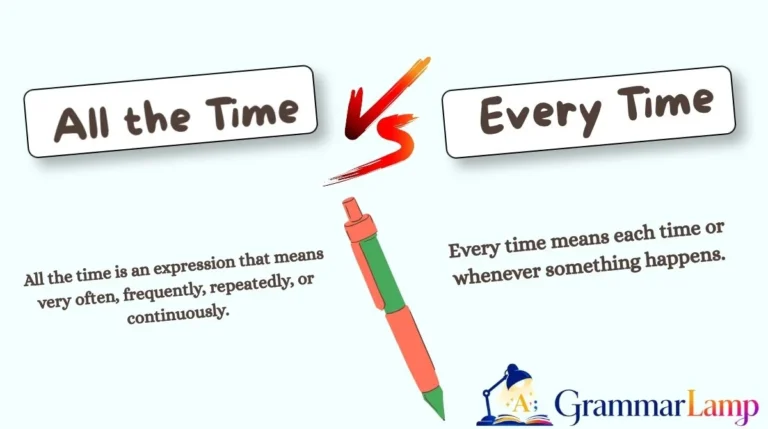
All the time and every time look very similar, so it is easy to mix them up.
Both expressions talk about repeated actions or events, and both are common in everyday English. However, they do not have the same meaning.
The main difference is simple: all the time usually means “very often,” “continuously,” or “again and again,” while every time means “each time something happens.”
The difference may seem small, but it can change the meaning of a sentence.
For example:
- My brother plays video games all the time.
- My brother smiles every time he wins a game.
In the first sentence, the speaker means that the brother plays games very often. It does not necessarily mean that he never stops. In the second sentence, the brother smiles on each occasion when he wins.
Understanding this difference is useful for speaking, writing, exams, emails, conversations, and everyday English.
Many learners know the words separately but become unsure when they need to choose between them.
By the end of this guide, you will know exactly when to use all the time and every time. You will also see the grammar patterns, common mistakes, easy memory tricks, and natural examples that native speakers use in daily conversation.
What Does “All the Time” Mean?
All the time is an expression that means very often, frequently, repeatedly, or continuously.
It usually describes something that happens again and again or seems to happen almost constantly. It does not always mean that something literally happens without stopping.
For example:
She talks about her new job all the time.
This does not necessarily mean that she talks about her job every second. It means she talks about it very frequently.
When Should You Use “All the Time”?
Use all the time when you want to say that an action happens very frequently or again and again.
It is common in everyday spoken English and can be used with many different types of verbs.
Here are some examples:
- I listen to music all the time.
- He complains about his neighbors all the time.
- My phone rings all the time.
- She is busy all the time.
- They argue all the time.
- We see each other all the time.
- My little brother asks questions all the time.
- It rains here all the time.
Notice that these sentences focus on frequency or repetition.
Grammar Rule for “All the Time”
The expression all the time usually works as an adverbial phrase. It tells us how frequently or continuously something happens.
A common sentence pattern is:
Subject + verb + all the time
For example:
- Tom watches TV all the time.
- They talk all the time.
- I think about it all the time.
With the verb be, it usually comes after the verb:
- She is tired all the time.
- He is busy all the time.
- They are worried all the time.
Does “All the Time” Always Mean “Without Stopping”?
No. This is one of the most important points.
When people say:
You are using your phone all the time.
They usually mean you use your phone very frequently, not that you literally hold it and use it every second.
Similarly:
He talks all the time.
Usually means he talks a lot or very frequently.
So, all the time can express exaggeration in casual speech.
“All the Time” Can Also Mean Continuously
Sometimes the expression really does suggest something that continues for a long period.
For example:
The baby was crying all the time during the flight.
Here, the speaker emphasizes that the crying continued for much of the flight.
The exact meaning depends on the context.
What Does “Every Time” Mean?
Every time means each time or whenever something happens.
It refers to every individual occasion in a repeated situation.
For example:
Every time I see her, she smiles.
This means that on each occasion when I see her, she smiles.
The focus is not simply on frequency. The focus is on a repeated situation and what happens on each occasion.
When Should You Use “Every Time”?
Use every time when one event happens whenever another particular event happens.
A very common structure is:
Every time + subject + verb, subject + verb.
For example:
- Every time I call him, he is busy.
- Every time she visits us, she brings a cake.
- Every time it rains, the road gets muddy.
- Every time I hear that song, I remember school.
You can also put the phrase at the end:
- He laughs every time I tell that joke.
- She gets nervous every time she takes an exam.
- I check my phone every time I hear a notification.
Eight Examples of “Every Time”
- Every time I wake up, I check the time.
- She laughs every time she watches that movie.
- Every time he comes here, he orders coffee.
- I feel happy every time I see my friends.
- Every time the teacher asks a question, Ali raises his hand.
- He gets angry every time someone interrupts him.
- Every time we travel, we take lots of pictures.
- My dog runs to the door every time someone knocks.
In each example, every time means each occasion when something happens.
Common Learner Confusion
Many learners think every time simply means “very often.” That is not quite right.
Compare these two sentences:
She calls me all the time.
This means she calls me very frequently.
She calls me every time she needs help.
This means she calls me on each occasion when she needs help.
The second sentence gives us a specific condition: she needs help.
That condition is the key difference.
Difference Between “All the Time” and “Every Time”
The easiest way to understand the difference is to remember this:
All the time = very often / continuously
Every time = each time / whenever
| Expression | Basic meaning | Main idea | Example |
|---|---|---|---|
| all the time | very often, repeatedly, continuously | frequency | She calls me all the time. |
| every time | each time, whenever | each occasion | She calls me every time she needs help. |
1. Difference in Meaning
All the time describes how frequently something happens.
He checks his phone all the time.
The person checks his phone very frequently.
Every time connects one repeated event with another.
He checks his phone every time he hears a sound.
Here, we know the situation that causes the action: he hears a sound.
2. Difference in Grammar
All the time can stand alone as an adverbial phrase:
I think about that all the time.
Every time often introduces a clause:
Every time I think about that, I smile.
It can also appear after a sentence:
I smile every time I think about that.
3. Difference in Focus
Think of all the time as answering:
“How often?”
How often does she call you?
She calls me all the time.
Think of every time as answering:
“When does this happen?”
When does she call you?
She calls me every time she needs something.
4. Compare These Examples
My son asks questions all the time.
This means he asks questions very frequently.
My son asks questions every time we go shopping.
This means that whenever we go shopping, he asks questions.
The first sentence talks about general frequency. The second describes a repeated situation.
5. “Every Time” Often Has a Second Clause
This is one of the easiest clues.
Every time I eat spicy food, I get thirsty.
Every time she visits, we have dinner together.
Every time he drives, he listens to music.
There is often a clear relationship between two events.
With all the time, you usually do not need such a second clause:
He listens to music all the time.
Grammar Rules You Must Remember
Rule 1: Use “All the Time” for Very Frequent Actions
When you mean very often or again and again, use all the time.
My sister uses social media all the time.
The meaning is that she uses it very frequently.
Another example:
Our neighbors make noise all the time.
This means they make noise very frequently.
Rule 2: Use “Every Time” for Each Repeated Occasion
Use every time when something happens on each occasion.
Every time I visit my grandmother, she makes tea.
The speaker means that this happens on every visit.
The phrase can also come later:
She makes tea every time I visit her.
Both sentences have the same basic meaning.
Rule 3: “Every Time” Can Mean “Whenever”
A useful grammar trick is to replace every time with whenever.
For example:
Every time I hear that song, I dance.
You can say:
Whenever I hear that song, I dance.
The meaning is almost the same.
This replacement does not normally work with all the time.
I listen to music all the time.
You cannot naturally replace it with:
I listen to music whenever. ❌
Rule 4: Do Not Automatically Translate “Every” as “All”
This is a common problem for learners.
Every focuses on individual occasions or members one by one.
All focuses on the whole amount or a broad period.
So:
I see him all the time.
means very often.
But:
I see him every time I go to the gym.
means on each visit to the gym.
Common Mistakes Students Make
Learners often make mistakes because both expressions contain the idea of repetition. The solution is to look at the meaning rather than translate each word directly.
Mistake 1: Using “Every Time” When You Mean “Very Often”
Incorrect for the intended meaning:
I watch movies every time.
If you simply mean “I watch movies very often,” this sounds incomplete or unnatural.
Better:
I watch movies all the time.
However, every time can be correct if you give it a situation:
Every time I have a free evening, I watch a movie.
Mistake 2: Using “All the Time” for a Specific Repeated Situation
Suppose you mean that something happens whenever you meet your friend.
You might say:
She gives me advice all the time I meet her. ❌
A natural sentence is:
She gives me advice every time I meet her. ✅
The phrase every time fits because you are talking about each meeting.
Mistake 3: Forgetting the Difference Between Frequency and Occasion
Compare:
He is late all the time.
He is late very frequently.
He is late every time we meet.
On each occasion when you meet, he is late.
Both can be true, but the meaning is different.
Mistake 4: Thinking “All the Time” Means Literally 24 Hours
In everyday English, all the time often means very frequently.
She talks about football all the time.
It does not mean she talks about football every minute of every day.
Easy Correction Tip
When you are unsure, ask yourself:
Am I talking about frequency?
Use all the time.
Am I talking about each occasion when something happens?
Use every time.
That one question will solve most problems.
Easy Trick to Remember the Difference
Here is a simple memory trick:
ALL = A LOT
Think:
All the time → a lot / very often
He plays games all the time.
He plays games a lot.
EVERY = EACH
Think:
Every time → each time
He plays games every time he visits me.
Each time he visits, he plays games.
You can remember it like this:
ALL THE TIME = HOW OFTEN?
EVERY TIME = EACH TIME WHEN?
Imagine two situations.
Your friend calls you ten times a day. You say:
My friend calls me all the time.
Now imagine your friend calls whenever he needs help. You say:
He calls me every time he needs help.
The first sentence describes frequent behavior. The second describes a repeated condition.
This small difference is much easier to remember than trying to memorize complicated grammar definitions.
Daily Life Examples
These expressions appear constantly in normal conversations. Here are some natural examples.
Example 1
A: Why is your phone always in your hand?
B: I check messages all the time.
Here, all the time means very frequently.
Example 2
A: Why do you smile whenever you see that picture?
B: I smile every time I look at it.
Each occasion of looking at the picture produces the same reaction.
Example 3
My mother calls me all the time.
This means she calls very frequently.
Example 4
My mother calls me every time she needs help with her phone.
This means each time she needs help, she calls.
Example 5
I get hungry all the time.
The speaker feels hungry very frequently.
Example 6
I get hungry every time I smell fresh bread.
The smell of fresh bread causes the feeling on each occasion.
Example 7
He talks about his car all the time.
He talks about his car very frequently.
Example 8
He checks the engine every time he drives a long distance.
Each time he takes a long trip, he checks the engine.
Example 9
She loses her keys all the time.
She loses them very frequently.
Example 10
She checks her bag every time she leaves the house.
Each time she leaves, she checks her bag.
Notice how natural these expressions are in ordinary English. You will hear them in conversations, movies, classrooms, workplaces, and casual chats.
Practice Section
Choose all the time or every time to complete each sentence.
1.
My brother plays football __________.
2.
__________ I visit that restaurant, I order the same meal.
3.
She checks her email __________.
4.
__________ it rains, this road becomes difficult to drive on.
5.
I feel nervous __________ I have to speak in front of a group.
Answers
1. all the time
My brother plays football all the time.
This means he plays very frequently.
2. every time
Every time I visit that restaurant, I order the same meal.
This means on each visit.
3. all the time
She checks her email all the time.
This means very frequently.
4. every time
Every time it rains, this road becomes difficult to drive on.
The road becomes difficult on each rainy occasion.
5. every time
I feel nervous every time I have to speak in front of a group.
The nervous feeling happens on each such occasion.
FAQs
What is the difference between “all the time” and “every time”?
All the time usually means very often, frequently, or continuously. Every time means each time or whenever a particular event happens.
For example, “He calls me all the time” means he calls very frequently. “He calls me every time he needs help” means he calls on each occasion when he needs help.
Can we use “every time” in questions?
Yes. Every time can be used naturally in questions.
For example:
Why does this happen every time I use this computer?
You can also ask:
Does she get nervous every time she speaks English?
Here, every time refers to each occasion.
Is “all the time” formal or informal?
All the time is very common in both everyday speech and normal writing. It is especially natural in conversations.
For example:
I think about that all the time.
In more formal writing, you may sometimes choose words such as frequently, continually, or constantly, depending on the exact meaning.
Can “all the time” mean “every time”?
Usually, no. They can sometimes seem similar because both describe repeated actions, but their meanings are different.
All the time focuses on frequency:
She calls me all the time.
Every time focuses on each occasion:
She calls me every time she has a problem.
Can “every time” be replaced with “whenever”?
Often, yes.
For example:
Every time I see him, he smiles.
and:
Whenever I see him, he smiles.
Both sentences express a very similar idea.
However, all the time cannot normally be replaced by whenever.
Which is correct: “I think about you all the time” or “I think about you every time”?
Both can be grammatically correct, but they have different meanings.
I think about you all the time means I think about you very frequently.
I think about you every time I hear that song means hearing that song causes me to think about you on each occasion.
The words that follow every time often make the situation clear.
Conclusion
The difference between all the time and every time is simple once you focus on the idea behind each expression.
Use all the time when you mean very often, frequently, repeatedly, or almost continuously:
She checks her phone all the time.
Use every time when you mean each time something happens:
She checks her phone every time she hears a notification.
A quick memory rule can help:
ALL THE TIME = A LOT
EVERY TIME = EACH TIME
When you speak or write, ask yourself whether you are describing general frequency or a repeated situation.
If you mean “very often,” choose all the time. If you mean “each occasion when,” choose every time.
The best way to make the difference feel natural is to use both expressions in your own sentences.
Try describing things you do regularly, then describe what happens whenever a particular event occurs. After a little practice, choosing the right expression will become much easier.

Liam Derren is a language writer at GrammarLamp, creating simple, helpful content about grammar, words, and everyday English. He makes language learning clear, practical, and easy to understand.