
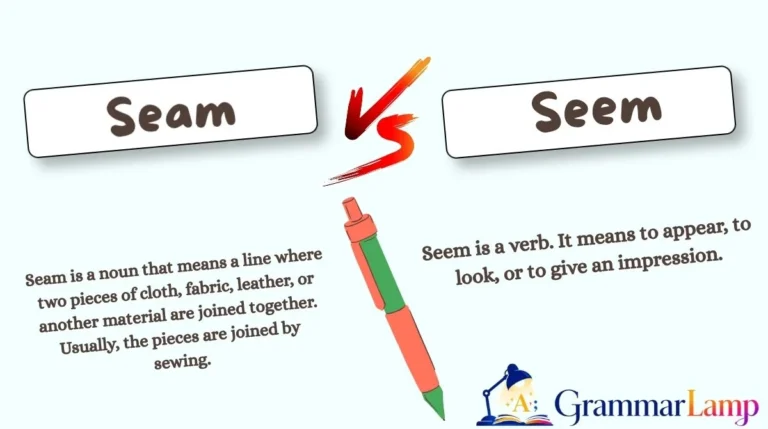
English has many words that sound exactly the same but have completely different meanings. Seam and seem are a good example.
When you hear them in a conversation, they can be difficult to tell apart because both words are pronounced almost the same.
However, their meanings, spellings, and uses are very different.
A seam is a line where two pieces of material are joined together, especially in clothing. You can find a seam on a shirt, pair of trousers, dress, or piece of fabric.
Seem, on the other hand, is a verb that means “appear” or “give the impression of being something.” For example, you can say, “You seem tired,” when someone looks or appears tired.
This small spelling difference can cause big mistakes in writing. A student might write “You seam happy” when the correct sentence is “You seem happy.”
Another learner may write “The seem of my shirt is broken” instead of “The seam of my shirt is broken.”
Understanding these two words will make your everyday English more accurate.
After learning the rules and examples below, you should be able to recognize seam vs seem quickly, use both words correctly, and avoid common spelling mistakes in schoolwork, emails, messages, and daily conversations.
What Does “Seam” Mean?
Seam is a noun that means a line where two pieces of cloth, fabric, leather, or another material are joined together. Usually, the pieces are joined by sewing.
Think about a shirt. The places where different pieces of fabric are sewn together are called seams.
For example:
- The seam on my shirt is coming apart.
- There is a small tear along the seam.
- The tailor repaired the seam of my trousers.
- Check the seam before you buy the dress.
- The side seam of this jacket is very strong.
- She noticed a loose seam in her skirt.
- The seam was carefully stitched by hand.
- The fabric began to split along the seam.
The word seam is most often used when talking about clothes and sewing, but it can have other meanings too.
A seam can also mean a line where two things meet or join. For example, a seam can appear between sections of a surface or material. In geology and mining, seam can also describe a layer of a substance such as coal.
When Should You Use “Seam”?
Use seam when you are talking about a joining line, especially one created by sewing or joining pieces of material.
Common phrases include:
- a shirt seam
- a side seam
- a shoulder seam
- a seam in a dress
- a loose seam
- a broken seam
- a strong seam
- a stitched seam
Here is a simple way to understand it:
Seam = a joining line in material.
If you can imagine a needle, thread, fabric, or two pieces being joined together, seam may be the word you need.
Is “Seam” a Verb?
In normal everyday English, seam is mainly used as a noun.
For example:
The seam is loose.
Here, seam is the subject of the sentence.
There is also a verb seam, meaning to mark or join something with a seam, but this use is much less common for beginners. You do not usually need this meaning in basic daily English.
Common Learner Confusion
The biggest problem is pronunciation. Seam and seem are homophones, meaning they sound alike but have different spellings and meanings.
If someone says:
“The seam is broken.”
You cannot know the spelling just by hearing the sentence. You need to understand the meaning.
If the speaker is talking about clothing or fabric, seam is probably correct.
What Does “Seem” Mean?
Seem is a verb. It means to appear, to look, or to give an impression.
We use seem when something appears to be true, even when we are not completely certain.
For example:
- You seem tired.
- She seems happy today.
- He seems nervous.
- This seems difficult.
- They seem friendly.
- It seems strange.
- The children seem excited.
- Your idea seems interesting.
In each sentence, seem tells us how something appears to us.
When you say:
You seem tired.
You are not necessarily saying that the person definitely is tired. You are saying that their appearance, behavior, or voice gives you that impression.
When Should You Use “Seem”?
Use seem when you want to describe how a person, thing, situation, or idea appears.
For example:
She seems angry.
This means that she appears angry.
The test seems easy.
This means that the test appears to be easy.
He seems like a nice person.
This means that he gives the impression of being a nice person.
Common Sentence Patterns With “Seem”
There are several useful structures with seem.
Seem + adjective
You seem happy.
The food seems expensive.
Seem + to + verb
He seems to understand the problem.
She seems to know the answer.
Seem + like + noun
It seems like a good idea.
He seems like a kind person.
It seems + adjective/clause
It seems strange.
It seems that we are late.
These patterns are common in everyday English.
Common Learner Confusion
Students often confuse seem with look because both can describe appearance.
For example:
You look tired.
You seem tired.
Both sentences can be correct, but they are not exactly the same. Look often focuses more directly on someone’s visible appearance, while seem can be based on appearance, behavior, words, or the general situation.
The key point is that seem is a verb related to appearance or impression, while seam is usually a noun related to joining material.
Difference Between Seam and Seem
The easiest way to understand seam vs seem is to remember that they belong to completely different word groups.
| Word | Part of Speech | Main Meaning | Common Use | Example |
|---|---|---|---|---|
| Seam | Noun | A joining line | Clothes, fabric, materials | The seam is loose. |
| Seem | Verb | Appear or give an impression | People, things, situations | You seem happy. |
Usage Difference
Seam is connected with something being joined.
The seam of my jacket is damaged.
Seem is connected with something appearing a certain way.
My jacket seems old.
The first sentence talks about a physical part of the jacket. The second sentence gives an impression about the jacket.
Grammar Difference
This is an important point.
Seam is generally a noun:
The seam is broken.
Here, the seam is the thing being discussed.
Seem is a verb:
The shirt seems expensive.
Here, seems is the verb describing how the shirt appears.
The spelling can change depending on the subject:
I seem tired.
You seem tired.
They seem tired.
But:
He seems tired.
She seems tired.
The dress seems expensive.
With he, she, it, or a singular noun in the present tense, we normally add -s:
seem → seems
Meaning Comparison
Imagine that you are looking at a shirt.
If you say:
The seam is damaged.
You are talking about the line where pieces of the shirt are joined.
If you say:
The shirt seems expensive.
You are talking about the impression the shirt gives you.
These two words can even appear in the same sentence:
The seam looks strong, but the shirt seems expensive.
That sentence uses both words correctly because they perform different jobs.
Grammar Rules You Must Remember
Rule 1: Use “Seam” for a Joining Line
Use seam when you are talking about the place where pieces of material are joined.
Example:
The seam of my trousers has come loose.
The word seam refers to the stitched joining line.
Another example:
The tailor fixed the seam.
You are talking about clothing and sewing, so seam is correct.
Rule 2: Use “Seem” When Something Appears a Certain Way
Use seem when something appears to have a particular quality.
Example:
She seems worried.
This means she appears worried.
You could also say:
The question seems difficult.
The question appears difficult to you.
Rule 3: “Seem” Is a Verb and Can Change to “Seems”
Remember subject-verb agreement.
With I, you, we, they, use seem:
I seem tired.
You seem busy.
They seem happy.
With he, she, it, use seems:
He seems tired.
She seems busy.
It seems strange.
A common mistake is writing:
She seem happy.
The correct sentence is:
She seems happy.
Rule 4: “Seem” Can Be Followed by “To”
A useful structure is:
subject + seem/seems + to + verb
Examples:
He seems to understand me.
She seems to know the answer.
They seem to enjoy the game.
The baby seems to be sleeping.
Do not confuse this structure with seam.
You cannot use seam in these sentences.
Common Mistakes Students Make
Many mistakes with these words happen because they sound the same. When students are speaking, this is not usually a problem. The listener understands the meaning from context.
The problem appears when students write.
Mistake 1: Using “Seam” Instead of “Seem”
Wrong:
You seam very happy today.
Correct:
You seem very happy today.
Why? The sentence describes someone’s appearance or impression. It has nothing to do with fabric.
Mistake 2: Using “Seem” for Clothing
Wrong:
The seem of my shirt is broken.
Correct:
The seam of my shirt is broken.
The sentence refers to a joining line in the shirt, so seam is needed.
Mistake 3: Forgetting the “S” With such as they
Wrong:
She seem tired.
Correct:
She seems tired.
The subject is she, so the present-tense verb needs -s.
Mistake 4: Confusing “Seem” With “Look”
Sometimes learners write the wrong word because they remember that seem relates to appearance.
For example:
He seems happy.
This is correct.
He looks happy.
This is also correct, but the meaning has a slightly different focus.
The important thing is not to replace seem with seam. They are not spelling variations of the same word.
Easy Correction Tip
Ask yourself one question:
Am I talking about fabric or appearance?
If you are talking about fabric, clothing, sewing, or a joining line, choose seam.
If you are talking about how something appears or feels, choose seem.
Easy Trick to Remember the Difference
Here is a simple memory trick that works well for beginners.
Think: “Seam = Sewing”
The words seam and sewing both begin with the sound “see/s”, but you can connect the -am ending with material being joined.
A seam is something you can often see on clothes.
Imagine a pair of trousers. Look at the side where two pieces of fabric have been stitched together.
That line is the seam.
Now think about a person.
If you look at your friend and say:
You seem tired.
You are giving an impression about your friend.
So remember:
SEAM → sewing, stitching, fabric
SEEM → appear, look, give an impression
Another quick memory sentence is:
The seam is on the shirt, but the shirt seems expensive.
This one sentence contains both words and shows their meanings clearly.
If you practice that sentence a few times, the difference becomes much easier to remember.
Daily Life Examples
Here are everyday examples that show how native and fluent English speakers might use these words.
Example 1
A: Why are you taking your shirt off?
B: The seam under my arm is hurting me.
Here, seam refers to the stitched part of the shirt.
Example 2
A: How is your new teacher?
B: She seems very friendly.
Here, seems means “appears.”
Example 3
The seam on these jeans is starting to open.
This sentence is about clothing, so seam is correct.
Example 4
Your brother seems very excited about the trip.
The speaker is describing an impression, so seems is correct.
Example 5
I need to repair the seam before I wear this dress.
The word seam refers to the part of the dress where the fabric is joined.
Example 6
This restaurant seems popular.
The restaurant appears to be popular based on what the speaker can see or experience.
Example 7
The tailor checked every seam on the jacket.
The sentence is about sewing and clothing.
Example 8
It seems like a good plan.
Here, seems means “appears to be.”
Example 9
He seems to know what he is doing.
The speaker has an impression that he knows what he is doing.
Example 10
There is a small hole in the seam of my bag.
The sentence describes a physical joining line in the bag.
Notice how the meaning makes the correct spelling clear. Even though seam and seem sound alike, the surrounding words usually give you a strong clue.
Practice Section
Choose seam or seem to complete each sentence.
1. You _____ very tired today.
2. The _____ of my jacket has come loose.
3. This question _____ difficult.
4. There is a hole in the _____ of my trousers.
5. They _____ to understand the instructions.
Try answering these without looking at the answers.
Answers
1. seem
You seem very tired today.
The sentence describes someone’s appearance.
2. seam
The seam of my jacket has come loose.
The sentence refers to a part of clothing.
3. seems
This question seems difficult.
Because the subject is singular, seem becomes seems.
4. seam
There is a hole in the seam of my trousers.
The sentence is about the joining line in clothing.
5. seem
They seem to understand the instructions.
The subject is they, so we use seem.
FAQs
What is the difference between seam and seem?
Seam is usually a noun that means a line where two pieces of material are joined, especially by sewing. Seem is a verb that means “appear” or “give an impression.” For example, “The seam is broken” refers to clothing, while “You seem tired” describes someone’s appearance.
Can “seem” be used in questions?
Yes. Seem can be used in questions.
For example:
Do I seem worried?
Does she seem happy?
Does this seem strange?
Remember that after do or does, use the base form seem, not seems.
For example, “Does he seem tired?” is correct.
Is “seam” a noun or a verb?
Seam is most commonly used as a noun in everyday English. It refers to the joining line between pieces of fabric or another material. There is also a less common verb use, but beginners will usually meet seam as a noun.
Is “seem” formal or informal?
Seem is neither strongly formal nor strongly informal. It is a normal English verb used in everyday conversation, school writing, emails, and more formal writing.
For example, both “You seem tired” and “The results seem unusual” are natural sentences.
Why do seam and seem sound the same?
Seam and seem are homophones. Homophones are words that have the same or very similar pronunciation but different meanings and spellings. This is why listening alone may not tell you which word is being used.
How can I remember seam vs seem?
Connect seam with sewing and clothing. A seam is where material is joined. Connect seem with appear. If something appears a certain way, use seem.
A useful sentence to remember is:
The seam is broken, but the shirt seems expensive.
Conclusion
The difference between seam and seem becomes simple once you connect each word with its meaning.
Seam is mainly a noun. It refers to a joining line in fabric or another material. You can find seams in shirts, trousers, dresses, jackets, bags, and many other things.
Seem is a verb. It means “appear” or “give an impression.” You can use it to talk about people, objects, ideas, situations, and experiences.
The pronunciation can make these words confusing, but the meaning gives you the answer. When the sentence is about sewing, fabric, or a joining line, choose seam. When the sentence means appear or give an impression, choose seem.
Try using both words in your own sentences. For example, write one sentence about a shirt seam and another about how someone seems.
A little practice will help you remember the difference naturally.
Once you stop focusing only on how these words sound and start focusing on what they mean, seam vs seem is much easier to master.

Liam Derren is a language writer at GrammarLamp, creating simple, helpful content about grammar, words, and everyday English. He makes language learning clear, practical, and easy to understand.
2 thoughts on “Seam vs Seem: Difference, Meaning, Examples & Grammar Rules (2026)”