
Have you ever written “hight” when you wanted to talk about how tall a person is? You are not alone. Many English learners make this spelling mistake because the words they hear do not always make their correct spelling clear.
When people speak quickly, it can be hard to notice the difference between a correct word and a spelling error.
The good news is that this confusion is easy to fix. Height is the correct standard English word for the measurement of how tall someone or something is.
For example, we talk about the height of a person, a building, a tree, or a mountain. The spelling hight, on the other hand, is not normally used for this meaning in modern English.
This small spelling difference matters in everyday writing. You may need to describe your height on a school form, enter your measurements on a medical form, talk about a tall building, or write a sentence for an English assignment. Using the correct spelling helps your writing look clear and professional.
Another reason learners get confused is that English spelling does not always follow simple sound rules. Words such as light, night, and right end in “ight,” so some learners naturally assume that the same pattern should work for height. However, the correct spelling of this word is different.
By understanding the meaning, spelling, grammar, and everyday use of these terms, you can avoid this common mistake.
You will also learn how to use the correct word in questions, descriptions, conversations, and written sentences.
More Useful posts
Seam vs Seem: Difference, Meaning, Examples & Grammar Rules (2026)
All the Time vs Every Time: Meaning, Difference, Rules & Examples (2026)
Afterward or Afterwards? Meaning, Difference, and Correct Usage in 2026
A MA or an MA Degree? The Correct Grammar Rule in 2026
What Does “Height” Mean?
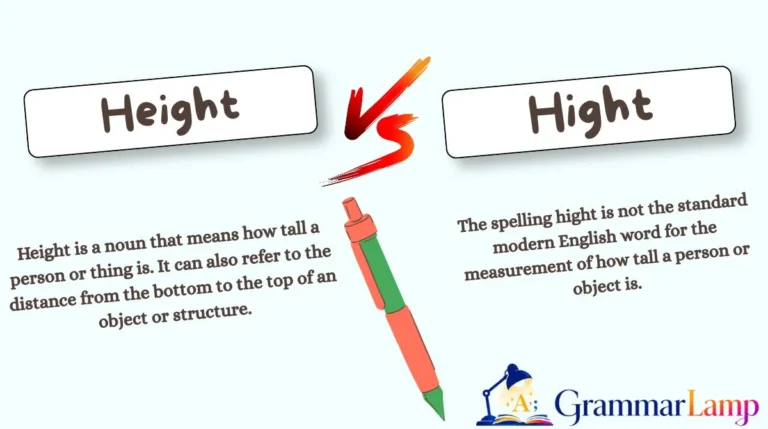
Height is a noun that means how tall a person or thing is. It can also refer to the distance from the bottom to the top of an object or structure.
For example, if someone asks, “What is your height?” they want to know how tall you are. If you measure a door from its bottom to its top, you are measuring the door’s height.
The word is used in many everyday situations. You might talk about the height of a child, the height of a classroom ceiling, or the height of a mountain. It is also common in science, sports, construction, health records, and schoolwork.
When Should You Use “Height”?
Use height whenever you want to describe or measure how tall someone or something is.
For example, a teacher might ask students to measure the height of a plant as it grows. A builder might check the height of a wall before installing a window. A person buying furniture might want to know the height of a table before placing it in a room.
The word can also be used in a more general or figurative way. For example, the phrase “the height of success” can describe a very high level of achievement. Similarly, “the height of summer” refers to the period when summer is at its strongest or most fully developed.
These uses share the general idea of a high point, level, or measurement.
Grammar Rule for “Height”
Height is a noun. It names a measurement or quality rather than describing an action.
You can use it in several common sentence patterns:
- The height of + noun: The height of the building is 50 meters.
- Possessive + height: My height is 170 centimeters.
- What is the height of + noun?: What is the height of this tree?
- Height + measurement: The wall has a height of three meters.
You can also use the plural form heights when talking about different measurements or high places.
For example:
- The heights of the two buildings are different.
- The climbers reached great heights.
- The doctor recorded the children’s heights.
Remember that height is a noun, while high is usually an adjective or adverb. You can say, “The wall is high,” or “The height of the wall is three meters.” Both sentences are correct, but their grammatical structures are different.
Examples of “Height” in Sentences
Here are eight simple examples that show how to use the word correctly.
- My height is 165 centimeters.
This sentence tells us the speaker’s measured height. - What is the height of that building?
The speaker wants to know how tall the building is. - The height of the door is two meters.
The sentence gives a measurement from the bottom to the top of the door. - The doctor checked the child’s height.
The doctor measured how tall the child was. - This tree has reached a great height.
The tree has grown very tall. - The basketball player has an advantage because of his height.
His tall body may help him reach the basket more easily. - Please write your height on the application form.
The form requires a measurement. - We enjoyed the beautiful view from the heights of the mountain.
Here, heights refers to high areas or elevated places.
Common Confusion About “Height”
Many learners confuse the spelling of height with the spelling of high. This happens because both words are related in meaning, but they do not follow the same spelling pattern.
For example:
- Correct: The wall is high.
- Correct: The height of the wall is three meters.
- Incorrect: The hight of the wall is three meters.
A helpful point to remember is that high describes something that reaches a great distance upward, while height names the measurement or quality.
You should also remember that height is spelled with “e” after “h” and before “i”: h-e-i-g-h-t. The letters “gh” appear near the end, followed by “t.”
What Does “Hight” Mean?
The spelling hight is not the standard modern English word for the measurement of how tall a person or object is. In ordinary modern English writing, it is generally considered a misspelling of height when used with that meaning.
For example, if you write, “My hight is 180 centimeters,” the reader will probably understand what you mean. However, the sentence contains a spelling error. The correct version is, “My height is 180 centimeters.”
It is important to understand that hight is not simply another accepted spelling of height. In everyday English, schoolwork, professional writing, and standard publications, you should use height.
Why Do People Write “Hight”?
There are several reasons why people make this mistake.
First, English spelling can be confusing. The words light, night, right, and sight all contain “ight.” Learners may notice this pattern and mistakenly apply it to height.
Second, pronunciation can contribute to spelling mistakes. In many English accents, height is pronounced with a long “i” sound, similar to the vowel sound in light. However, the correct spelling is not hight.
Third, people often type quickly on phones or computers. If a person is writing a message without checking it, a spelling mistake may remain in the final text.
Finally, English learners sometimes learn a word by hearing it before they see it written down. If they have not studied its spelling, they may guess incorrectly.
Is “Hight” Ever a Real Word?
The answer requires a little care. Hight does appear in historical English and in older literary uses, including as an archaic form meaning something like “called” or “named.” It can also appear as a surname or in proper names.
However, these unusual uses do not make hight a correct alternative spelling for the modern noun height.
For example, if you encounter hight in an old poem or historical text, its meaning may depend on the period and context. You should not assume that it refers to a person’s physical measurement.
For normal communication, you do not need to learn these rare uses unless you are studying older English literature or researching a particular name.
Examples Showing the Incorrect Modern Use of “Hight”
The following examples show mistakes that learners should avoid.
- Incorrect: My hight is 175 centimeters.
Correct: My height is 175 centimeters. - Incorrect: What is your hight?
Correct: What is your height? - Incorrect: The hight of the tower is impressive.
Correct: The height of the tower is impressive. - Incorrect: Please measure the hight of the table.
Correct: Please measure the height of the table. - Incorrect: His hight makes him a good basketball player.
Correct: His height makes him a good basketball player. - Incorrect: The hight of this wall is three meters.
Correct: The height of this wall is three meters. - Incorrect: I need to enter my hight on the form.
Correct: I need to enter my height on the form. - Incorrect: We measured the hight of every student.
Correct: We measured the height of every student.
In all these examples, the intended meaning is clear, but the spelling needs to be corrected.
Common Learner Confusion About “Hight”
The biggest mistake is believing that hight and height are interchangeable. They are not interchangeable in standard modern English when you mean a measurement.
Another common mistake is thinking that a spelling is correct simply because people use it online. Informal messages often contain typing errors, shortcuts, and nonstandard spellings. Seeing a word in a comment or text message does not necessarily mean it is accepted in formal English.
If you are unsure about a word, check a reliable dictionary or a trusted spelling tool. This habit is especially useful when preparing school assignments, job applications, website content, and other important documents.
Difference Between Height and Hight
The main difference is simple: height is the correct modern English spelling for a measurement of how tall someone or something is, while hight is generally a spelling mistake when used with that meaning.
Although the two spellings look similar, they do not have the same status in everyday English. You should use height in normal speech-related writing, schoolwork, professional communication, and formal documents.
Comparison Table
| Feature | Height | Hight |
|---|---|---|
| Standard modern spelling | Correct | Incorrect for the measurement |
| Part of speech | Noun | Not the standard noun for this meaning |
| Meaning | How tall someone or something is | Usually a misspelling of height |
| Everyday use | Very common | Not standard for physical measurement |
| Use in schoolwork | Correct choice | Avoid |
| Use in formal writing | Correct choice | Avoid for this meaning |
| Example | What is your height? | What is your hight? |
| Special uses | Standard measurement word | May appear in archaic language or names |
Usage Difference
The word height belongs in sentences about measurements and vertical distance. You can use it to discuss people, animals, buildings, trees, mountains, furniture, and many other things.
For example, “The height of the shelf is 150 centimeters” is a correct sentence. It gives the reader a clear measurement.
By contrast, “The hight of the shelf is 150 centimeters” contains a spelling mistake. Even if the reader understands the sentence, the spelling is not suitable for standard English writing.
This difference becomes especially important when you are writing something that other people will evaluate, such as an examination answer, an article, a school report, or a job application.
Grammar Logic
The word height is a noun related to the adjective high. English often changes the form of a word when creating a related noun, and these changes do not always follow a simple spelling pattern.
Consider these examples:
- High → Height
- Wide → Width
- Long → Length
- Strong → Strength
Notice that the noun forms are not made simply by adding “-t” to each adjective. The spelling changes in different ways.
This is one reason why it is important to learn common word families instead of trying to guess every spelling from a rule. The connection between high and height is useful, but you still need to remember the correct spelling of the noun.
Sentence Structure Difference
Because height is the correct noun, you can place it in several common sentence patterns.
Pattern 1: Subject + be + height
- My height is 170 centimeters.
- Her height is recorded on the form.
Pattern 2: What + be + possessive + height?
- What is your height?
- What is the building’s height?
Pattern 3: The height of + noun + verb
- The height of the wall is three meters.
- The height of the tree has increased.
Pattern 4: Verb + the height of + noun
- We measured the height of the room.
- The worker checked the height of the gate.
You should not replace height with hight in these structures when you mean a measurement. The sentence structure may be grammatically correct, but the spelling would still be wrong.
Meaning Comparison
In everyday English, the intended meaning behind height and the mistaken spelling hight is often the same because readers can guess what the writer wants to say. However, understanding the intended meaning is not the same as accepting the spelling.
Think about the sentence, “My hight is 160 centimeters.” Most readers will understand it, but they may also notice the error. Correcting it to “My height is 160 centimeters” makes the sentence standard and polished.
This is a useful lesson for English learners: a sentence can communicate an idea successfully while still containing a spelling mistake. Learning correct spelling helps you communicate clearly and make a better impression.
Explore More Posts
A or an: Easy Rules, Examples, and Common Mistakes in 2026
From My End or From My Side? Which Is Correct in English? (2026 Guide)
Honor or Honour: What Is the Difference? A Simple Guide for 2026
Collaborate vs Corroborate: Meaning, Difference, and Examples in 2026
Grammar Rules You Must Remember
A few simple rules will help you use the correct spelling without having to think too hard every time.
Rule 1: Use “Height” for Physical Measurements
Whenever you want to describe how tall someone or something is, write height.
Examples:
- What is the height of the building?
- The height of my younger brother is 150 centimeters.
- We measured the height of the door.
Do not write hight in these sentences. The correct noun is always height for this meaning in standard modern English.
Rule 2: Remember That “Height” Is a Noun
A noun names a person, place, thing, idea, or quality. In this case, height names a measurement or quality related to how tall something is.
Compare these two sentences:
- The mountain is high.
- The height of the mountain is impressive.
In the first sentence, high describes the mountain. In the second, height names the quality being discussed.
This distinction will help you choose the right word when building a sentence.
Rule 3: Learn the Spelling Instead of Guessing from Sound
English words do not always follow the spelling patterns you expect. The words light, night, and right end in “ight,” but the correct noun related to high is height.
Write the word slowly when learning it:
H – E – I – G – H – T
Practising the letters can help you remember the correct order. You can also write the word a few times and use it in your own sentences.
Rule 4: Check Your Writing Before You Submit It
A quick spelling check can prevent many common errors. This is especially important when writing formal documents, school assignments, online articles, or professional messages.
For example:
- First draft: Please enter your hight.
- Corrected version: Please enter your height.
Read your sentence again after correcting the spelling. Make sure the word fits the meaning and that the rest of the sentence is also clear.
Common Mistakes Students Make
English learners often make spelling mistakes because they rely on sound, copy what they see online, or type too quickly. These are normal parts of learning a language, but recognising the problem makes it easier to improve.
Mistake 1: Writing “Hight” on a Form
Wrong: Please enter your hight in centimeters.
Correct: Please enter your height in centimeters.
This mistake can happen when someone is filling out a form quickly or has not learned the spelling. Since forms often require accurate personal measurements, it is worth checking the word carefully.
Easy tip: If the form asks how tall you are, use height.
Mistake 2: Using the Wrong Spelling in a Question
Wrong: How much is your hight?
Correct: What is your height?
The incorrect version has two problems. First, hight is not the standard spelling. Second, “How much is your height?” is not the most natural way to ask for this measurement in ordinary English.
A more natural question is “What is your height?” You can also ask, “How tall are you?” Both are useful in everyday conversation.
Easy tip: Learn the complete question instead of memorising the noun alone.
Mistake 3: Confusing “High” and “Height”
Wrong: The height wall is very beautiful.
Correct: The wall is very high.
Another correct version is, “The height of the wall is impressive.”
The first sentence is wrong because height is a noun and cannot be used in the same way as the adjective high. The sentence needs a describing word before wall, or it needs a different structure using the noun.
Easy tip: Use high to describe something directly. Use height to name its measurement.
Mistake 4: Copying a Typing Error from the Internet
Wrong: The hight of the mountain is 4,000 meters.
Correct: The height of the mountain is 4,000 meters.
A spelling error may appear in a social media post, comment, or informal message. Repeatedly seeing it can make the incorrect version seem familiar.
Easy tip: When a spelling looks unusual, check it in a trusted dictionary instead of assuming it is correct.
Mistake 5: Assuming Similar Sounds Mean Similar Spellings
Wrong: The hight of the shelf is 90 centimeters.
Correct: The height of the shelf is 90 centimeters.
Learners may copy the spelling pattern of light or night. However, the sound of a word does not always tell you exactly how to spell it.
Easy tip: Learn height as a complete word. Do not rely on spelling guesses based on similar sounds.
Easy Trick to Remember the Difference
Here is a simple memory trick:
High is how you describe it; height is what you measure.
For example:
- The tree is high.
- The height of the tree is six meters.
When you are describing something directly, high may be the right word. When you are talking about its measurement, use height.
Now remember the spelling: HEIGHT has an “E” after the H. Do not leave that letter out.
You can connect the word to everyday life. Imagine standing beside a door and measuring it from the floor to the top. You are measuring its height. Imagine looking up at a tall building and describing it to a friend. You might say, “That building is very high.”
This real-life connection helps you remember both the meaning and the grammar.
Another useful method is to practise a short pair of sentences every day:
- The wall is high.
- The height of the wall is three meters.
Say them aloud, write them down, and notice how the two words work differently. A little practice is often more useful than memorising a long list of rules.
Daily Life Examples: Height vs Hight
In everyday conversation, you will usually hear the correct word height. Here are ten examples that show how to use it naturally.
1. Talking to a Friend
Ali: How tall are you?
Hamza: I’m about 175 centimeters tall.
You can ask about someone’s height by using “How tall are you?” This is often more natural in casual conversation than asking for the person’s height directly.
2. Filling Out a Form
Staff member: Please enter your height here.
Visitor: Should I write it in centimeters?
Staff member: Yes, please.
This example shows how the word is used in formal situations where accurate measurements are needed.
3. At the Doctor’s Office
Doctor: We need to record your height and weight.
Patient: All right.
Health professionals may record both measurements as part of a routine check.
4. Talking About a Building
Sara: That tower looks really tall.
Mina: Yes. I wonder what its height is.
Here, height refers to the tower’s vertical measurement.
5. Buying Furniture
Customer: What is the height of this table?
Shop assistant: It is 75 centimeters high.
Both height and high appear in this exchange. The first asks about a measurement, while the second describes the table.
6. At School
Teacher: Measure the height of the plant and write it in your notebook.
Student: Should I measure it again next week?
Teacher: Yes, so you can see how much it grows.
This is a common use in science lessons and classroom activities.
7. Talking About Sports
Coach: Your height can help you reach the basketball hoop.
Player: I still need to practise my jumping.
This example shows that height can be relevant to sports, although skill and practice are important too.
8. Comparing Two Trees
Ayesha: Which tree is taller?
Hina: The height of the tree on the left is greater.
The word height helps compare the measurements of two objects.
9. Giving Directions for a Project
Worker: We need to check the height of this gate before installing it.
Manager: Good idea. Please measure it carefully.
This is an example of the word being used in a work setting.
10. Correcting a Spelling Mistake
Student: I wrote “hight” in my homework.
Teacher: Change it to “height.” That is the correct spelling.
This short conversation shows the exact error learners should avoid.
Practice Section: Choose the Correct Word
Test what you have learned. Choose the correct option in each sentence.
- What is your (height / hight)?
- The (height / hight) of the building is 30 meters.
- Please write your (height / hight) on this form.
- We measured the (height / hight) of the tree.
- His (height / hight) gives him an advantage in basketball.
Answers and Explanations
- Height — This is the correct spelling for a person’s measurement.
- Height — The sentence refers to the building’s vertical measurement.
- Height — Standard forms require the correct spelling.
- Height — We use this noun when measuring a tree from its bottom to its top.
- Height — This sentence refers to the person’s physical measurement.
If you answered all five correctly, well done! If you made a mistake, review the spelling and try the questions again. Repeating the correct form will help it become easier to remember.
More Helpful posts
Sleeve vs Sleave: Which Is Correct? Meaning, Difference, and Examples in 2026
Time off vs time-off: The Complete Grammar Guide for 2026
I’m vs I Am: Complete Difference, Rules, Examples & Usage Guide 2026
Sun vs Son: Meaning, Difference, Rules, and Examples (2026)
FAQs
1. What is the difference between height and hight?
Height is the correct standard English word for the measurement of how tall someone or something is. Hight is generally a spelling mistake when used with this meaning. Always use height in normal writing and conversation.
2. Is hight a real English word?
Hight appears in some older English texts and may also occur in names. However, it is not the standard modern English spelling for a physical measurement. If you want to describe how tall a person or object is, write height.
3. How do you spell the word for how tall someone is?
The correct spelling is height. It contains six letters: H, E, I, G, H, and T. For example, you can write, “My height is 170 centimeters.”
4. Can I use height in a question?
Yes. You can ask, “What is your height?” or “What is the height of this building?” In everyday conversation, “How tall are you?” is also a very common and natural question.
5. Is height a noun or an adjective?
Height is a noun because it names a measurement or quality. High is usually an adjective when it describes something, as in “a high wall.” You can say, “The wall is high,” or “The height of the wall is three meters.”
6. Why do people confuse height and hight?
People often confuse these spellings because English pronunciation does not always match spelling patterns. Words such as light and night may lead learners to guess the wrong spelling. Remembering the correct letter order in height can prevent this error.
Conclusion
The difference between height and hight is mainly a matter of correct spelling.
When you want to talk about how tall a person, building, tree, or other object is, height is the standard English word you should use. The spelling hight is not correct for this meaning in modern everyday English.
Remember that height is a noun, while high is commonly used as an adjective. You can say, “The building is high,” or “The height of the building is 50 meters.” Both sentences are correct because each word has a different grammatical role.
If you sometimes write the wrong spelling, do not worry. English has many words that are difficult to spell because their sounds and letters do not always follow simple patterns. The best way to improve is to practise the correct form, read English regularly, and check your writing before submitting it.
Keep the simple rule in mind: Use height for a measurement, and do not use hight as its replacement. With a little practice, you will remember the correct spelling and use it confidently in daily English.

Liam Derren is a language writer at GrammarLamp, creating simple, helpful content about grammar, words, and everyday English. He makes language learning clear, practical, and easy to understand.
1 thought on “Height vs Hight (2026): Which Spelling Is Correct and What Does It Mean?”