
Have you ever seen per cent in a British newspaper and percent in an American article? You may have wondered whether one spelling is wrong or whether both words have different meanings.
This is a common question for English learners. The two forms look slightly different, but they express the same idea. Both are used to talk about a part of something out of every hundred.
For example, if a shop offers a 20 percent discount, you may also see the same offer written as a 20 per cent discount. The meaning does not change.
The confusion usually comes from differences between British English and American English. British English traditionally uses two words, while American English normally uses one word. However, both forms are understood in English-speaking countries.
Knowing which spelling to choose is useful when writing school assignments, business emails, reports, articles, and everyday messages. It can also help you write more naturally for readers in different countries.
This guide explains the meaning of each form, the main spelling difference, grammar rules, common mistakes, and real-life examples. You will also learn when to use the word form and when to use the symbol %.
By the end, you will know how to use both spellings correctly and confidently.
More Useful posts
Continuing Success vs Continued Success (2026): Meaning, Differences, and Examples
Height vs Hight (2026): Which Spelling Is Correct and What Does It Mean?
People Do vs People Does (2026): Which One Is Correct?
Yours Sincerely vs Your Sincerely (2026): Which Is Correct in English?
What Does “Per Cent” Mean?
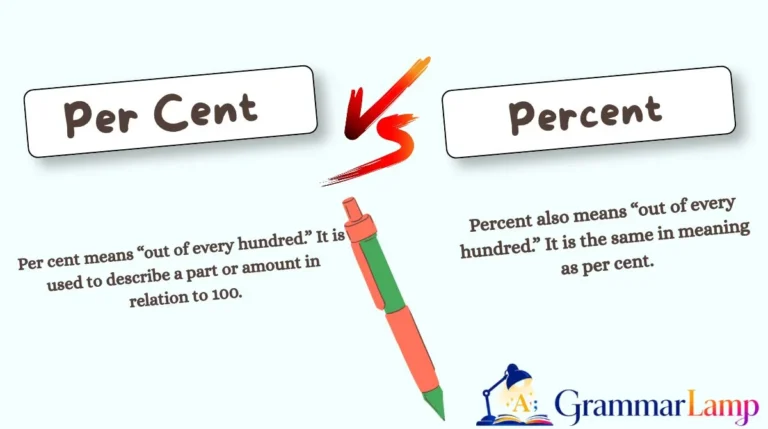
Per cent means “out of every hundred.” It is used to describe a part or amount in relation to 100.
The word per means “for each,” while cent comes from a word meaning “hundred.” Together, they express the idea of a number for every hundred.
For example, 25 per cent means 25 out of every 100. It can also be written as 25%.
When should you use “per cent”?
The two-word spelling is mainly used in British English and in writing that follows British spelling rules.
You may see it in:
- British newspapers and magazines
- School textbooks
- Formal reports
- Government documents
- Business writing in the UK
- Educational materials using British English
It is especially common in traditional British style, although some British publications also use the one-word form.
Grammar rule
When writing the number in words, use per cent as two separate words.
Examples:
- The company made a profit of ten per cent.
- Nearly fifty per cent of the students passed.
- The price increased by five per cent.
- Only one per cent of the land is used for farming.
When using a number, the phrase usually follows it:
Number + per cent
Examples:
- 15 per cent
- 40 per cent
- 75 per cent
Example sentences
- More than 60 per cent of the students arrived on time.
- The shop is offering a 20 per cent discount.
- About 35 per cent of the workers use public transport.
- The population increased by three per cent last year.
- Only ten per cent of the food was wasted.
- The bank offers an interest rate of five per cent.
- Around 80 per cent of the people supported the plan.
- The school improved its results by 12 per cent.
Common learner confusion
Some learners think per cent is incorrect because it contains two words. Others believe it has a different meaning from percent.
Neither idea is correct.
The two-word form is a standard spelling, especially in British English. It does not describe a different mathematical value.
For example:
- 50 per cent = 50 percent = 50%
All three mean 50 out of 100.
What Does “Percent” Mean?
Percent also means “out of every hundred.” It is the same in meaning as per cent.
The main difference is spelling, not meaning.
The one-word form is most common in American English. It is also widely used in online writing, international business, science, and many modern publications.
When should you use “percent”?
Use percent when writing in American English or when a publication’s style guide prefers the one-word form.
It is common in:
- American newspapers and websites
- US school assignments
- Business reports
- Financial writing
- Scientific articles
- Online content
For example, an American newspaper would normally write:
“The unemployment rate fell by two percent.”
A British publication might write:
“The unemployment rate fell by two per cent.”
Both sentences are correct.
Grammar rule
When writing the word in American English, spell it as one word.
Number + percent
Examples:
- 10 percent
- 25 percent
- 90 percent
The word usually comes after a number and describes how much of something is being discussed.
Example sentences
- The company reduced its prices by 15 percent.
- About 70 percent of the students chose English.
- The phone battery is at 20 percent.
- The team improved its performance by 10 percent.
- The bank charges a 3 percent fee.
- Nearly 50 percent of the voters supported the idea.
- The product contains 100 percent natural ingredients.
- The temperature increased by 5 percent.
Common learner confusion
Some learners think percent is only informal or that it should always be written with the symbol %.
That is not true.
Percent is a standard word and can be used in formal writing. It is also acceptable to write the word instead of the symbol when the style guide allows it.
For example:
- The rate increased by 5 percent.
- The rate increased by 5%.
Both are correct in many contexts.
However, it is important to follow the spelling style used in the rest of your writing.
Difference Between Per Cent and Percent
The main difference between per cent and percent is the spelling convention used in different forms of English.
They have the same meaning, pronunciation, and grammatical function.
Comparison table
| Feature | Per cent | Percent |
|---|---|---|
| Meaning | Out of every hundred | Out of every hundred |
| Spelling | Two words | One word |
| Common variety | British English | American English |
| Meaning difference | None | None |
| Pronunciation | Same | Same |
| Example | 25 per cent | 25 percent |
| Symbol | 25% | 25% |
| Formal use | Correct | Correct |
1. Usage difference
The two spellings are connected to regional writing styles.
British English traditionally prefers per cent. American English generally prefers percent.
For example:
British English:
- The price rose by 8 per cent.
- About 40 per cent of the population lives in cities.
American English:
- The price rose by 8 percent.
- About 40 percent of the population lives in cities.
The meaning remains the same in both examples.
2. Grammar logic
Both forms work in the same way in a sentence.
They can describe amounts, rates, changes, discounts, results, and proportions.
Examples:
- The company earned 20 per cent more.
- The company earned 20 percent more.
Both sentences are grammatically correct.
The spelling does not change the grammar of the sentence.
3. Sentence structure
The usual structure is:
Number + per cent/percent + of + noun
Examples:
- 30 per cent of the students
- 30 percent of the students
- 60 per cent of the money
- 60 percent of the money
You can also use the word after verbs such as increase, decrease, rise, and fall.
Examples:
- Sales increased by 10 per cent.
- Sales increased by 10 percent.
- The price fell by 5 per cent.
- The price fell by 5 percent.
4. Meaning comparison
There is no difference in value.
| Written form | Meaning |
|---|---|
| 10 per cent | 10 out of 100 |
| 10 percent | 10 out of 100 |
| 10% | 10 out of 100 |
| 50 per cent | Half |
| 50 percent | Half |
| 100 per cent | The whole amount |
| 100 percent | The whole amount |
For example, if 20 out of 100 students pass an exam, you can say:
- Twenty per cent of the students passed.
- Twenty percent of the students passed.
- 20% of the students passed.
Each sentence communicates the same information.
5. Which spelling should you choose?
The best choice depends on your audience and the style of your writing.
If you are writing for a British school, newspaper, or website, per cent is a traditional choice.
If you are writing for an American audience, percent is usually preferred.
If you are writing for an international website, either may be understood. However, choose one spelling and use it consistently.
Explore More Posts
Next Friday vs This Friday (2026): What Is the Difference?
Result In vs Result To: Meaning, Differences, and Examples (2026)
Sell vs Sale: Meaning, Difference, Grammar Rules, and Examples (2026)
Underwent vs. Undergone: Meaning, Grammar Rules, and Examples (2026)
Grammar Rules You Must Remember
Rule 1: Both spellings have the same meaning
Do not use one spelling to describe a different amount.
Correct:
- The price increased by 10 per cent.
- The price increased by 10 percent.
Both sentences mean the price increased by ten out of every hundred.
Rule 2: Use the spelling that matches your English style
British English traditionally uses per cent, while American English usually uses percent.
Correct British style:
- The result improved by 15 per cent.
Correct American style:
- The result improved by 15 percent.
Try not to switch between the two spellings in the same article.
Rule 3: Use “of” when identifying a part of a group
When you want to say how much of a group or amount is involved, use:
Percent/per cent + of + noun
Examples:
- 25 percent of the class was absent.
- 40 per cent of the workers were women.
- 10 percent of the water was wasted.
The verb depends on the noun or idea being described. A singular amount may take a singular verb, while individual people or things may take a plural verb.
Rule 4: The symbol % can replace the word in many contexts
The symbol % means the same as percent or per cent.
Examples:
- The score was 90%.
- The shop offers a 25% discount.
- The battery is at 15%.
In formal writing, follow the required style guide. Some styles use the symbol mainly with numerals, while others prefer the word in ordinary prose.
Common Mistakes Students Make
Learners often make mistakes because they try to treat these spellings as different words. In reality, the main issue is regional spelling and consistent style.
Mistake 1: Thinking “per cent” is wrong
Incorrect idea:
- “Per cent is not a real English expression.”
Correct:
- Per cent is a standard spelling, especially in British English.
Example:
- The result improved by 20 per cent.
Mistake 2: Thinking “percent” is always informal
Incorrect idea:
- “Percent should only be used in casual messages.”
Correct:
- Percent is standard American English and is suitable for formal writing.
Example:
- The report shows a 12 percent increase in sales.
Mistake 3: Using both spellings in the same paragraph
Less consistent:
- The company earned 10 percent more. Costs fell by 5 per cent.
Better:
- The company earned 10 percent more. Costs fell by 5 percent.
Or, in British style:
- The company earned 10 per cent more. Costs fell by 5 per cent.
Mistake 4: Adding an unnecessary plural ending
Incorrect:
- The rate increased by ten percents.
Correct:
- The rate increased by ten percent.
- The rate increased by ten per cent.
In ordinary use, percent and per cent do not take a plural ending after a number.
Mistake 5: Confusing percent with percentage
These words are related, but their grammar is different.
Correct:
- The percentage of students who passed was high.
- Fifty percent of students passed.
Use percent after a number. Use percentage when talking about the amount or proportion as a noun.
Mistake 6: Using “of” incorrectly
Incorrect:
- 20 percent students passed.
Correct:
- 20 percent of the students passed.
When referring to a specific group, include of.
Easy correction tips
- Remember that both forms mean “out of 100.”
- Use per cent for traditional British style.
- Use percent for American style.
- Do not add an “s” after a number.
- Use percentage when you need a noun.
- Keep the spelling consistent throughout your writing.
Easy Trick to Remember the Difference
Here is a simple memory trick:
British English = per cent (two words).
American English = percent (one word).
Think of per cent as the traditional British spelling with a space between the two parts.
Think of percent as the shorter American spelling, joined into one word.
You can also remember this simple idea:
Different spelling, same value.
For example, imagine a shop in London and a shop in New York both offering a 30% discount.
The London shop may write:
“30 per cent off.”
The New York shop may write:
“30 percent off.”
The customer receives the same discount in both places.
This is why you should focus on the meaning first and the spelling style second.
If you are unsure which form to use, check the spelling style of the website, book, or assignment you are writing for. Then follow that style throughout.
Daily Life Examples
These examples show how both forms are used in everyday conversations.
1. Shopping
A: Is this jacket on sale?
B: Yes, you can get 25 per cent off.
American style:
B: Yes, you can get 25 percent off.
2. School results
A: How many students passed the test?
B: About 80 percent of the class passed.
British style:
B: About 80 per cent of the class passed.
3. Mobile phone battery
A: How much battery do you have left?
B: Only 15 percent.
You may also write:
“Only 15 per cent.”
4. Business
A: Did the company make more money this year?
B: Yes, its profits increased by 12 percent.
British style:
“Profits increased by 12 per cent.”
5. Saving money
A: How much of your salary do you save?
B: I try to save 20 percent every month.
6. Weather report
A: Is there a chance of rain today?
B: Yes, there is a 60 percent chance of rain.
7. Sports
A: What was the team’s success rate?
B: They won 75 percent of their matches.
8. Health and fitness
A: How much body fat do you have?
B: My body fat is around 18 percent.
9. Internet usage
A: How many people use smartphones in your country?
B: More than 90 percent of adults use them.
10. Everyday conversation
A: Did everyone agree with the plan?
B: Almost 100 percent of the team agreed.
These examples show that both spellings fit naturally into spoken and written English.
Practice Section
Choose the correct form for each sentence. Think about whether the sentence follows British or American English.
Questions
- The shop is offering a 20 ______ discount.
(per cent / percent) - In American English, the usual spelling is ______.
(per cent / percent) - About 50 ______ of the students were absent.
(per cent / percent) - The company increased its sales by ten ______.
(percents / percent) - In traditional British English, the spelling is ______.
(per cent / percent)
Answers
- Both are correct, depending on the style.
- Percent
- Both are correct, depending on the style.
- Percent
- Per cent
Remember, the purpose of this exercise is not to find a difference in meaning. It is to understand the spelling styles and use them consistently.
More Helpful posts
Years of Experience vs Years Experience: Which Is Correct? (2026 Guide)
Later vs Later On: What Is the Difference? (2026 Guide)
I Was Wondering vs I Am Wondering vs I Wonder (2026): Meaning, Differences, and Examples
Disoriented vs Disorientated: Meaning, Difference, and Examples (2026)
FAQs
1. What is the difference between per cent and percent?
There is no difference in meaning. Both mean “out of every hundred.” Per cent is traditionally used in British English, while percent is the usual American spelling.
2. Is “per cent” one word or two words?
It is written as two words: per cent. This spelling is common in British English. The American form, percent, is written as one word.
3. Is percent formal or informal?
Percent is a standard spelling and is suitable for formal writing, especially in American English. It is not limited to casual speech or informal messages.
4. Can I use percent in British English?
Yes. British readers understand percent, and some British publications use it. However, per cent is the traditional British form. Follow the style guide of your publication or assignment.
5. Should I write percent or %?
Both forms are widely used. The word is useful in ordinary writing, while the symbol is common in tables, charts, reports, and figures. Follow the style guide when writing formally.
6. Is percentage the same as percent?
They are related but used differently. Percent usually follows a number, as in “25 percent.” Percentage is a noun, as in “The percentage of people who agreed was high.”
Conclusion
The difference between per cent and percent is simple once you understand that both forms have the same meaning.
They both mean “out of every hundred” and can be used to describe discounts, rates, amounts, changes, test results, and many other things.
The main difference is spelling. Per cent is traditionally used in British English, while percent is the usual spelling in American English.
Neither form is wrong. The best choice depends on your audience and the style of English you are using.
Remember to keep your spelling consistent, avoid adding an unnecessary “s,” and use percentage when you need a noun instead of a word following a number.
With a little practice, you will find it easy to use both forms in schoolwork, business writing, emails, and everyday conversations.
Keep learning, keep practising, and remember: different spelling does not always mean different meaning!

Liam Derren is a language writer at GrammarLamp, creating simple, helpful content about grammar, words, and everyday English. He makes language learning clear, practical, and easy to understand.