
Have you ever made plans with a friend and felt confused about which Friday they meant? Maybe someone said, “Let’s meet this Friday,” while another person said, “Let’s meet next Friday.” Both sentences sound simple, but they can cause confusion in everyday conversations.
The problem is that “this Friday” and “next Friday” can sometimes refer to different dates, depending on when the speaker is talking and how they use these expressions. In some situations, people even use them to mean the same day.
For English learners, this can make it difficult to arrange meetings, plan trips, schedule appointments, or understand messages from friends and coworkers. Imagine preparing for a meeting one week too early because you misunderstood a single word. That is a small language mistake that can create a big problem.
The good news is that you do not need to learn a complicated grammar rule to understand these expressions. You mainly need to understand how English speakers talk about the current week and the following week.
In this guide, you will learn the meaning of each expression, the difference between them, common mistakes, and simple rules for choosing the right phrase. You will also see examples from daily conversations and practice sentences to test your understanding.
By the end, you will know how to use these expressions more clearly and avoid confusion when making plans in English.
More Useful posts
John and Me vs Me and John: Which Is Correct? 2026 Grammar Guide
As Soon As vs As Early As: Easy Difference, Rules & Examples in 2026
Imbalanced vs Disbalanced: What Is the Difference? (2026)
Orientated vs Oriented: What’s the Difference? [2026 Guide]
What Does “This Friday” Mean?
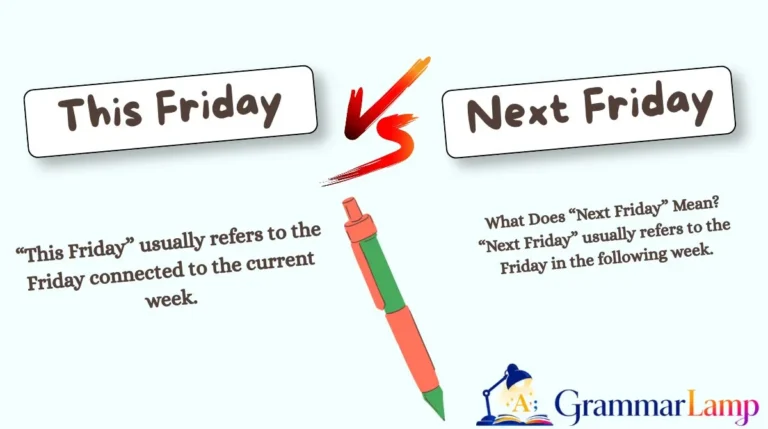
“This Friday” usually refers to the Friday connected to the current week. People often use it when talking about an upcoming Friday that they consider part of the present week.
For example, imagine today is Monday. If your friend says, “We are going shopping this Friday,” they will usually mean the Friday coming up in the current week.
The word “this” is a demonstrative determiner. It helps identify a particular time, day, or thing that the speaker has in mind.
When you say “this Friday,” you are pointing to a specific Friday that feels close to the present time or belongs to the current week in your mind.
When Should You Use “This Friday”?
Use “this Friday” when you want to talk about a particular Friday associated with the current week.
It is common in conversations about work, school, family plans, parties, appointments, and other activities.
For example, a teacher might say, “Your assignment is due this Friday.” The teacher is identifying the Friday that students should treat as the deadline.
Similarly, a manager might say, “We have a team meeting this Friday.” The phrase identifies the intended meeting day, although the exact date may need clarification if the week is unclear.
Grammar Rule for “This Friday”
The usual structure is:
This + day of the week
Examples include:
- This Monday
- This Tuesday
- This Wednesday
- This Thursday
- This Friday
- This Saturday
- This Sunday
In ordinary English, you do not need to add “on” before “this Friday” when using it in a sentence.
For example:
- Correct: I will see you this Friday.
- Also correct: I will see you on Friday.
- Usually unnatural: I will see you on this Friday.
The last sentence is not always impossible, but the extra “on” is generally unnecessary in everyday English.
8 Examples of “This Friday”
- I have an important exam this Friday.
The exam is planned for the Friday the speaker has in mind, usually in the current week. - Are you free this Friday?
The speaker is asking about someone’s availability for a particular Friday. - We are going to visit our grandparents this Friday.
The visit is planned for the upcoming Friday associated with the current week. - The school will close early this Friday.
The school will close early on the specified Friday. - I need to finish this report this Friday.
The speaker has a deadline for the intended Friday. - Let’s have dinner together this Friday.
The speaker is suggesting a dinner plan for that Friday. - My brother is arriving this Friday morning.
The arrival is expected on the Friday being discussed. - The company is launching its new website this Friday.
The launch is scheduled for that particular Friday.
Common Confusion About “This Friday”
The main confusion happens when people are talking about a Friday that is close to the present but may fall in the following calendar week.
For example, imagine today is Sunday. Some speakers may use “this Friday” for the Friday only five days away. Others may use “next Friday” for that same date.
There is no single worldwide rule that forces every English speaker to make the same choice in every situation. Regional habits, personal preferences, and context can affect how people interpret these expressions.
That is why the phrase is useful but not always precise enough for important plans. If the date matters, saying “Friday, October 30” is clearer than relying only on “this Friday.”
What Does “Next Friday” Mean?
“Next Friday” usually refers to the Friday in the following week. However, the exact date can depend on the day of the week when the phrase is used and on the speaker’s intended meaning.
For example, if today is Monday and someone says, “I will visit you next Friday,” many people will understand that the person means the Friday of the following week, not the Friday only four days away.
The word “next” helps identify something that comes after the current point in a sequence. In this expression, it often points to the next week’s Friday.
However, some speakers also use “next Friday” to mean the next Friday that will arrive, even if it is only a few days away. This is especially likely when the current day is near the end of the week.
When Should You Use “Next Friday”?
Use “next Friday” when you want to refer to the Friday you understand as belonging to the following week.
For example, suppose today is Tuesday, October 20. You want to arrange a meeting for Friday, October 30 rather than the upcoming Friday, October 23.
You might say, “Let’s meet next Friday.”
Many listeners will understand that you mean October 30. However, if the date is important, it is better to confirm the exact date rather than assume everyone interprets the phrase in the same way.
This expression is common in casual and professional English. People use it when discussing future events, travel, school activities, work deadlines, and social plans.
Grammar Rule for “Next Friday”
The common structure is:
Next + day of the week
Examples include:
- Next Monday
- Next Tuesday
- Next Wednesday
- Next Thursday
- Next Friday
- Next Saturday
- Next Sunday
Like “this Friday,” the phrase normally does not need “on” before it.
Examples:
- Correct: I will call you next Friday.
- Also correct: I will call you on Friday.
- Usually unnecessary: I will call you on next Friday.
In standard everyday usage, “next Friday” is the natural choice when you want to identify the intended Friday in the future.
8 Examples of “Next Friday”
- We have a meeting next Friday.
The speaker probably means the Friday of the following week. - I am traveling to Lahore next Friday.
The trip is planned for the Friday the speaker identifies as next Friday. - Can you submit the assignment next Friday?
The speaker is asking for the assignment to be submitted on that Friday. - My cousin is getting married next Friday.
The wedding is scheduled for the intended Friday. - Our new course starts next Friday.
The course will begin on the Friday being discussed. - I will send you the documents next Friday.
The speaker plans to send the documents on that date. - The doctor has given me an appointment for next Friday.
The appointment is arranged for the intended Friday. - We are planning a family trip for next Friday.
The trip is expected to begin or take place on that Friday.
Common Confusion About “Next Friday”
The biggest problem is that “next Friday” does not always mean the same date to every listener.
Suppose today is Thursday. One person might use “next Friday” for tomorrow, because tomorrow is the next Friday to arrive. Another person might understand it as the Friday of the following week.
Both interpretations can occur in everyday speech, which is why the phrase may cause misunderstandings.
The safest approach is to consider the context. If someone says “next Friday” on Monday, they may well mean the Friday of the following week. If they say it on Thursday, you should not automatically assume whether they mean tomorrow or the Friday a week later.
When there is any doubt, ask, “Do you mean tomorrow or Friday next week?”
Difference Between “Next Friday” and “This Friday”
The main difference is that “this Friday” usually points to the Friday associated with the current week, while “next Friday” often points to the Friday in the following week. However, everyday English does not always follow this distinction consistently.
Both expressions are correct. The difference is not a spelling or grammar mistake; it is about the date the speaker intends.
Comparison Table
| Feature | This Friday | Next Friday |
|---|---|---|
| Basic meaning | Usually the Friday associated with the current week | Usually the Friday of the following week |
| Main idea | The Friday being identified as part of this week | The Friday being identified as next week’s Friday |
| Common use | Current-week plans and deadlines | Plans for the following week |
| Example | I have an exam this Friday. | I have an exam next Friday. |
| Possible confusion | May mean the upcoming Friday near the weekend | May mean the nearest Friday or the following week’s Friday |
| Best way to be precise | Give the calendar date | Give the calendar date |
1. Usage Difference
Imagine today is Monday, October 19, 2026.
The Friday coming up is October 23, and the Friday of the following week is October 30.
If you say, “I have a job interview this Friday,” most listeners will understand that the interview is on October 23.
If you say, “I have a job interview next Friday,” many listeners will understand that the interview is on October 30.
This is a useful distinction, especially when you are making plans several days in advance.
However, these interpretations are not guaranteed. A speaker might use “next Friday” to mean October 23, particularly if they are thinking of it as the next Friday to arrive.
2. Grammar Logic
Both expressions use a determiner followed by a day of the week.
In “this Friday,” the word “this” identifies a particular Friday in relation to the present time or current week.
In “next Friday,” the word “next” indicates a Friday that comes next in the speaker’s intended sequence. The speaker may be thinking about the next week rather than the nearest upcoming Friday.
Neither expression has a special verb tense. You can use both with the present simple, present continuous, or future forms, depending on what you want to say.
Examples:
- I work this Friday.
- I am working next Friday.
- I will visit you this Friday.
- We are meeting next Friday.
The verb form depends on the meaning of the sentence, not on whether you use “this” or “next.”
3. Sentence Structure Difference
The sentence structure is almost identical.
This Friday + sentence
- This Friday is my last day at work.
- This Friday will be very busy.
- This Friday works well for me.
Next Friday + sentence
- Next Friday is my last day at work.
- Next Friday will be very busy.
- Next Friday works well for me.
You can also place either expression at the end of a sentence.
- We are having a party this Friday.
- We are having a party next Friday.
The sentence structure does not change. Only the intended date changes.
4. Meaning Comparison With Dates
Let’s look at a simple calendar example.
Suppose today is Monday, October 19, 2026.
- This Friday: October 23, 2026, in the usual current-week interpretation.
- Next Friday: October 30, 2026, in the usual following-week interpretation.
Now imagine today is Sunday, October 25, 2026.
The Friday coming up is October 30. Some speakers may call it “this Friday” because they are referring to the Friday in the current calendar week. Others may call it “next Friday” because it is the next Friday to arrive.
This example shows why the expressions can overlap. It is not always possible to identify the intended date from the phrase alone.
5. Which Expression Is More Natural?
Neither expression is more correct in every situation. Choose the phrase that best matches the date you intend to communicate.
Use “this Friday” when you want to identify the Friday you associate with the current week. Use “next Friday” when you mean the Friday you associate with the following week.
If you are speaking with someone who may interpret the phrases differently, include the date.
For example:
- Less precise: Let’s meet next Friday.
- More precise: Let’s meet Friday, October 30.
The second sentence removes uncertainty and is especially useful for work meetings, appointments, travel plans, and deadlines.
Explore More Posts
Do You vs Are You: What’s the Difference? Complete Guide for 2026
Dateline vs Deadline: Meaning, Difference, Examples & Easy Rules (2026)
Whole vs Hole: Meaning, Difference, Examples, and Easy Rules (2026)
Farther vs Further: The Easy Difference Explained for 2026
Grammar Rules You Must Remember
Learning four simple rules will help you use these expressions naturally and avoid many common mistakes.
Rule 1: Use “This Friday” for the Friday You Associate With the Current Week
When you are talking about the Friday in the current week, “this Friday” is usually the natural choice.
For example:
- Today is Tuesday. Our test is this Friday.
- I have a meeting this Friday afternoon.
- We are going to the market this Friday.
These sentences identify a Friday that is close to the present and belongs to the speaker’s current-week plans.
Remember that “current week” can depend on how the speaker thinks about the week. If you are unsure, confirm the date.
Rule 2: Use “Next Friday” for the Following Week’s Friday When That Is Your Intended Meaning
If you want to talk about the Friday in the week after the current one, “next Friday” is often appropriate.
For example:
- Today is Monday. Let’s meet next Friday, October 30.
- My course begins next Friday.
- I will finish the project next Friday.
The calendar date in the first example makes the intended meaning clear. This is a good habit when the timing matters.
Rule 3: Do Not Add “On” Before These Expressions in Ordinary Sentences
In everyday English, you normally say “this Friday” and “next Friday” without “on.”
Correct:
- I will see you this Friday.
- We are leaving next Friday.
- She has an exam this Friday.
- They are visiting us next Friday.
Less natural in ordinary usage:
- I will see you on this Friday.
- We are leaving on next Friday.
However, “on” is correct when the wording is different, such as “on Friday” or “on the next Friday after the holiday.”
For example, “The event takes place on the next Friday after the school term ends” is grammatical because “the next Friday after the school term ends” is a longer noun phrase.
Rule 4: Use the Calendar Date When Timing Must Be Clear
This is the most useful rule for avoiding confusion.
If you are arranging a medical appointment, booking travel, setting a deadline, or planning an important meeting, do not depend only on “this Friday” or “next Friday.”
Instead, say:
- “Let’s meet on Friday, October 30.”
- “Your appointment is Friday, November 6.”
- “The assignment is due on October 30.”
You can also confirm the date in a message after a conversation.
For example: “Just confirming that our meeting is on Friday, October 30, at 10 a.m.”
This small habit can prevent missed appointments and unnecessary misunderstandings.
Common Mistakes Students Make
English learners often make mistakes with these expressions because the words seem simple, but the timing is not always obvious. Here are some common problems and ways to correct them.
Mistake 1: Assuming Everyone Uses “Next Friday” the Same Way
Confusing sentence: “The meeting is next Friday, so everyone knows the date.”
The problem is that not everyone will interpret the phrase in the same way. One person might think of the Friday of the following week, while another might think of the nearest upcoming Friday.
Better approach: “The meeting is next Friday, October 30.”
Adding the date makes the message much clearer.
Mistake 2: Using “On” Before “This Friday”
Less natural: “I am going to the dentist on this Friday.”
Better: “I am going to the dentist this Friday.”
In ordinary English, “this Friday” already identifies the day. Adding “on” is usually unnecessary.
You can say “on Friday” without “this,” or simply say “this Friday.”
Mistake 3: Thinking “This Friday” Always Means Tomorrow
The phrase does not mean tomorrow unless tomorrow is Friday.
For example, if today is Wednesday, “this Friday” usually refers to the day two days later, not Thursday.
Incorrect understanding: “Today is Wednesday, so this Friday means tomorrow.”
Correct understanding: “Today is Wednesday, so this Friday usually means the upcoming Friday, which is two days away.”
Always check which day of the week it is before interpreting the phrase.
Mistake 4: Thinking “Next Friday” Always Means Exactly Seven Days From Today
This is another common misunderstanding.
If today is Monday, the Friday of the following week is eleven days away, not seven days away. The Friday that is seven days away would actually be the following Monday.
For example, if today is October 19, 2026:
- The upcoming Friday is October 23.
- The following week’s Friday is October 30.
- Seven days from October 19 is October 26, a Monday.
Tip: Count the calendar days rather than assuming “next Friday” means seven days from today.
Mistake 5: Using the Expressions Without Checking the Context
Imagine your coworker says, “I need the report next Friday.” You assume the report is due on the nearest Friday, but your coworker expects it the following week.
The mistake is not necessarily your grammar. The date was not clear enough.
Better response: “Just to confirm, do you mean this coming Friday or Friday next week?”
Asking a short question is better than guessing and missing a deadline.
Easy Trick to Remember the Difference
Here is a simple memory trick:
THIS = think of the current week.
NEXT = think of the following week.
Imagine you are looking at a calendar. You are in the current week, and Friday is coming up. You point to that Friday and say, “This Friday.”
Then you move your finger to the Friday in the next row or following week. You say, “Next Friday.”
This trick works well when you are learning the usual distinction between the expressions.
However, remember that real conversations do not always follow a strict calendar pattern. When a person says “next Friday,” they might mean the next Friday that arrives, even if it is in the current week.
For that reason, a second trick is even more reliable:
If the date matters, say the date.
Instead of saying, “I’ll call you next Friday,” you can say, “I’ll call you on October 30.”
You can still use the shorter expressions in casual conversations. Just make sure the other person understands which Friday you mean.
Daily Life Examples: How People Use These Expressions
The best way to learn these phrases is to see them in natural conversations. Here are ten examples you can use in daily English.
Example 1: Talking to a Friend
Ali: Are you free this Friday?
Ahmed: Yes, I am. Why?
Ali: Let’s watch a movie together.
Here, Ali is asking about the Friday he has in mind, usually the upcoming Friday in the current week.
Example 2: Planning a Meeting
Manager: Can we discuss the new project next Friday?
Employee: Sure. Do you mean October 30?
Manager: Yes, that’s right.
The employee confirms the date to avoid confusion.
Example 3: Talking About School
Student A: When is our English test?
Student B: It’s this Friday.
Student A: Thanks. I need to start studying.
The student uses “this Friday” to identify the intended test date.
Example 4: Making a Family Plan
Mother: Your uncle is coming next Friday.
Daughter: Great! Is he staying for the weekend?
Mother: Yes, he is.
The family is discussing a visit planned for the Friday they understand as next Friday.
Example 5: Discussing Work
Coworker A: When do you need the presentation?
Coworker B: I need it this Friday afternoon.
Coworker A: Okay, I’ll finish it before then.
The phrase identifies a deadline. If the deadline is important, adding the date would make it even clearer.
Example 6: Booking an Appointment
Receptionist: We have an available appointment next Friday.
Patient: Could you tell me the date, please?
Receptionist: It’s October 30.
The patient asks for the date rather than relying on an expression that may be interpreted differently.
Example 7: Talking About Travel
Friend A: When are you leaving for Islamabad?
Friend B: This Friday morning.
Friend A: Have you booked your ticket?
Friend B: Yes, everything is ready.
The speaker identifies the planned departure day.
Example 8: Discussing a Deadline
Teacher: Please submit your project next Friday.
Student: Should I submit it on October 30?
Teacher: Yes, that’s the deadline.
The student checks the exact date and avoids making a wrong assumption.
Example 9: Arranging Dinner
Sara: Would you like to have dinner next Friday?
Ayesha: I’d love to. Which date do you mean?
Sara: October 30.
The conversation shows how a quick question can make plans clear.
Example 10: Sending a Text Message
Hamza: Are we meeting this Friday or next Friday?
Usman: Next Friday, October 30.
Hamza: Perfect. I’ll add it to my calendar.
This is a useful way to clarify a date when both expressions are possible.
Practice Section: Choose the Correct Expression
Test your understanding by choosing “this Friday” or “next Friday” for each sentence. Use the usual distinction that “this Friday” refers to the current week’s Friday and “next Friday” refers to the following week’s Friday.
Questions
1. Today is Monday, October 19. You want to talk about October 23. Which phrase fits the usual meaning?
- A. This Friday
- B. Next Friday
2. Today is Monday, October 19. You want to talk about October 30. Which phrase fits the usual meaning?
- A. This Friday
- B. Next Friday
3. Your coworker says, “The meeting is next Friday,” but you are unsure of the date. What should you do?
- A. Guess the date.
- B. Ask which date they mean.
4. Which sentence sounds more natural in everyday English?
- A. I have an exam on this Friday.
- B. I have an exam this Friday.
5. You are arranging an important appointment and want to avoid confusion. Which message is clearer?
- A. Let’s meet next Friday.
- B. Let’s meet on Friday, October 30.
Answers and Explanations
1. A — This Friday. October 23 is the upcoming Friday in the current week.
2. B — Next Friday. October 30 is the Friday of the following week under the usual distinction.
3. B — Ask which date they mean. People may interpret “next Friday” differently, so checking is sensible.
4. B — I have an exam this Friday. “On” is normally unnecessary before “this Friday.”
5. B — Let’s meet on Friday, October 30. Giving the calendar date removes uncertainty.
More Helpful posts
In Development vs Under Development: Meaning, Differences, and Examples (2026)
Non-Restrictive Clauses: Meaning, Rules, Examples & Differences in 2026
Conform With vs Conform To (2026): What’s the Difference? Easy Grammar Guide for English Learners
Who’s vs Whose (2026): What’s the Difference? Easy Grammar Rules, Examples, and Common Mistakes
FAQs
1. What is the difference between “next Friday” and “this Friday”?
“This Friday” usually refers to the Friday associated with the current week. “Next Friday” often refers to the Friday in the following week. However, speakers sometimes use these expressions differently, so the intended date may need clarification.
2. Does “next Friday” mean the Friday coming up?
It can. Some people use “next Friday” to mean the next Friday that will arrive, even if it is only a few days away. Others use it to mean the Friday of the following week. If the date is important, ask for the calendar date.
3. Is “this Friday” grammatically correct?
Yes, “this Friday” is completely correct and widely used in everyday English. It identifies a particular Friday in relation to the current time or week. For example, “I have a job interview this Friday” is a natural sentence.
4. Can I say “on this Friday” or “on next Friday”?
In everyday English, it is usually more natural to say “this Friday” or “next Friday” without “on.” For example, say, “We are meeting next Friday.” However, “on Friday” is correct, and longer phrases such as “on the next Friday after the holiday” are also grammatical.
5. Which expression should I use when making plans?
Use “this Friday” when you mean the Friday you associate with the current week, and “next Friday” when you mean the Friday you associate with the following week. Since people may interpret these phrases differently, confirm the date for meetings, appointments, and other important plans.
6. Is there a difference between British and American English?
Both British and American English use “this Friday” and “next Friday.” Individual habits and interpretations can vary in either variety. It is not safe to assume that every British or American speaker will use “next Friday” in exactly the same way, so giving the date is the clearest option.
Conclusion
Understanding the difference between “next Friday” and “this Friday” can make everyday English much easier. Both expressions are correct, but they usually point to different Fridays.
“This Friday” often refers to the Friday associated with the current week, while “next Friday” commonly refers to the Friday in the following week.
The important thing to remember is that people do not always use these phrases in the same way. Someone may use “next Friday” to mean the nearest upcoming Friday, especially when the conversation happens close to the weekend. That is why context matters.
For casual conversations, these expressions are useful and natural. You can use them when talking about school, work, travel, family plans, or meeting friends. When the exact date is important, however, it is better to say the month and day.
For example, “Let’s meet on Friday, October 30” is clearer than simply saying “Let’s meet next Friday.”
Keep practicing with real conversations, check the calendar when needed, and do not be afraid to ask someone to confirm a date. Clear communication is more important than guessing the meaning.

Liam Derren is a language writer at GrammarLamp, creating simple, helpful content about grammar, words, and everyday English. He makes language learning clear, practical, and easy to understand.
1 thought on “Next Friday vs This Friday (2026): What Is the Difference?”