
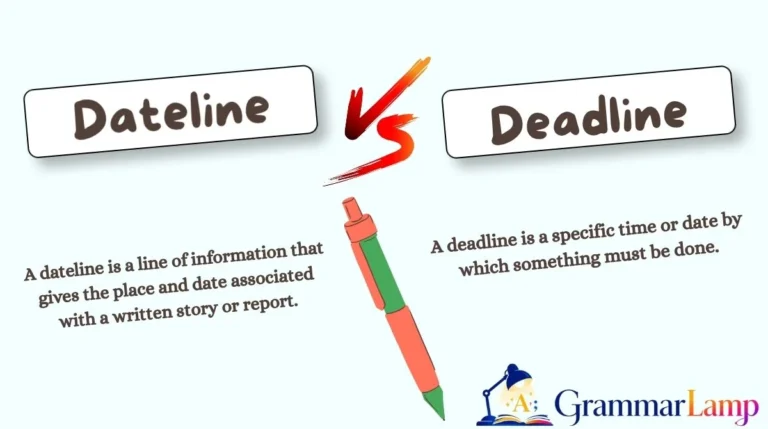
“Dateline” and “deadline” look almost the same. Both words contain date, both end with line, and both are connected with time. That is exactly why many English learners mix them up.
However, these two words do not mean the same thing.
A dateline is usually connected with a news story, newspaper article, report, or other written material. It can show the place and date connected with the writing or publication.
In journalism, you may see something such as LONDON — 16 August 2026 at the beginning of a story. That information is called a dateline.
Dictionaries also recognize another meaning related to the International Date Line.
A deadline, on the other hand, is the time or date by which something must be finished, submitted, or completed. For example, your teacher might say, “The deadline for the assignment is Friday.” You must finish the assignment by that time.
The difference becomes much easier when you connect each word with a simple idea:
Dateline = information about a date and place.
Deadline = the final time for doing something.
These words appear in school, work, newspapers, emails, applications, business, and everyday conversations.
By the end of this guide, you will know exactly when to use each word, how to recognize the difference, and how to avoid the common mistakes learners make.
What Does “Dateline” Mean?
A dateline is a line of information that gives the place and date associated with a written story or report.
It is especially common in newspapers, journalism, news websites, press releases, and other forms of reporting.
Cambridge defines it as the line in a newspaper article that tells the place and date of writing. Merriam-Webster gives a broader definition: a line in a written document or publication giving the date and place of composition or issue.
For example:
TOKYO — August 16, 2026
If this appears at the beginning of a news report, it can be a dateline.
When do we use “dateline”?
You mainly see dateline in writing related to news and reporting.
It can be used when talking about:
- newspaper articles
- news reports
- press releases
- journalism
- reports
- published documents
- the location from which a news story is reported
A dateline helps readers understand where a story is coming from and when it was written or issued.
Grammar rule for “dateline”
Dateline is normally used as a countable noun.
You can say:
- a dateline
- the dateline
- several datelines
- the story has a dateline
The plural form is datelines.
Examples of “dateline”
- The newspaper changed the dateline before publishing the story.
- The article carried a New York dateline.
- Check the dateline at the beginning of the report.
- The reporter wrote the story under a Washington dateline.
- The editor corrected the dateline before the article went online.
- The report has a London dateline.
- The journalist sent the story with a Paris dateline.
- The dateline shows where the report was filed.
These examples all connect the word with reporting, writing, location, or publication.
A common learner confusion
Many students see the word date inside dateline and think it means “the last date.”
That is not correct.
The word deadline contains the idea of an ending point or final time. Dateline does not normally mean “last date.”
Compare:
The article has a Delhi dateline.
This tells us about the article’s reporting location or dateline.
The application deadline is Monday.
This tells us the final time to submit the application.
That small difference is extremely important.
Another meaning of “dateline”
There is another meaning that you may encounter in geography: the International Date Line. This is the imaginary line around the Earth where the calendar date changes.
For beginners, however, the journalism meaning is the one most likely to cause confusion with deadline.
What Does “Deadline” Mean?
A deadline is a specific time or date by which something must be done.
This can be a school assignment, job application, project, payment, registration, report, or any other task that has a final time.
Cambridge defines a deadline as “a time or day by which something must be done.” Merriam-Webster similarly defines it as a date or time before which something must be done.
Think of a deadline as the finish line for a task.
For example:
The deadline for the project is Friday.
This means Friday is the final time for completing the project.
When do we use “deadline”?
You use deadline when something has a final date or time.
Common situations include:
- homework
- school projects
- college applications
- job applications
- work projects
- tax forms
- payments
- registrations
- competitions
- reports
- contracts
- business tasks
The word is very common in both formal and everyday English.
Grammar rule for “deadline”
Like dateline, deadline is a countable noun.
You can say:
- a deadline
- the deadline
- my deadline
- our deadline
- several deadlines
- a tight deadline
- a final deadline
Common expressions include:
meet a deadline = finish something on time
miss a deadline = fail to finish something on time
set a deadline = choose a final time for something
extend a deadline = give people more time
work under a deadline = work with a limited amount of time
Examples of “deadline”
- The deadline for the assignment is Friday.
- I need to finish this report before the deadline.
- She missed the application deadline.
- The manager gave us a new deadline.
- Can we extend the deadline by two days?
- We are working under a tight deadline.
- Please submit your form before the deadline.
- The deadline is approaching quickly.
Notice something important: a deadline is connected with an action that must be completed.
That is the key idea.
A common learner confusion
Students sometimes use dateline when they actually mean deadline.
For example:
❌ The dateline for my homework is Monday.
✅ The deadline for my homework is Monday.
Why?
Because Monday is the final day for completing the homework. It is not information about where or when a news story was written.
Difference Between Dateline and Deadline
The easiest way to understand the difference is to stop looking at the spelling and focus on the job each word does.
Comparison table
| Feature | Dateline | Deadline |
|---|---|---|
| Basic meaning | Information showing a date/place connected with writing or publication | Final time or date by which something must be done |
| Common area | Journalism, newspapers, reports | School, work, business, applications, everyday life |
| Main idea | Where/when a story was filed or written | When a task must be completed |
| Refers to a task? | Usually no | Yes |
| Can you miss it? | Not normally in the usual sense | Yes |
| Common expressions | news dateline, London dateline | meet a deadline, miss a deadline |
| Example | “The report has a Nairobi dateline.” | “The report deadline is Friday.” |
Usage difference
Here is a simple pair:
The article has a New York dateline.
The sentence tells us something about the article.
Now compare it with:
The article has a Friday deadline.
This tells us when the article must be completed or submitted.
The two words may appear in the same workplace, but they perform completely different jobs.
Grammar logic
Both words are nouns, but their meanings are built around different ideas.
Dateline is related to the date and place connected with a written item.
Deadline is related to the final limit for an activity.
Ask yourself:
“Am I talking about information attached to a news story?”
Use dateline.
“Am I talking about the final time to finish something?”
Use deadline.
Sentence structure difference
Common sentence patterns with dateline include:
Subject + has/carries + a + dateline
The article carries a London dateline.
Subject + has + a + place + dateline
The report has a Sydney dateline.
With deadline, common patterns include:
The deadline for + noun + is + time/date
The deadline for registration is Friday.
Subject + verb + before + the deadline
Please submit the form before the deadline.
Subject + meet/miss + the deadline
We must meet the deadline.
Meaning comparison
Think about this simple newsroom example:
PARIS — August 16
That is a dateline.
Then imagine the editor says:
The deadline for the story is 6 p.m.
That is a deadline.
The dateline tells you where/when the story comes from.
The deadline tells you when the work must be finished.
Grammar Rules You Must Remember
Rule 1: Use “deadline” for the final time to do something
When a task has a final date or time, use deadline.
The deadline for the project is August 20.
Not:
❌ The dateline for the project is August 20.
The task has a final completion point, so deadline is correct.
Rule 2: Use “dateline” for a date/place line in reporting
When discussing the information at the beginning of a news story or written report, dateline is the appropriate word.
The news story has a Kabul dateline.
The word is about the story’s reporting location and associated date, not the final time for completing work.
Rule 3: “Meet” and “miss” commonly go with “deadline”
English speakers frequently use these combinations:
meet the deadline
miss the deadline
extend the deadline
set a deadline
For example:
I worked all night to meet the deadline.
She missed the deadline for the application.
These are very common everyday and professional expressions. Cambridge specifically lists “meet a deadline,” “tight deadline,” and “miss a deadline” among common uses.
Rule 4: A dateline is not normally something you “meet”
You would not normally say:
❌ I need to meet the dateline.
That sounds wrong because a dateline is not the final time for completing a task.
Instead, say:
✅ I need to meet the deadline.
You might say:
The editor checked the dateline.
That makes sense because the editor is checking information associated with the story.
Common Mistakes Students Make
These two words are confusing mainly because they look so similar. Learners often notice the word date and guess the meaning instead of looking at the whole word.
Mistake 1: Using “dateline” for homework
Wrong:
❌ My homework dateline is tomorrow.
Correct:
✅ My homework deadline is tomorrow.
A homework deadline is the final time to submit the work.
Mistake 2: Using “deadline” for a news location
Wrong:
❌ The article has a London deadline.
If you mean the location/date information at the beginning of the story, use:
✅ The article has a London dateline.
Mistake 3: Thinking both words mean “date”
They do not.
A date simply tells you a day, month, or year.
A deadline gives a final point by which something must happen.
A dateline can identify the date and place associated with a written report.
Mistake 4: Saying “before the dateline”
If you mean the final time for submitting work, say:
✅ Submit your application before the deadline.
Not:
❌ Submit your application before the dateline.
Easy correction tip
Before using either word, ask:
Is this about a news story or report?
→ Dateline
Is this about finishing or submitting something?
→ Deadline
That one question can prevent most mistakes.
Easy Trick to Remember the Difference
Here is a simple memory trick that works well for beginners.
Think: “Date tells. Dead stops.”
Dateline = date information
A dateline helps tell you something about a story’s date and place.
Deadline = final stopping point
A deadline is the point after which you may no longer be allowed to submit or complete something on time.
Imagine your teacher gives you an assignment.
The teacher says:
“Submit it by Friday.”
Friday is the deadline.
Now imagine you open a newspaper and see:
ISLAMABAD — August 16
That is a dateline in a news-reporting context.
Another trick is to remember the common verb:
meet a deadline
You can meet a deadline, miss a deadline, extend a deadline, and set a deadline.
The word deadline has a strong connection with a task that has to be completed.
So whenever you see a task and a final time, your brain should immediately think:
Deadline!
Daily Life Examples
Understanding a word becomes easier when you see how real people use it.
Example 1: School
A: When is the science project due?
B: The deadline is next Monday.
Here, deadline means the final time for submitting the project.
Example 2: Job application
A: Have you applied for the job?
B: Not yet. The application deadline is Friday.
Again, the word refers to the final date for action.
Example 3: Office work
A: Can you finish the report today?
B: Yes. I need to meet the deadline.
This is a very natural workplace expression.
Example 4: News writing
A: Where was this story filed?
B: It has a Nairobi dateline.
Here, dateline relates to the location and date associated with the report.
Example 5: Newspaper article
A: What does the information at the top of the story mean?
B: That’s the dateline. It tells readers the place and date connected with the report.
Example 6: Registration
A: Can I register tomorrow?
B: Yes, but hurry. The deadline is tomorrow evening.
The deadline is the final time for registration.
Example 7: Group project
A: We have only two days left.
B: I know. The deadline is getting close.
This is ordinary spoken English.
Example 8: Press release
A: Why does the press release start with a city name?
B: That information can function as a dateline.
Example 9: Late submission
A: Why didn’t you send the form?
B: I missed the deadline.
This is one of the most common expressions with deadline.
Example 10: More time
A: We cannot finish everything today.
B: Let’s ask the manager to extend the deadline.
Again, the word refers to the final time allowed for completing the work.
Practice Section
Choose dateline or deadline in each sentence.
1. The newspaper article has a Washington ________.
2. The ________ for the scholarship application is September 1.
3. We need to finish the report before the ________.
4. The editor checked the ________ before publishing the story.
5. I missed the ________ for submitting my assignment.
Answers
1. dateline
The sentence is about the information connected with a news article.
2. deadline
The application must be submitted by a certain date.
3. deadline
The report must be finished by a final time.
4. dateline
The editor is checking the reporting information attached to the story.
5. deadline
The student failed to submit the assignment by the required final time.
Try creating five sentences of your own. Make three sentences with deadline and two with dateline. This small exercise can make the difference much easier to remember.
FAQs
What is the difference between dateline and deadline?
A dateline is information showing the date and place associated with a written story or report, especially in journalism.
A deadline is the final time or date by which something must be completed or submitted.
The easiest way to remember them is: dateline = story information; deadline = final time to act.
Can we use “deadline” in questions?
Yes. Deadline is very common in questions.
For example:
What is the deadline?
When is the deadline for registration?
Can you meet the deadline?
These questions are natural in school, work, business, and everyday conversations.
Is “dateline” formal or informal?
Dateline is mainly a specialized word used in journalism, publishing, reporting, and related contexts. It is not a word people normally use for ordinary appointments or personal schedules.
For everyday tasks, deadline is much more common.
Can “dateline” mean the International Date Line?
Yes. Dictionaries recognize a separate geographical meaning connected with the International Date Line, the imaginary line around the Earth where the calendar date changes.
However, when you are comparing dateline vs deadline in normal English writing, the journalism meaning of dateline is usually the important one.
Can I say “meet the dateline”?
Usually, no, not when you mean a final time for completing work.
Say:
meet the deadline
miss the deadline
extend the deadline
A dateline serves a different purpose. It identifies information connected with the date and place of a report.
Why do students confuse dateline and deadline?
The words look almost identical, and both contain the word date. That makes them easy to mix up.
The best solution is to remember their functions rather than their spelling:
Dateline describes information associated with a report.
Deadline describes the final time for an action.
Once you connect each word with its purpose, the confusion becomes much smaller.
Conclusion
The difference between dateline and deadline is simple once you focus on meaning rather than spelling.
A dateline is commonly found in news stories, reports, and other written material. It gives information about the place and date connected with the writing or publication. In journalism, a dateline helps show where a story was filed or reported.
A deadline is completely different. It is the final time or date by which something must be done. You can meet a deadline, miss a deadline, set a deadline, or extend a deadline.
Here is the easiest rule to keep in your mind:
Dateline = date/place information connected with a report.
Deadline = final time to complete something.
When you see a task that must be finished by Friday, think deadline. When you see a place and date at the beginning of a news report, think dateline.
A few practice sentences will make this distinction feel natural. After that, you will be much less likely to confuse these two similar-looking words.

Liam Derren is a language writer at GrammarLamp, creating simple, helpful content about grammar, words, and everyday English. He makes language learning clear, practical, and easy to understand.
1 thought on “Dateline vs Deadline: Meaning, Difference, Examples & Easy Rules (2026)”