
Many English learners hesitate when they want to compare two people or things using the adjective clever.
They may wonder whether to say “She is cleverer than me” or “She is more clever than me.” Both forms can sound different, and this often makes the choice confusing.
The problem comes from a simple grammar rule that students learn early: short adjectives usually take -er, while longer adjectives usually use more. However, clever has two syllables, so it sits in a middle area where English speakers use both patterns.
You may hear a teacher say, “This student is cleverer,” while another person says, “This student is more clever.” That does not automatically mean one speaker is making a grammar mistake.
Understanding this difference is useful because comparisons are part of everyday English. We compare students, ideas, plans, phones, clothes, roads, skills, and many other things. You may need these forms at school, at work, in conversation, or while writing.
By the end, you will know what cleverer and more clever mean, how their grammar works, when each form sounds natural, what mistakes to avoid, and how to choose the right form without stopping to think too much.
More Useful posts
Orientated vs Oriented: What’s the Difference? [2026 Guide]
Do You vs Are You: What’s the Difference? Complete Guide for 2026
Dateline vs Deadline: Meaning, Difference, Examples & Easy Rules (2026)
Whole vs Hole: Meaning, Difference, Examples, and Easy Rules (2026)
What Does “Cleverer” Mean?
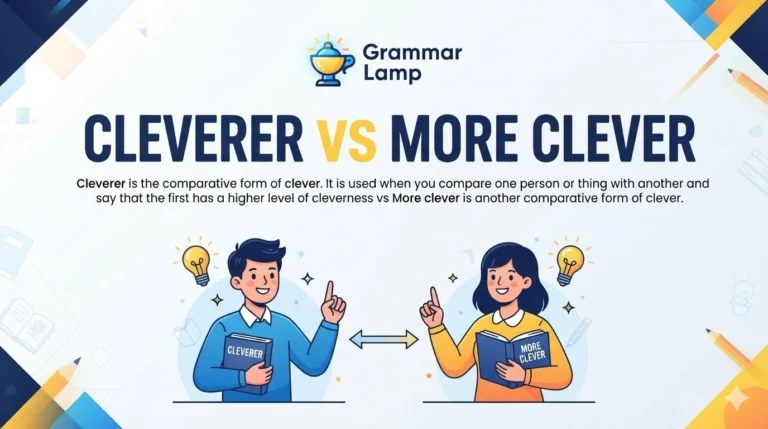
Cleverer is the comparative form of clever. It is used when you compare one person or thing with another and say that the first has a higher level of cleverness.
The basic structure is:
clever + -er = cleverer
For example:
- Ali is cleverer than Hamza.
- This solution is cleverer than the first one.
Here, cleverer means “more clever” or “more intelligent, skillful, or inventive.”
The word clever itself can have several related meanings. It can describe someone who learns quickly, thinks well, solves problems, or finds a smart way to do something. It can also describe an idea, method, design, or trick that shows skill and good thinking.
When should you use “cleverer”?
Use cleverer when you want to make a direct comparison and the -er form sounds natural to you or fits the variety of English you are using.
Common patterns include:
Subject + be + cleverer + than + comparison
Examples:
- Sarah is cleverer than her brother.
- This child is cleverer than he looks.
- Your new idea is cleverer than mine.
- Tom found a cleverer way to solve the problem.
- The second plan is cleverer than the first.
- Maria was cleverer than everyone expected.
- That was a cleverer answer than I thought you would give.
- He is getting cleverer with every project he completes.
The word can also appear before a noun:
- We need a cleverer solution.
- They came up with a cleverer plan.
Grammar rule for “cleverer”
The important point is that cleverer is a comparative adjective. It normally compares two people or things, either directly or by context.
You often see than after it:
- Jack is cleverer than Mike.
- This method is cleverer than the old one.
However, than is not always necessary if the comparison is already clear:
- We need a cleverer approach.
- She came up with a cleverer answer.
A common learner confusion
Some learners think that because clever has two syllables, cleverer must be wrong. That is not true.
The rule “two syllables always need more” is too simple. English has many two-syllable adjectives that can use -er, especially adjectives such as clever, simple, narrow, quiet, and friendly in common usage.
So cleverer is a valid comparative form.
Another confusion is spelling. The correct word is:
cleverer
Not:
- cleverer ❌ with an unnecessary extra change
- cleverest is not the comparative ❌
- more cleverer ❌
The last one is especially important. Standard English does not normally use more + cleverer together because both forms already express comparison.
What Does “More Clever” Mean?
More clever is another comparative form of clever.
Instead of adding -er to the adjective, English uses more before it:
more + clever = more clever
The meaning is the same basic comparative idea: one person or thing has a greater degree of cleverness than another.
For example:
- Sarah is more clever than her brother.
- This is a more clever solution.
In ordinary English, more clever is fully acceptable. Some speakers naturally prefer it, especially when it makes the sentence sound smoother to them.
When should you use “more clever”?
You can use more clever when making a comparison between two people, things, ideas, or actions.
The common structure is:
Subject + be + more clever + than + comparison
Examples:
- John is more clever than his cousin.
- This plan is more clever than the one we discussed yesterday.
- She is more clever than people realize.
- We need a more clever solution to this problem.
- His second answer was more clever than his first.
- That was a more clever way to handle the situation.
- The new design is more clever than the old one.
- My sister is more clever than I expected.
You can also use it when the adjective has extra words around it:
- This is a much more clever approach.
- She found a far more clever solution.
- That was a slightly more clever response.
These examples show one useful advantage of the more clever pattern: it works naturally with degree words such as much, far, slightly, a little, and considerably.
Grammar rule for “more clever”
The grammar of more clever is straightforward. More acts as the comparative marker, and clever stays in its original form.
Compare:
- clever → cleverer
- clever → more clever
Do not change the adjective after more:
- more clever ✅
- more cleverer ❌
Examples:
- He is more clever than me. ✅
- He is more cleverer than me. ❌
In careful formal writing, you may also choose a more complete pronoun structure:
- He is more clever than I am.
In everyday speech, however, “than me” is very common.
A common learner confusion
Students sometimes believe that more clever sounds wrong because they were taught that short adjectives should use -er.
But English comparison is not based on one rule that works perfectly for every adjective. There are patterns, preferences, and common variations.
With clever, both cleverer and more clever are established forms. The choice can depend on the speaker, the type of English being used, and the style of the sentence.
Difference Between Cleverer and More Clever
The main difference is form, not basic meaning.
Both forms are comparative. Both can describe a person, idea, method, plan, answer, or object as having a higher degree of cleverness than another.
| Point | Cleverer | More clever |
|---|---|---|
| Base adjective | clever | clever |
| Comparative form | cleverer | more clever |
| Basic meaning | higher in cleverness | higher in cleverness |
| Grammar | adjective + -er | more + adjective |
| Used for comparisons | Yes | Yes |
| Usually followed by “than” | Often | Often |
| Standard English | Yes | Yes |
| Meaning generally changes? | No | No |
Usage difference
In many situations, you can replace one with the other without changing the main meaning.
For example:
- Emma is cleverer than Lucy.
- Emma is more clever than Lucy.
Both tell us that Emma is being described as having a greater degree of cleverness than Lucy.
The difference is mainly in how the sentence sounds.
Some speakers find cleverer shorter and more natural. Others prefer more clever, particularly in varieties or writing styles where the periphrastic comparative feels smoother.
Grammar logic
English has two common ways of forming comparatives:
1. Add -er
- fast → faster
- small → smaller
- clever → cleverer
2. Use more
- useful → more useful
- careful → more careful
- clever → more clever
The adjective clever is one of the words where both patterns are possible.
This is why learners should avoid memorizing a rule like “two syllables always use more.” Real English has exceptions and flexible patterns.
Sentence structure difference
The sentence structure is almost the same.
Cleverer:
Subject + be + cleverer + than + noun/pronoun
More clever:
Subject + be + more clever + than + noun/pronoun
Examples:
- David is cleverer than Mark.
- David is more clever than Mark.
Both structures are grammatically sound.
Meaning comparison
There is usually no important difference in meaning.
If you tell someone:
“That was a cleverer idea.”
you are saying the idea was cleverer than another idea.
If you say:
“That was a more clever idea.”
you are communicating the same basic comparison.
In some individual sentences, a speaker may choose more clever for emphasis or because the phrase feels more balanced, but this is a style preference rather than a completely different grammatical meaning.
One important point is that clever itself can mean different things depending on context. It may mean intelligent, skillful, inventive, or good at finding solutions. The comparative forms carry whichever sense of clever the context provides.
Explore More Posts
Farther vs Further: The Easy Difference Explained for 2026
In Development vs Under Development: Meaning, Differences, and Examples (2026)
Non-Restrictive Clauses: Meaning, Rules, Examples & Differences in 2026
Conform With vs Conform To (2026): What’s the Difference? Easy Grammar Guide for English Learners
Grammar Rules You Must Remember
Rule 1: Both “cleverer” and “more clever” can be used as comparatives
You do not have to treat one form as automatically wrong.
Examples:
- My brother is cleverer than me.
- My brother is more clever than me.
The central meaning is the same.
Rule 2: Do not use “more” with “cleverer”
Because cleverer already contains the comparative ending -er, adding more creates a double comparative.
Wrong:
- She is more cleverer than her friend. ❌
Correct:
- She is cleverer than her friend. ✅
- She is more clever than her friend. ✅
Choose one comparative pattern, not both at the same time.
Rule 3: Use “than” when you clearly name the second person or thing
When the comparison is explicit, than normally connects the two sides.
Examples:
- This idea is cleverer than mine.
- This idea is more clever than mine.
- Aisha is cleverer than her sister.
- Aisha is more clever than her sister.
Without than, the comparison may still be understood from context:
- We need a cleverer idea.
- We need a more clever idea.
The second person or thing simply is not stated.
Rule 4: Use “much,” “far,” “slightly,” and similar words with the comparative
You can make the comparison stronger or weaker.
Examples:
- This is much more clever.
- Her answer is far more clever than mine.
- His new plan is slightly more clever.
- That was much cleverer than the first idea.
Both comparative patterns can work with modifiers, although more clever often makes these combinations feel especially natural:
- much more clever
- far more clever
- a little more clever
- considerably more clever
This is one reason you may frequently hear more clever in conversation and writing.
Common Mistakes Students Make
The biggest mistakes usually happen because learners try to follow one comparison rule too strictly.
Mistake 1: Thinking “cleverer” is always wrong
Some students learn that adjectives with two syllables should use more, so they avoid cleverer.
That is too strict.
Cleverer is a standard comparative form.
Wrong idea:
“Clever has two syllables, so cleverer cannot be correct.”
Better understanding:
“Clever is one of the adjectives that can form a comparative with either -er or more.”
Mistake 2: Using “more cleverer”
This is a common double-comparative error.
Incorrect:
My brother is more cleverer than me.
There are two comparative markers here: more and -er.
Correct:
My brother is cleverer than me.
Or:
My brother is more clever than me.
Mistake 3: Forgetting the comparison
Sometimes students say:
She is cleverer her brother.
The sentence needs the connecting word than.
Correct:
She is cleverer than her brother.
Or:
She is more clever than her brother.
Mistake 4: Changing “more clever” into “more cleverly”
Clever and cleverly are not the same part of speech.
- clever = adjective
- cleverly = adverb
Compare:
He is more clever than his brother.
But:
He solved the problem more cleverly than his brother.
The first sentence describes the person. The second describes how he solved the problem.
Mistake 5: Assuming the choice changes the meaning completely
Usually, it does not.
Learners sometimes spend too much time asking which form is “the real one.” Both forms can be correct, so the better question is often which one sounds more natural in the sentence and variety of English you are using.
Easy correction tips
When checking your sentence, ask yourself three questions:
Am I making a comparison?
If yes, a comparative is probably needed.
Did I choose either -er or more?
Do not use both together.
Did I use than when naming the second side?
For example:
This is cleverer than the old design.
That simple check will prevent most mistakes.
Easy Trick to Remember the Difference
Here is a simple trick:
“Clever has two doors.”
One door is:
clever → cleverer
The other door is:
clever → more clever
Both doors lead to the same basic meaning: a higher degree of cleverness.
Think about buying two phones. One phone may have a cleverer design. You could also call it a more clever design.
The important thing is not to open both doors at once.
So remember:
cleverer ✅
more clever ✅
more cleverer ❌
A second memory trick is to think of the word more as a helper.
When more is doing the comparison work, leave clever alone:
more + clever
When -er is doing the work, attach it directly:
clever + er
Never make both do the same job in one normal comparative phrase.
Daily Life Examples
These examples show how the two forms can appear naturally in everyday English.
1. Talking about students
Teacher: Who solved the puzzle first?
Student: Ahmed did.
Teacher: Yes, he found a cleverer way to solve it.
2. Comparing ideas
Ali: I think we should take the short road.
Sara: Your idea is more clever than mine. It will save us time.
3. Talking about technology
Friend 1: The new app can organize everything automatically.
Friend 2: It has a cleverer system than the old app.
4. Discussing a plan
Tom: Why don’t we meet online instead?
John: That’s a more clever plan. We won’t need to travel.
5. Talking about children
Mother: Your little sister solved that puzzle herself.
Father: She’s getting cleverer every day.
6. Comparing answers
Teacher: Both answers are good, but Mary’s answer is more clever.
This can sound especially natural when the teacher wants to stress the quality of the answer rather than simply use the shorter comparative.
7. At work
Manager: We need a faster way to collect the information.
Employee: I have a cleverer solution. We can use one online form.
8. Talking about money
Brother: Why did you buy the cheaper ticket?
Sister: It was a more clever choice. The travel time is almost the same.
9. Comparing designs
Designer 1: Which layout do you prefer?
Designer 2: The second one. It is cleverer and easier to use.
10. Everyday problem-solving
Friend 1: I tried opening the box with a knife.
Friend 2: You need a more clever way. Just pull this small tab.
Notice that both forms work naturally. The choice does not normally change the central message.
Practice Section
Choose the better option in each sentence.
1. My sister is ___ than me at solving puzzles.
A. cleverer
B. more cleverer
2. We need a ___ way to fix this problem.
A. more clever
B. more cleverer
3. This design is ___ than the old one.
A. cleverer
B. more cleverer
4. His second idea was ___ than his first one.
A. more clever
B. more cleverer
5. She found a ___ solution to the problem.
A. cleverer
B. more cleverer
Answers
1. A — cleverer
“Cleverer” is a correct comparative form.
2. A — more clever
Use more clever, not more cleverer.
3. A — cleverer
The sentence needs a comparative, and cleverer works correctly.
4. A — more clever
The correct combination is more + clever.
5. A — cleverer
“Cleverer solution” is a standard and natural phrase.
Remember that in several of these sentences, more clever could also be grammatically possible. The key exercise is learning to avoid the incorrect double comparative more cleverer.
More Helpful posts
Who’s vs Whose (2026): What’s the Difference? Easy Grammar Rules, Examples, and Common Mistakes
Compare to vs Compare with: Easy Grammar Guide for 2026
Apportion vs Portion vs Proportion: Meaning, Differences, and Easy Examples (2026)
Case in Point vs Case and Point: Which Is Correct? (2026)
FAQs
What is the difference between cleverer and more clever?
Cleverer and more clever are both comparative forms of clever. They usually have the same basic meaning.
They are used to compare two people, things, ideas, or actions and show that one has a greater degree of cleverness. The main difference is the grammar form: one uses -er, while the other uses more.
Is “cleverer” grammatically correct?
Yes. Cleverer is a grammatically correct comparative form of clever.
For example:
She is cleverer than her brother.
You may also say:
She is more clever than her brother.
Both forms are used in standard English.
Is “more clever” correct English?
Yes. More clever is also correct.
It follows the pattern more + adjective, and many speakers use it naturally. It can be especially useful when the sentence contains words such as much, far, slightly, or considerably.
For example:
This is much more clever than the first plan.
Which is more common: cleverer or more clever?
Usage varies by speaker, region, and style, so there is no need to treat one form as universally correct and the other as wrong.
Both forms are established. Cleverer is very common in many varieties of English, while more clever is also widely used. Your choice can depend on what sounds natural in your variety of English.
Can I say “more cleverer”?
No. In normal standard English, more cleverer is considered a double comparative.
Use one form:
He is cleverer than me. ✅
Or:
He is more clever than me. ✅
Avoid:
He is more cleverer than me. ❌
Can “cleverer” and “more clever” be used in questions?
Yes. Both forms can appear in questions.
Examples:
Who is cleverer, John or Peter?
Which solution is more clever?
The question form does not change the basic comparative rule. Choose cleverer or more clever, but do not combine them as more cleverer.
Conclusion
Cleverer and more clever are both valid comparative forms of clever. They can both be used when you compare one person, thing, idea, or method with another.
The main difference is how they are formed. Cleverer uses the ending -er, while more clever uses more before the adjective. In most situations, they communicate the same basic meaning.
The most important rule to remember is simple: use cleverer or more clever, but do not use more cleverer. When you clearly name the second person or thing, than normally connects the comparison.
English often gives speakers more than one natural way to express an idea. That is exactly what happens here.
Rather than worrying about choosing a single “correct” form, focus on building clear sentences and noticing which form is common in the English you read and hear.
With a little practice, cleverer vs more clever will stop being confusing and become an easy everyday grammar choice.

Liam Derren is a language writer at GrammarLamp, creating simple, helpful content about grammar, words, and everyday English. He makes language learning clear, practical, and easy to understand.