
English has many words that look or sound similar but do very different jobs. Apportion, portion, and proportion are a good example. They all relate to the idea of dividing or sharing something, so it is easy for English learners to mix them up.
The confusion usually starts because the words come from the same family. A portion is a part of something.
To apportion something means to divide or distribute it among people or groups. A proportion is a relationship between a part and a whole, or between two quantities.
That small difference matters. You would talk about a portion of food, but you might apportion the food among six guests. You could also say that a large proportion of the food was eaten by the guests. All three sentences are correct, but each word gives a different meaning.
These words also appear in school writing, news reports, business English, government documents, mathematics, and everyday speech. Understanding them can make your English more accurate and natural.
By the end of this guide, you will know what each word means, how to use it in a sentence, which grammar patterns go with it, and how to avoid the common mistakes learners make.
You will also get simple tricks and real-life examples that make the differences much easier to remember.
What Does “Apportion” Mean?
Simple definition
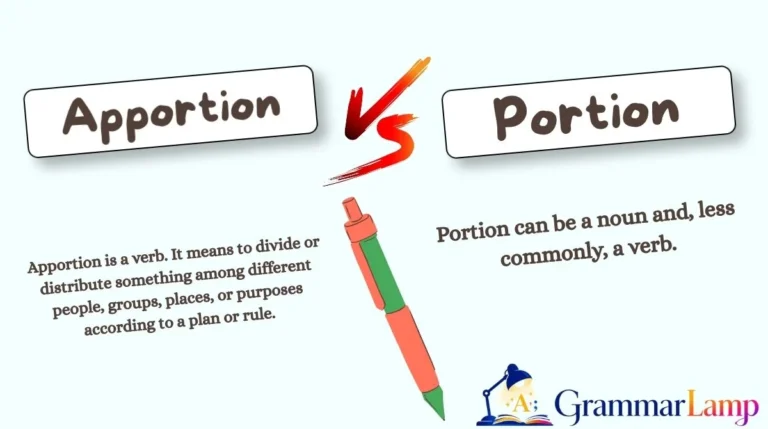
Apportion is a verb. It means to divide or distribute something among different people, groups, places, or purposes according to a plan or rule.
The word often suggests that someone is deciding how much each person or group should receive.
Think of it this way:
Apportion = divide and give each part its share.
For example, imagine that a teacher has 100 marks to divide between five activities. The teacher may apportion the marks among the activities.
When should you use “apportion”?
Use apportion when the focus is on the act of dividing or distributing something.
It is common when talking about:
- money
- responsibilities
- time
- resources
- costs
- land
- seats
- work
- blame or responsibility
The word is usually more formal than divide or share. You are more likely to see it in business, law, government, academic writing, or formal speech.
Grammar rule
Because apportion is a verb, it normally needs an object.
A common structure is:
Subject + apportion + object + among/between + people or groups
Examples:
The manager apportioned the work among the employees.
Another structure is:
Subject + apportion + something + to + someone/something
Examples:
The committee apportioned part of the budget to education.
The past form is apportioned, and the present participle is apportioning.
Example sentences
- The teacher apportioned the classwork among the students.
- The company apportioned the budget between its three departments.
- The government apportioned funds to local schools.
- The judge apportioned the costs between the two parties.
- We need to apportion the available time carefully.
- The team leader apportioned different tasks to each member.
- The land was apportioned among the families.
- Responsibility was apportioned between the two managers.
Common learner confusion
One common mistake is using apportion as if it were a noun.
Incorrect:
We received a small apportion of the food.
Correct:
We received a small portion of the food.
Another common mistake is using apportion when you simply mean “part.”
Remember: apportion describes an action. It is something you do.
You can say:
They apportioned the money.
But you cannot naturally say:
I bought an apportion of cake.
For a part of something, use portion.
What Does “Portion” Mean?
Simple definition
Portion can be a noun and, less commonly, a verb.
As a noun, it means a part or share of something, especially a part that has been divided from a larger amount.
Think:
Portion = one part of a whole.
If a pizza is cut into eight pieces, each piece is a portion of the pizza. If a restaurant gives you one serving of rice, that serving can also be called a portion.
When should you use “portion”?
Use portion when you are talking about one part, share, amount, or serving of something.
It is very common in everyday English.
You can talk about:
- a portion of food
- a portion of land
- a portion of money
- a portion of time
- a portion of the population
- a portion of a book
- a portion of the work
It can be used in both formal and informal English.
Grammar rule
As a noun, portion often follows words such as:
a + portion + of + noun
Examples:
a portion of the cake
a portion of the budget
a portion of the population
It can also be plural:
The restaurant served large portions.
As a verb, portion means to divide something into parts, usually into measured amounts.
For example:
She portioned the soup into six bowls.
Still, the noun form is much more common in normal conversation.
Example sentences
- I only ate a small portion of the cake.
- He gave me a portion of his lunch.
- A large portion of the budget goes to healthcare.
- The restaurant serves generous portions.
- Each child received an equal portion of the prize.
- We saved a portion of the money for later.
- Only a small portion of the land is used for farming.
- She portioned the rice into four containers.
Common learner confusion
Learners sometimes think portion always means food. That is not true.
Food is one common use:
a portion of rice
But portion can describe almost any part of a whole:
a portion of the population
a portion of the building
a portion of the budget
a portion of the day
Another mistake is using portion when the sentence needs a verb showing distribution.
Incorrect:
The manager portioned the tasks among the workers.
This sentence is possible in a very specific sense, but apportioned is normally the better word when the meaning is “distributed or assigned.”
Better:
The manager apportioned the tasks among the workers.
So, portion usually focuses on the part itself, while apportion focuses on the process of assigning shares.
Difference Between Apportion and Portion (Detailed)
The easiest way to separate these two words is to look at what they are doing in the sentence.
| Word | Part of speech | Basic meaning | Main focus | Common structure |
|---|---|---|---|---|
| Apportion | Verb | Divide or distribute something | The act of assigning shares | apportion something among/between groups |
| Portion | Noun | A part or share of something | The part itself | a portion of something |
Usage difference
The biggest difference is simple:
Apportion = the action of dividing.
Portion = the part that results from division.
Compare these:
The manager apportioned the money among the departments.
Here, the manager is doing the dividing.
Now look at:
Each department received a portion of the money.
Here, the focus is on the share each department received.
The two ideas are closely connected, but the grammar and focus are different.
Grammar logic
Apportion is mainly a verb, so it describes an action.
The committee apportioned the seats.
Portion is mainly a noun, so it names a thing or amount.
Each group received a portion of the seats.
This is one reason learners get confused. The words are related in meaning, but they do not normally occupy the same place in a sentence.
Sentence structure difference
With apportion, you often need an object:
They apportioned the money among the workers.
With portion, a very common pattern is:
a portion of + noun
For example:
a portion of the food
a portion of the land
a portion of the income
Meaning comparison
Imagine you have $1,000 to share between four departments.
Apportion describes what you do:
The company apportioned the $1,000 among the departments.
Portion describes what each department receives:
Each department received a portion of the money.
That is the key difference.
What about “Proportion”?
There is one more important word in this family: proportion.
Proportion is a noun. It refers to the relationship between the size or amount of one part and the size or amount of the whole, or between two things.
For example:
A large proportion of the students passed the exam.
This means a large part of the students passed.
You can think of it like this:
portion = a part
proportion = the size or relationship of a part compared with the whole or another part
For example:
A large portion of the cake was eaten.
This simply says a large part of the cake was eaten.
A large proportion of the cake was eaten.
This emphasizes the relationship between the amount eaten and the total cake. It sounds more analytical or measurable.
Proportion is also common in mathematics:
The proportion of red balls to blue balls is 2:3.
So, while portion and proportion are related, they are not interchangeable in every sentence.
Grammar Rules You Must Remember
Rule 1: Use “apportion” for the act of dividing or assigning.
Because apportion is a verb, it describes what someone does.
Correct:
The manager apportioned the work among the team members.
Incorrect:
Each employee got an apportion of the work.
Use portion for the noun.
Rule 2: Use “portion of” when you mean a part of something.
The phrase a portion of is extremely common.
Examples:
a portion of the food
a portion of the money
a portion of the building
a portion of the population
The noun after of is the larger whole.
Rule 3: Use “proportion” when comparing a part with a whole or another quantity.
Examples:
A high proportion of students use smartphones.
The proportion of women to men was nearly equal.
Only a small proportion of the budget was spent.
When the sentence focuses on a percentage, ratio, balance, or relationship, proportion is often the better choice.
Rule 4: “Apportion” usually sounds more formal than “divide” or “share.”
In everyday conversation, people often say:
We divided the money among the children.
In formal writing, you might see:
The money was apportioned among the children.
Both are correct. Apportion simply has a more formal tone.
This is useful for exams, essays, business writing, and official documents.
Common Mistakes Students Make
Mistake 1: Using “portion” as a verb when “apportion” is better
A learner may write:
The teacher portioned the marks among the students.
Although portion can function as a verb, the intended meaning here is usually better expressed by apportioned.
Better:
The teacher apportioned the marks among the students.
Mistake 2: Using “apportion” for a physical piece
Incorrect:
I ate an apportion of pizza.
Correct:
I ate a portion of pizza.
A portion is the part. Apportion is the action of dividing or assigning.
Mistake 3: Confusing “portion” with “proportion”
Compare:
I ate a portion of the cake.
This means I ate a part of the cake.
Now:
A large proportion of the cake was eaten.
This focuses more on how much of the total cake was eaten.
Mistake 4: Thinking “proportion” always means “percentage”
Not exactly.
A proportion can be expressed as a percentage, but it can also show a relationship or ratio.
For example:
The proportion of adults to children was 3 to 1.
That is a relationship, not just a percentage.
Easy correction tip
Ask yourself one question:
Am I talking about an action, a part, or a relationship?
- Action of dividing → apportion
- A part or share → portion
- Relationship or amount compared with the whole → proportion
That one question can solve many problems.
Easy Trick to Remember the Difference
Here is a simple classroom trick:
Apportion = Action
The word apportion starts with A, and you can think of A = Action.
They apportioned the money.
Someone is doing something.
Portion = Part
The word portion contains the idea of a part.
I received a portion of the food.
It is one part of a larger thing.
Proportion = Part + Relationship
Think:
Proportion = how one part relates to the whole or another part.
A large proportion of students passed.
So remember:
Apportion → divide
Portion → part
Proportion → relationship between parts or between a part and the whole
Imagine a birthday cake.
First, you apportion the cake among the guests.
Each guest gets a portion.
Then you can discuss what proportion of the whole cake each guest received.
That is the whole idea in one picture.
Daily Life Examples (Very Important)
These words become much easier when you see them in natural conversations.
1. Sharing a bill
Ali: How should we divide the restaurant bill?
Sara: We can apportion the cost equally among the four of us.
Here, apportion means divide the cost between the people.
2. Talking about food
Ali: Did you finish the whole pizza?
Sara: No, I only ate a small portion.
Here, portion means a part of the pizza.
3. Talking about students
A large proportion of the students arrived early.
The sentence focuses on the amount of students compared with the whole group.
4. Dividing work
The supervisor apportioned the tasks among the workers.
The supervisor assigned different shares of work.
5. Talking about money
We should save a portion of our monthly income.
A portion is simply a part of the income.
6. Talking about a population
Only a small proportion of the population lives in this area.
The focus is on the relationship between that group and the total population.
7. Sharing land
The land was apportioned among the three families.
The land was officially divided among them.
8. Talking about a book
I have read only a portion of the book.
You read part of it, not the whole thing.
9. Talking about a budget
A large proportion of the budget is spent on education.
The sentence discusses the amount in relation to the total budget.
10. Talking about responsibility
The two companies agreed to apportion the responsibility between them.
The responsibility was divided between the companies.
Practice Section
Choose the correct word: apportion, portion, or proportion.
Question 1
The manager decided to ______ the work among the employees.
Question 2
I only ate a small ______ of the dessert.
Question 3
A large ______ of the students passed the test.
Question 4
The committee ______ the money between the two projects.
Question 5
She saved a ______ of her salary for emergencies.
Answers
1. apportion
The manager is doing the action of dividing the work.
2. portion
A portion is a part of something.
3. proportion
The sentence compares the number who passed with the total group.
4. apportioned
The committee divided or assigned the money.
5. portion
A portion means part or share.
A useful next step is to make your own three sentences: one with apportion, one with portion, and one with proportion. Writing your own examples helps the differences stick.
FAQs
What is the difference between apportion and portion?
Apportion is mainly a verb meaning to divide or distribute something among people or groups. Portion is mainly a noun meaning a part or share of something. For example, a manager can apportion money, and each department can receive a portion of it.
What is the difference between portion and proportion?
A portion is a part of something. A proportion describes the relationship of a part to the whole or to another quantity. For example, “a portion of the cake” means a part of the cake, while “a large proportion of the cake” emphasizes how much of the total cake that part represents.
Can we use apportion in questions?
Yes. Apportion can be used in questions just like other verbs.
Examples:
How should we apportion the money?
Who will apportion the work?
Did they apportion the costs equally?
These are grammatically correct and often sound formal.
Is apportion formal or informal?
Apportion is generally more formal than divide, split, or share. It is common in legal, business, government, academic, and official writing. In casual conversation, people usually choose simpler words such as “divide” or “share.”
Can portion be used as a verb?
Yes. Portion can be a verb meaning to divide something into measured or suitable amounts.
For example:
The chef portioned the food into six containers.
However, when you mean distributing something among people or groups, apportion is often a more natural choice.
What is the easiest way to remember apportion, portion, and proportion?
Use this three-word memory trick:
Apportion = divide
Portion = part
Proportion = relationship
When you remember those three ideas, most sentence choices become much easier.
Conclusion
Apportion, portion, and proportion are closely related words, but they are not the same.
Use apportion when you mean to divide, distribute, or assign something among people, groups, or purposes. It is a verb and is usually more formal than “divide.”
Use portion when you mean a part or share of something. It is especially common in everyday English, including food, money, work, land, time, and many other areas.
Use proportion when you are talking about the relationship between a part and the whole or between two quantities. It is common in formal English, statistics, mathematics, business, and everyday descriptions of amounts.
The easiest way to keep them apart is:
Apportion = action
Portion = part
Proportion = relationship
Do not worry if these words feel confusing at first. They become much easier when you see them in real sentences. Start with simple examples, then create a few sentences of your own. With a little practice, choosing the right word will become natural.

Liam Derren is a language writer at GrammarLamp, creating simple, helpful content about grammar, words, and everyday English. He makes language learning clear, practical, and easy to understand.
1 thought on “Apportion vs Portion vs Proportion: Meaning, Differences, and Easy Examples (2026)”