English learners often stop when they see “compared to” and “as compared to.” Both expressions look almost the same, so it is natural to wonder whether one is correct and the other is wrong.
The extra word “as” can make the difference look more important than it really is.
The good news is that the basic meaning is very similar. Both expressions are used when you put one person, thing, place, idea, or situation next to another to show a relationship, difference, or similarity.
Cambridge Dictionary gives examples such as “compared to/with ours,” showing that compared to is normal standard usage.
Oxford also lists examples such as “standards … improved enormously compared to 40 years ago.”
The real difference is mostly about style, sentence flow, and context. Compared to is shorter and very common in everyday speech and writing.
As compared to can sound a little more formal or deliberate, and it appears in academic, business, statistical, and technical writing too.
Cambridge’s corpus includes examples using “as compared to” in formal discussion and research contexts.
Once you understand this small difference, choosing between the two becomes much easier.
More Useful posts
Apportion vs Portion vs Proportion: Meaning, Differences, and Easy Examples (2026)
Case in Point vs Case and Point: Which Is Correct? (2026)
Work Alongside You vs Work Alongside With You (2026): Which One Is Correct in English?
Lets vs Let’s (2026): What’s the Difference? Easy Grammar Guide with Examples
What Does “Compared To” Mean?
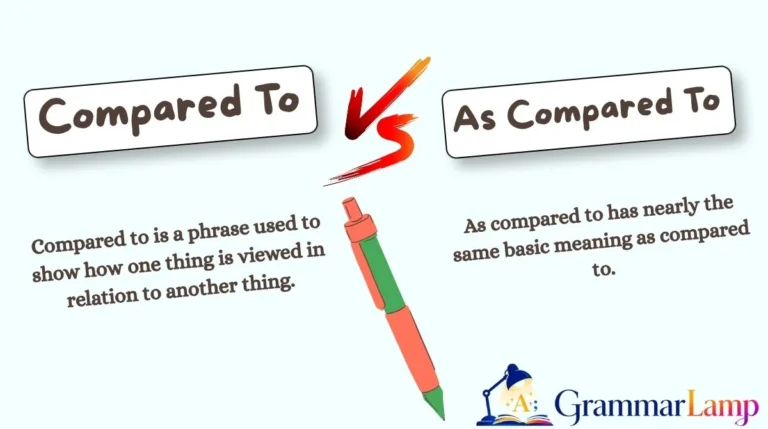
Compared to is a phrase used to show how one thing is viewed in relation to another thing.
In simple words, it means “when you look at this thing next to another thing” or “in relation to another thing.”
For example:
This bag is cheap compared to that one.
Here, the price of one bag is being considered in relation to the price of the other bag.
The word compared is the past participle of the verb compare. Dictionaries define compare as looking at two or more things to see similarities and differences.
When Do We Use “Compared To”?
We commonly use compared to when talking about:
- prices
- sizes
- ages
- numbers
- performance
- people
- places
- past and present situations
- different products
- personal experiences
It can be used in casual English as well as formal writing.
For example:
My new phone is much faster compared to my old one.
This road is quiet compared to the main road.
Ali is very tall compared to his brother.
The phrase simply tells the reader what the first thing is being measured or considered against.
Grammar Rule for “Compared To”
A common structure is:
Subject + verb + information + compared to + noun/pronoun
Examples:
The room is small compared to the kitchen.
This car uses less fuel compared to my old car.
The new version is easier to use compared to the previous version.
You can also place the phrase at the beginning of a sentence:
Compared to last year, sales are much higher.
Compared to my old school, this one is very large.
In this position, compared to works like an introductory participial phrase.
8 Example Sentences with “Compared To”
- This laptop is light compared to my old one.
- The city is very busy compared to the village.
- This winter feels colder compared to last winter.
- My new shoes are more comfortable compared to my old pair.
- The blue bag is cheap compared to the black one.
- Sarah speaks confidently compared to some of her classmates.
- Compared to yesterday, I feel much better today.
- This apartment is small compared to our previous home.
Common Learner Confusion
Many students think compared to is only used with things that are exactly alike. That is not true.
You can compare a city with a village, a student with another student, a phone with an older phone, or even a present situation with a past situation.
For example:
Compared to ten years ago, people use the internet much more.
The two situations are not identical, but they can still be compared.
Another common confusion is thinking that compared to always means “better.” It does not. It can show that something is better, worse, bigger, smaller, faster, slower, cheaper, more expensive, or simply different.
What Does “As Compared To” Mean?
As compared to has nearly the same basic meaning as compared to.
It introduces the thing that is used as the point of comparison.
For example:
The new system is easier as compared to the old system.
This means the new system is being considered in relation to the old system.
The important point is that “as” does not create a completely different type of comparison. In many sentences, it can be removed without changing the basic idea:
The new system is easier compared to the old system.
The new system is easier as compared to the old system.
Both can be understood, although many writers would prefer a different structure here, such as:
The new system is easier than the old system.
That last version is shorter and more direct.
When Do We Use “As Compared To”?
As compared to is often seen in writing that sounds more formal, such as reports, research writing, business documents, statistics, or technical discussions.
For example:
The company saw a rise in sales as compared to the previous year.
The machine uses less energy as compared to the older model.
The number of visitors was higher as compared to the same month last year.
This does not mean that as compared to is reserved only for formal English. It can appear in ordinary writing too. Cambridge’s English corpus includes real examples of “as compared to” in technical and analytical contexts.
Grammar Rule for “As Compared To”
The basic structure is:
Subject + verb + information + as compared to + noun/pronoun
Examples:
The new model is small as compared to the older model.
The cost is lower as compared to last month.
The process is simple as compared to the previous system.
You can also put it at the beginning:
As compared to last year, the business is doing better.
However, in many everyday sentences, removing as makes the sentence more direct:
Compared to last year, the business is doing better.
8 Example Sentences with “As Compared To”
- The new building is small as compared to the old one.
- This phone is expensive as compared to similar models.
- The road is safer as compared to the highway.
- Our current results are better as compared to last month.
- The village is peaceful as compared to the city.
- This method is easier as compared to the earlier method.
- The company has fewer employees as compared to five years ago.
- As compared to yesterday, the weather is much warmer today.
Common Learner Confusion
The biggest misunderstanding is thinking that as compared to has a special meaning that compared to does not have.
Usually, it does not.
The word as often adds style rather than a major change in meaning. That is why you may see both forms in English writing.
Another problem happens when learners use as compared to simply because it looks more advanced.
For example:
My new phone is very good as compared to my old phone.
This is understandable, but in ordinary English, compared to is often cleaner:
My new phone is very good compared to my old phone.
Or, depending on the intended meaning:
My new phone is better than my old phone.
The goal is not to use more words. The goal is to make the comparison clear.
Difference Between “Compared To” and “As Compared To”
The most important point is this:
There is usually no major difference in basic meaning between “compared to” and “as compared to.”
Both introduce a comparison.
Cambridge lists compared to/with as standard usage, while its corpus also contains examples of as compared to. Oxford likewise gives “compared to” examples in both everyday and formal contexts.
The choice often depends on style and sentence structure.
Comparison Table
| Point | Compared to | As compared to |
|---|---|---|
| Basic meaning | Shows a comparison | Shows a comparison |
| Common in speech | Very common | Less common |
| Length | Shorter | Longer |
| Style | Natural and direct | Often more formal or deliberate |
| Everyday writing | Very common | Possible, but often unnecessary |
| Academic/business writing | Common | Also common |
| Can introduce a comparison | Yes | Yes |
| Can appear at the start of a sentence | Yes | Yes |
| Main difference | Concise wording | Adds “as” without usually changing the core meaning |
1. Usage Difference
The easiest way to understand the difference is to think about length and tone.
Compared to is more economical:
Compared to last year, sales increased.
As compared to is longer:
As compared to last year, sales increased.
The basic message is almost identical.
For everyday English, many speakers naturally choose compared to because it is quick and direct.
2. Grammar Logic
The verb compare can be followed by to or with in standard English. Oxford gives patterns such as compare A with/to B and examples of compared with and compared to.
When compared is used in a phrase such as:
Compared to my old car…
it means the first thing is being viewed in relation to the second.
Adding as gives:
As compared to my old car…
The comparison itself remains the central idea.
So, for learners, there is no need to memorize a complicated rule saying that one form means “similarity” and the other means “difference.” In modern English, the real usage is more flexible than that. Cambridge, for example, gives compared to/with in the same usage pattern.
3. Sentence Structure Difference
Both can fit similar sentence patterns.
Compared to + noun
Compared to my brother, I am short.
As compared to + noun
As compared to my brother, I am short.
Both are understandable.
But English often has an even more natural option when you are making a direct comparison:
I am shorter than my brother.
This is an important lesson. Sometimes the question is not really “compared to or as compared to?” Sometimes the best answer is “than.”
4. Meaning Comparison
Look at these examples:
This car is cheap compared to that one.
This car is cheap as compared to that one.
The meaning is basically the same.
The difference is mainly one of expression. The first sentence feels more compact. The second can feel more formal or slightly more wordy.
That is why good writing depends on the whole sentence, not just on choosing the longer expression.
Explore More Posts
Based Out of vs Based In (2026): What’s the Difference? Easy Grammar Guide with Examples
Crews vs Cruise (2026): What’s the Difference? Easy Grammar Guide with Examples
Everything vs Every Thing: Easy Difference, Rules, Examples & Practice (2026)
All Is vs All Are: Which One Is Correct? Complete Grammar Guide for 2026
Grammar Rules You Must Remember
Rule 1: “Compared to” and “as compared to” usually have the same core meaning.
Both are used to put one thing in relation to another.
Example:
This phone is small compared to my old phone.
This phone is small as compared to my old phone.
The basic comparison has not changed.
Rule 2: “Compared to” is usually the simpler choice.
When you are speaking or writing ordinary English, compared to is often enough.
Example:
Compared to last week, I am much busier.
There is usually no need to add extra words unless the sentence or context calls for them.
Rule 3: Use “than” when making a direct comparative comparison.
Words such as bigger, smaller, faster, better, worse, cheaper, more expensive, easier, and harder naturally work with than.
For example:
This car is faster than that car.
My new laptop is better than my old one.
You may see sentences like:
This car is faster compared to that car.
Such wording occurs in real English, but when your purpose is a clear direct comparison, than is often the cleaner choice.
Rule 4: Do not think “as” automatically means more correct.
Some learners believe a longer phrase must be more formal and therefore better.
That is not always true.
Compared to last year, the business is growing.
is perfectly clear.
Adding as may be acceptable:
As compared to last year, the business is growing.
But it does not automatically make the sentence better.
Good English is about clarity, natural wording, and correct structure, not simply adding extra words.
Common Mistakes Students Make
Mistake 1: Thinking one is correct and the other is always wrong
This is probably the most common mistake.
Students may learn that:
Compared to = correct
and
As compared to = incorrect
That is too simple.
As compared to appears in real standard English, including corpus examples from formal contexts.
A better lesson is that compared to is usually the shorter, more natural option, while as compared to is also used, especially in formal or analytical writing.
Mistake 2: Using “as compared to” everywhere
Some learners think it sounds smarter.
Wrong idea:
My house is big as compared to yours.
Better everyday wording:
My house is big compared to yours.
Or, for a direct comparative:
My house is bigger than yours.
Mistake 3: Using “compared to” when “than” is much clearer
Consider:
Sarah is taller compared to Anna.
This can be understood, and similar constructions are common in actual usage. But:
Sarah is taller than Anna.
is more direct.
The same applies to:
This test is easier than the last one.
There is no need to make the sentence longer just because you are discussing a comparison.
Mistake 4: Believing “compared to” only shows similarities
That is not correct.
You can use it to talk about a difference:
This bag is cheaper compared to the other one.
You can also use it for similarities:
Her voice was often compared to a famous singer’s voice.
Cambridge and Oxford both show that compare to can be used when something is considered similar to another thing.
Mistake 5: Comparing things without making the comparison clear
Sometimes learners write a sentence that leaves the reader wondering what is being compared.
For example:
Compared to before, the office is better.
“Before” is vague.
Better:
Compared to last year, the office is much better.
Now the reader knows the exact point of comparison.
Easy Correction Tips
When you write a comparison, ask yourself three questions:
What am I comparing?
What am I comparing it with?
Would “than” make the sentence clearer?
This small check can fix many comparison mistakes.
Easy Trick to Remember the Difference
Here is a simple trick:
Think: “Compared to” = shorter and everyday
When you are speaking with a friend, writing a normal email, or making an ordinary statement, compared to will usually feel natural.
Think:
Compare → keep it short → compared to.
For example:
This room is bright compared to the other room.
Think: “As compared to” = longer comparison phrase
When you see as compared to, do not panic or think that it has a completely new meaning.
Just remember:
as + compared to = a longer version of the comparison phrase
For example:
The result is better as compared to last year.
The central idea is still the same: one result is being considered against another.
One More Helpful Trick
When you are unsure, remove as.
Read both versions:
Compared to last month, prices are higher.
As compared to last month, prices are higher.
If both make sense, choose the version that sounds more natural for your audience.
For everyday English, compared to will often be the easier choice.
Daily Life Examples (Very Important)
These examples show how the phrases can appear in real conversations.
Example 1: Talking About a Phone
Ali: How do you like your new phone?
Hamza: I love it. It is much faster compared to my old one.
Here, Hamza is comparing the new phone with the old phone.
Example 2: Talking About Weather
Sara: Is it colder today?
Mina: Yes. Compared to yesterday, it is much colder.
Compared to yesterday tells us the point of comparison.
Example 3: Talking About Prices
Customer: Why is this laptop more expensive?
Shopkeeper: It has a better processor compared to the cheaper model.
The customer and shopkeeper are comparing two products.
Example 4: Talking About Cities
A: Do you like living here?
B: Yes. It is quieter compared to the capital.
The speaker is comparing the current place with the capital city.
Example 5: Talking About Work
Manager: How is this month’s performance?
Employee: It is much better compared to last month.
This is common business English.
Example 6: Talking About School
Student: Is this class difficult?
Teacher: Not really. It is easy compared to the advanced class.
The teacher is comparing two levels.
Example 7: Talking About Travel
A: Was the train expensive?
B: No, it was cheap compared to the plane.
A simple everyday comparison.
Example 8: Formal Report Style
Manager: How did the new system perform?
Employee: The new system was more efficient as compared to the previous system.
The longer form can appear in business or technical writing.
Example 9: Talking About Health and Exercise
A: How do you feel after walking every day?
B: I feel more energetic compared to before.
The speaker is comparing the current condition with an earlier condition.
Example 10: Talking About a New House
A: Do you like your new house?
B: Yes. It is much bigger compared to our old house.
A natural conversational comparison.
Practice Section
Choose the better option in each sentence.
1. ______ last year, the company has grown quickly.
A. Compared to
B. Compare to
2. This phone is cheaper ______ the other model.
A. as compared to
B. than
3. The new road is much safer ______ the old road.
A. compared to
B. compare to
4. ______ my previous job, this job is less stressful.
A. As compared to
B. Compare with
5. My new laptop is faster ______ my old laptop.
A. than
B. as compared
Answers
1. A — Compared to
2. B — than
3. A — compared to
4. A — As compared to
5. A — than
Notice that the practice does not say “as compared to is always wrong.” The goal is to choose the structure that fits the sentence naturally.
More Helpful posts
At the Weekend or On the Weekend? 2026 Guide to British and American English
To Discuss or Discuss About: Which Is Correct? | Easy Grammar Guide 2026
Upmost vs Utmost: Meaning, Difference, and Correct Usage in 2026
Seam vs Seem: Difference, Meaning, Examples & Grammar Rules (2026)
FAQs
What is the difference between “compared to” and “as compared to”?
Both phrases are used to show a comparison between two things. In most situations, their basic meaning is the same. Compared to is shorter and often more natural, while as compared to can sound more formal or deliberate.
Is “as compared to” grammatically correct?
Yes, as compared to is used in standard English. Cambridge corpus examples include sentences using the expression in formal and analytical contexts. However, adding as is not always necessary.
Is “compared to” better than “as compared to”?
There is no universal rule that makes one form correct and the other incorrect. In everyday English, compared to is often the cleaner choice because it is shorter. The context and sentence structure matter more than simply choosing the longer form.
Can I use “compared to” in formal writing?
Yes. Compared to is widely used in formal, academic, business, and technical writing. Oxford gives formal examples such as changes in standards being discussed “compared to 40 years ago.”
Can “compared to” be used in a question?
Yes. You can use it in questions when asking someone to compare things.
For example:
How is this model compared to the older one?
However, a more natural question in many situations is:
How does this model compare to the older one?
Cambridge and Oxford both document compare with/to in question structures such as asking how something compares with another thing.
Should I use “than” instead of “compared to”?
Sometimes, yes. When you have a direct comparative adjective such as bigger, better, faster, smaller, or easier, than often gives the clearest sentence.
For example:
This car is faster than that car.
That is usually more direct than:
This car is faster compared to that car.
Conclusion
The difference between compared to and as compared to is much smaller than many English learners expect.
Both expressions can introduce a comparison, and both can be used correctly. The main difference is usually in style and sentence flow rather than basic meaning.
Compared to is shorter, common, and very natural in everyday English. It is also completely suitable for formal writing.
As compared to is also used in English, especially in business, research, statistics, and technical writing, but the extra word as does not usually create a new meaning.
One of the best things to remember is that sometimes neither phrase is the clearest choice. When you are making a direct comparison with words like better, bigger, faster, or easier, than may be the most natural structure.
The best way to learn this is to notice comparisons in real English and then practice writing your own sentences.
Once you see the pattern a few times, choosing between these forms becomes easy.

Liam Derren is a language writer at GrammarLamp, creating simple, helpful content about grammar, words, and everyday English. He makes language learning clear, practical, and easy to understand.
2 thoughts on “Compared To vs As Compared To (2026): Meaning, Difference & Correct Usage”