
Which and witch are two English words that often confuse learners because they sound exactly the same in standard English.
When you hear them in a conversation, you cannot tell which spelling the speaker means. You have to understand the sentence to know whether the person means which or witch.
This is a common example of homophones. Homophones are words that have the same pronunciation but different spellings and meanings.
English has many of them, such as right and write, see and sea, and there and their. Which vs witch is another pair that students should learn clearly.
The good news is that the two words have completely different jobs. Which is usually used when we ask about a choice or give more information about something.
It can also be used as a relative pronoun. Witch, on the other hand, is a noun. It traditionally means a woman believed to have magical powers.
Knowing the difference is useful in school, work, writing, texting, and everyday conversation.
By the end of this guide, you will know when to use each word, how their sentence structures differ, what common mistakes to avoid, and an easy trick that will help you remember the correct spelling.
More Useful posts
Sneek vs Sneak: Which Spelling Is Correct in 2026?
In vs Into vs On vs Onto: Easy Grammar Rules and Examples in 2026
Couple of Hours vs Couple Hours: Which Is Correct in 2026?
Canceled vs Cancelled: Which Spelling Is Correct in 2026?
What Does “Which” Mean?
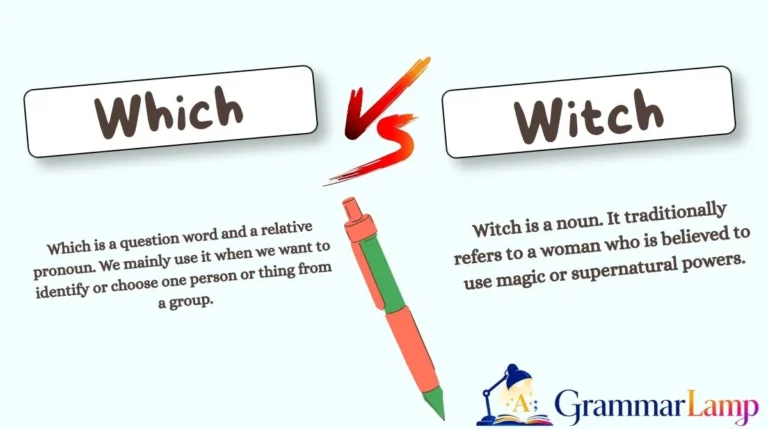
Which is a question word and a relative pronoun. We mainly use it when we want to identify or choose one person or thing from a group.
For example:
Which shirt do you like?
Here, the speaker is asking the listener to choose from shirts. The word which introduces a choice.
When Do We Use “Which”?
There are two main uses of which.
1. Which in questions
We use which when asking someone to choose or identify something.
For example:
Which color do you prefer?
The speaker wants the listener to choose a color.
Which bus goes to the city center?
The speaker wants to know which particular bus has that route.
We often use which when the number of choices is limited or known.
Compare:
Which dress should I wear, the blue one or the black one?
The choices are clearly given.
2. Which to add information
Which can also connect one part of a sentence to another. In this use, it acts as a relative pronoun.
For example:
I bought a new phone, which has a very good camera.
The phrase which has a very good camera gives extra information about the phone.
Another example:
She missed the bus, which made her late for work.
Here, which connects the extra information to the situation mentioned before it.
Grammar Rule for “Which”
When which is used as a question word, it normally comes before a noun or is used by itself.
Examples:
- Which book do you want?
- Which one is yours?
- Which road should we take?
- Which student answered correctly?
The basic structure is often:
Which + noun + verb + …?
For example:
Which movie do you want to watch?
We can also use which without a noun:
Which do you prefer?
The listener already understands what the choices are.
8 Examples of “Which”
- Which restaurant should we try tonight?
- Which shirt looks better on me?
- Which train goes to Lahore?
- Which book are you reading?
- Which one is your brother?
- Which subject do you like the most?
- I bought a laptop, which was quite expensive.
- She chose the red bag, which matched her shoes.
A Common Confusion About “Which”
Students sometimes think which is only used for questions. That is not true.
It can certainly be used in questions:
Which car is yours?
But it can also introduce extra information:
My car, which is very old, still works well.
So remember that which can have more than one grammatical role.
What Does “Witch” Mean?
Witch is a noun. It traditionally refers to a woman who is believed to use magic or supernatural powers.
The word is often found in stories, fairy tales, movies, books, and Halloween-related conversations.
For example:
The witch lived in a dark forest.
This sentence describes a fictional or traditional character who is believed to have magical powers.
The important point is simple: witch is a person or character, not a question word.
When Do We Use “Witch”?
We use witch when talking about a witch as a person or character.
For example:
The witch cast a spell on the prince.
In stories, a witch may be shown as good, bad, helpful, frightening, funny, or mysterious. The exact meaning depends on the story.
The word can also appear in historical discussions about people who were accused of witchcraft. However, modern English learners will most commonly see witch in stories, fiction, history, movies, and cultural discussions.
Grammar Rule for “Witch”
Witch is a countable noun.
That means we can use a, the, or a plural form with it.
Singular:
a witch
the witch
Plural:
witches
For example:
A witch appeared in the story.
The witch disappeared into the forest.
The children were reading stories about witches.
Notice the spelling of the plural:
witch → witches
The final -es is added because of the spelling and pronunciation pattern.
8 Examples of “Witch”
- The witch lived in an old castle.
- The story is about a young witch.
- The witch used magic to help the village.
- A witch appeared in the movie.
- The children dressed like witches for Halloween.
- The old story describes a powerful witch.
- The witch flew across the sky on her broomstick.
- The book has a funny witch as its main character.
A Common Confusion About “Witch”
The biggest problem is that witch and which sound the same.
Someone may say:
Which book do you want?
and
The witch lives in the forest.
When you only hear these sentences, pronunciation does not tell you which spelling is being used.
You must use the meaning and context.
If the sentence is asking about a choice, you probably need which.
If the sentence is talking about a magical woman or character, you need witch.
Difference Between Which and Witch
The main difference is their meaning and grammatical function.
Which is generally used for questions, choices, or extra information about something.
Witch is a noun referring to a woman or character associated with magic or witchcraft.
Comparison Table
| Word | Meaning | Part of Speech | Main Use | Example |
|---|---|---|---|---|
| which | asks about a choice or identifies something | pronoun/determiner | questions and relative clauses | Which bag is yours? |
| witch | a woman believed to have magical powers | noun | people or characters | The witch lives in the forest. |
Usage Difference
Look at these two sentences:
Which book do you want?
The witch is in the book.
The first sentence asks the listener to make a choice. Therefore, which is correct.
The second sentence talks about a magical character. Therefore, witch is correct.
Grammar Logic
Which works as part of the grammar of a sentence. It can help form a question or connect additional information.
For example:
Which car is yours?
Here, which helps identify a particular car.
It can also connect information:
I bought a car, which is very comfortable.
Witch does not work this way. It names a person or character.
For example:
The witch is angry.
Here, witch is the subject of the sentence.
You can put an article before it:
a witch
the witch
You cannot normally do the same thing with which when it is functioning as a question word.
Sentence Structure Difference
A common structure with which is:
Which + noun + verb…?
Examples:
Which movie do you want?
Which answer is correct?
Which road should we take?
With witch, a common structure is:
Article + witch + verb
Examples:
A witch appeared.
The witch disappeared.
Or:
Subject + verb + witch
The story describes a witch.
Meaning Comparison
Think about the words this way:
Which = choice or information
Witch = magical person/character
That simple difference solves most confusion.
Explore More Posts
Ambiance vs Ambience: Meaning, Difference, Usage & Examples in 2026
Compared To vs As Compared To (2026): Meaning, Difference & Correct Usage
Gone to Soon vs Gone Too Soon: Which Is Correct? (2026 Guide)
Stayed vs Staid: Meaning, Difference, Examples & Easy Rules in 2026
Grammar Rules You Must Remember
Rule 1: Use “which” for choices
When you are asking someone to choose or identify something, use which.
Which phone should I buy?
Which dress do you prefer?
Which answer is correct?
A useful question to ask yourself is:
“Am I asking about a choice?”
If yes, which is probably the word you need.
Rule 2: Use “witch” for a magical person or character
When the sentence talks about a woman or character associated with magic, use witch.
The witch lives in the forest.
A witch appeared in the story.
The children dressed as witches.
Here, witch is a noun.
Rule 3: “Which” can be used before a noun
Which often comes directly before a noun.
Which car is yours?
Which movie are you watching?
Which student won the competition?
The structure is:
Which + noun
Rule 4: “Witch” can have articles and a plural form
Because witch is a countable noun, you can say:
a witch
the witch
two witches
many witches
For example:
Two witches appeared in the story.
This is very different from which.
Common Mistakes Students Make
The most common mistake is choosing the spelling based only on pronunciation.
Since which and witch sound the same for most speakers, learners sometimes write the wrong word without noticing.
Mistake 1: Using “witch” in a question
❌ Witch color do you like?
✅ Which color do you like?
Why?
Because the speaker is asking about a choice. There is no magical character involved.
Mistake 2: Using “which” for a magical character
❌ The which lives in the castle.
✅ The witch lives in the castle.
Why?
Because the sentence is talking about a magical character.
Mistake 3: Mixing the words in writing
A student might write:
I don’t know witch bus to take.
The correct sentence is:
I don’t know which bus to take.
The sentence is about choosing a bus, so which is required.
Mistake 4: Thinking the pronunciation will help
This is not a reliable way to choose the spelling.
When speaking, both words generally sound the same. When writing, however, the spelling changes the meaning completely.
That is why context is your best tool.
Easy Correction Tip
Before writing the word, ask:
Am I talking about a choice?
If yes → which
Am I talking about a magical woman or character?
If yes → witch
This quick check can prevent most mistakes.
Easy Trick to Remember the Difference
Here is a simple memory trick.
Which = Choice
Notice that which is commonly connected with a choice.
For example:
Which one do you want?
Which color should I choose?
So you can remember:
Which = Which choice?
Witch = Magic
Think of a witch from a fairy tale.
You may picture:
- a magic wand
- a broomstick
- a spell
- a pointy hat
- a mysterious forest
That mental picture can help you remember witch.
A Simple Classroom Trick
Imagine your teacher puts two books on the desk and asks:
Which book do you want?
You are choosing.
Now imagine a story character who can cast spells:
The witch has a magic wand.
You are talking about a magical character.
So:
Which = choose
Witch = magic
If you remember those two ideas, the spelling becomes much easier.
Daily Life Examples
Although witch is more common in stories than in everyday conversation, which appears constantly in spoken English.
Example 1: Choosing food
Ali: Which pizza should we order?
Hamza: I think we should get the chicken one.
Here, which asks about a choice.
Example 2: Choosing a bus
Sara: Which bus goes to the market?
Driver: Bus number 12.
Again, which is used because Sara wants to identify the correct bus.
Example 3: Choosing clothes
Mother: Which shirt are you going to wear?
Son: The blue one.
The question asks the person to choose one shirt.
Example 4: Choosing a movie
Friend 1: Which movie should we watch tonight?
Friend 2: Let’s watch the comedy.
Which introduces the choice.
Example 5: Asking about a person
Teacher: Which student submitted this homework?
Student: Ahmed did.
The speaker wants to identify one student from a group.
Example 6: Talking about a story
Child: Is the witch the bad character?
Mother: Yes, in this story she is.
Here, witch refers to a character associated with magic.
Example 7: Talking about a movie
Friend 1: Have you seen that movie about the witch?
Friend 2: Yes. It was pretty interesting.
Here, witch is a noun referring to a character.
Example 8: Asking for directions
Tourist: Which road goes to the station?
Local: Take the road on the left.
The speaker is choosing or identifying a road, so which is correct.
Example 9: Reading a fairy tale
Child: The witch has a magic broom.
Parent: Yes. That’s part of the story.
The sentence describes a magical character.
Example 10: Choosing a product
Customer: Which laptop would you recommend?
Salesperson: Both are good, but they have different features.
The customer is asking about a choice, so which is the correct word.
Practice: Which or Witch?
Choose the correct word in each sentence.
1. _____ dress should I wear to the party?
A. Which
B. Witch
2. The _____ lived in a small house near the forest.
A. Which
B. Witch
3. _____ bus should we take?
A. Which
B. Witch
4. The story was about a young _____ who could use magic.
A. Which
B. Witch
5. _____ book belongs to you?
A. Which
B. Witch
Answers
- Which — The sentence asks about a choice.
- Witch — The sentence describes a magical character.
- Which — The speaker is choosing a bus.
- Witch — It refers to a person who can use magic.
- Which — The speaker wants to identify a book.
Try creating your own sentences after checking the answers. Writing a few examples is one of the easiest ways to make the difference stick.
More Helpful posts
Newfound vs New-Found: Which Is Correct in 2026?
Over Time vs Overtime: Meaning, Difference, Examples & Rules in 2026
Year Old or Years Old? Easy Grammar Guide for 2026
Lieu vs Loo: Meaning, Difference, Usage, and Examples in 2026
FAQs
What is the difference between which and witch?
Which is used mainly for choices, questions, and sometimes to add information to a sentence. Witch is a noun for a woman or fictional character traditionally associated with magic.
They sound the same in standard English, but they have different spellings and meanings.
Can we use “which” in questions?
Yes. Which is very common in questions, especially when you are asking someone to choose or identify something.
For example:
Which color do you like?
Which train should I take?
It can come before a noun or be used by itself.
Is “witch” a noun?
Yes. Witch is a noun.
It refers to a woman believed to have magical powers or to a fictional character with magical abilities. You can use it as a singular or plural noun:
a witch
two witches
Are which and witch homophones?
Yes. Which and witch are commonly treated as homophones because they have the same pronunciation in standard English.
Their meanings and spellings are different. Context tells you which word is being used.
Can “which” and “witch” be used in the same sentence?
Yes, although the sentence may sound unusual depending on the context.
For example:
Which witch appeared in the story?
Here, which asks the listener to identify one witch from several witches.
The sentence is grammatically possible because the two words have completely different jobs.
Why do learners confuse which and witch?
The main reason is pronunciation. When learners hear the words, they may sound identical, so it is easy to choose the wrong spelling when writing.
The best solution is to focus on meaning. Which is connected with choices or questions, while witch refers to a magical person or character.
Conclusion
The difference between which and witch is easy once you connect each word with its meaning.
Use which when you are asking about a choice, identifying something, or adding information to a sentence. For example, “Which book do you want?” uses which because the speaker is asking someone to choose.
Use witch when you are talking about a woman or character traditionally associated with magic. For example, “The witch lives in the forest” uses witch because it refers to a magical character.
The tricky part is that the two words sound the same, so listening alone may not help you. When writing, always think about the meaning before choosing the spelling.
A simple memory trick can make this much easier: which = choice, witch = magic.
Keep practicing with short sentences, and soon you will be able to choose the correct word without stopping to think.

Liam Derren is a language writer at GrammarLamp, creating simple, helpful content about grammar, words, and everyday English. He makes language learning clear, practical, and easy to understand.