
English learners often hear people say both “a couple of hours” and “a couple hours.” This can be confusing because the two expressions look almost the same.
The only visible difference is the small word “of,” but that little word changes the style and grammar of the expression.
The phrase “a couple of hours” is the traditional and standard form. It is used in everyday English, professional writing, emails, school assignments, and formal situations.
Cambridge Dictionary gives examples such as “a couple of weeks,” “a couple of days,” and “a couple of hours” to mean two or a small number of units of time.
At the same time, “a couple hours” is also widely used, especially in informal American English.
Merriam-Webster’s usage guidance describes the form without “of” as an informal American use that is especially common with periods of time. Dictionary.com gives examples such as “a couple years ago” and “a couple gallons of gas.”
After reading this guide, you will know which form to use in formal writing, how native speakers use both forms in real life, whether they have the same meaning, and how to avoid common mistakes.
More Useful posts
Case in Point vs Case and Point: Which Is Correct? (2026)
Work Alongside You vs Work Alongside With You (2026): Which One Is Correct in English?
Lets vs Let’s (2026): What’s the Difference? Easy Grammar Guide with Examples
Based Out of vs Based In (2026): What’s the Difference? Easy Grammar Guide with Examples
What Does “A Couple of Hours” Mean?
Simple Definition
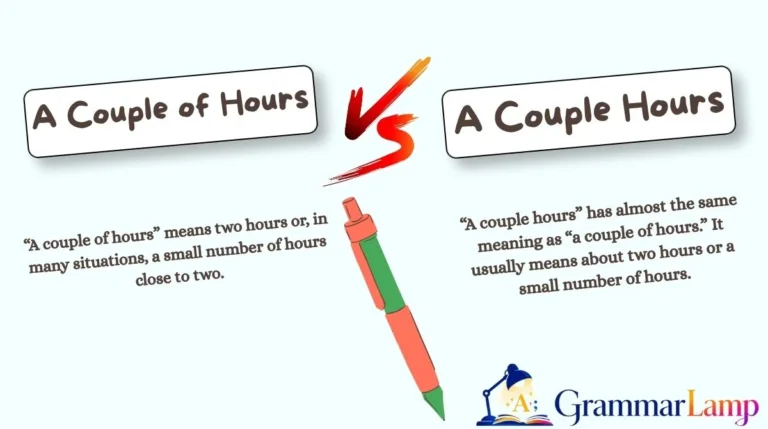
“A couple of hours” means two hours or, in many situations, a small number of hours close to two.
The word “couple” can refer to two things or a small number of things. Cambridge Dictionary defines “a couple of” as two or a few things or people. That is why we commonly say “a couple of hours” when talking about a short period of time.
For example:
I will be back in a couple of hours.
This means the speaker expects to return after about two hours.
The exact meaning depends on context. If someone says, “The meeting will last a couple of hours,” they usually mean around two hours rather than an exact mathematical measurement.
When Do We Use “A Couple of Hours”?
We use “a couple of hours” when we want to talk about a short period of time without giving an exact number.
It works naturally with many common time expressions:
- in a couple of hours
- for a couple of hours
- after a couple of hours
- a couple of hours ago
- within a couple of hours
- every couple of hours
These expressions are extremely common in everyday English.
For example:
I need to finish this work in a couple of hours.
She waited for a couple of hours.
We arrived a couple of hours ago.
The food should be ready within a couple of hours.
The phrase is especially useful when exact timing is not important.
Grammar Rule
The usual structure is:
a + couple + of + plural noun
With time:
a couple of + hours
The noun “hours” is plural because we are talking about more than one hour.
The word “of” connects “couple” with the noun that follows it.
Think of the structure this way:
a couple → a pair or small number
a couple of hours → a small number of hours
This is why “a couple of hours” is the safest form for learners.
8 Example Sentences
- I will call you in a couple of hours.
- She studied for a couple of hours before the exam.
- We waited a couple of hours for the bus.
- He came home a couple of hours ago.
- The repair may take a couple of hours.
- I need a couple of hours to finish this project.
- They stayed at the airport for a couple of hours.
- The medicine should start working within a couple of hours.
Each sentence uses the standard form “a couple of hours.”
Common Learner Confusion
Many learners hear native speakers leave out “of” and assume that the shorter version must be more correct or more natural everywhere.
That is not necessarily true.
English has many differences between spoken language and careful written language. A form may be common in casual conversation but still not be the best choice for a school essay, business email, report, or formal document.
So when you are unsure, remember:
“A couple of hours” is the safe standard form.
It works naturally in both casual and formal situations.
What Does “A Couple Hours” Mean?
Simple Definition
“A couple hours” has almost the same meaning as “a couple of hours.” It usually means about two hours or a small number of hours.
The main difference is that the word “of” has been left out.
For example:
I will be back in a couple hours.
This has essentially the same meaning as:
I will be back in a couple of hours.
The shortened form is a real and widely used English construction. Merriam-Webster describes “a couple” without “of” before an ordinary plural noun as an American usage that is common in speech and in writing that is not formal or elevated. It is especially frequent with periods of time and numbers.
When Do We Use “A Couple Hours”?
You are most likely to hear or see “a couple hours” in casual conversation, informal messages, social media posts, texts, and relaxed American English.
For example:
I’ll call you in a couple hours.
We can leave in a couple hours.
She worked there for a couple hours.
I saw him a couple hours ago.
These sentences sound natural in informal conversation.
However, for careful writing, “a couple of hours” is usually the better choice.
Grammar Rule
The informal structure is:
a + couple + plural noun
So:
a couple hours
instead of:
a couple of hours
Here, “couple” is being used directly before the plural noun as a modifier.
This form is not simply a random mistake. It is a recognized usage. Merriam-Webster lists “a couple” as being used before periods of time, including examples such as “a couple weeks.” Dictionary.com also identifies the shortened form as an Americanism used mainly in informal speech and informal writing, especially with units of measurement such as time.
8 Example Sentences
- I’ll be home in a couple hours.
- She studied for a couple hours last night.
- We waited a couple hours before leaving.
- He called me a couple hours ago.
- The job should take a couple hours.
- I need a couple hours to think about it.
- They drove for a couple hours without stopping.
- The store will reopen in a couple hours.
These sentences are common in informal English, particularly American English.
Common Learner Confusion
The biggest problem is believing that “a couple hours” and “a couple of hours” must have completely different meanings.
They usually do not.
The main difference is style and usage, not the basic idea of time.
So:
I’ll be back in a couple of hours.
and
I’ll be back in a couple hours.
normally communicate the same message.
The first is more suitable when you want standard, careful English. The second sounds more casual.
Difference Between “A Couple of Hours” and “A Couple Hours”
The easiest way to understand the two expressions is to compare grammar, style, and context.
| Feature | A couple of hours | A couple hours |
|---|---|---|
| Basic meaning | About two hours / a small number of hours | About two hours / a small number of hours |
| “Of” included | Yes | No |
| Standard form | Yes | Common informal form |
| Formal writing | Recommended | Usually avoid |
| Casual speech | Very common | Very common |
| Informal American English | Common | Especially common |
| Suitable for school writing | Yes | Better to avoid |
| Suitable for business writing | Yes | Better to avoid |
| Meaning difference | Usually none | Usually none |
Usage Difference
The key point is simple:
“A couple of hours” is the safer general choice.
You can use it almost anywhere.
If you are writing an email to your manager, choose:
I will finish the report in a couple of hours.
For a school assignment:
The experiment lasted a couple of hours.
For everyday conversation:
I’ll be back in a couple of hours.
There is nothing unnatural about the longer form.
“A couple hours” is more relaxed.
For example:
I’ll be back in a couple hours.
This is perfectly understandable and commonly heard, especially in American speech.
Grammar Logic
The traditional construction treats “couple” as a noun followed by “of.”
Compare:
a couple of hours
with:
a pair of shoes
In both expressions, “of” connects the quantity word to the plural noun.
But English also allows “couple” to be used directly before plural nouns in certain informal styles.
That gives us:
a couple hours
This is similar to other casual quantity expressions that have changed over time.
Merriam-Webster notes that the no-“of” version is especially common before periods of time and numbers.
Sentence Structure Difference
The standard structure is:
Subject + verb + a couple of hours
Example:
I waited for a couple of hours.
The informal structure is:
Subject + verb + a couple hours
Example:
I waited for a couple hours.
The basic sentence meaning stays the same.
The difference is the structure used for the quantity expression.
Meaning Comparison
In ordinary conversation, both expressions normally point to roughly the same amount of time.
For example:
She’ll arrive in a couple of hours.
She’ll arrive in a couple hours.
Both tell us that her arrival is expected after a short period, usually around two hours.
The word “couple” itself does not always force an exact mathematical meaning. Cambridge includes “two or a few” in its definition, while dictionary sources also describe “a couple of” as being used for a small number.
That means context matters.
If the exact time is important, say:
She will arrive in exactly two hours.
That sentence is much clearer than either “couple” expression.
Explore More Posts
Crews vs Cruise (2026): What’s the Difference? Easy Grammar Guide with Examples
Everything vs Every Thing: Easy Difference, Rules, Examples & Practice (2026)
All Is vs All Are: Which One Is Correct? Complete Grammar Guide for 2026
At the Weekend or On the Weekend? 2026 Guide to British and American English
Grammar Rules You Must Remember
Rule 1: Use “a couple of hours” as your default form
When you are learning English, “a couple of hours” is the easiest form to remember and the safest one to use.
Example:
I need a couple of hours to finish the work.
This is natural in everyday English and also works well in formal writing.
Rule 2: “A couple hours” is common in informal English
Leaving out “of” is not simply something learners invented. It is a recognized usage, especially in informal American English and especially with time expressions.
Example:
I’ll see you in a couple hours.
This sounds casual and conversational.
Rule 3: Do not usually drop “a” in a normal sentence
Learners sometimes write:
I’ll be back in couple hours.
For standard English, this should normally be:
I’ll be back in a couple of hours.
Or, informally:
I’ll be back in a couple hours.
The article “a” is normally part of the expression when couple is used in this way.
So remember:
a couple of hours ✅
a couple hours ✅ informal
couple hours ⚠️ possible in very casual usage, headlines, notes, or clipped speech, but not the best standard sentence form
Rule 4: Use “two hours” when you need exact meaning
“Couple” can be slightly flexible because speakers sometimes use it to mean around two or a small number.
If exact timing matters, use “two hours.”
Compare:
I’ll be there in a couple of hours.
This is approximate.
I’ll be there in two hours.
This is more exact.
That small difference is important in appointments, schedules, instructions, and professional communication.
Common Mistakes Students Make
Mistake 1: Thinking “couple hours” is always wrong
Some learners are taught that “of” can never be removed.
That is too simple.
The form “a couple hours” is genuinely used in English, and major dictionaries describe it as a recognized informal usage. It is particularly associated with American English and time expressions.
Wrong idea:
Native speakers who say “a couple hours” are making a grammar mistake.
Better understanding:
“A couple hours” is a common informal form, while “a couple of hours” is the safer standard choice.
Mistake 2: Using “couple” without “a”
A common learner error is:
I need couple hours.
For careful standard English, use:
I need a couple of hours.
Or informally:
I need a couple hours.
The missing article “a” is the bigger problem here.
Mistake 3: Using the informal form in formal writing
Suppose you are writing a professional report.
You write:
The system was tested for a couple hours.
This may be understood easily, but a more polished choice is:
The system was tested for a couple of hours.
The second version is better suited to careful formal writing.
Mistake 4: Believing “couple” always means exactly two
Sometimes “couple” means exactly two.
For example:
The couple got married last year.
That clearly refers to two people.
But “a couple of hours” can be less exact. It can mean approximately two hours or a small number of hours, depending on context. Cambridge specifically gives “two or a few” for “a couple of.”
So do not assume that every use must mean exactly 120 minutes.
Easy Correction Tip
When writing, ask yourself one question:
“Do I need formal, safe English?”
If the answer is yes, write:
a couple of hours
If you are simply talking casually, you will often hear:
a couple hours
Easy Trick to Remember the Difference
Here is a simple trick:
When in doubt, keep the “of.”
Think of “a couple of hours” as your full, safe version.
You can use it at work, at school, in an email, in an exam, or while speaking with friends.
The shorter form is like a relaxed version:
Standard:
a couple of hours
Casual:
a couple hours
Imagine that “of” is a small bridge between “couple” and “hours.”
The full bridge is:
couple → of → hours
In casual English, speakers may remove that bridge:
couple → hours
The meaning usually stays the same.
There is another useful trick.
When you are writing something important, imagine that your teacher will read it. Choose:
a couple of hours
When you are texting a close friend, you may naturally see:
a couple hours
This is not a strict law. It is simply a practical way to remember the difference in style.
And one more important point: do not confuse “couple” with an exact clock measurement. When the exact duration matters, simply say:
two hours
That removes all doubt.
Daily Life Examples
Real conversations make this difference much easier to understand.
Example 1: Talking to a Friend
Ali: When will you come back?
Hassan: I’ll be back in a couple of hours.
This is the standard form.
A casual speaker might say:
Hassan: I’ll be back in a couple hours.
Both normally mean about two hours.
Example 2: At Work
Manager: How long will the repair take?
Employee: It should take a couple of hours.
This sounds natural and professional.
Example 3: Casual Text Message
Friend: Are you coming tonight?
You: Yes. I just need a couple hours to finish my work.
This is a relaxed message, so the shorter version sounds natural.
For a more formal email, write:
I need a couple of hours to finish the work.
Example 4: Talking About the Past
I spoke to Sarah a couple of hours ago.
This means the conversation happened approximately two hours earlier.
You may also hear:
I spoke to Sarah a couple hours ago.
The meaning is essentially the same.
Example 5: Waiting for Someone
A: How long have you been waiting?
B: A couple of hours.
This answer is very common.
Notice that “of” can be heard clearly in careful speech.
Example 6: Planning a Trip
Dad: When should we leave?
Son: Maybe in a couple of hours.
This gives an approximate time rather than an exact schedule.
Example 7: Studying
I studied English for a couple of hours last night.
This tells us the study session lasted around two hours.
A casual speaker may say:
I studied English for a couple hours last night.
Again, the meaning does not normally change.
Example 8: Waiting for Food
Customer: How long will the special order take?
Worker: It may take a couple of hours.
Because this is a service situation, the full version sounds especially natural.
Example 9: Casual Conversation
Mike: Are you tired?
John: Yes. I’ve been driving for a couple hours.
This is typical of relaxed speech.
Example 10: Professional Email
The report should be ready in a couple of hours.
This version is clear, natural, and appropriate for professional communication.
Practice Section
Choose the better option for each sentence.
1. I will call you in ______.
A. a couple of hours
B. a couple hourses
Answer: A. a couple of hours
“Hours” is the correct plural noun, and the standard expression is “a couple of hours.”
2. She waited ______ for the doctor.
A. a couple of hours
B. a couple hours
Answer: Both can be used, but A is the safer standard choice.
“A couple of hours” works in formal and informal English. “A couple hours” is common in casual English.
3. We arrived ______ ago.
A. a couple of hours
B. couple of hour
Answer: A. a couple of hours
The noun must be plural: hours.
4. Which sentence is best for a formal email?
A. I will return in a couple hours.
B. I will return in a couple of hours.
Answer: B. I will return in a couple of hours.
The full form is the better choice for careful professional writing.
5. Which sentence gives an exact time?
A. I’ll arrive in a couple of hours.
B. I’ll arrive in two hours.
Answer: B. I’ll arrive in two hours.
“Two hours” clearly gives the exact number.
More Helpful posts
To Discuss or Discuss About: Which Is Correct? | Easy Grammar Guide 2026
Upmost vs Utmost: Meaning, Difference, and Correct Usage in 2026
Seam vs Seem: Difference, Meaning, Examples & Grammar Rules (2026)
All the Time vs Every Time: Meaning, Difference, Rules & Examples (2026)
FAQs
What is the difference between “a couple of hours” and “a couple hours”?
The main difference is style and grammar structure, not basic meaning. “A couple of hours” is the traditional standard form and works well in formal and informal English. “A couple hours” is a common informal form, especially in American English.
Can we use “a couple hours” in questions?
Yes. You may hear questions such as:
How many hours will it take?
Or informally:
Will it take a couple hours?
The shorter form is natural in casual speech. For careful writing, “a couple of hours” is usually the safer choice.
Is “a couple hours” formal or informal?
“A couple hours” is generally more informal. Merriam-Webster describes the no-“of” construction as an American usage that is common in speech and in writing that is not formal or elevated, especially with periods of time.
Is “a couple of hours” grammatically correct?
Yes. “A couple of hours” is a standard and very common English expression. Cambridge Dictionary uses it in examples and explains “a couple of” as referring to two or a few things or units.
Does “a couple of hours” always mean exactly two hours?
Not always. It often means about two hours, and context can make it slightly flexible. If the exact duration matters, use “two hours” instead. That gives the listener or reader a precise number.
Can I write “I need couple hours”?
In standard English, this is not the form you should normally use. Write:
I need a couple of hours.
In casual English, you may also hear:
I need a couple hours.
The important point is that the article “a” normally stays in the expression.
Final Conclusion
The difference between “a couple of hours” and “a couple hours” is much easier once you separate standard English from casual English.
“A couple of hours” is the safest and most widely suitable form. It means about two hours or a small number of hours, depending on context. You can use it in conversation, school writing, professional emails, reports, and formal situations.
“A couple hours” is also commonly used, especially in informal American English. It usually carries the same basic meaning, but it has a more casual feel.
Major dictionary sources recognize this shortened construction, particularly with periods of time.
For learners, the easiest rule is simple: keep “of” when you are unsure.
Say:
I’ll be back in a couple of hours.
And when you need an exact number, simply say:
I’ll be back in two hours.
Practice these forms in everyday sentences, and the difference will soon feel natural.

Liam Derren is a language writer at GrammarLamp, creating simple, helpful content about grammar, words, and everyday English. He makes language learning clear, practical, and easy to understand.
1 thought on “Couple of Hours vs Couple Hours: Which Is Correct in 2026?”