
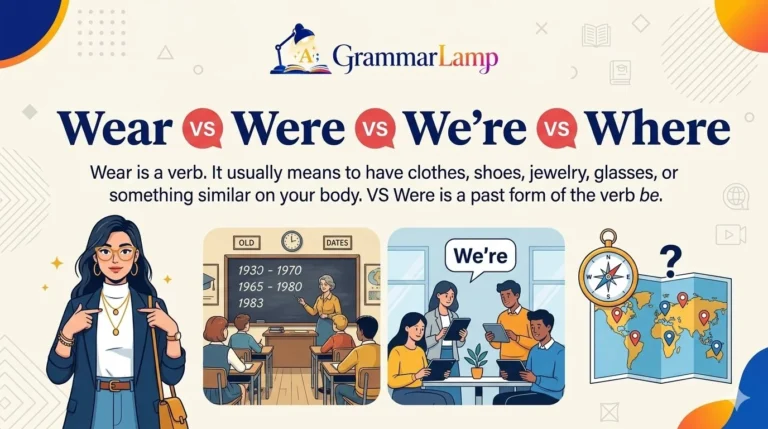
Wear, were, we’re, and where are four English words that sound confusingly similar, especially when people speak quickly.
For many English learners, this can make simple sentences feel difficult. You may know what you want to say, but when it is time to write the sentence, you suddenly wonder, “Which spelling is correct?”
The problem is easier to understand when you remember that these words have different meanings and different jobs in a sentence.
Wear is mainly a verb connected with clothes, shoes, glasses, or things you have on your body. Were is a past form of the verb be. We’re is a short form of we are. Where usually asks about a place or tells us about location.
These words are very common in everyday English. You hear them at school, at work, at home, in text messages, and in normal conversations.
That is why learning the difference is so useful. A small spelling mistake can completely change the meaning of a sentence.
Once you understand the meaning, grammar, and sentence pattern of each word, the confusion becomes much smaller. By the end, you will be able to choose the correct word quickly and use each one naturally in both speaking and writing.
More Useful posts
Sneek vs Sneak: Which Spelling Is Correct in 2026?
In vs Into vs On vs Onto: Easy Grammar Rules and Examples in 2026
Couple of Hours vs Couple Hours: Which Is Correct in 2026?
Canceled vs Cancelled: Which Spelling Is Correct in 2026?
What Does “Wear” Mean?
Wear is a verb. It usually means to have clothes, shoes, jewelry, glasses, or something similar on your body.
For example:
I wear a blue shirt every Monday.
This means the person puts on or has a blue shirt on their body every Monday.
The word wear is about something being on your body. It is different from put on. We usually use put on for the action of getting dressed, while wear describes having the item on.
Compare:
I put on my jacket before going outside.
I wear my jacket when it is cold.
The first sentence focuses on the action. The second sentence focuses on the state or situation.
When Do We Use “Wear”?
We use wear when talking about:
- clothes
- shoes
- hats
- glasses
- watches
- rings and other jewelry
- uniforms
- makeup in some expressions
- protective things such as helmets or gloves
It can also be used in other ways. For example, something can wear out because it becomes old or damaged from use.
Grammar Rule for “Wear”
The base form is wear.
With I, you, we, and they, we normally use wear:
I wear glasses.
They wear uniforms.
With he, she, and it, we use wears:
She wears a red dress.
He wears black shoes.
The past form is wore, and the past participle is worn:
I wore a blue shirt yesterday.
She has worn that dress before.
So remember:
wear → wore → worn
Examples of “Wear”
- I wear comfortable shoes to work.
- She wears a beautiful necklace every day.
- Do you wear glasses?
- They wear uniforms at school.
- He wears a jacket in winter.
- Please wear a helmet when riding a bike.
- I usually wear jeans on weekends.
- What do you like to wear at parties?
Common Confusion With “Wear”
Learners sometimes confuse wear with where because they sound alike in many accents.
For example:
❌ Where a jacket when it is cold.
✅ Wear a jacket when it is cold.
The correct word is wear because the sentence is about putting clothing on your body.
A useful question to ask yourself is:
“Am I talking about clothing or something I have on my body?”
If the answer is yes, wear may be the word you need.
What Does “Were” Mean?
Were is a past form of the verb be.
The verb be has several forms, including:
am, is, are, was, were
We use were mainly with you, we, and they in the past.
Examples:
You were tired yesterday.
We were at home.
They were happy.
So were is connected with a past situation, condition, place, or state.
When Do We Use “Were”?
We use were to talk about something that was true or happening in the past.
For example:
We were busy yesterday.
The sentence tells us about a past condition.
We can also use were to talk about a past location:
They were at the library.
The word tells us where they were in the past.
Grammar Rule for “Were”
In the simple past of be, use:
I was
He was
She was
It was
But:
You were
We were
They were
Examples:
I was tired.
You were tired.
We were tired.
They were tired.
One interesting point is that were can also appear with I in certain hypothetical sentences:
If I were you, I would apologize.
This is a common English expression. Here, were is used for an unreal or imaginary situation.
Examples of “Were”
- We were late for school yesterday.
- They were very excited about the trip.
- You were right about the answer.
- Were you at home last night?
- The children were tired after the game.
- We were not ready yet.
- Where were you this morning?
- If I were you, I would take an umbrella.
Common Confusion With “Were”
The biggest confusion is often between were and we’re.
Look at these sentences:
We were tired.
We’re tired.
They look similar, but the time is different.
We were tired = We were tired in the past.
We’re tired = We are tired now, or around the present time.
Another common mistake is writing were when you actually mean we are.
Always check whether the sentence needs a past form or the contraction we’re.
What Does “We’re” Mean?
We’re is a contraction.
It means:
we are
The apostrophe replaces some of the missing letters in we are.
For example:
We’re ready.
This means:
We are ready.
When Do We Use “We’re”?
Use we’re when you mean we are.
It is very common in conversation, informal writing, messages, emails, and everyday English.
Examples:
We’re going home.
We’re busy.
We’re students.
We’re happy to help.
The contraction sounds natural and relaxed.
In formal writing, some writers may prefer we are, especially when they want a more formal or careful tone. But we’re is standard English and is not grammatically wrong.
Grammar Rule for “We’re”
The structure is:
We’re + adjective
We’re tired.
We’re happy.
Or:
We’re + noun
We’re teachers.
We’re friends.
Or:
We’re + verb-ing
We’re working.
We’re studying.
We’re waiting.
Or:
We’re + place
We’re at home.
We’re in the office.
A simple test is very useful:
Can you replace “we’re” with “we are”?
If yes, we’re is correct.
For example:
We’re late.
Change it:
We are late.
The sentence still works, so we’re is correct.
But:
Where is the station?
You cannot replace where with we are. So where is clearly different.
Examples of “We’re”
- We’re going to the market.
- We’re very happy today.
- We’re students at the same school.
- We’re waiting for the bus.
- We’re ready to leave.
- We’re not sure about the answer.
- We’re at home right now.
- We’re learning English together.
Common Confusion With “We’re”
A very common mistake is confusing we’re and were.
Remember:
We’re = we are
Were = past form of be
Compare:
We’re at school.
We were at school yesterday.
The first sentence usually describes the present situation. The second describes a past situation.
Also be careful with the apostrophe. We’re has an apostrophe:
we’re
Without the apostrophe, were is a completely different word.
What Does “Where” Mean?
Where is usually used to talk about place or location.
It is one of the most common question words in English.
For example:
Where do you live?
The speaker wants to know the place.
You can also use where in statements:
This is the house where I grew up.
Here, where connects the idea of a place with more information about that place.
When Do We Use “Where”?
We use where when asking or talking about location.
Common questions include:
Where are you?
Where do you live?
Where is my phone?
Where did they go?
It can also refer to the place in a longer sentence:
I know where she works.
In this sentence, where means the place at which she works.
Grammar Rule for “Where”
Where is not a verb and does not mean we are.
It is commonly used as a question word:
Where + be + subject?
Where are you?
Where is Ali?
Or:
Where + do/does/did + subject + verb?
Where do you live?
Where does she work?
Where did they go?
We can also use where inside statements:
I know where he lives.
She showed me where the key was.
Examples of “Where”
- Where do you live?
- Where is my bag?
- Where are the children?
- Where did you buy that shirt?
- Do you know where the bank is?
- Tell me where you found it.
- This is the park where we met.
- Where were you yesterday?
Common Confusion With “Where”
The most common confusion is between where and wear because the two words usually sound the same.
Compare:
Where is your coat?
Wear your coat.
The first asks about a location. The second gives advice about clothing.
A simple meaning check solves the problem:
where = place
wear = clothes
Difference Between Wear, Were, We’re, and Where
Although wear, were, we’re, and where may sound similar, they have completely different meanings and grammatical roles.
| Word | Meaning | Grammar Role | Example |
|---|---|---|---|
| wear | have clothes or something on your body | Verb | I wear a blue shirt. |
| were | past form of “be” | Verb | We were tired. |
| we’re | short form of “we are” | Pronoun + verb | We’re ready. |
| where | asks or tells about a place | Question word / adverb | Where do you live? |
1. Wear Is About Clothing
When the topic is something you put on your body, wear is usually the correct word.
I wear glasses.
She wears a uniform.
It can also be used for items such as watches, rings, helmets, and shoes.
2. Were Is About the Past
Were usually points to a past state, situation, or location.
They were tired.
We were at school.
It is part of the past form of be.
3. We’re Means “We Are”
This one is easy to test.
Replace we’re with we are.
We’re hungry.
We are hungry.
The meaning stays the same.
4. Where Is About Place
When you are asking about location, use where.
Where is your house?
Where did you go?
It can also connect a place with another part of a sentence:
This is the restaurant where we ate.
Sentence Structure Difference
The four words also appear in different sentence patterns.
Wear + object
I wear a jacket.
Subject + were + adjective/place/noun
We were tired.
They were at home.
We’re + adjective/noun/verb-ing/place
We’re happy.
We’re students.
We’re studying.
Where + question structure
Where are you?
Where do they live?
Seeing these patterns can help more than simply trying to memorize definitions.
Explore More Posts
Ambiance vs Ambience: Meaning, Difference, Usage & Examples in 2026
Compared To vs As Compared To (2026): Meaning, Difference & Correct Usage
Gone to Soon vs Gone Too Soon: Which Is Correct? (2026 Guide)
Stayed vs Staid: Meaning, Difference, Examples & Easy Rules in 2026
Grammar Rules You Must Remember
Rule 1: Use “wear” for clothes and things on your body
When you are talking about clothing, shoes, glasses, or similar items, use wear.
Correct: I wear black shoes to work.
Incorrect: I where black shoes to work.
Think about the meaning. The sentence is about clothing, so wear is needed.
Rule 2: Use “were” for past situations with you, we, and they
Were is a past form of be.
You were tired.
We were busy.
They were late.
Do not use we’re when you mean a past situation.
❌ We’re late yesterday.
✅ We were late yesterday.
The word yesterday clearly places the action in the past.
Rule 3: Use “we’re” only when you can say “we are”
This is the fastest grammar test.
We’re ready.
We are ready.
Because the full form works, we’re is correct.
Another example:
We’re going home.
We are going home.
Again, both work.
Rule 4: Use “where” for location or place
When the sentence asks or talks about a place, use where.
Where is your phone?
I know where the shop is.
Do not confuse where with wear just because they sound alike.
Common Mistakes Students Make
These mistakes happen because the four words can sound very similar in normal speech. Learners often choose a spelling from memory instead of checking the meaning.
Mistake 1: Using “where” for clothing
❌ Where your jacket when you go outside.
✅ Wear your jacket when you go outside.
The second sentence is correct because it tells someone what to put on.
Mistake 2: Using “wear” for a place
❌ Wear is the nearest hospital?
✅ Where is the nearest hospital?
The sentence asks about location, so where is needed.
Mistake 3: Confusing “were” and “we’re”
❌ We’re very tired after yesterday’s trip.
✅ We were very tired after yesterday’s trip.
The sentence describes a past condition, so were is correct.
But:
We’re very tired right now.
Here, we’re means we are, so it works for the current situation.
Mistake 4: Forgetting the apostrophe in “we’re”
❌ Were going to the store.
✅ We’re going to the store.
Without the apostrophe, were becomes a different word.
Mistake 5: Choosing by sound alone
This is perhaps the biggest problem.
English has many words that sound alike but have different spellings and meanings. Instead of asking, “Which word sounds right?” ask:
What does the sentence mean?
Is it about clothes? Use wear.
Is it about the past form of be? Use were.
Does it mean we are? Use we’re.
Is it about a place? Use where.
Easy Trick to Remember the Difference
A simple four-word memory trick can make this much easier:
Wear = clothes
Were = past
We’re = we are
Where = place
You can even remember them with four simple questions:
Wear: “What do I have on?”
Were: “What happened in the past?”
We’re: “Can I say we are?”
Where: “What place?”
For example, look at this sentence:
We’re wearing shoes at school.
There are actually two useful words here.
We’re = we are
wearing = having shoes on our feet
Now look at:
Where were you?
Here:
Where = asks about place
Were = past form of be
This is why understanding meaning is more powerful than focusing only on pronunciation.
Another helpful trick is to remember that the apostrophe in we’re is your clue. When you see ‘re, think of are.
So:
we’re → we are
That little apostrophe can save you from many common spelling mistakes.
Daily Life Examples
These four words appear naturally in everyday conversations. Here are some simple examples you may hear at home, at school, at work, or with friends.
Example 1
A: Where are you going?
B: We’re going to the market.
Here, where asks about the destination, while we’re means we are.
Example 2
A: What do you usually wear to work?
B: I wear a white shirt and black pants.
Here, wear is connected to clothing.
Example 3
A: Where were you last night?
B: We were at my cousin’s house.
This example uses both where and were.
Where asks about a place.
Were describes the past situation.
Example 4
A: We’re late!
B: I know. Where is the bus?
The first sentence means we are late. The second asks about location.
Example 5
A: Were you at school yesterday?
B: Yes, I was.
Were is used in the past question because the speaker is asking about yesterday.
Example 6
A: What should I wear to the party?
B: Wear something comfortable.
The first question asks about clothing. The answer uses wear as a verb.
Example 7
A: Where is Sara?
B: We’re not sure.
The first sentence asks about location. The second means we are not sure.
Example 8
A: Why were you late?
B: We were stuck in traffic.
Both uses of were refer to a past situation.
Example 9
A: We’re going to the beach tomorrow.
B: Really? What are you going to wear?
The first sentence uses we’re for we are. The second uses wear for clothing.
Example 10
A: Do you remember where we were yesterday?
B: Yes. We were at the new restaurant.
This example is especially useful because where and were appear together.
Practice Section
Choose the correct word: wear, were, we’re, or where.
1. ______ are you from?
A. Wear
B. Were
C. We’re
D. Where
2. We ______ very tired after the game.
A. wear
B. were
C. we’re
D. where
3. ______ going to visit our grandparents tomorrow.
A. Wear
B. Were
C. We’re
D. Where
4. I usually ______ comfortable shoes.
A. wear
B. were
C. we’re
D. where
5. ______ did you buy that jacket?
A. Wear
B. Were
C. We’re
D. Where
Answers
1. Where
The sentence asks about a place or origin.
2. Were
The sentence talks about a past condition.
3. We’re
It means we are going to visit.
4. Wear
The sentence is about having shoes on your feet.
5. Where
The question asks about the place of purchase.
More Helpful posts
Newfound vs New-Found: Which Is Correct in 2026?
Over Time vs Overtime: Meaning, Difference, Examples & Rules in 2026
Year Old or Years Old? Easy Grammar Guide for 2026
Lieu vs Loo: Meaning, Difference, Usage, and Examples in 2026
FAQs
What is the difference between wear, were, we’re, and where?
Wear is a verb related to clothes or things worn on the body. Were is a past form of be. We’re is short for we are. Where is mainly used for place or location.
Can we use “where” in questions?
Yes. Where is one of the most common question words in English. It asks about a place, position, or location.
Examples include: Where do you live? and Where is my phone?
Is “we’re” formal or informal?
We’re is standard English and is common in everyday speech and writing. It is the contraction of we are. In very formal writing, some people may choose the full form we are, but we’re is grammatically correct.
How can I remember “were” and “we’re”?
Remember this simple rule: we’re = we are, while were = past.
Try replacing we’re with we are. If the sentence still makes sense, we’re is correct.
Are “wear” and “where” pronounced the same?
In standard English, wear and where are commonly pronounced alike or very similarly. Because they can sound the same, spelling and meaning are especially important when writing them.
Which is correct: “Where were you?” or “Wear were you?”
The correct sentence is “Where were you?” because the question asks about a past location.
Where refers to the place, and were is the past form of be.
Conclusion
Wear, were, we’re, and where may sound similar, but their meanings are very different. The easiest way to use them correctly is to focus on what the sentence is trying to say.
Remember these four simple ideas:
Wear is connected with clothes and things you have on your body.
Were is a past form of be.
We’re means we are.
Where is connected with place or location.
Once you stop relying only on sound and start checking the meaning, these words become much easier to separate. Pay attention to them when reading, texting, watching videos, and speaking English.
A few minutes of practice can make a big difference. Write your own sentences with all four words, and read them aloud. Soon, choosing the correct spelling will feel natural rather than difficult.

Liam Derren is a language writer at GrammarLamp, creating simple, helpful content about grammar, words, and everyday English. He makes language learning clear, practical, and easy to understand.