
English has many small words that sound the same but work in very different ways. “To” and “too” are two of the most common examples.
Because they have the same pronunciation, learners often type the wrong one without noticing. The phrase “gone to soon” vs “gone too soon” is a perfect example.
You may see both versions online, but they are not equal. One is normally a spelling and grammar mistake when the intended meaning is that someone left or died earlier than expected. The correct phrase for that meaning is “gone too soon.”
The word too is an adverb. It can be used before another adverb to show that something happened more than was wanted, expected, or suitable.
Cambridge gives this use of too before adverbs, such as when something happens “too quickly.”
The word gone is the usual past participle of go. It can describe someone who has left, or in some contexts someone who is no longer living.
Once you understand what each small word is doing, the choice becomes easy.
You will know why “gone too soon” is correct, why “gone to soon” usually does not work, how to use the phrase naturally, and how to avoid this common mistake in writing, messages, and everyday English.
More Useful posts
Recommend to vs recommend for 2026: Clear Grammar Rules, Examples, and Common Mistakes
Wreckless or Reckless? Which Spelling Is Correct in 2026?
Brite vs Bright: Meaning, Difference, Spelling & Correct Usage in 2026
I Ordered vs I Have Ordered: What’s the Difference? Simple Grammar Guide (2026)
What Does “Gone to Soon” Mean?
Is “gone to soon” correct?
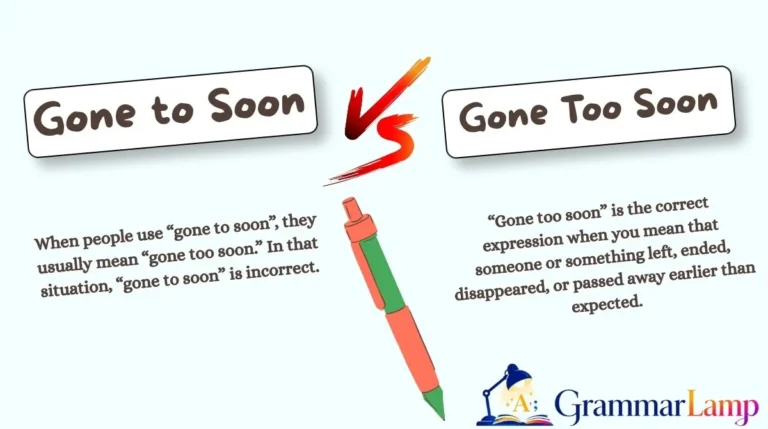
When people use “gone to soon”, they usually mean “gone too soon.” In that situation, “gone to soon” is incorrect.
The problem is the word to. The word to does not mean “more than expected” or “earlier than expected.” It cannot perform the job needed in this phrase.
Look at the intended meaning:
He was gone too soon.
This means he left, disappeared, or died earlier than people expected or wanted.
Now look at:
He was gone to soon.
This does not form the normal English expression. A reader will usually understand that to was typed by mistake instead of too.
Why does this mistake happen?
The main reason is pronunciation. To and too are pronounced the same in normal speech. When people hear the phrase instead of seeing it written, they may not know which spelling to choose.
This is especially common with learners who are still building confidence in written English. They may know what the sentence means, but they choose the wrong word because both words sound like /tuː/.
What is “to” normally used for?
To has several important jobs in English. It can show direction:
We went to the store.
It can also come before a base verb:
I want to learn English.
In these sentences, to has a clear grammatical role. It is not being used to mean “more than expected.”
So when you say:
gone ___ soon
you need a word that can modify soon. That word is too, not to.
Examples of incorrect use
The following sentences use to where too is normally needed:
- ❌ She was gone to soon.
- ❌ The summer holiday was gone to soon.
- ❌ My friend left to soon.
- ❌ He passed away to soon.
- ❌ The happy moment was gone to soon.
- ❌ They were gone to soon from the party.
- ❌ Our teacher’s speech ended to soon.
- ❌ The chance was gone to soon.
In all of these examples, the intended idea is earlier than expected or desired. Therefore, too is needed.
An important point
“Gone to soon” is not completely impossible as a random sequence of words in every imaginable sentence. English can contain unusual combinations depending on context. However, as the common phrase meaning “left, ended, or died earlier than expected,” it is not correct.
That distinction matters because learners sometimes think every word combination must have a separate dictionary meaning. Here, the issue is really about choosing the correct small word for the intended grammar.
What Does “Gone Too Soon” Mean?
“Gone too soon” is the correct expression when you mean that someone or something left, ended, disappeared, or passed away earlier than expected.
The key word is too.
Cambridge defines too as an adverb that can mean “more than is needed or wanted” or “more than is suitable or enough.” It can be placed directly before an adverb, such as too quickly.
Since soon is an adverb, too soon is a natural grammatical combination.
Meaning of “gone too soon”
The phrase can have several closely related meanings.
It can mean:
- someone left earlier than expected
- something ended earlier than people wanted
- an opportunity disappeared quickly
- a person died at a younger age or earlier than people felt was right
For example:
The guests were gone too soon.
Here, the guests left earlier than expected.
Another example:
The weekend was gone too soon.
The weekend seemed to end very quickly and earlier than the speaker wanted.
The expression can also be used about death:
He was gone too soon.
In this context, it often means the person died earlier than expected or at an age when people felt his or her life should have continued.
Cambridge notes that gone is the past participle of go, and it can also be used as an adjective meaning dead in certain expressions.
Grammar rule for “too soon”
The basic pattern is:
too + adverb
Here:
- too = more than expected, wanted, or suitable
- soon = before the expected or desired time
So:
too + soon = earlier than expected or wanted
Then we can place it with gone:
gone + too soon
Examples of correct sentences
- ✅ The guests were gone too soon.
- ✅ The movie was over too soon.
- ✅ Our holiday was gone too soon.
- ✅ He was gone too soon, and everyone missed him.
- ✅ She left too soon to say goodbye properly.
- ✅ The beautiful evening was gone too soon.
- ✅ The opportunity was gone too soon.
- ✅ Their favorite teacher was gone too soon.
Notice how too works with soon. It tells us that the timing was earlier than expected or desired.
“Gone too soon” can be emotional
This phrase often carries emotion, especially when talking about a person who has died.
For example:
Your kindness touched so many people. You were gone too soon.
This sounds sad and respectful.
At the same time, the phrase is not limited to death. You can also say:
The party was gone too soon.
That sentence is less common than “The party ended too soon,” but the general idea is still understandable: the enjoyable time finished earlier than the speaker wanted.
Difference Between “Gone to Soon” and “Gone Too Soon”
The difference is mainly a grammar and meaning issue.
| Point | Gone to Soon | Gone Too Soon |
|---|---|---|
| Standard phrase? | ❌ No | ✅ Yes |
| Correct word before “soon” | ❌ To | ✅ Too |
| Role of word | “To” shows direction or introduces a verb in common uses | “Too” modifies “soon” |
| Meaning | Does not express the intended idea | Earlier than expected or wanted |
| Common in condolences | ❌ No | ✅ Yes |
| Common learner mistake | ✅ Yes | — |
| Example | ❌ He was gone to soon. | ✅ He was gone too soon. |
Usage difference
The sentence “He was gone too soon” gives a clear idea about timing. Something happened earlier than expected.
The word too adds the idea of excess.
Compare:
He left soon.
This simply tells us he left in a short time or earlier in the situation.
Now:
He left too soon.
This gives an extra meaning. The speaker thinks he left earlier than was appropriate, expected, or wanted.
That small word makes a big difference.
Grammar logic
The structure works because too can modify adverbs.
For example:
- too quickly
- too slowly
- too early
- too late
- too often
- too soon
Cambridge specifically explains that too is used immediately before adjectives and adverbs when something is more than necessary, suitable, or wanted.
So:
too + soon
is grammatically natural.
By contrast, to is not used as an adverb meaning “more than expected.” That is why it does not fit here.
Sentence structure difference
Look at the pattern:
Subject + be + gone + too soon
He was gone too soon.
Or:
Subject + verb + too soon
She left too soon.
The second pattern is especially common in everyday English.
Meaning comparison
Consider these sentences:
The train left soon.
This means the train left after a short amount of time.
The train left too soon.
This means the train left earlier than the speaker expected or wanted.
The same idea applies to gone too soon.
Too adds a judgment about timing, while soon simply describes an early time.
Grammar Rules You Must Remember
Rule 1: Use “too” before “soon”
When you mean earlier than expected or wanted, use:
too soon
Examples:
You left too soon.
The show ended too soon.
He was gone too soon.
Cambridge confirms that too can come before an adverb such as soon to show that something happened more than was suitable or wanted.
Rule 2: “To” and “too” have different jobs
To is commonly used for direction or before a verb:
We went to school.
I want to study.
Too can mean “also” or show “more than wanted or needed”:
I want to study too.
It is too late.
Do not choose between them only by sound. Check the grammar and meaning.
Rule 3: “Soon” is an adverb
Because soon is an adverb, it can be modified by too:
too soon
This is similar to:
too quickly
too early
too late
The structure is normal English grammar.
Rule 4: Ask yourself what you mean
Before writing the sentence, ask:
“Do I mean earlier than expected or wanted?”
If the answer is yes, use too soon.
For example:
Was I too soon?
More naturally:
Did I arrive too soon?
Did she leave too soon?
Was the opportunity gone too soon?
That quick meaning check can help you choose the correct spelling.
Explore More Posts
Timber vs Timbre (2026): Meaning, Differences, Grammar Rules, Examples, and Easy Guide
On a Call or In a Call (2026): What’s the Difference? Easy Grammar Guide with Examples
Any Way vs Anyway: What’s the Difference? Complete Guide for 2026
Choose vs Chose: Difference, Meaning, Rules & Examples (2026)
Common Mistakes Students Make
Mistake 1: Choosing “to” because it sounds right
This is the biggest problem.
Both to and too sound alike in everyday speech. So a learner may write:
❌ She left to soon.
The correct version is:
✅ She left too soon.
Mistake 2: Thinking “too” always means “also”
Many students learn too through sentences such as:
I like tea too.
Here, too means also.
But too has another major use. It can mean more than wanted, suitable, or necessary. Cambridge lists both meanings.
For example:
It is too cold.
He arrived too early.
She left too soon.
In “too soon,” the meaning is about timing, not “also.”
Mistake 3: Writing the phrase the way it sounds
Speaking helps you learn pronunciation, but spelling cannot always be copied directly from sound.
You may hear:
too soon
and write:
to soon
This happens because both words are pronounced the same.
Mistake 4: Using “gone too soon” without understanding “gone”
“Gone” is the past participle of go.
For example:
She has gone to work.
In another context:
He is gone.
Here, gone means that he is no longer there. Cambridge also records gone as an adjective meaning dead in certain uses.
So the exact meaning of gone too soon depends on context.
Wrong vs correct examples
| Wrong | Correct |
|---|---|
| ❌ He left to soon. | ✅ He left too soon. |
| ❌ The trip ended to soon. | ✅ The trip ended too soon. |
| ❌ She was gone to soon. | ✅ She was gone too soon. |
| ❌ The meeting finished to soon. | ✅ The meeting finished too soon. |
| ❌ He died to soon. | ✅ He died too soon. |
Easy correction tip
Whenever you see soon, check whether you want to say “more early than expected.”
If yes, remember:
too soon = earlier than wanted
That one small rule will fix most mistakes.
Easy Trick to Remember the Difference
Here is a simple memory trick:
“Too” means extra
Think of too as a word connected to more than needed.
For example:
too expensive = more expensive than I want
too late = later than is acceptable
too early = earlier than I want
too soon = earlier than I want
So:
too soon = more soon than expected
That wording may sound funny, but it helps you remember the idea.
Another trick is to notice the extra o in too.
You can think:
TWO O’s = TOO much
The extra o can remind you that too often gives an idea of something being beyond the expected amount or level.
Then remember:
to = direction / verb marker
go to school
want to eat
too = extra / more than expected
too soon
too late
too fast
Real-life logic
Imagine your friend leaves a party after only ten minutes.
You say:
You left too soon!
Why too?
Because your friend left earlier than you wanted.
Now imagine you are giving directions:
Go to the station.
Here, to points toward a place.
The jobs are completely different.
When you connect the word with its job instead of only its sound, the spelling becomes much easier.
Daily Life Examples (Very Important)
Real conversations are often the best way to understand a phrase.
Example 1: Leaving a party
A: Why did you leave the party so early?
B: I had work in the morning.
A: You were gone too soon. We missed you!
Here, the speaker thinks the person left earlier than they wanted.
Example 2: A short holiday
A: How was your vacation?
B: Amazing.
A: Did you enjoy it?
B: Yes, but it was gone too soon.
The vacation ended faster than the speaker wanted.
Example 3: Saying goodbye
A: I didn’t even get to say goodbye.
B: I know. She left too soon.
The person left earlier than expected.
Example 4: A movie
A: How did you like the movie?
B: I loved it.
A: Same here. I wish it had been longer.
B: Me too. It ended too soon.
The ending came earlier than the viewers wanted.
Example 5: A sad message
A: I still can’t believe he is gone.
B: I know. He was gone too soon.
In this context, the phrase refers to death.
Example 6: A weekend
A: It is Monday already!
B: I know. The weekend was gone too soon.
The speaker feels the weekend ended very quickly.
Example 7: Leaving work
A: Are you leaving already?
B: Yes, I have an appointment.
A: You came too soon and left too soon!
This could be said jokingly when someone arrives and leaves earlier than expected.
Example 8: A guest at home
A: Thanks for coming.
B: Thanks for having me.
A: You are leaving too soon. Stay for dinner!
The host wants the guest to stay longer.
Example 9: An opportunity
A: I wanted that job, but now the position is gone.
B: That happened too soon. You should have applied earlier.
The opportunity disappeared earlier than the speaker expected.
Example 10: A special moment
A: That was such a beautiful evening.
B: It really was. It was gone too soon.
The moment ended sooner than the speaker wanted.
These examples show that “too soon” is about timing. The meaning can be light, casual, disappointed, or deeply emotional depending on the situation.
Practice Section
Choose the correct option: to or too.
1. He left ___ soon.
A. to
B. too
2. The holiday was gone ___ soon.
A. to
B. too
3. She arrived ___ early for the meeting.
A. to
B. too
4. I wanted to say goodbye, but he was gone ___ soon.
A. to
B. too
5. The show ended ___ soon.
A. to
B. too
Answers
- B — too
- B — too
- B — too
- B — too
- B — too
The reason is simple: in every sentence, too modifies the timing and means something happened earlier than expected or wanted.
More Helpful posts
At the Weekend or On the Weekend then? Which Is Correct in 2026?
Similar to vs Similarly to: Meaning, Grammar, and Examples (2026)
Is It Correct to Say “Repeat Again”? 2026 Grammar Guide
John and Me vs Me and John: Which Is Correct? 2026 Grammar Guide
FAQs
What is the difference between “gone to soon” and “gone too soon”?
“Gone too soon” is the correct phrase when you mean someone or something left, ended, or passed away earlier than expected or wanted. “Gone to soon” is normally a spelling and grammar mistake in this meaning. The word too is needed because it modifies soon.
Can we use “gone too soon” in a question?
Yes, but the exact question depends on your meaning. You could ask, “Did he leave too soon?” or “Was the opportunity gone too soon?” The phrase can work in questions when you are asking whether something happened earlier than expected.
Is “gone too soon” formal or informal?
It can be used in both everyday and more emotional writing. You may hear it in conversations about someone leaving early, and you may also see it in sympathy or memorial messages. Its level of formality depends more on the surrounding sentence than on the phrase itself.
Why do people write “to soon” instead of “too soon”?
The most common reason is pronunciation. To and too sound the same, so learners often confuse their spellings. The easiest solution is to remember that too soon means earlier than expected or wanted.
Does “too soon” always have a negative meaning?
Usually, too soon suggests that the timing was not ideal because something happened earlier than expected or desired. However, the feeling can be mild, serious, humorous, or emotional depending on context. For example, “You left too soon!” can simply be a friendly request to stay longer.
Can “gone too soon” refer to a person who has died?
Yes. In emotional or memorial language, “gone too soon” commonly means that a person died earlier than expected or at a young age. The word gone can refer to someone who is no longer living in certain contexts.
Conclusion
The correct expression is “gone too soon,” not “gone to soon,” when you mean that someone or something left, ended, or passed away earlier than expected or wanted.
The key is understanding the job of each word. Too is an adverb that can come before another adverb such as soon and can show that something happened more than was suitable or desired.
By contrast, to is used in other grammatical structures, such as showing direction or coming before a base verb. That is why it does not fit the common expression too soon.
A simple memory trick is:
too soon = earlier than expected
So when you are writing a message, article, caption, or sentence, choose too in this phrase.
For example:
He was gone too soon.
She left too soon.
The holiday ended too soon.
Once you connect too with the idea of “more than expected,” this common spelling mistake becomes much easier to avoid.
Keep practicing these small word differences, because mastering them can make your English writing much clearer and more natural.

Liam Derren is a language writer at GrammarLamp, creating simple, helpful content about grammar, words, and everyday English. He makes language learning clear, practical, and easy to understand.
1 thought on “Gone to Soon vs Gone Too Soon: Which Is Correct? (2026 Guide)”