
English has many words that look almost the same and seem to have the same meaning. Disenroll vs unenroll is one of those confusing pairs.
Both words are connected to enroll, which means to officially join a course, program, organization, or other list.
Because the prefixes dis- and un- can both suggest removal or reversal, learners often wonder whether one word is correct and the other is wrong.
The good news is that both disenroll and unenroll are used in English. The main difference is often about context, tone, and who is taking the action.
Cambridge Dictionary lists disenroll as a verb meaning to remove someone’s name, or your own name, from a list such as a membership list or medical care plan.
Collins also defines disenroll as removing or causing someone to be removed from a program or similar arrangement.
Unenroll is also used to mean reversing an enrollment or causing someone to no longer be enrolled. It is especially familiar in education, online courses, memberships, and digital systems.
Once you understand the small difference in usage, choosing between these words becomes much easier.
More Useful posts
Sneek vs Sneak: Which Spelling Is Correct in 2026?
In vs Into vs On vs Onto: Easy Grammar Rules and Examples in 2026
Couple of Hours vs Couple Hours: Which Is Correct in 2026?
Canceled vs Cancelled: Which Spelling Is Correct in 2026?
What Does “Disenroll” Mean?
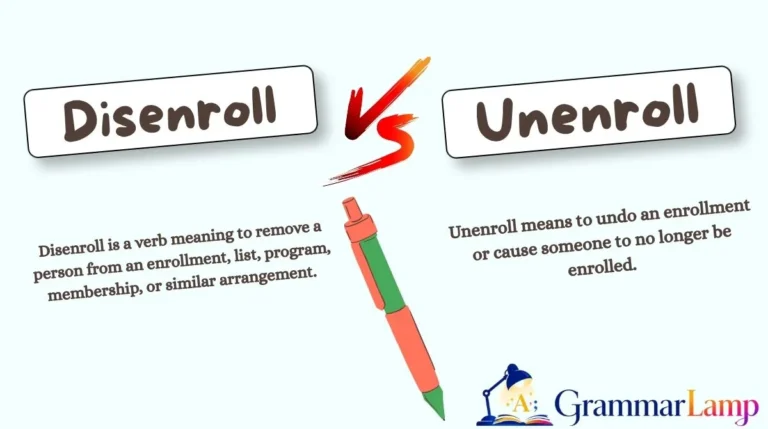
Disenroll is a verb meaning to remove a person from an enrollment, list, program, membership, or similar arrangement. Cambridge Dictionary explains it as removing someone’s name or your own name from a list, such as a list of organization members or a medical care plan.
Collins gives a slightly more specific explanation: disenroll can mean to dismiss someone or cause them to be removed from a program of training, care, or a similar service.
So, the basic idea is:
Disenroll = remove from an enrollment, roll, program, or membership.
The word is especially common in official, institutional, administrative, education, healthcare, and membership contexts.
For example, an organization may disenroll a member who no longer meets its requirements. A school may disenroll a student under certain rules. A health plan may disenroll a person when their eligibility changes.
Grammar rule for “disenroll”
Disenroll can be used as a verb. In a sentence, it may take a direct object when someone or something is removing another person:
The school disenrolled the student.
It can also appear without a direct object or in a passive structure:
The student was disenrolled from the program.
A useful structure is:
disenroll + someone + from + program/list/membership
Examples of “disenroll”
- The university may disenroll students who fail to complete the required forms.
- The company disenrolled several members from the benefits program.
- The academy disenrolled the trainee after repeated violations of its rules.
- Some families may choose to disenroll from the health plan.
- The organization decided to disenroll him from the membership list.
- She was disenrolled from the program after missing several required sessions.
- The school contacted us before it disenrolled our son.
- You can disenroll from the plan according to its withdrawal rules.
Notice that disenroll does not always mean that another person forced the removal. The important point is that the enrollment status has been ended or the person’s name has been removed. Cambridge explicitly includes both removing someone else’s name and removing your own name.
Common confusion about “disenroll”
Many learners think disenroll must mean “expel.” That is not always true.
For example:
The academy disenrolled the student.
This could mean that the academy removed the student from its program, perhaps because of a rule, eligibility issue, or administrative decision.
However:
I disenrolled from the course.
can simply mean that the speaker ended their own enrollment.
The surrounding context tells us why the enrollment ended.
What Does “Unenroll” Mean?
Unenroll means to undo an enrollment or cause someone to no longer be enrolled. The word is formed from un- + enroll, with un- commonly expressing reversal or removal.
In simple terms:
Unenroll = stop being enrolled or remove someone from enrollment.
The word appears often in education and digital learning. Students may unenroll from a course, unenroll from a class, or unenroll from an online program. Reverso examples also show unenroll being used for courses, memberships, services, and mailing lists.
Grammar rule for “unenroll”
Unenroll can be used in both intransitive and transitive patterns.
For example:
I decided to unenroll from the class.
Here, the subject is removing themselves.
You can also say:
The teacher unenrolled the student from the class.
Here, the subject is removing someone else.
The pattern unenroll from + noun is particularly natural when a person talks about leaving something themselves:
I unenrolled from the course.
Examples of “unenroll”
- I decided to unenroll from the evening class.
- She wants to unenroll from the online course.
- He accidentally joined the wrong class and had to unenroll.
- Students can unenroll from the course before the deadline.
- I need to unenroll my child from the program.
- They decided to unenroll from the training session.
- The website allows users to unenroll from a course.
- She unenrolled from the membership after moving to another city.
Common confusion about “unenroll”
Some learners think unenroll is not a proper English word because they hear disenroll more often in formal documents. That is too simple. Unenroll is an established form in actual English use, although dictionary coverage and frequency can vary between sources. Wiktionary lists it as a verb meaning to undo enrollment or cause someone to no longer be enrolled, while other dictionaries and language resources also record its use.
So you should not treat unenroll as a spelling mistake.
For everyday communication, especially about classes, websites, and online learning, it is easy to understand and commonly used.
Difference Between Disenroll and Unenroll
The biggest point to remember is that the two words overlap a lot. They are not perfect opposites or two completely different actions.
Both can describe ending an enrollment.
The practical difference is often one of context and focus.
| Feature | Disenroll | Unenroll |
|---|---|---|
| Basic meaning | Remove from enrollment | Undo enrollment |
| Common context | Programs, organizations, healthcare, administration | Courses, classes, online systems, memberships |
| Can describe self-removal? | Yes | Yes |
| Can describe removal of someone else? | Yes | Yes |
| Often sounds | More administrative | More direct and everyday |
| Common structure | disenroll someone from a program | unenroll from a course |
| Main idea | Removal from an official roll or program | Reversing an enrollment |
Usage difference
A useful tendency is that disenroll often sounds more institutional.
For example:
The health provider disenrolled the member.
This sounds like an administrative action.
Now compare:
I unenrolled from the online course.
This sounds like a personal choice made by the speaker.
However, this is a usage tendency, not a strict grammar rule. Cambridge allows disenroll for removing your own name as well as someone else’s, and unenroll can also be used transitively.
Grammar logic
Both words are built from enroll.
Enroll means to officially join or place someone in a class, institution, organization, or list. Collins describes enrollment as officially joining an institution or class.
Then we add a prefix:
dis + enroll → disenroll
un + enroll → unenroll
The prefixes both give the idea of reversing or ending the original state.
That is why the meanings are so close.
Sentence structure difference
These sentences are both grammatically possible:
I disenrolled from the course.
I unenrolled from the course.
The second may sound more natural in casual conversation to some speakers, especially when talking about an online class.
When an organization takes the action, both forms may also be possible:
The school disenrolled the student.
The school unenrolled the student.
The first can sound more formal or administrative, while the second can sound more like a simple description of what the system or school did.
Meaning comparison
Think about the focus of each word.
Disenroll often puts attention on removal from an official roll, program, or membership.
Unenroll often puts attention on undoing enrollment.
There is no major difference in the final result: the person is no longer enrolled.
That is why context matters more than trying to find a hard rule that always separates them.
Grammar Rules You Must Remember
Rule 1: Use “from” when saying what you leave
Both verbs commonly work with from when the person or organization leaves a course, program, plan, or membership.
I unenrolled from the class.
She disenrolled from the health plan.
They unenrolled from the training program.
The structure is:
verb + from + noun
Remember that enroll in and enroll on may be used differently depending on variety and context, but when describing the action of leaving, from is very common with both unenroll and disenroll.
Rule 2: Both can take an object
When someone removes another person, either verb can appear with an object.
The school disenrolled the student.
The administrator unenrolled the student.
Here, student is the object of the verb.
The pattern is:
subject + verb + person + from + program
For example:
The manager disenrolled Sam from the training program.
Rule 3: Do not confuse “unenroll” with “unroll”
These are different words.
Unenroll means to end enrollment.
I need to unenroll from the course.
Unroll means to open something that has been rolled up.
Please unroll the poster.
Only one extra en changes the meaning completely.
Rule 4: Use the organization’s own terminology when possible
Schools, websites, companies, healthcare providers, and membership systems may choose their own official terms.
A website may have a button that says Unenroll.
A policy document may use Disenroll or Disenrollment.
When you are filling out a form or writing an official message, following the organization’s wording is usually the clearest choice.
Explore More Posts
Ambiance vs Ambience: Meaning, Difference, Usage & Examples in 2026
Compared To vs As Compared To (2026): Meaning, Difference & Correct Usage
Gone to Soon vs Gone Too Soon: Which Is Correct? (2026 Guide)
Stayed vs Staid: Meaning, Difference, Examples & Easy Rules in 2026
Common Mistakes Students Make
Mistake 1: Thinking one word is wrong
A common learner asks:
Is “unenroll” wrong?
No. It is used as a verb meaning to undo enrollment or cause someone not to be enrolled.
Likewise, disenroll is a recognized dictionary word. Cambridge and Collins both list it.
Mistake 2: Assuming “disenroll” always means forced removal
Wrong idea:
Disenroll always means the school expelled me.
Not necessarily.
Correct understanding:
I disenrolled from the course.
This can describe your own decision.
For example:
I disenrolled from the course because my work schedule changed.
There is no idea of punishment here.
Mistake 3: Using “unroll” instead of “unenroll”
Incorrect:
I want to unroll from the class.
Correct:
I want to unenroll from the class.
Unroll is related to physical things such as paper, fabric, cables, or carpets.
Mistake 4: Forgetting “from”
Learners sometimes write:
I unenrolled the course.
This is unclear if they mean they left the course themselves.
Better:
I unenrolled from the course.
When you are removing someone else, you can use an object:
The administrator unenrolled me from the course.
Mistake 5: Treating the distinction as absolute
It is tempting to memorize a rule like this:
Unenroll = voluntary
Disenroll = forced
That can help as a beginner’s memory aid, but it is not a complete grammar rule.
Actual dictionary usage shows overlap. Cambridge says disenroll can involve removing your own name as well as someone else’s.
So context and local usage still matter.
Easy Trick to Remember the Difference
Here is a simple trick:
UN = undo
Think of words such as:
- unlock = undo a lock
- untie = undo a tie
- unwrap = undo wrapping
- unenroll = undo enrollment
So when you say:
I unenrolled from the course.
you can imagine yourself undoing your enrollment.
Now think of DIS as a word part often connected with separation or removal. With disenroll, imagine a person’s name being removed from an official roll or program.
A very simple classroom memory sentence is:
I unenroll; an office may disenroll me.
Again, this is a memory trick, not an absolute rule. Either verb can be used in more situations, but the trick helps you remember the common difference in tone and focus.
For a personal, everyday sentence, unenroll is often a comfortable choice:
I need to unenroll from this class.
For an official administrative action, disenroll may sound more natural:
The program disenrolled the participant.
Daily Life Examples
1. Online course
Student: I joined the wrong course.
Friend: Can’t you unenroll from it?
Student: Yes. I’ll do it now.
2. University class
I decided to unenroll from the class because it conflicts with my work schedule.
3. Training program
The academy may disenroll students who repeatedly ignore the safety rules.
4. Membership
I want to disenroll from the club before the new membership period starts.
5. Health plan
Some members may be disenrolled when they are no longer eligible for the plan.
This type of administrative use is especially natural with disenroll. Cambridge includes medical care plans among its examples of the word’s use.
6. School registration
Parent: Can I unenroll my daughter from the summer program?
Staff member: Yes, please complete this form.
7. Digital learning platform
If you do not need the class anymore, you can unenroll from the course through your account.
8. Organization
The organization disenrolled three members after reviewing their eligibility.
9. Personal decision
Tom: Are you still taking that class?
Mia: No. I unenrolled last week.
10. Official notice
Your membership may be disenrolled if the required documents are not submitted.
These examples show why it is better to learn both words instead of trying to remove one from your vocabulary.
Practice Section
Choose disenroll or unenroll to complete each sentence.
1.
I decided to ______ from the online course.
2.
The organization may ______ members who no longer meet the requirements.
3.
Can I ______ my child from the summer program?
4.
She was ______ from the health plan.
5.
He wants to ______ from the class before the deadline.
Answers
1. unenroll — “I decided to unenroll from the online course.”
2. disenroll — “The organization may disenroll members who no longer meet the requirements.”
3. unenroll — “Can I unenroll my child from the summer program?”
4. disenrolled — “She was disenrolled from the health plan.”
5. unenroll — “He wants to unenroll from the class before the deadline.”
Some answers can have more than one acceptable choice depending on context. The exercise simply shows the usage patterns that sound especially natural.
More Helpful posts
Newfound vs New-Found: Which Is Correct in 2026?
Over Time vs Overtime: Meaning, Difference, Examples & Rules in 2026
Year Old or Years Old? Easy Grammar Guide for 2026
Lieu vs Loo: Meaning, Difference, Usage, and Examples in 2026
FAQs
What is the difference between disenroll and unenroll?
Both words mean ending or reversing an enrollment. Disenroll often sounds more administrative and is commonly used for removing someone from an official program, membership, or plan. Unenroll often sounds more direct and is common when someone talks about leaving a class or online course. The meanings overlap, so the difference is not absolute.
Can we use unenroll in questions?
Yes. Unenroll can easily be used in questions.
Can I unenroll from this course?
How do I unenroll from the class?
These are natural questions, especially in educational and online settings.
Is disenroll formal or informal?
Disenroll can sound more formal or administrative, especially when used in official programs, organizations, healthcare, and membership contexts. That does not mean it is too formal for everyday English. Its suitability depends on the situation and the wording used by the organization.
Is “unenroll” a real English word?
Yes. Unenroll is used as a verb meaning to undo enrollment or cause someone to no longer be enrolled. It is particularly common in education and digital services.
Should I say “disenroll from school” or “unenroll from school”?
Both can be understood, but unenroll from school may sound more like a personal decision, while disenroll from school can sound more administrative. In many real situations, withdraw from school or leave school may also be more natural, depending on exactly what you mean.
What is the past tense of disenroll and unenroll?
The past tense and past participle are disenrolled and unenrolled.
Examples:
She disenrolled from the program.
He unenrolled from the course.
For both verbs, the spelling keeps the final l before -ed in standard American spelling.
Conclusion
The choice between disenroll and unenroll becomes much easier once you stop looking for a rule that separates them completely. Both words are used to describe ending an enrollment or removing someone from an enrolled status.
Disenroll often appears in official, administrative, organizational, healthcare, and program-related situations.
Unenroll is especially common when talking about leaving a class, course, online program, or other enrollment personally. Still, the two words overlap, and real English allows both to be used in more than one situation.
A good beginner rule is simple: think of unenroll as “undo enrollment,” and remember that disenroll often sounds more connected with official removal from a roll or program.
Most importantly, look at the context. Notice how schools, websites, companies, and organizations use the words around you.
The more examples you see, the more natural the difference will become.

Liam Derren is a language writer at GrammarLamp, creating simple, helpful content about grammar, words, and everyday English. He makes language learning clear, practical, and easy to understand.