
Have you ever written ambiance and then wondered whether it should be ambience? This is a common problem for English learners because the two words look slightly different, but they mean almost exactly the same thing.
You may see one spelling in a restaurant review and the other in a book, website, or newspaper.
The good news is that you usually do not have to worry about choosing the wrong word. Ambiance and ambience are both standard English spellings.
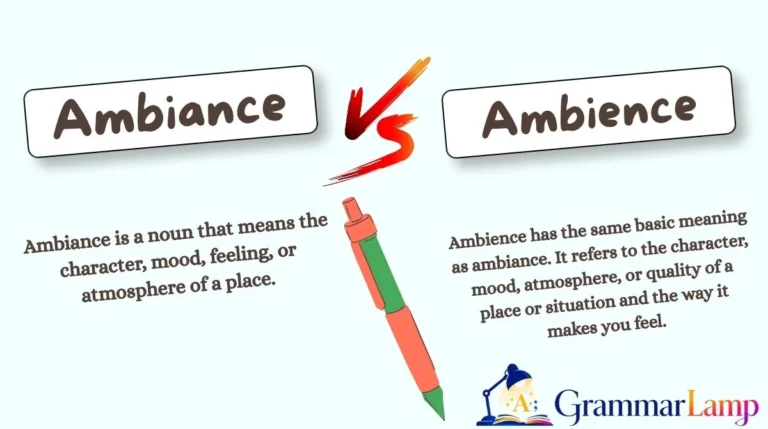
They are nouns used for the character, feeling, mood, or atmosphere of a place or situation.
Major dictionaries such as Cambridge and Oxford list ambiance as an alternative form of ambience, confirming that the two forms have the same basic meaning.
The small difference comes mainly from spelling preference and regional usage. Ambience is very common in British English, while ambiance is especially familiar in American English.
However, both spellings can be found in both varieties, so neither one is grammatically wrong.
By the end, you will know what each spelling means, how to use it naturally, which form to choose in different situations, and how to avoid the common mistakes learners make with these words.
More Useful posts
Year Old or Years Old? Easy Grammar Guide for 2026
Lieu vs Loo: Meaning, Difference, Usage, and Examples in 2026
Is It Worth It vs Does It Worth It? 2026 Grammar Guide
Good for Me vs Good to Me: Meaning, Difference, and Examples (2026)
What Does “Ambiance” Mean?
Ambiance is a noun that means the character, mood, feeling, or atmosphere of a place. It describes the overall feeling you get from a restaurant, hotel, room, café, city, event, or another setting.
For example, when someone says, “I love the ambiance of this café,” they are not talking only about the furniture. They may mean the lighting, music, decoration, colors, noise level, people, and general feeling of the place.
Cambridge lists ambiance as an alternative spelling of ambience, while Oxford also gives ambiance as another form. Both dictionaries connect the word with the character and atmosphere of a place.
When should you use “ambiance”?
Use ambiance when you want to talk about the feeling or atmosphere created by a place or situation.
It is especially common when describing:
- restaurants and cafés
- hotels and resorts
- homes and rooms
- shops
- parties and events
- cities and neighborhoods
- workplaces
- art galleries and theaters
For example, a restaurant may have soft music, warm lighting, wooden furniture, and quiet tables. You can describe all of those features together by saying the restaurant has a pleasant ambiance.
Grammar rule for “ambiance”
Ambiance is a noun.
It can appear after words such as the, a, its, this, that, good, pleasant, relaxing, warm, romantic, peaceful, modern, and quiet.
Common patterns include:
the ambiance of + place
The ambiance of the hotel was peaceful.
a + adjective + ambiance
The restaurant has a warm ambiance.
ambiance + of + noun
I enjoyed the ambiance of the old town.
It can also be used after verbs such as create, enjoy, improve, change, add to, and love.
Examples of “ambiance”
- The restaurant has a warm and friendly ambiance.
- We loved the romantic ambiance of the café.
- Soft lights can create a relaxing ambiance.
- The hotel is known for its elegant ambiance.
- The candles added to the cozy ambiance of the room.
- I really enjoyed the peaceful ambiance of the garden.
- The music changed the ambiance of the party.
- The new furniture gives the office a more modern ambiance.
Common learner confusion about “ambiance”
The biggest confusion is usually the spelling. Students may think ambiance is the correct American form and ambience is the correct British form, with no overlap at all.
That is too strict.
Both dictionaries treat the forms as alternatives. Cambridge gives ambiance as an alternative to ambience, and Oxford does the same.
Another common mistake is thinking that ambiance means only “beautiful decoration.” It does not. A place can have a dark ambiance, sad ambiance, busy ambiance, quiet ambiance, or energetic ambiance.
The word describes the overall feeling, not simply whether a place looks attractive.
What Does “Ambience” Mean?
Ambience has the same basic meaning as ambiance. It refers to the character, mood, atmosphere, or quality of a place or situation and the way it makes you feel.
Cambridge defines ambience as the character of a place or the quality it seems to have. Oxford describes it as the character and atmosphere of a place. Both dictionaries list ambiance as an alternative spelling.
The main difference is not meaning. It is simply the spelling.
When should you use “ambience”?
Use ambience when describing the general feeling of a place or setting.
For many British English readers, ambience is a very familiar spelling. It is common in writing about restaurants, travel, hotels, homes, events, and cultural spaces.
For example:
The ambience of the restaurant was calm and welcoming.
This means the restaurant created a calm and welcoming feeling.
Grammar rule for “ambience”
Like ambiance, ambience is a noun.
You can use it with adjectives:
a peaceful ambience
a stylish ambience
a lively ambience
You can also use it with the:
The ambience was perfect.
Another useful structure is:
the ambience of + place
For example:
We enjoyed the ambience of the hotel.
You can also use common verbs with the word:
create an ambience
enjoy the ambience
change the ambience
improve the ambience
add to the ambience
Examples of “ambience”
- The café has a relaxed ambience.
- The low lighting gives the room a romantic ambience.
- I love the quiet ambience of this library.
- The hotel has a beautiful seaside ambience.
- The new plants have improved the ambience of the office.
- The music creates a lively ambience.
- We chose the restaurant because of its friendly ambience.
- The old building has a special ambience that modern buildings do not have.
Common learner confusion about “ambience”
Learners sometimes think the extra e in ambience changes the pronunciation or meaning. It does not create a different meaning.
You should treat ambience and ambiance as two spelling forms of the same word.
Another problem comes from pronunciation. Cambridge gives different pronunciation patterns for British and American English, but the spelling difference is not a difference in meaning.
A useful habit is to focus first on the meaning:
Ambience / ambiance = the feeling or atmosphere of a place.
Once that is clear, the spelling becomes much easier to handle.
Difference Between Ambiance and Ambience
The most important point is this:
Ambiance and ambience have the same meaning.
They are both nouns that describe the character, mood, or atmosphere of a place or situation. Oxford and Cambridge both list one as an alternative form of the other.
Comparison table
| Feature | Ambiance | Ambience |
|---|---|---|
| Part of speech | Noun | Noun |
| Basic meaning | Character or atmosphere of a place | Character or atmosphere of a place |
| Meaning difference | None | None |
| Spelling | Ambiance | Ambience |
| Common association | Often familiar in American English | Often familiar in British English |
| Can describe a place? | Yes | Yes |
| Can describe a situation? | Yes | Yes |
| Is it correct English? | Yes | Yes |
| Formal or informal? | Standard noun | Standard noun |
The regional point deserves a little care. Ambience is commonly associated with British English, while ambiance is especially familiar in American English, but both forms appear in both varieties. Cambridge and Oxford list the spellings as alternatives rather than treating one as incorrect.
Usage difference
There is no major difference in what the two words communicate.
Compare these sentences:
The restaurant has a wonderful ambiance.
The restaurant has a wonderful ambience.
The meaning is the same.
You can replace one with the other without changing the basic message.
Grammar logic
Both words function as nouns.
They can be the subject:
The ambience was relaxing.
They can be the object:
I loved the ambiance.
They can follow a preposition:
We talked about the ambience of the hotel.
They can be modified by adjectives:
a cozy ambiance
a peaceful ambience
This is why learners should not try to create separate grammar rules for the two forms. The grammar stays the same because the word is essentially the same noun with two accepted spellings.
Sentence structure difference
There is no special sentence structure for one spelling.
You do not need a different verb with ambiance and ambience. You do not use one spelling in questions and the other in statements.
For example:
What is the ambiance like?
What is the ambience like?
Both are possible.
Likewise:
The ambiance of the restaurant is lovely.
The ambience of the restaurant is lovely.
Both express the same idea.
Meaning comparison
Think of the two forms as twins.
They look slightly different, but they do the same job.
When someone talks about a place’s ambience or ambiance, they may be describing its:
- lighting
- music
- colors
- decoration
- noise level
- design
- energy
- mood
- general feeling
So, ambiance does not mean one thing while ambience means another.
Explore More Posts
Whether It Be vs Whether It Is: Meaning, Difference, and Correct Use in 2026
EG vs IE: Easy Difference, Meaning, Rules, and Examples in 2026
Dragged vs Drug: What Is the Difference? Easy Guide for 2026
Consult With, To, On or About: Which Is Correct? 2026
Grammar Rules You Must Remember
Rule 1: Both spellings are correct
Do not think that one spelling is a mistake.
Ambiance and ambience are both accepted forms. Major dictionaries list them as alternatives.
Example:
The café has a peaceful ambiance.
The café has a peaceful ambience.
Both sentences are correct.
Rule 2: Both are nouns
Do not use ambiance or ambience as if they were adjectives.
You can say:
The hotel has a beautiful ambience.
But you should not say:
The hotel is very ambience.
The adjective is not ambience. A natural sentence would be:
The hotel has a beautiful ambience.
Or:
The hotel has a relaxing atmosphere.
Rule 3: Use them for atmosphere or character
These words describe the feeling or character of a setting.
Example:
The soft music created a calm ambience.
The word ambience describes the overall feeling produced by the environment.
Rule 4: Keep the spelling consistent
If you are writing for a website, essay, school assignment, or company document, choose one spelling and use it consistently.
For example, if you start with:
The restaurant has a pleasant ambience.
there is no need to switch later to:
The restaurant has a romantic ambiance.
You are not wrong to switch, but consistency usually makes your writing look cleaner.
Common Mistakes Students Make
Many mistakes with these words are not grammar mistakes. They are usually spelling, meaning, or consistency mistakes.
Mistake 1: Thinking “ambiance” is wrong
Some learners have only seen ambience, so they assume ambiance is misspelled.
That is not correct.
Wrong idea:
Ambiance is not a real English word.
Correct understanding:
Ambiance is an accepted spelling of the noun.
Oxford and Cambridge both support this usage.
Mistake 2: Thinking they have different meanings
A learner may ask:
“Ambiance is the mood, but ambience is the atmosphere, right?”
Not really.
They can both refer to the character, mood, feeling, or atmosphere of a place.
Compare:
I love the ambiance of this hotel.
I love the ambience of this hotel.
The message is the same.
Mistake 3: Using the word for physical surroundings only
Ambiance is more than the physical environment.
Consider:
The restaurant has beautiful chairs.
This describes a physical feature.
But:
The restaurant has a warm ambience.
This describes the overall feeling created by many things together.
The chairs may be part of that feeling, but the word refers to the bigger picture.
Mistake 4: Using it like an adjective
Incorrect:
It is a very ambience restaurant.
Correct:
It is a restaurant with a lovely ambience.
Or:
It is a restaurant with a lovely ambiance.
Mistake 5: Mixing spellings randomly
Both forms are correct, but random switching can make writing look careless.
For polished writing, pick one form and stay with it.
Easy correction tip
Whenever you see ambiance or ambience, ask:
“Am I talking about the overall feeling or character of a place?”
If the answer is yes, the word may be right.
Then check your spelling choice and keep it consistent.
Easy Trick to Remember the Difference
Here is the easiest trick:
Ambiance = Ambience = Atmosphere
Think of all three as members of the same family.
When you enter a restaurant, you notice more than the food. You notice the lights, music, tables, smells, people, noise, and general mood.
Together, these things help create the restaurant’s ambience or ambiance.
Another simple memory trick is:
“A and E both work.”
You can remember that the middle spelling can have A:
ambiance
or E:
ambience
Both are accepted.
Real-life logic
Imagine two students standing outside a café.
One says:
“I like the ambiance here.”
The other says:
“Yes, the ambience is really relaxing.”
They are not disagreeing about grammar. They are using two accepted spellings for the same noun.
That is the key idea to remember.
Do not waste time trying to find a deep difference where there is none.
Daily Life Examples
Here are some natural examples you may hear or use in everyday English.
Example 1: At a restaurant
A: How do you like this restaurant?
B: I love it. The ambience is really nice.
Here, ambience means the overall feeling of the restaurant.
Example 2: Talking about a café
A: Why do you always come here?
B: The coffee is good, but I really like the ambiance.
The speaker likes the atmosphere as well as the coffee.
Example 3: Choosing a hotel
A: Did you enjoy the hotel?
B: Yes. It had a peaceful ambience.
The hotel created a calm feeling.
Example 4: Talking about a wedding
A: Everything looked beautiful at the wedding.
B: Yes, and the romantic ambiance made it even better.
Here, ambiance describes the mood of the event.
Example 5: At home
A: Your room feels different today.
B: I changed the lights. They create a warmer ambience.
The lighting changes the feeling of the room.
Example 6: At work
A: How is your new office?
B: It has a much more relaxed ambiance.
The speaker is talking about the general feeling of the workplace.
Example 7: Talking about a city
A: What do you like about the old part of the city?
B: I love its quiet ambience and old buildings.
The word describes the special character of that area.
Example 8: At a coffee shop
A: This place is always busy.
B: True, but it still has a friendly ambience.
The place can be busy and still feel pleasant.
Example 9: Talking about music
A: Why do you like this small restaurant?
B: The music creates a lovely ambiance.
Music is one factor that helps create the overall mood.
Example 10: Talking about a room
A: Should we use candles for dinner tonight?
B: Yes. They will give the room a cozy ambience.
The candles help create a certain feeling.
Practice Section
Choose the better option in each sentence. Remember that both spellings are correct, so the exercise mainly tests whether you understand the meaning and grammar.
1. The restaurant has a very relaxing ______.
A. ambiance
B. ambience
2. Soft lights can create a romantic ______.
A. ambiance
B. ambience
3. I love the ______ of this old library.
A. ambiance
B. ambience
4. The new decorations have improved the ______ of the room.
A. ambiance
B. ambience
5. What do you think of the ______ in this café?
A. ambiance
B. ambience
Answers
- A or B — both are correct
- A or B — both are correct
- A or B — both are correct
- A or B — both are correct
- A or B — both are correct
The important lesson is that the two spellings do not create different meanings.
More Helpful posts
Run vs Ran: What Is the Difference? Easy Grammar Guide 2026
It Worth It or Is It Worth It? Which One Is Correct in 2026?
Symbol vs Cymbal 2026: Meaning, Difference, Examples, and Easy Grammar Rules
In My Spare Time or On My Spare Time in 2026? The Correct Expression Explained
FAQs
What is the difference between ambiance and ambience?
There is no important difference in meaning. Both words are nouns meaning the character, mood, atmosphere, or general feeling of a place or situation. Cambridge and Oxford list them as alternative forms.
Is ambiance American or British English?
Ambiance is especially familiar in American English, while ambience is strongly associated with British English. However, both spellings are used in both varieties, so it is not correct to treat one as completely forbidden in the other.
Can I use ambience in American English?
Yes. American English speakers and writers use ambience, and American dictionaries also recognize it. Cambridge’s American English entry lists ambience with ambiance as an alternative.
Can I use ambiance in British English?
Yes. British English can also use ambiance. Cambridge’s British English entry lists ambiance as an alternative form of ambience.
Can ambiance and ambience be used in questions?
Yes. Both can be used naturally in questions.
For example:
What is the ambience like?
or:
What is the ambiance like?
You can also ask:
How do you like the ambience of this restaurant?
The grammar does not change because of the spelling.
Is ambience formal or informal?
Ambience is a standard English noun and can be used in everyday speech as well as formal writing. It is common when talking about restaurants, hotels, design, travel, and other settings. In casual conversation, people may also use simpler words such as atmosphere or vibe. Cambridge lists atmosphere and vibe among related terms.
Is “ambience” only used for beautiful places?
No. A place can have a pleasant, dark, tense, lively, strange, peaceful, or uncomfortable ambience. The word describes the overall character or feeling, not whether the place is good or attractive.
For example:
The office had a tense ambience.
This means the workplace felt tense.
Should I use ambiance or ambience in SEO content?
Either spelling can be used because both are correct. For one page, however, it is usually better to choose a primary spelling and use it naturally and consistently. You can mention the alternative spelling once or twice so readers understand the relationship between the two words.
Conclusion
Ambiance and ambience are not two different words with different meanings. They are two accepted spellings of the same noun.
Both describe the character, mood, atmosphere, or general feeling of a place or situation.
Oxford and Cambridge both recognize the two forms, with ambiance commonly associated with American English and ambience especially familiar in British English.
The most important thing is to understand the meaning, not to worry about a small spelling difference. You can talk about the ambiance of a restaurant, the ambience of a hotel, or the ambiance of a room.
When writing, choose the spelling that fits your preferred variety of English, your audience, or your style guide. Then use it consistently.
Once you remember ambiance = ambience = atmosphere, this confusing pair becomes much easier. A little practice with real sentences will help the difference feel natural every time you write or speak.

Liam Derren is a language writer at GrammarLamp, creating simple, helpful content about grammar, words, and everyday English. He makes language learning clear, practical, and easy to understand.
1 thought on “Ambiance vs Ambience: Meaning, Difference, Usage & Examples in 2026”