
English learners often get confused when they want to ask if something is valuable, useful, or a good choice.
Two sentences that look very similar are “Is it worth it?” and “Does it worth it?” Because both sentences seem to ask about the value of something, many learners think they can use either one.
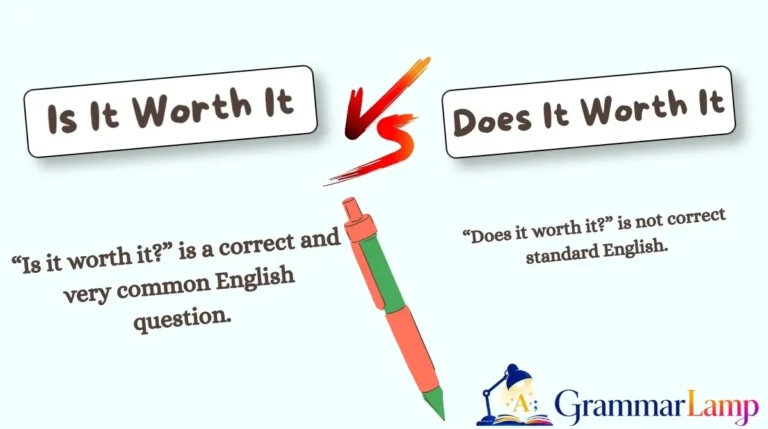
However, these two sentences are not equal. “Is it worth it?” is correct English, while “Does it worth it?” is grammatically incorrect in standard English.
This confusion usually happens because learners know that do and does are used to make questions.
For example, we say, “Does it work?” and “Does it help?” So, learners may naturally think that “Does it worth it?” should also be correct.
The problem is that worth does not work like a normal verb in this expression. In “It is worth it,” the word worth describes the value of something, so we use the verb is.
After reading this guide, you will understand why we say “Is it worth it?”, why “Does it worth it?” is wrong, how to use worth with money, time, effort, and experiences, and what to say instead when you want to use does.
More Useful posts
Dialog vs Dialogue: What’s the Difference? A Simple English Guide for 2026
Learned vs Learnt: What’s the Difference? A Simple Guide for 2026
It’s vs Its: Simple Difference, Rules, Examples & Practice (2026)
Enamor vs Enamour: What’s the Difference? Meaning, Usage & Examples in 2026
What Does “Is It Worth It?” Mean?
“Is it worth it?” is a correct and very common English question.
We use it when we want to ask whether something is valuable enough to justify its cost, time, effort, trouble, or risk.
The word worth means having a particular value. In everyday English, worth it often means that the result is good enough to make something a good choice.
For example:
“This phone is expensive. Is it worth it?”
Here, the speaker is asking whether the phone is good enough to justify its high price.
The basic structure is:
Is + subject + worth + it?
Examples:
- Is it worth it?
- Is this phone worth it?
- Is the trip worth it?
- Is this course worth the money?
- Is it worth the effort?
- Is waiting two hours worth it?
- Is buying a new laptop worth it?
- Is the extra cost worth it?
Notice that we use is, not does, in this question.
Why do we use “is”?
Look at the normal statement:
It is worth it.
When we turn this statement into a question, we move is to the beginning:
Is it worth it?
This is the same pattern we use with many sentences containing be.
For example:
It is expensive.
→ Is it expensive?
It is useful.
→ Is it useful?
It is worth it.
→ Is it worth it?
This makes the grammar easier to understand.
“Worth it” can refer to different things
The phrase worth it does not only talk about money.
It can talk about time:
“I spent three hours fixing my old computer. Was it worth it?”
It can talk about effort:
“Learning English takes time, but it is worth it.”
It can talk about trouble:
“The restaurant was far away, but the food was worth it.”
It can talk about a difficult experience:
“The training was hard, but it was worth it.”
It can also talk about risk:
“Do you think the risk is worth it?”
So, worth it is a flexible expression used in many everyday situations.
A common learner confusion
Many learners think worth is a normal action verb because it appears in a sentence with it.
But compare:
It works.
It helps.
It costs a lot.
These use normal verbs.
With worth, we normally say:
It is worth it.
That is why the question becomes:
Is it worth it?
Not:
Does it worth it?
What Does “Does It Worth It?” Mean?
“Does it worth it?” is not correct standard English.
You may hear similar mistakes from English learners, but native speakers normally do not use worth this way.
The main problem is the grammar structure.
Does is used to make questions with a main verb.
For example:
- Does it work?
- Does it help?
- Does it matter?
- Does it cost a lot?
- Does it take long?
- Does it look good?
In these sentences, work, help, matter, cost, take, and look are verbs.
But in the expression “worth it,” we use worth after a form of be:
It is worth it.
Therefore, the correct question is:
Is it worth it?
Why “does it worth it” sounds wrong
When we use does, the word after it normally needs to be the base form of a verb.
For example:
Does he work here?
The verb is work.
Does she like coffee?
The verb is like.
Does this help you?
The verb is help.
But worth is not being used as the main verb in:
It is worth it.
The verb is is.
So we cannot simply replace is with does.
Compare these sentences
❌ Does it worth it?
✅ Is it worth it?
❌ Does the price worth it?
✅ Is the price worth it?
❌ Does the course worth it?
✅ Is the course worth it?
❌ Does buying this phone worth it?
✅ Is buying this phone worth it?
The easiest correction is to look for worth and ask yourself:
“Am I talking about whether something has enough value?”
If yes, you will usually need is/are/was/were, depending on the subject and tense.
What can you use with “does”?
If you really want to use does, choose a real verb.
For example:
Does it help?
Does it work?
Does it cost a lot?
Does it save time?
These questions are correct because help, work, cost, and save are verbs.
Difference Between “Is It Worth It?” and “Does It Worth It?”
The main difference is simple: “Is it worth it?” is grammatically correct, while “Does it worth it?” is incorrect.
Here is a quick comparison:
| Expression | Correct? | Reason |
|---|---|---|
| Is it worth it? | ✅ Correct | Uses is + worth |
| Does it worth it? | ❌ Incorrect | worth is not used as the main verb here |
| Is this worth it? | ✅ Correct | Correct be + worth structure |
| Does this help? | ✅ Correct | help is a verb |
| Does this cost a lot? | ✅ Correct | cost is a verb |
| Is this worth the money? | ✅ Correct | Correct use of worth |
Usage difference
There is no real difference in meaning because “does it worth it” is not a correct standard construction.
If you want to ask whether something is a good use of money, time, or effort, use:
Is it worth it?
For example:
“The laptop costs $1,500. Is it worth it?”
You could also say:
“Does it offer enough features for the price?”
Here, does is correct because offer is a verb.
Grammar logic
The statement is:
It is worth it.
The question is:
Is it worth it?
This follows the normal English question pattern with the verb be.
Compare:
She is ready.
→ Is she ready?
The movie is good.
→ Is the movie good?
The trip is worth it.
→ Is the trip worth it?
The same grammar is working in all three examples.
Sentence structure
The structure of “Is it worth it?” is:
Is + subject + worth + object/pronoun?
- Is = verb “be”
- it = subject
- worth = word showing value
- it = thing being evaluated
Example:
Is the trip worth it?
Here, the trip is the subject.
Example:
Is the extra money worth it?
Here, the extra money is the subject.
Example:
Is waiting this long worth it?
Here, waiting this long is the subject.
Meaning comparison
The correct expression asks:
“Does this thing have enough value to justify what I have to give?”
That “something” could be:
- money
- time
- effort
- energy
- inconvenience
- risk
For example:
“The concert tickets are expensive. Are they worth it?”
The question is not only about the price. It asks whether the experience is valuable enough for the money.
Explore More Posts
I’ve Added vs I Added: Easy Difference, Rules & Examples (2026)
This Is She or This Is Her? The Correct Choice in English in 2026
Jewel vs Joule: Meaning, Difference, Examples & Easy Rules (2026)
Foul or Fowl: Meaning, Difference, Examples & Easy Rules for 2026
Grammar Rules You Must Remember
Rule 1: Use “is” with “worth it”
The most important rule is simple:
Use “is/are/was/were” with worth when worth describes value.
Examples:
Is it worth it?
Is this book worth the price?
Are these shoes worth the money?
Was the trip worth it?
Were the lessons worth the cost?
Do not say:
❌ Does it worth it?
Rule 2: “Does” needs a main verb
We use does to make present simple questions with singular subjects such as he, she, it, or a singular noun.
Examples:
Does it work?
Does she like it?
Does he understand?
Does this help?
Does the machine use a lot of electricity?
Here, work, like, understand, help, and use are verbs.
So, if you want to use does, you need a suitable verb.
Rule 3: “Worth” can be followed by a noun or -ing form
We can use worth + noun:
This car is worth the money.
The painting is worth $500.
The book is worth the price.
We can also use worth + -ing:
It is worth trying.
It is worth watching.
It is worth learning.
It is worth visiting.
It is worth buying.
Notice that we do not say:
❌ It is worth to try.
Instead:
✅ It is worth trying.
This is another important pattern for English learners.
Rule 4: “Worth it” means “valuable enough”
When someone says:
“It was worth it.”
They usually mean the result was good enough to justify the cost, effort, time, or difficulty.
For example:
“I waited three hours for the concert, but it was worth it.”
The person means that the concert was good enough to make those three hours acceptable.
Another example:
“The course was difficult, but it was worth it.”
The speaker thinks the benefits of the course were valuable enough to justify the difficulty.
Common Mistakes Students Make
Many mistakes with worth it come from translating directly from another language or treating worth like a normal action verb.
Mistake 1: Using “does” before “worth”
❌ Does it worth it?
✅ Is it worth it?
The correction is easy: remember the basic sentence:
It is worth it.
Then change it into a question:
Is it worth it?
Mistake 2: Saying “Does it worth the money?”
❌ Does it worth the money?
✅ Is it worth the money?
The correct pattern is:
Subject + is + worth + noun
So:
This phone is worth the money.
Question:
Is this phone worth the money?
Mistake 3: Using “worth to”
Some learners say:
❌ It is worth to buy.
This is not the normal structure.
Say:
✅ It is worth buying.
More examples:
❌ It is worth to watch.
✅ It is worth watching.
❌ It is worth to try.
✅ It is worth trying.
❌ It is worth to learn.
✅ It is worth learning.
Mistake 4: Confusing “worth it” with “cost”
These expressions are related, but they are not the same.
How much does it cost?
asks about the price.
Is it worth it?
asks whether the thing is valuable enough for that price.
For example:
“The phone costs $1,000. Is it worth it?”
The first sentence asks for the price. The second asks about value.
Easy correction tip
When you want to ask about value, try making a statement first.
Instead of thinking:
“Does it worth it?”
Think:
“It is worth it.”
Now turn it into a question:
“Is it worth it?”
This simple trick can prevent the mistake.
Easy Trick to Remember the Difference
Here is a very easy memory trick:
WORTH = IS
When you use worth to talk about value, remember:
It IS worth it.
So:
IS it worth it?
Think of these as a pair:
It is worth it.
Is it worth it?
If you see worth it, your first thought should be is.
What about “does”?
Think:
DOES + ACTION VERB
For example:
Does it work?
Does it help?
Does it cost a lot?
Does it save money?
These words describe actions or processes.
But:
Is it worth it?
talks about value.
A real-life way to remember
Imagine you are buying a new phone.
You can ask:
How much does it cost?
This asks about the price.
Then you can ask:
Is it worth it?
This asks whether the phone is valuable enough for that price.
You can also ask:
Does it work well?
This asks about performance.
So remember:
Does it cost?
Does it work?
Does it help?
But:
Is it worth it?
That difference is enough to solve most beginner mistakes.
Daily Life Examples
Here are some natural examples you may hear in everyday English.
1. Buying a new phone
Ali: This phone costs $900.
Hamza: Wow, that’s expensive.
Ali: I know. Do you think it’s worth it?
Hamza: If you need the camera and battery life, maybe.
Here, “Is it worth it?” asks whether the phone is valuable enough for its price.
2. Going to a restaurant
Sara: The restaurant is an hour away.
Mina: Really?
Sara: Yes, but the food is supposed to be amazing.
Mina: Is it worth the drive?
Sara: I think so.
The phrase worth the drive means valuable enough to justify the long drive.
3. Taking an English course
Student: The course costs $300.
Friend: Does it include speaking practice?
Student: Yes, and there are live classes.
Friend: Then it might be worth it.
Here, worth it refers to the money and the possible benefits.
4. Waiting in a long line
Tom: We’ve been waiting for an hour.
Jack: I know.
Tom: Is it worth waiting?
Jack: I think the tickets will sell out, so yes.
Here, the speaker is asking whether continuing to wait is a good use of time.
5. Buying expensive shoes
A: These shoes are really expensive.
B: Are they comfortable?
A: Very.
B: Then they may be worth the money.
6. Studying for an exam
Student: I don’t want to study tonight.
Brother: You have an exam tomorrow.
Student: I know.
Brother: A few extra hours of study could be worth it.
Here, worth it refers to the effort and possible result.
7. Traveling for a concert
Mike: The concert is in another city.
John: Are you going?
Mike: Yes. It’s my favorite band.
John: That’s a long trip.
Mike: I know, but it will be worth it.
8. Fixing an old computer
David: My computer is ten years old.
Sam: How much will the repair cost?
David: About $100.
Sam: Is it worth repairing?
David: Probably not. I think I’ll buy a new one.
Here, worth repairing asks whether repairing the computer is a good choice.
9. Learning a difficult skill
Student: Coding is difficult.
Teacher: It can be at first.
Student: Should I continue?
Teacher: Yes. Learning it will take time, but it can be worth it.
10. Going to the gym
Friend 1: The gym is a little far from my house.
Friend 2: Do you like it?
Friend 1: Yes. The trainers are great.
Friend 2: Then it sounds like it’s worth the extra travel.
Practice Section
Choose the correct option in each sentence.
1. ______ worth it?
A. Does it
B. Is it
2. ______ this book worth the money?
A. Is
B. Does
3. ______ this machine work properly?
A. Is
B. Does
4. It is worth ______.
A. trying
B. to try
5. ______ the trip worth the time?
A. Is
B. Does
Answers
1. B — Is it worth it?
2. A — Is this book worth the money?
3. B — Does this machine work properly?
4. A — It is worth trying.
5. A — Is the trip worth the time?
If you got these wrong, don’t worry. The main idea is to remember that worth normally works with a form of be when we talk about value.
More Helpful posts
Berth vs Birth: Meaning, Difference, Examples & Easy Rules for 2026
Insight vs Incite: What’s the Difference? Easy Guide for 2026
In the Same Day vs On the Same Day: Which Is Correct? A Simple Guide for 2026
Licence or License: Which Spelling Is Correct in 2026?
FAQs
What is the difference between “is it worth it” and “does it worth it”?
“Is it worth it?” is correct English. “Does it worth it?” is grammatically incorrect in standard English.
We use is because the normal statement is “It is worth it.” When we make a question, it becomes “Is it worth it?”
Can we use “does” with “worth”?
You cannot normally use does + worth in the expression “does it worth it.”
If you want to use does, use a verb such as work, help, cost, or matter. For example, “Does it work?” and “Does it help?”
Is “Is it worth it?” formal or informal?
“Is it worth it?” is a natural expression used in both everyday and more formal conversations.
You can use it when talking to friends, teachers, coworkers, or customers. The exact meaning depends on whether you are talking about money, time, effort, or another type of value.
Is “Does it worth it?” ever correct?
No, “Does it worth it?” is not the standard grammatical form.
Use “Is it worth it?” instead. If you want to use does, you need another verb, such as “Does it cost a lot?” or “Does it help?”
Is it correct to say “It is worth to buy”?
No. The normal structure is “It is worth buying.”
After worth, we commonly use a noun or an -ing form. For example, “It is worth the money,” “It is worth trying,” and “It is worth watching.”
Can I say “Is it worth the money?”
Yes. “Is it worth the money?” is completely correct and very common.
It asks whether something has enough value to justify its price. For example, “This laptop is expensive. Is it worth the money?”
What is the difference between “Is it worth it?” and “Does it cost a lot?”
These questions ask different things.
“Does it cost a lot?” asks about price. “Is it worth it?” asks whether the thing is valuable enough to justify that price, time, or effort.
Can “worth it” talk about time and effort?
Yes. Worth it can describe much more than money.
You can say, “Is it worth the wait?” “Is it worth the effort?” or “Was the trip worth it?” The expression means that the result is valuable enough to justify what you had to give or experience.
Conclusion
The difference between “Is it worth it?” and “Does it worth it?” is easy once you understand the grammar behind worth.
“Is it worth it?” is the correct expression. We use it when asking whether something has enough value to justify its cost, time, effort, trouble, or risk.
“Does it worth it?” is incorrect because worth is not being used as a normal action verb in this structure. The basic statement is “It is worth it,” so the question becomes “Is it worth it?”
Also remember the useful patterns worth + noun and worth + -ing:
- It is worth the money.
- It is worth the effort.
- It is worth trying.
- It is worth watching.
When you are unsure, make a statement first: “It is worth it.” Then turn it into a question: “Is it worth it?”
With a little practice, this pattern will become natural. The next time you want to ask about the value of something, you will know exactly which form to use.

Liam Derren is a language writer at GrammarLamp, creating simple, helpful content about grammar, words, and everyday English. He makes language learning clear, practical, and easy to understand.
2 thoughts on “Is It Worth It vs Does It Worth It? 2026 Grammar Guide”