
Many English learners wonder whether they should say “listen to music” or “listen to the music.”
Both expressions are correct, and that is exactly why this small difference can feel confusing.
The main difference is not the verb listen. The important difference is the word “the.” We usually say “listen to music” when we are talking about music in general.
We use “listen to the music” when we mean a particular kind of music, song, recording, or music that the other person can identify from the situation.
For example, you might say, “I listen to music when I study.” Here, you are talking about the activity in general. You are not pointing to one specific piece of music.
But imagine that you are at a concert and your friend is talking loudly. You might say, “Please listen to the music.” Now both of you know which music you mean—the music being played at the concert.
This difference matters in everyday English. You will hear both expressions in conversations, questions, songs, classrooms, restaurants, concerts, cars, and homes.
Once you understand when a noun is general and when it is specific, choosing between these two expressions becomes much easier.
More Useful posts
Is It Worth It vs Does It Worth It? 2026 Grammar Guide
Good for Me vs Good to Me: Meaning, Difference, and Examples (2026)
Whether It Be vs Whether It Is: Meaning, Difference, and Correct Use in 2026
EG vs IE: Easy Difference, Meaning, Rules, and Examples in 2026
What Does “Listen to Music” Mean?
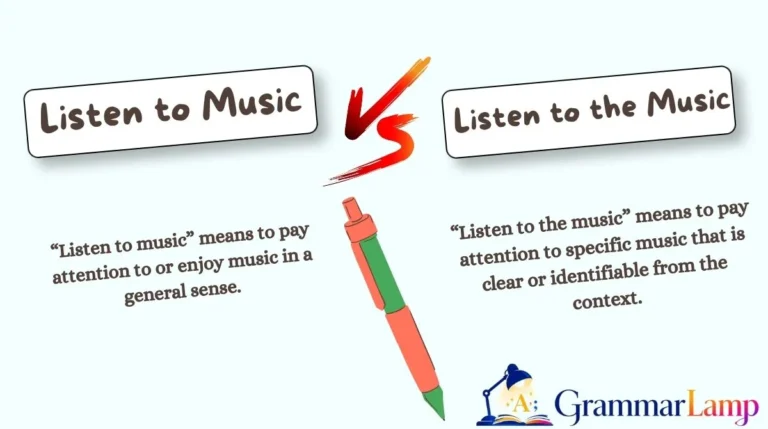
“Listen to music” means to pay attention to or enjoy music in a general sense. We use this expression when we are talking about music as an activity, habit, interest, or general type of thing.
The word music is normally an uncountable noun. That means we do not usually say “a music” when we mean music in general. Cambridge identifies music as an uncountable noun, and Oxford also lists it as uncountable.
The structure is:
listen + to + music
The preposition to is important. In standard English, we do not normally say “listen music.” We say “listen to music.” Cambridge and Oxford both specifically give this pattern.
When do we use “listen to music”?
We normally use “listen to music” when:
- talking about a regular habit
- talking about music in general
- discussing someone’s taste in music
- saying that music is part of an activity
- describing what you enjoy
Examples
- I listen to music every morning.
- She loves to listen to music while cooking.
- Do you listen to music when you drive?
- My brother listens to music before bed.
- We often listen to music at work.
- I like to listen to music when I feel tired.
- They listen to music together on weekends.
- What kind of music do you listen to?
Notice that these sentences do not point to one particular song or recording. The speaker is simply talking about music as a general activity or interest.
Common learner confusion
A common mistake is thinking that every noun needs “the” after a verb. It does not.
For example:
I listen to music. ✅
I listen to the music. ✅
Both are correct, but they do not always mean the same thing.
There is also another common mistake:
I listen music every day. ❌
I listen to music every day. ✅
The verb listen normally takes to before the thing or person you are listening to.
So remember the basic pattern:
listen to + something
Examples include:
listen to music
listen to the radio
listen to a song
listen to your teacher
listen to me
What Does “Listen to the Music” Mean?
“Listen to the music” means to pay attention to specific music that is clear or identifiable from the context.
The word “the” is a definite article. It tells us that the speaker has a particular thing in mind, or expects the listener to know which thing is being discussed. The British Council explains that the is used when the speaker believes the listener knows exactly what is being referred to.
The structure is:
listen + to + the + music
For example:
Listen to the music.
This normally means that there is some particular music happening right now, or there is music that has already been mentioned.
Maybe you are sitting in a restaurant, and music is playing in the background. You could say:
“I really like the music here.”
The listener knows that the music means the music being played in that restaurant.
When do we use “listen to the music”?
Use it when the music is:
- already mentioned
- happening in the current situation
- connected to a particular place or event
- identified by both speakers
- made specific by additional information
Examples
- Listen to the music. It sounds beautiful.
- We sat quietly and listened to the music.
- Can you listen to the music for a moment?
- I love the music at this restaurant.
- The children were dancing while they listened to the music.
- She stopped talking and listened to the music outside.
- We listened to the music from the concert.
- Turn off the television and listen to the music.
In these examples, the music has a clear reference. It is not simply music as a general idea.
Common learner confusion
Some learners think “the music” is always more correct than “music.” That is not true.
Compare:
I listen to music every day.
This is a general statement about a habit.
Now compare:
I am listening to the music you sent me.
Here, the speaker means a specific recording. The phrase “you sent me” makes the reference clear.
The same noun can therefore appear with or without the, depending on what the speaker means.
Difference Between “Listen to Music” and “Listen to the Music” (Detailed)
The easiest way to understand the difference is to focus on general vs specific.
| Expression | Main meaning | Use |
|---|---|---|
| listen to music | music in general | Habits, interests, general activities |
| listen to the music | particular music | Music identified by context or description |
| listen to a song | one song | One countable song |
| listen to this music | specific music | Music directly identified as “this” |
| listen to my music | specific music belonging to me | Possessive makes it specific |
Usage difference
Consider these two sentences:
I listen to music when I study.
This tells us about the person’s habit. It does not matter which songs are playing.
Now:
I listen to the music when I study.
This sounds more specific. It can mean there is particular music connected to the situation, perhaps music already mentioned or a certain music track.
Another useful pair is:
Do you listen to music?
This asks about your general habit or interest.
Are you listening to the music?
This normally asks about the particular music playing or being discussed at that moment.
So the article changes the reference, not the basic action.
Grammar logic
The word music is normally uncountable. You can talk about it without an article when you mean it generally:
Music can improve the mood.
I love music.
She studies music.
They listen to music.
But when the speaker means a particular, identifiable set or instance of music, the can be used:
The music at the party was too loud.
I couldn’t hear the music in the next room.
We listened to the music from the film.
The British Council’s general rule is useful here: the is a specific determiner used when the listener or reader is expected to know exactly what is being referred to.
Sentence structure difference
The basic structures are:
Subject + listen + to + music
Example:
I listen to music.
And:
Subject + listen + to + the + music
Example:
I listen to the music.
The verb stays the same. The important change is the noun phrase:
music → general
the music → specific
Meaning comparison
Here is a simple situation.
Your friend asks:
“What do you do when you relax?”
You can say:
“I listen to music.”
You are talking about your normal activity.
Now imagine music is playing in the room and your friend says:
“Stop talking for a second and listen to the music.”
The phrase the music points to the music that is playing right now.
That is the key idea.
“The” does not always require the music to be named
You do not have to say exactly what the music is before using the.
For example:
Listen to the music!
You and your friend can both hear it. The situation itself tells you what the music means.
This is one reason learners sometimes find the article confusing. The noun can become specific because of the situation, not only because of earlier words.
More Helpful posts
Dragged vs Drug: What Is the Difference? Easy Guide for 2026
Consult With, To, On or About: Which Is Correct? 2026
Run vs Ran: What Is the Difference? Easy Grammar Guide 2026
It Worth It or Is It Worth It? Which One Is Correct in 2026?
Grammar Rules You Must Remember
Rule 1: Use “listen to” before music
The verb listen normally needs to before its object.
I listen to music every day. ✅
She listens to the radio. ✅
They listened to the song. ✅
Do not normally say:
I listen music every day. ❌
Cambridge and Oxford both describe listen to something as the standard pattern.
Rule 2: Use “music” for music in general
When you are talking about music as a broad activity or general idea, no article is normally needed.
I listen to music when I exercise.
My children love music.
He listens to music on the bus.
Here, you are not pointing to one particular piece of music.
Rule 3: Use “the music” when the music is identifiable
When both people can identify which music you mean, the is natural.
Listen to the music in this room.
The phrase “in this room” identifies it.
Another example:
We listened to the music at the wedding.
The wedding tells us which music is being discussed.
Rule 4: Other words can also make “music” specific
You do not always need the to make music specific.
Compare:
I listen to this music.
I listen to your music.
I listen to classical music.
I listen to music from that movie.
Words such as this, your, my, that, and other descriptions can identify the noun.
So do not think:
specific = always the
The real idea is that English uses different determiners and descriptions to show reference.
Common Mistakes Students Make
Many mistakes happen because learners translate directly from their first language. Another problem is that learners know that “the” means something specific, but they are not sure when a noun becomes specific.
Mistake 1: Adding “the” to general habits
I listen to the music every day. ❌
This sentence is possible in a special context, but for a general habit, the natural choice is:
I listen to music every day. ✅
Why?
Because you are not talking about one particular music source. You are talking about the activity of listening to music.
Mistake 2: Removing “the” when the music is specific
Listen to music playing in the room.
This can sound less natural when the speaker wants to point to the particular music that everyone can hear.
More natural:
Listen to the music playing in the room. ✅
The phrase “playing in the room” identifies the music.
Mistake 3: Forgetting “to”
I listen music at night. ❌
Correct:
I listen to music at night. ✅
This is one of the most common problems with listen. Cambridge specifically warns learners to use to before a direct object.
Mistake 4: Thinking “the music” means one song
Not necessarily.
The music can refer to several songs, a soundtrack, background music, or music being performed.
For example:
The music at the party was great.
This does not have to mean one song. It can mean the whole musical selection or music being played at that event.
Easy correction tip
Before speaking, ask yourself one question:
“Am I talking about music in general, or do I mean particular music?”
General:
I listen to music.
Particular:
I listen to the music you recommended.
That small question will solve most problems.
Easy Trick to Remember the Difference
Here is a very simple memory trick:
No “the” = general idea.
“The” = you can point to it.
Think about a classroom.
Your teacher asks:
“Do you like music?”
You might answer:
“Yes, I listen to music every day.”
There is no particular song in your mind.
Now your teacher plays a song and says:
“Listen to the music.”
Now the music is right there. You can hear it, identify it, and point to it.
So remember:
music = music as a general activity
the music = this particular music
Imagine a finger pointing at something.
If you can mentally say:
“That music over there”
then “the music” may be appropriate.
For example:
Listen to the music.
Think:
Listen to that specific music.
But when you say:
I listen to music every day.
you are not pointing at anything. You are talking about the general activity.
This trick also works with many other uncountable nouns.
For example:
I like coffee.
This means coffee in general.
The coffee is cold.
This means a particular coffee that we both know about.
The same basic idea works with music.
Daily Life Examples (Very Important)
Here are natural examples you may hear in everyday English.
1. Talking about a hobby
A: What do you do in your free time?
B: I usually listen to music and watch movies.
Here, music is general.
2. Talking about a current song
A: What are you doing?
B: I’m listening to the music you sent me.
The words “you sent me” identify the music.
3. In the car
A: Do you listen to music while driving?
B: Yes, almost every day.
This is about a regular habit.
4. At a party
A: Everyone is talking.
B: I know. I just want to listen to the music for a while.
The speaker means the music being played at the party.
5. Talking about study habits
A: Can you study with music?
B: Yes. I often listen to music while studying.
The noun is general.
6. At a concert
A: Stop talking and listen to the music.
B: You’re right. It’s amazing.
Both people know which music is being performed.
7. Talking about taste
A: What kind of music do you listen to?
B: I mostly listen to rock and pop music.
This is a general question about musical taste. Cambridge gives the same general pattern in its learner dictionary: “What kind of music do you listen to?”
8. In a restaurant
A: I like this place.
B: Me too. The food is good, and I love the music.
The music means the particular music being played in that restaurant.
9. At home
A: Can you turn the TV down?
B: Sure. I’ll listen to music on my headphones.
The speaker means music generally, not a specific recording.
10. Talking about a recommendation
A: Did you hear that new album?
B: Yes. I listened to the music on it last night.
Here, the music refers to the specific music on that album.
Notice how naturally the article changes when the context becomes specific.
Practice Section
Choose the better option in each sentence.
1.
I usually __________ when I am cleaning my room.
A. listen to music
B. listen to the music
2.
Please be quiet and __________. This is my favorite part.
A. listen to music
B. listen to the music
3.
What kind of __________ do you like?
A. listen to music
B. listen to the music
4.
We sat in the concert hall and __________.
A. listened to music
B. listened to the music
5.
Do you __________ before going to sleep?
A. listen to music
B. listen to the music
Answers
1. A — listen to music
It is a general habit.
2. B — listen to the music
The speaker means the particular music playing at that moment.
3. A — listen to music
The question asks about music in general.
4. B — listened to the music
The concert gives us a specific context. The listener knows what music is being discussed.
5. A — listen to music
This describes a general habit, so no the is needed.
More Helpful posts
Symbol vs Cymbal 2026: Meaning, Difference, Examples, and Easy Grammar Rules
In My Spare Time or On My Spare Time in 2026? The Correct Expression Explained
May or May Not: Meaning, Grammar Rules, Examples, and Common Mistakes in 2026
Peaked vs Peeked vs Piqued: Meaning, Differences, Examples, and Grammar Rules (2026)
FAQs
What is the difference between “listen to music” and “listen to the music”?
“Listen to music” usually means listening to music in general. “Listen to the music” normally refers to particular music that is known or clear from the context. Both are grammatically correct.
Can we use “listen to music” in questions?
Yes. It is very common.
For example:
Do you listen to music?
What kind of music do you listen to?
Do you listen to music while studying?
These questions usually ask about someone’s general habits or preferences.
Is “listen to the music” formal or informal?
Neither expression is especially formal or informal. Both are normal everyday English. The choice depends on whether music is being discussed generally or whether the music refers to something specific.
Is “I listen music” correct?
No, not in standard English when a noun follows listen.
The usual structure is:
listen to + person or thing
So say:
I listen to music. ✅
I listen to the music. ✅
Cambridge and Oxford both confirm this listen to pattern.
Why do we say “listen to music” without “the”?
Because music is normally an uncountable noun, and no article is commonly used when an uncountable noun is discussed in a general way. “I listen to music” means the activity in general rather than one identifiable piece of music.
Can “listen to the music” refer to many songs?
Yes. The music does not mean only one song.
It can refer to all the music being played at a place or event, such as:
the music at the party
the music in the restaurant
the music from the movie
The article makes the musical material specific; it does not necessarily make it singular.
Conclusion
The difference between “listen to music” and “listen to the music” is mainly about general and specific meaning.
Use “listen to music” when you are talking about music as a general activity, habit, or interest:
I listen to music every day.
Use “listen to the music” when you mean particular music that the listener can identify:
Listen to the music. It sounds beautiful.
Also remember the important grammar pattern: listen to, not listen music.
The good news is that you do not need to memorize a long grammar rule. Just stop for a second and ask yourself: “Am I talking about music in general, or can the other person identify the music I mean?”
With a little practice, the choice will start to feel natural. Read the examples aloud, make a few sentences about your own daily routine, and pay attention to how native speakers use music and the music in real conversations.

Liam Derren is a language writer at GrammarLamp, creating simple, helpful content about grammar, words, and everyday English. He makes language learning clear, practical, and easy to understand.