
Peaked, peeked, and piqued are three English words that sound exactly the same but have completely different meanings and uses.
This makes them especially confusing for English learners. When you hear someone say, “My interest was piqued,” you may wonder why they used piqued instead of peaked.
If someone says, “She peeked through the window,” the spelling changes again.
These words are called homophones. Homophones are words that have the same pronunciation but different meanings and spellings. English has many confusing homophones, and these three are a good example.
The good news is that the difference is actually simple once you connect each spelling with its meaning.
Peaked is related to a peak, a high point, or sometimes a person’s appearance or health. Peeked means looked quickly or secretly. Piqued means stimulated someone’s interest, curiosity, or attention.
Knowing the difference is useful in emails, school writing, conversations, social media, and everyday English. A spelling mistake can change the meaning of a sentence completely.
By the end of this guide, you will know exactly when to use peaked, peeked, and piqued. You will also learn easy memory tricks, common mistakes, real-life examples, grammar rules, and practice questions.
More Helpful posts
Whole vs Hole: Meaning, Difference, Examples, and Easy Rules (2026)
Farther vs Further: The Easy Difference Explained for 2026
In Development vs Under Development: Meaning, Differences, and Examples (2026)
Non-Restrictive Clauses: Meaning, Rules, Examples & Differences in 2026
What Does “Peaked” Mean?
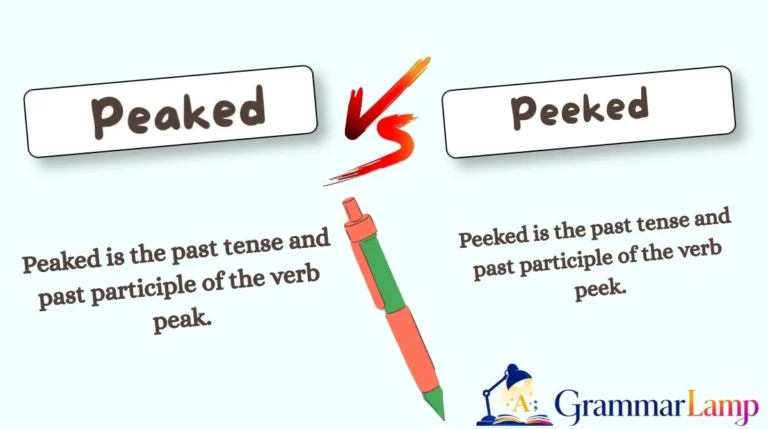
Peaked is the past tense and past participle of the verb peak.
The word peak means the highest point, level, amount, or stage of something. So, peaked usually means that something reached its highest point.
For example:
Sales peaked in December.
This means sales reached their highest level in December.
The word can describe numbers, performance, popularity, interest, activity, temperature, production, or many other things.
When Do We Use “Peaked”?
Use peaked when something reaches its highest or greatest level.
You can use it when talking about:
- sales
- popularity
- performance
- temperature
- interest
- production
- prices
- activity
- physical performance
- success
The basic structure is often:
Subject + peaked + time/place/level
For example:
The company’s sales peaked in July.
Here, sales reached their highest level in July.
Another common structure is:
Subject + peaked at + number
For example:
The temperature peaked at 40°C.
This means 40°C was the highest temperature recorded.
Examples of “Peaked”
- The team’s performance peaked during the final match.
- The temperature peaked at 42°C yesterday.
- Her popularity peaked in the early 2000s.
- Online sales peaked during the holiday season.
- The company’s profits peaked last year.
- His career peaked when he won the national award.
- The number of visitors peaked at 10,000 in June.
- Interest in the show peaked after the final episode.
Notice that peaked is connected to the idea of a peak, or the highest point.
Another Meaning of “Peaked”
There is another use of peaked, especially in British English.
If someone looks peaked, it means they look pale, tired, or unwell.
For example:
You look a little peaked today. Are you okay?
Here, peaked does not mean “reached the highest point.” It describes someone’s appearance.
This meaning is less common for many learners, but it is useful to know.
Common Confusion With “Peaked”
Many learners write peaked when they mean piqued.
For example:
❌ The story peaked my curiosity.
Correct:
✅ The story piqued my curiosity.
Why? Because piqued means “made someone curious or interested.”
What Does “Peeked” Mean?
Peeked is the past tense and past participle of the verb peek.
To peek means to look quickly, secretly, or through a small opening.
Think about a child opening a door slightly to see what is happening inside. The child is peeking.
The past form is peeked.
She peeked through the door.
This means she looked through the door quickly or secretly.
When Do We Use “Peeked”?
Use peeked when someone looks at something, usually quickly, secretly, or without being noticed.
The word often appears with:
- through
- inside
- around
- at
- out of
Common structures include:
peeked + through + something
He peeked through the window.
peeked + inside
She peeked inside the box.
peeked + at + something
I peeked at the answer.
Examples of “Peeked”
- I peeked through the window to see who was outside.
- She peeked inside the box.
- The child peeked around the corner.
- He peeked at my phone screen.
- I peeked through the door before opening it.
- She peeked out of the room to check what was happening.
- The students peeked at their answers during the test.
- He quietly peeked inside the gift bag.
In every example, peeked is about looking.
“Peeked” and “Looked” Are Not Exactly the Same
Looked is a general word.
I looked through the window.
Peeked gives the idea of a quick, small, secret, or careful look.
I peeked through the window.
The second sentence suggests that the person looked briefly or perhaps secretly.
That small difference makes peeked useful in storytelling and everyday conversation.
Common Confusion With “Peeked”
A common mistake is using peaked when the meaning is “looked.”
❌ She peaked through the door.
✅ She peeked through the door.
Remember: if someone is looking, you need peeked.
Difference Between Peaked and Peeked
Although peaked and peeked sound the same, their meanings are completely different.
| Word | Meaning | Common Use | Example |
|---|---|---|---|
| Peaked | Reached the highest point | Sales, prices, popularity, performance | Sales peaked in June. |
| Peeked | Looked quickly or secretly | Looking through/at something | She peeked through the door. |
| Piqued | Created interest or curiosity | Interest, curiosity, attention | The story piqued my interest. |
Usage Difference
Peaked is about reaching a high point.
The athlete’s performance peaked last season.
Peeked is about looking.
The athlete peeked through the window.
One letter changes the meaning completely.
Grammar Logic
Peaked comes from the noun and verb peak.
peak → peaked
Peeked comes from the verb peek.
peek → peeked
Both are regular verbs, so we add -ed to form the past tense.
The key is not the ending. The key is the base word.
If the base word is peak, use peaked.
If the base word is peek, use peeked.
Sentence Structure
With peaked, you often see expressions such as:
Sales peaked at $2 million.
Demand peaked in December.
Her career peaked when she won the award.
With peeked, you often see expressions related to looking:
He peeked through the window.
She peeked inside the bag.
I peeked at the answer.
So, the words can often be identified by what comes after them.
What Does “Piqued” Mean?
Piqued is the past tense and past participle of pique.
When something piques your interest, it makes you interested in something.
When something piques your curiosity, it makes you want to know more.
For example:
The strange message piqued my curiosity.
This means the strange message made me curious.
When Do We Use “Piqued”?
Piqued is most commonly used when something creates or increases:
- interest
- curiosity
- attention
The most common expressions are:
piqued my interest
The new course piqued my interest.
piqued my curiosity
Her answer piqued my curiosity.
piqued their interest
The advertisement piqued their interest.
Examples of “Piqued”
- The unusual story piqued my curiosity.
- His explanation piqued my interest.
- The headline piqued her curiosity.
- The mysterious sound piqued everyone’s interest.
- The new product piqued my interest.
- Her unusual question piqued the teacher’s curiosity.
- The documentary piqued his interest in history.
- The strange email piqued my curiosity.
“Piqued” Does Not Mean “Made Angry”
There is another meaning of pique related to feelings of irritation or wounded pride, although this is less common for beginners.
For example:
His comments piqued her pride.
However, in everyday English, learners will most often see piqued in expressions such as “piqued my interest” and “piqued my curiosity.”
Common Confusion With “Piqued”
This is probably the most common spelling mistake among these three words.
People often write:
❌ That movie peaked my interest.
But the correct sentence is:
✅ That movie piqued my interest.
Why?
Because the movie made you interested. It did not reach a highest point.
Difference Between Peaked, Peeked, and Piqued
Now we can put all three words side by side.
| Word | Base Word | Main Meaning | Easy Meaning |
|---|---|---|---|
| Peaked | peak | Reached the highest point | Reached the top |
| Peeked | peek | Looked quickly or secretly | Took a quick look |
| Piqued | pique | Created interest or curiosity | Made someone curious |
A very simple way to understand them is:
Peaked = highest point
Peeked = looked
Piqued = interested
Compare these sentences:
Sales peaked in December.
Sales reached their highest level.
I peeked through the window.
I looked quickly through the window.
The mystery piqued my curiosity.
The mystery made me curious.
The pronunciation is the same, but the meaning is completely different.
How Grammar Helps You Choose the Correct Word
Look at the meaning of the sentence before choosing the spelling.
Ask yourself:
Is something reaching its highest point?
Use peaked.
Prices peaked last month.
Is someone looking?
Use peeked.
She peeked inside the room.
Is someone becoming interested or curious?
Use piqued.
The question piqued my curiosity.
This simple three-question test can prevent most mistakes.
Explore More Posts
Conform With vs Conform To (2026): What’s the Difference? Easy Grammar Guide for English Learners
Who’s vs Whose (2026): What’s the Difference? Easy Grammar Rules, Examples, and Common Mistakes
Compare to vs Compare with: Easy Grammar Guide for 2026
Apportion vs Portion vs Proportion: Meaning, Differences, and Easy Examples (2026)
Grammar Rules You Must Remember
Rule 1: Use “Peaked” for the Highest Point
Use peaked when something reaches its highest level, amount, or stage.
The temperature peaked at 39°C.
The temperature reached its highest point at 39°C.
Another example:
The company’s profits peaked in 2025.
This means 2025 was the point when profits were at their highest.
Rule 2: Use “Peeked” When Someone Looks
Use peeked when a person or animal takes a quick or secret look.
The boy peeked through the curtain.
He looked through the curtain, probably for a short time.
Another example:
I peeked inside the package.
The action is related to looking, so peeked is correct.
Rule 3: Use “Piqued” for Interest or Curiosity
Use piqued when something causes interest or curiosity.
The book piqued my interest.
The book made me interested in it.
Another common example:
Her question piqued my curiosity.
The question made me want to know more.
Rule 4: Remember That All Three Sound the Same
Do not depend on pronunciation to choose the spelling.
Peaked, peeked, and piqued are pronounced the same in standard English.
You need to think about the meaning.
If you hear:
“It peaked…”
think highest point.
If you hear:
“She peeked…”
think looked.
If you hear:
“It piqued…”
think interest or curiosity.
Common Mistakes Students Make
These mistakes are common because the three words sound identical.
Mistake 1: Using “Peaked My Interest”
❌ The book peaked my interest.
✅ The book piqued my interest.
The book made you interested, so piqued is correct.
Mistake 2: Using “Peeked” for a High Point
❌ The company’s sales peeked in December.
✅ The company’s sales peaked in December.
Sales reached their highest level. They did not look at anything.
Mistake 3: Using “Peaked” for Looking
❌ He peaked through the window.
✅ He peeked through the window.
He was looking through the window.
Mistake 4: Confusing “Piqued” With “Peaked”
❌ Her question peaked my curiosity.
✅ Her question piqued my curiosity.
A question can create curiosity, so piqued is the correct spelling.
Easy Correction Tip
When you are unsure, replace the word with a simple meaning.
If you can replace it with reached the highest point, use peaked.
If you can replace it with looked quickly, use peeked.
If you can replace it with made interested, use piqued.
For example:
The story ______ my curiosity.
“Made my curiosity stronger” makes sense.
So:
The story piqued my curiosity.
Easy Trick to Remember the Difference
Here is a simple memory trick:
Peaked = Peak = Top
Think of a mountain.
The peak is the top of the mountain.
So:
peak → top → peaked
Sales peaked in December.
Sales reached the top level.
Peeked = Peek = Look
The word peek contains the sound of “see” in the idea behind it: you peek when you want to look at something quickly.
Think:
peek → look → peeked
She peeked through the door.
She looked through the door.
Piqued = Interest
The easiest phrase to memorize is:
piqued my interest
Also remember:
piqued my curiosity
When you see interest or curiosity, piqued should immediately come to mind.
The movie piqued my interest.
The mystery piqued my curiosity.
So the three-word memory trick is:
Peaked = top
Peeked = look
Piqued = interest
That is all you need to remember most of the time.
Daily Life Examples
These examples show how the three words can appear naturally in everyday English.
Example 1: Talking About Sales
A: How were sales last month?
B: They were good. They peaked during the weekend.
Here, peaked means sales reached their highest level.
Example 2: Looking Through a Door
A: Did you see who was outside?
B: Yes. I peeked through the door.
Here, peeked means took a quick look.
Example 3: Talking About a Movie
A: Why did you watch that movie?
B: The trailer piqued my interest.
The trailer made the person interested in the movie.
Example 4: Looking Inside a Gift
A: Did you open your birthday gift?
B: Not yet, but I peeked inside the bag.
The person looked inside quickly.
Example 5: Talking About Temperature
A: How hot did it get yesterday?
B: The temperature peaked at 41°C.
The temperature reached its highest point at 41°C.
Example 6: Talking About Curiosity
A: Why did you ask him about the message?
B: It piqued my curiosity.
The message made the person curious.
Example 7: Looking at a Phone
A: Did you read my message?
B: I only peeked at it. I’ll reply later.
The person took a quick look.
Example 8: Talking About a Career
A: When was his career at its best?
B: His career peaked after he won that award.
His career reached its highest point after the award.
Example 9: Talking About a Strange Story
A: Why are you reading that story?
B: The title piqued my interest.
The title made the person interested.
Example 10: Looking Around a Corner
A: Where is Sara?
B: She peeked around the corner a few minutes ago.
She briefly looked around the corner.
Practice Section
Choose the correct word: peaked, peeked, or piqued.
1. The temperature ______ at 40°C.
2. She ______ through the window.
3. The strange story ______ my curiosity.
4. The company’s sales ______ in December.
5. He ______ inside the box before giving it to her.
Answers
1. peaked
The temperature peaked at 40°C.
The temperature reached its highest point.
2. peeked
She peeked through the window.
She looked through the window.
3. piqued
The strange story piqued my curiosity.
The story made her curious.
4. peaked
The company’s sales peaked in December.
Sales reached their highest level.
5. peeked
He peeked inside the box before giving it to her.
He took a quick look inside.
More Useful posts
Case in Point vs Case and Point: Which Is Correct? (2026)
Work Alongside You vs Work Alongside With You (2026): Which One Is Correct in English?
Lets vs Let’s (2026): What’s the Difference? Easy Grammar Guide with Examples
Based Out of vs Based In (2026): What’s the Difference? Easy Grammar Guide with Examples
FAQs
What is the difference between peaked, peeked, and piqued?
Peaked means reached the highest point. Peeked means looked quickly or secretly. Piqued means created interest or curiosity.
For example, sales peaked, someone peeked through a door, and a story piqued your interest.
Can we use “peeked” in questions?
Yes. Peeked can be used in questions when you are asking whether someone looked quickly or secretly.
For example:
Did you peeked inside? ❌
After did, use the base form:
Did you peek inside? ✅
But in the past-tense statement:
You peeked inside. ✅
Is “piqued” formal or informal?
Piqued is a normal English word and can be used in both everyday and formal writing.
It is especially common in the phrases “piqued my interest” and “piqued my curiosity.”
For simple conversation, you can also say “made me interested” or “made me curious.”
Is “peaked my interest” correct?
No, not when you mean that something made you interested.
The correct expression is:
The book piqued my interest.
Peaked is related to reaching a highest point, while piqued is used for interest or curiosity.
Is “peeked” the past tense of “peek”?
Yes. Peeked is the past tense and past participle of peek.
For example:
I peek at the answer.
I peeked at the answer.
It means you looked at something quickly, often secretly or carefully.
Why do peaked, peeked, and piqued sound the same?
They are homophones, which means they have the same pronunciation but different spellings and meanings.
English has many homophones, such as to, too, and two. The pronunciation alone does not tell you which spelling is correct.
You must look at the meaning and context.
Conclusion
Peaked, peeked, and piqued may sound exactly the same, but their meanings are easy to separate once you learn the basic idea behind each word.
Use peaked when something reaches its highest point:
Sales peaked in December.
Use peeked when someone takes a quick or secret look:
She peeked through the window.
Use piqued when something creates interest or curiosity:
The story piqued my interest.
The easiest memory trick is top, look, interest. Peaked means top, peeked means look, and piqued means interest or curiosity.
Do not worry if these words feel confusing at first. They sound the same, so even experienced English speakers sometimes have to think about the spelling.
The best way to learn them is to notice how they are used in real sentences and practice writing your own examples.
Once you connect each spelling with its meaning, choosing the right word becomes much easier.

Liam Derren is a language writer at GrammarLamp, creating simple, helpful content about grammar, words, and everyday English. He makes language learning clear, practical, and easy to understand.
2 thoughts on “Peaked vs Peeked vs Piqued: Meaning, Differences, Examples, and Grammar Rules (2026)”