
Accessory and accessary look almost the same. They also sound the same in modern English, which makes the difference even harder to notice.
For many English learners, the final “c” in accessory and the “a” in accessary create a small spelling problem. The good news is that the two words are closely connected, not completely different words.
Today, accessory is the normal and widely used spelling. It can mean an extra item added to something, such as a phone case, a bag, sunglasses, or equipment for a car.
It can also describe a person who helps with a crime, which is a legal meaning.
Accessary is a much less common spelling. Modern dictionaries describe it as a variant of accessory, and Collins notes that in British English it is a less common spelling, especially in legal use.
This difference matters because learners may find accessary in an old book, a legal text, or another formal source and wonder whether it is a spelling mistake.
It is not necessarily a mistake, but it is unusual in everyday English.
By the end, you will know what both words mean, when they are used, how their grammar works, and why accessory is usually the spelling you should choose.
More Useful posts
Peaked vs Peeked vs Piqued: Meaning, Differences, Examples, and Grammar Rules (2026)
If There Is Any vs If There Are Any: Meaning, Difference, and Examples (2026)
Also Have or Have Also: Which Is Correct? Complete Grammar Guide 2026
Sneaked vs Snuck: What Is the Difference? 2026 Guide
What Does “Accessory” Mean?
Simple Definition of Accessory
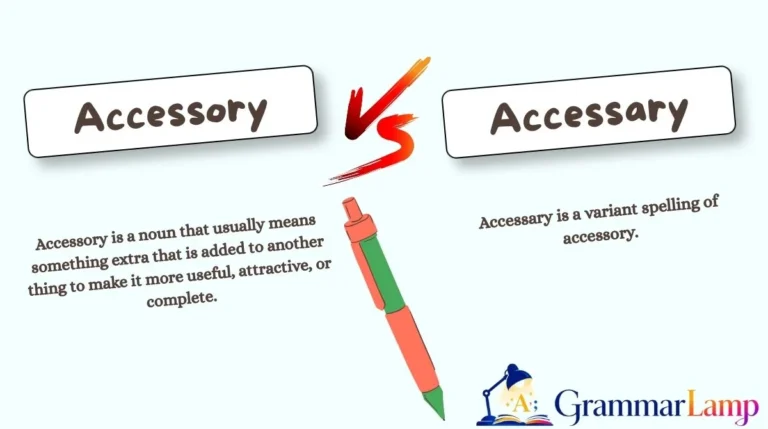
Accessory is a noun that usually means something extra that is added to another thing to make it more useful, attractive, or complete.
For example, a phone charger, a camera strap, or a handbag can be an accessory. In fashion, an accessory is something you wear or carry with your clothes, such as a belt, watch, scarf, or necklace. Oxford and Cambridge both give these meanings.
The word can also have a legal meaning. An accessory to a crime is a person who helps someone commit a crime or is involved in the crime without being the main person who commits it.
So, accessory has two major everyday areas:
- an extra item
- a person connected to a crime
When Should You Use Accessory?
Use accessory when you are talking about an extra object or item that goes with something else.
Common examples include:
- fashion accessories
- car accessories
- phone accessories
- computer accessories
- kitchen accessories
- bathroom accessories
- camera accessories
It is often used in the plural because people normally have several items in a group. Cambridge gives examples such as belts, scarves, computer accessories, and bathroom accessories.
Grammar Rule for Accessory
Accessory is mainly a countable noun.
The singular form is:
an accessory
The plural form is:
accessories
Notice the spelling change:
accessory → accessories
The y changes to ies.
It can also be used as an adjective, especially when it comes before another noun. In this use, it means something that is secondary or not the main part. Oxford gives accessory muscles of respiration as an example.
You may therefore see:
an accessory item
or
accessory equipment
However, in normal conversations, the noun use is much more common.
Examples of Accessory
- She bought a new handbag as a fashion accessory.
- My phone came with several useful accessories.
- You need to buy a charger because it is not included as an accessory.
- He sells computer accessories online.
- Sunglasses are my favorite summer accessory.
- The car has many accessories, including a roof rack and floor mats.
- She wore a simple dress with a few beautiful accessories.
- The camera accessory made it easier to take pictures at night.
These examples show that accessory often describes something that is not the main object but adds usefulness, comfort, style, or convenience.
Another Meaning: A Person Involved in a Crime
There is another important meaning that students should know.
In legal English, an accessory is someone who helps another person commit a crime, or someone who has a supporting role connected to it.
For example:
He was charged as an accessory to the crime.
You may also hear:
accessory before the fact
and
accessory after the fact
These are specialized legal expressions. They are not common phrases in everyday conversation.
What Does “Accessary” Mean?
Simple Definition of Accessary
Accessary is a variant spelling of accessory.
That means the two words are closely related, and accessary does not normally introduce a completely different meaning. Dictionary.com describes accessary as accessory, while Collins describes it in British English as a less common spelling of accessory.
This is the most important fact to remember.
You may see:
accessary
in older writing, legal material, or historical texts. But in ordinary modern English, accessory is the spelling most readers expect.
When Should You Use Accessary?
For most modern writing, especially for learners, students, websites, emails, schoolwork, and everyday communication, accessory is the safer and more natural choice.
Accessary has a much narrower place in modern usage. Collins lists it mainly in connection with legal language and marks the British spelling as less common.
So, if you are writing:
I bought a new phone accessory.
Use accessory, not accessary.
If you find accessary in an old legal text, that spelling can still be legitimate.
Grammar Rule for Accessary
Accessary can function as a noun or adjective in older or specialized usage. Collins lists it as both a noun and adjective in American English and notes its mainly legal use.
As a noun, its plural can be:
accessaries
This follows the same spelling pattern as:
accessory → accessories
Compare:
accessary → accessaries
The ending changes from y to ies.
Examples of Accessary
Because this spelling is uncommon today, the examples below are mainly useful for recognition rather than everyday writing.
- The old legal document called him an accessary to the offense.
- The book described her as an accessary after the fact.
- The lawyer discussed whether the accused was an accessary.
- Several accessaries were mentioned in the historical record.
- The writer used the older spelling accessary throughout the chapter.
- In older legal English, accessary was sometimes used instead of accessory.
- The court record used the spelling accessary for the person who assisted the offender.
- Modern readers may find accessary unusual because accessory is now much more familiar.
These sentences are useful mainly because they show where you might encounter the spelling.
Why Does “Accessary” Still Exist?
English spelling has changed over time, and different dictionaries and writers have used different forms. Historical legal writing sometimes used accessary, while other writers used accessory.
A Cambridge reference on English usage notes that accessory is now the all-purpose spelling in most contexts, while accessary has been associated especially with older legal writing and is now uncommon.
That explains why the unusual spelling can still appear even though it is not the normal choice today.
Difference Between Accessory and Accessary
The biggest difference is not really meaning. The main difference is spelling and modern usage.
| Point | Accessory | Accessary |
|---|---|---|
| Spelling | Modern common spelling | Variant, less common spelling |
| Meaning | Extra item; person connected to a crime | Generally the same meaning |
| Everyday English | Very common | Very uncommon |
| Fashion | Common | Rare |
| Technology | Common | Rare |
| Legal English | Common | Less common/older |
| Noun | Yes | Yes |
| Adjective | Yes | Yes, especially specialized usage |
| Plural | Accessories | Accessaries |
| Best choice for modern writing | Yes | Usually no |
1. Usage Difference
The most practical rule is simple:
Use accessory in normal modern English.
For example:
This phone accessory is very useful.
That sentence sounds natural.
You could theoretically replace the spelling with:
This phone accessary is very useful.
But most modern readers would find this unusual and may even suspect a spelling error.
That is why knowing that accessary exists is different from needing to use it.
2. Grammar Logic
Both forms developed around the idea of something secondary, additional, or helping another person or thing.
Today, accessory handles this job in normal English. Collins defines it as something added to equipment, clothing, or another object, and it also gives the legal meaning connected with helping in a crime.
Accessary is essentially a variant spelling of the same word, especially associated with legal or older usage.
So there is no major grammar rule such as:
Use accessory for objects but accessary for people.
That would be too simple and, in modern English, misleading.
The real distinction is that accessary is an uncommon spelling, not a completely separate everyday word.
3. Sentence Structure Difference
There is almost no difference in sentence structure.
With accessory, you can say:
She bought a new accessory.
You can also say:
He was an accessory to the crime.
With accessary, the same basic structures can appear in historical or specialized writing:
She bought an accessary.
or
He was an accessary to the crime.
The grammar is similar. The important change is the spelling and the level of modern usage.
4. Meaning Comparison
Both words can refer to something secondary or additional.
Consider:
a camera accessory
This means an extra item used with a camera.
The older form accessary can also carry the same general idea, but it is not the normal spelling most modern English writers choose.
The same applies to the legal meaning.
Today:
accessory to a crime
is standard and widely recognized.
The form:
accessary to a crime
can appear in older or specialized texts, but it is far less common.
5. Pronunciation
An interesting point is that the two spellings do not give you a useful pronunciation difference to rely on.
Cambridge gives the same pronunciation for accessory and accessary.
They are therefore easy to confuse when you hear them.
This is another reason spelling mistakes happen.
Grammar Rules You Must Remember
Rule 1: Use “Accessory” for normal modern English
When you mean an extra item used with clothes, phones, cars, cameras, or other objects, choose accessory.
Example:
I need a new laptop accessory.
This is the normal modern spelling.
Rule 2: “Accessary” is a variant spelling, not usually a different meaning
Do not assume that accessary has a completely separate meaning.
Dictionaries treat it as a variant of accessory, with especially strong association with legal and older usage.
Example:
The old document called him an accessary.
Here, the writer is using a less common spelling of a word that modern readers would normally see as accessory.
Rule 3: Remember the plural spelling
The plural of accessory is:
accessories
The plural of accessary is:
accessaries
Both change y to ies.
Example:
The store sells phone accessories.
In an older text, you may see:
The store sold several phone accessaries.
The second sentence is unusual in modern English, but the spelling follows the same plural pattern.
Rule 4: Do not use “accessary” just to sound more formal
This is a common trap.
Some learners see an unusual spelling and think it must be more formal or more academic. That is not a good rule here.
Accessory is already fully correct and is the normal modern choice. Oxford, Cambridge, and Collins all provide accessory as the standard entry for the common meanings.
Example:
Please bring the camera accessories.
This is better for modern general writing than:
Please bring the camera accessaries.
Explore More Posts
Wether vs Weather vs Whether: What’s the Difference? 2026 Guide
Instructions on vs Instructions for: Meaning, Difference, and Correct Usage in 2026
Role vs Roll: Meaning, Difference, Rules & Examples (2026)
John and I or John and Me? The Easy Grammar Guide for 2026
Common Mistakes Students Make
The confusion usually starts because the two words look almost identical.
Mistake 1: Thinking They Have Completely Different Meanings
Some students believe:
accessory = clothing
and
accessary = crime
That is not a reliable rule.
The legal meaning is also commonly spelled accessory today. Cambridge and Oxford both use accessory for the legal sense.
Wrong idea:
He is an accessary because the word is about crime.
Better:
He is an accessory to the crime.
Mistake 2: Using “Accessary” in Everyday Shopping English
You may see the unusual spelling somewhere and start using it in sentences like:
I bought a new accessary for my phone.
That sounds unusual in modern English.
Correct for everyday writing:
I bought a new accessory for my phone.
Mistake 3: Thinking “Accessary” Is Always Incorrect
The opposite mistake can also happen.
Because accessary is rare, some people assume that it is always a spelling error.
That is not quite right. Major dictionaries recognize it as a variant spelling, particularly in legal usage, although it is much less common.
So when you see accessary in an old text, do not immediately mark it wrong.
Mistake 4: Misspelling the Plural
A common spelling mistake is:
accessorys ❌
The correct plural is:
accessories ✅
The same pattern applies to accessary:
accessaries ✅
Remember the simple rule:
consonant + y → change y to ies
Easy Correction Tip
Before writing accessary, ask yourself:
“Am I writing ordinary modern English?”
If the answer is yes, use accessory.
If you are reading an old legal book or quoting historical wording, you may come across accessary.
This one question will solve most of the confusion.
Easy Trick to Remember the Difference
Here is the easiest memory trick:
C = Common
Think:
Accessory = Common choice
The spelling with -cory is the normal spelling you see in modern English.
Then think:
Accessary = Alternative spelling
The -ary form is something you may recognize, but you usually do not need it in everyday writing.
You can also connect the word with real life.
Think about your phone.
Your phone is the main thing.
Your case, charger, stand, earphones, or other extra equipment can be called accessories.
So remember:
Extra item = accessory
For example:
I bought three accessories for my new phone.
That is the spelling to use.
For the unusual version, think:
Accessary = old/less common form
This does not mean it is automatically wrong. It simply means it is not the spelling most people expect in modern general English. Collins specifically describes the British form as a less common spelling of accessory.
Daily Life Examples (Very Important)
The word accessory is much more useful in daily English, so these examples focus on natural modern conversations.
1. At a Phone Shop
A: Do you have any accessories for this phone?
B: Yes. We have cases, chargers, and screen protectors.
Here, accessories means extra things used with the phone.
2. Talking About Clothes
A: Your outfit looks great.
B: Thanks! I just added a few simple accessories.
A watch, belt, scarf, or necklace can be called an accessory.
3. Buying a Camera
A: Does the camera come with a bag?
B: No, the camera bag is sold as an extra accessory.
The bag is additional equipment.
4. Talking About a Car
A: What accessories does the car have?
B: It has a roof rack, floor mats, and parking sensors.
These are additional features or items related to the car.
5. At Work
A: Where did you buy that keyboard accessory?
B: I ordered it online last week.
The speaker is talking about an extra computer-related item.
6. Getting Ready for an Event
A: Are you wearing that necklace?
B: Yes. It is my favorite accessory.
The necklace adds style to the outfit.
7. Talking About a Gift
A: What did you buy for your sister?
B: I bought her a handbag and a matching accessory.
The word is being used for an extra fashion item.
8. In a Legal Conversation
A: Why was he arrested?
B: He was accused of being an accessory to the crime.
This is a specialized legal meaning.
9. Reading an Old Book
A: I found the word “accessary” in this old book.
B: It is a variant spelling of “accessory.”
This is the kind of situation where recognizing the less common form is useful.
10. Writing Modern English
A: Which spelling should I use on my website?
B: Use accessory for general modern English.
That is the practical choice for most learners and readers.
Practice Section
Choose the correct option in each sentence.
1. I bought a new phone ___ yesterday.
A) accessory
B) accessary
2. She wore several fashion ___ with her dress.
A) accessories
B) accessaries
3. He was charged as an ___ to the crime.
A) accessory
B) accessary
4. The old legal document used the word ___.
A) accessory
B) accessary
5. Which spelling is most common in modern general English?
A) accessory
B) accessary
Answers
- A — accessory
- A — accessories
- A — accessory
- B — accessary
- A — accessory
The fourth answer is different because the sentence specifically describes an old legal document. The less common spelling can appear in historical or specialized writing.
More Helpful posts
Formal vs Informal Usage: Complete Guide to English in 2026
Please Advise or Please Advice? The Correct Usage Explained (2026)
See vs Look vs Watch: Easy English Grammar Guide for 2026
Recommend to vs recommend for 2026: Clear Grammar Rules, Examples, and Common Mistakes
FAQs
What is the difference between accessory and accessary?
The two words are closely related and can have the same basic meaning. Accessory is the normal modern spelling, while accessary is a much less common variant, especially associated with legal or older writing.
Is accessary a correct word?
Yes. Major dictionaries recognize accessary as a variant of accessory. However, it is uncommon in modern general English, so most learners should normally choose accessory.
Can we use accessory in questions?
Yes. Accessory can be used naturally in questions.
For example:
“Do you sell phone accessories?”
You can also use it in legal questions, such as:
“Was he an accessory to the crime?”
The sentence structure does not change because the word is inside a question.
Is accessary formal or informal?
Accessary is not simply a “formal” version of accessory. It is mainly a rare or older variant spelling, with dictionaries especially noting legal usage.
For normal formal writing, accessory is still the better choice.
What is the plural of accessory?
The plural is accessories.
For example:
The shop sells computer accessories.
Do not write accessorys. The final y changes to ies.
What is the plural of accessary?
The plural is accessaries.
For example:
The historical document mentioned several accessaries.
This plural is much less common because the singular accessary itself is uncommon in modern English.
Conclusion
The easiest way to understand accessory vs accessary is to remember that they are not two completely different everyday words.
Accessory is the normal modern spelling and is used for extra items such as clothing items, phone equipment, car equipment, and many other useful or decorative additions.
It is also the common spelling for the legal meaning of a person who helps with a crime.
Accessary is a recognized variant spelling, but it is far less common today. You are more likely to find it in older books, historical texts, or specialized legal writing.
Dictionaries such as Collins and Dictionary.com recognize the form while marking it as less common or variant.
For everyday English, there is one simple habit to build: choose accessory. Knowing accessary is still useful because it helps you understand older or unusual texts without assuming the writer made a spelling mistake.
The more you see these words in real sentences, the easier the difference becomes.

Liam Derren is a language writer at GrammarLamp, creating simple, helpful content about grammar, words, and everyday English. He makes language learning clear, practical, and easy to understand.