
See, look, and watch are three very common English verbs. They all have a connection with our eyes, so it is easy to think they mean the same thing.
But native English speakers use them in different ways.
For example, we usually say “I saw a bird”, not “I watched a bird” when we simply notice the bird. We say “Look at that bird!” when we want someone to direct their eyes toward it. And we can say “I watched the bird fly away” when we pay attention to its movement for some time.
This small difference can cause many problems for English learners. You may understand all three words, but choosing the correct one in a sentence can still be difficult.
The good news is that the basic idea is quite simple. See is usually about noticing something with your eyes.
Once you understand this difference, many everyday sentences become much easier. You will know why we say “Look at me,” “I can see you,” and “We watched a movie.”
This guide explains the three verbs with simple rules, examples, common mistakes, conversations, and practice. By the end, you should be able to choose see, look, or watch with much more confidence.
More Useful posts
It’s vs Its: Simple Difference, Rules, Examples & Practice (2026)
Enamor vs Enamour: What’s the Difference? Meaning, Usage & Examples in 2026
Breath vs Breathe: Easy Difference, Meaning, Examples & Rules in 2026
No Longer Exist vs No Longer Exists: Which Is Correct? (2026 Guide)
What Does “See” Mean?
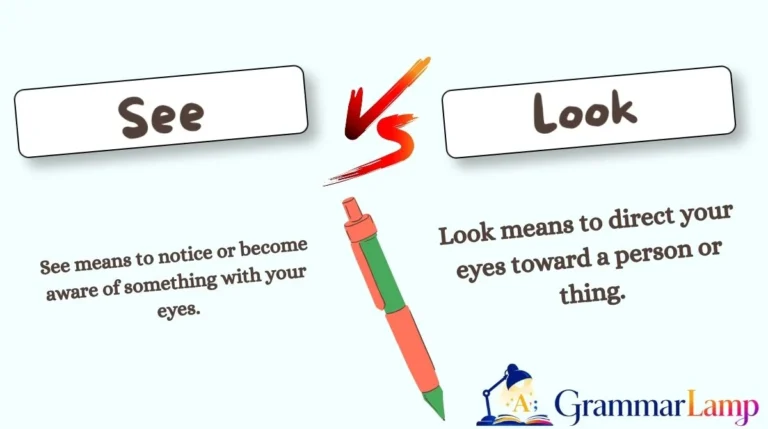
See means to notice or become aware of something with your eyes.
You normally do not need to make a special effort to see something. Your eyes receive the image, and you notice it.
For example:
I can see a car outside.
You are simply noticing the car. You are not necessarily trying to study it.
When Do We Use “See”?
We commonly use see when:
- something comes into your sight naturally
- you notice someone or something
- you have the ability to see
- you meet someone
- you understand something
- you experience something visually
The basic structure is:
see + person/thing
Examples:
- I can see a man at the door.
- Did you see that accident?
- I saw Sarah at the supermarket yesterday.
- Can you see the mountain from here?
- I can’t see anything in the dark.
- We saw a beautiful rainbow this morning.
- I saw your brother on the bus.
- She saw a strange animal in the garden.
Notice that see often describes something that happens naturally. You notice something because it is there.
See Can Also Mean “Understand”
English speakers also use see to mean understand.
For example:
Oh, I see what you mean.
Here, see has nothing to do with your eyes. It means “I understand.”
Other examples include:
- I see your point.
- Now I see why you were angry.
- I see what you are saying.
This is a very common use in spoken English.
See and People
We also use see when talking about meeting or visiting people.
For example:
I’m going to see my grandmother this weekend.
This does not simply mean that you will look at your grandmother. It means you will visit or meet her.
Similarly:
I saw Tom yesterday.
This can mean you met Tom or were with him for some time.
Common Confusion With “See”
A common mistake is using see when you want someone to direct their eyes toward something.
For example:
❌ See this picture!
This is possible in special contexts, but it is not the normal choice when you are telling someone to direct their eyes toward something.
More naturally:
✅ Look at this picture!
Remember: see is often about noticing, while look involves directing your eyes.
What Does “Look” Mean?
Look means to direct your eyes toward a person or thing.
Unlike see, looking usually involves an intentional action. You decide where to point your eyes.
For example:
Look at that dog!
You are telling another person to direct their eyes toward the dog.
When Do We Use “Look”?
Use look when:
- you intentionally direct your eyes somewhere
- you want another person to look at something
- you examine someone’s appearance
- you direct attention toward a particular place or object
The most important structure to remember is:
look at + person/thing
Examples:
- Look at this picture.
- Look at me when I’m talking to you.
- She looked at the clock.
- He looked at his phone.
- Look at that beautiful house!
- I looked at the menu before ordering.
- They looked at each other and laughed.
- Please look at the board.
Why Do We Say “Look At”?
For a specific object or person, look normally needs the preposition at.
So we say:
✅ Look at me.
Not:
❌ Look me.
We say:
✅ Look at the picture.
Not:
❌ Look the picture.
This is one of the most important grammar points for English learners.
Look Can Describe Appearance
Look also has another very common meaning. It can describe someone’s appearance or condition.
Examples:
- You look tired.
- She looks happy.
- That cake looks delicious.
- He looks angry.
- You look great today.
Here, we are not saying that the person intentionally directs their eyes somewhere. Instead, look describes how someone or something appears.
Notice the structure:
look + adjective
For example:
You look tired.
Not:
❌ You look at tired.
The phrase look at and the verb look followed by an adjective have different structures.
What Does “Watch” Mean?
Watch means to look at something carefully for a period of time, especially when it is moving, changing, or happening.
This is the key idea:
Watch = look carefully for some time.
For example:
We watched a football match.
The match continues for a period of time, and you pay attention to what happens.
We often use watch for:
- television programs
- movies
- sports
- people doing something
- animals moving
- events
- activities
- changes or developments
Examples:
- I watched a movie last night.
- We watched the football match together.
- She watched the children playing.
- He watched the bird fly away.
- They watched the sunset.
- I like watching cooking videos.
- The children watched the magician carefully.
- She watched the bus leave the station.
Watch and Movement
The idea of movement is especially useful.
Compare:
I saw a bird.
You noticed the bird.
I looked at the bird.
You intentionally directed your eyes toward it.
I watched the bird.
You paid attention to the bird for a period of time, perhaps while it was flying, eating, or moving.
This is the easiest way to see the difference.
Difference Between See, Look, and Watch
The three verbs are related, but the focus is different.
| Verb | Basic Meaning | Is It Intentional? | Usually Takes Time? | Common Examples |
|---|---|---|---|---|
| See | Notice with your eyes | Usually no | Not necessarily | see a car, see a friend |
| Look | Direct your eyes toward something | Yes | Usually short | look at a picture |
| Watch | Pay attention to something for a period of time | Yes | Yes | watch TV, watch a game |
1. See = Notice
When you see something, your eyes receive the image and you become aware of it.
I saw a cat in the street.
You noticed the cat.
You might not have spent any time looking at it.
2. Look = Direct Your Eyes
When you look, you intentionally point your eyes toward something.
Look at the cat!
You are choosing to direct your attention toward the cat.
3. Watch = Observe for a Period of Time
When you watch, you usually keep your eyes on something and pay attention to what happens.
I watched the cat play with a ball.
You observed the activity for some time.
A Simple Example With One Object
Imagine you are walking through a park.
You suddenly see a dog.
You say to your friend:
Look at that dog!
Your friend looks at it.
Then the dog starts running after a ball, and both of you watch it.
So the sequence can be:
See → Look → Watch
You see something naturally.
You look at it intentionally.
You watch it when you continue paying attention to it.
This is not an absolute rule for every sentence, but it is an excellent starting point for beginners.
Explore More Posts
Jewel vs Joule: Meaning, Difference, Examples & Easy Rules (2026)
Foul or Fowl: Meaning, Difference, Examples & Easy Rules for 2026
Dialog vs Dialogue: What’s the Difference? A Simple English Guide for 2026
Learned vs Learnt: What’s the Difference? A Simple Guide for 2026
Grammar Rules You Must Remember
Rule 1: Use “See” for Things You Notice
Use see when something becomes visible to you or you notice it.
I saw a bird in the garden.
You are simply reporting what you noticed.
Other examples:
- I can see your house.
- Did you see that man?
- She saw a snake on the road.
You do not normally need at after see.
✅ I saw him.
❌ I saw at him.
Rule 2: Use “Look at” for Directing Your Eyes
When you intentionally direct your eyes toward something, use:
look at + noun/pronoun
Examples:
Look at the sky.
Look at me.
Look at this photo.
She looked at her watch.
The preposition at is important when look is followed by a specific person or thing.
Rule 3: Use “Watch” for Something That Continues
Use watch when you observe something for a period of time, especially an activity or movement.
Examples:
We watched the game for two hours.
She watched the children play.
I watched the movie last night.
You can also use watch with television:
I watch TV every evening.
We do not normally say:
❌ I see TV every evening.
If you mean that you spend time viewing television programs, watch is the natural verb.
Rule 4: “Look” Has Different Grammar Patterns
Look at + noun means direct your eyes toward something.
Look at the picture.
But look + adjective describes appearance.
The picture looks beautiful.
Compare:
Look at John.
= Direct your eyes toward John.
John looks tired.
= John appears tired.
This difference is extremely useful because both sentences contain look, but their grammar and meaning are different.
Common Mistakes Students Make
Many learners confuse these verbs because some languages use one verb where English uses three. The problem becomes even bigger when learners translate directly from their first language.
Here are some common mistakes.
Mistake 1: “Look me”
❌ Look me!
✅ Look at me!
When look is directed toward a person or thing, use at.
Mistake 2: “I watched a bird” When You Only Mean “I Noticed It”
Suppose you are walking down the street and notice a bird.
You can say:
✅ I saw a bird.
If you say:
I watched a bird.
it sounds as if you spent some time observing the bird.
That sentence is also correct, but the meaning is different.
Mistake 3: “I Looked a Movie”
❌ I looked a movie last night.
✅ I watched a movie last night.
A movie is something that continues over time. We normally watch it.
You can say:
I looked at the movie poster.
Here, you are directing your eyes toward the poster, so look at is correct.
Mistake 4: “I Saw at the Picture”
❌ I saw at the picture.
If you mean you directed your eyes toward the picture:
✅ I looked at the picture.
If you mean you noticed the picture:
✅ I saw the picture.
The preposition at changes the grammar.
Mistake 5: “Watch Me” and “Look at Me”
Both can be correct, but they have different meanings.
Look at me means:
Direct your eyes toward me.
Watch me means:
Pay attention to what I am doing.
For example, a child learning to ride a bicycle might say:
Dad, watch me!
The child wants Dad to observe the action.
Easy Trick to Remember the Difference
Here is a simple memory trick:
👀 SEE = NOTICE
Think:
I see it.
Something is visible, and you notice it.
👉 LOOK = DIRECT
Think:
Look at it!
You intentionally point your eyes toward it.
🎬 WATCH = FOLLOW
Think:
Watch it happen.
You keep your attention on something for a while.
Another easy way to remember them is to imagine a football match.
You see the football because it is in front of you.
You look at the football when you direct your eyes toward it.
You watch the football match because you follow the action over time.
So remember:
See = notice
Look = direct your eyes
Watch = observe over time
If you remember those three ideas, you can solve most beginner-level questions about these verbs.
Daily Life Examples
The best way to understand these words is to hear them in normal situations.
Example 1: In the Street
Ali: Did you see that red car?
Sam: No. Where?
Ali: Look at it! It’s over there.
Here, see means notice, while look at tells Sam where to direct his eyes.
Example 2: Watching Football
A: Are you watching the football match?
B: Yes. It’s really exciting.
We use watching because the match continues and we are paying attention to the action.
Example 3: Looking at a Photo
A: Look at this photo.
B: Oh, I see your brother in the background!
The first person directs the other person’s eyes. The second person notices the brother.
Example 4: At the Cinema
A: What did you do last night?
B: I watched a movie with my friends.
A movie is something we normally watch because it continues for a period of time.
Example 5: In a Classroom
Teacher: Look at the board, please.
Student: I can see the answer now.
The teacher asks the student to direct their eyes toward the board. The student then notices the answer.
Example 6: At Home
Mom: What are you doing?
Son: I’m watching TV.
Mom: Can you see your sister?
Son: Yes, she’s sitting next to me.
Notice how naturally the three verbs can appear in the same conversation.
Example 7: Watching an Animal
We saw a deer in the forest, then we watched it walk across the road.
First, you noticed the deer. Then you continued observing its movement.
Example 8: Meeting Someone
I saw my teacher at the shopping center yesterday.
Here, saw can mean that you encountered or noticed your teacher.
You could also say:
I went to see my teacher yesterday.
Here, see means visit or meet.
Example 9: Looking at the Sky
Look at the sky! You can see the stars tonight.
Look at tells someone to direct their eyes upward.
See describes the stars that become visible.
Example 10: Learning a New Skill
Watch me do it first, then you can try.
The speaker wants the other person to observe the action carefully.
That is why watch is better than simply look at.
Practice Section
Choose see, look, or watch. Change the form if necessary.
1.
_____ at that beautiful painting!
2.
Did you _____ Sarah at school today?
3.
We _____ a documentary last night.
4.
I can’t _____ anything because it is too dark.
5.
_____ me carefully. I will show you how to do it.
Answers
1. Look — We direct our eyes toward the painting: Look at that beautiful painting!
2. See — We mean notice or meet Sarah: Did you see Sarah at school today?
3. Watched — A documentary continues over time: We watched a documentary last night.
4. See — This is about the ability to notice something visually: I can’t see anything because it is too dark.
5. Watch — The person wants us to observe an action carefully: Watch me carefully.
More Helpful posts
In the Same Day vs On the Same Day: Which Is Correct? A Simple Guide for 2026
Licence or License: Which Spelling Is Correct in 2026?
I’ve Added vs I Added: Easy Difference, Rules & Examples (2026)
This Is She or This Is Her? The Correct Choice in English in 2026
FAQs
What is the difference between see, look, and watch?
See usually means to notice something with your eyes. Look means to direct your eyes toward something. Watch means to look at something carefully for a period of time, especially when it moves or changes.
A simple memory rule is: see = notice, look = direct, watch = observe over time.
Can we use “look” in questions?
Yes. Look is very common in questions.
For example:
What are you looking at?
Did you look at the new website?
Remember that look at is normally used before a specific person or thing.
Is “watch” formal or informal?
Watch is neither especially formal nor informal. It is a normal everyday English verb.
You can use it in casual conversations, school writing, and many formal situations. For example: “We watched the presentation carefully.”
Can I say “watch a person”?
Yes. Watch a person is correct when you mean observing what that person does.
For example:
I watched the man cross the street.
If you only mean that you noticed the man, “I saw the man” is more natural.
What is the difference between “look at a movie” and “watch a movie”?
Watch a movie is the normal expression when you mean viewing the movie from beginning to end or for a period of time.
Look at a movie can be grammatically possible in a special context, such as looking at a movie poster, image, or information about a movie, but it is not the normal expression for viewing the actual film.
Is “look at me” different from “watch me”?
Yes. Look at me means direct your eyes toward me. Watch me means pay attention to me and observe what I am doing.
For example, a person performing a trick might say:
Watch me!
They want you to follow the action, not simply glance at them.
Conclusion
The difference between see, look, and watch becomes much easier when you focus on the action behind each word.
Use see when you notice something or when something is visible to you. Use look at when you intentionally direct your eyes toward a person or thing.
Use watch when you keep your attention on something for a period of time, especially an activity, movement, movie, show, or event.
Compare these three sentences:
I saw a dog.
You noticed it.
I looked at the dog.
You directed your eyes toward it.
I watched the dog run.
You observed its movement for some time.
You do not need to memorize hundreds of complicated grammar rules. Start with these three ideas: notice, direct, and observe.
Then pay attention to how native speakers use the words in movies, conversations, books, and everyday situations.
A little practice will make the difference feel natural. Soon, choosing between see, look, and watch will become much easier—and your everyday English will sound more natural too.

Liam Derren is a language writer at GrammarLamp, creating simple, helpful content about grammar, words, and everyday English. He makes language learning clear, practical, and easy to understand.