
English learners often get confused when they see recommend to and recommend for. Both forms are correct in the right sentence, but they do not normally do the same job.
The confusion usually comes from the fact that to and for can both connect people, things, jobs, and ideas.
A learner may think they can simply choose either preposition after recommend. In English, however, the meaning changes depending on what comes after the preposition.
Compare these two sentences:
- I recommended this restaurant to my friend.
- I recommended this restaurant for a family dinner.
The first sentence tells us who received the recommendation. The second tells us what purpose or situation the restaurant is suitable for.
There is another very common pattern:
- I recommended Ali for the job.
Here, for connects Ali with a position he is suitable for. This is especially common when talking about jobs, promotions, awards, roles, and other opportunities.
Understanding this small difference can make your English sound much more natural. It also helps you avoid common mistakes such as using recommend for when you mean a person receiving advice, or using recommend to when you mean a job or purpose.
By the end, you will know when to use recommend to, when to use recommend for, how sentence structure works with each one, and how to use recommend naturally in everyday conversations.
More Useful posts
Compare to vs Compare with: Easy Grammar Guide for 2026
Apportion vs Portion vs Proportion: Meaning, Differences, and Easy Examples (2026)
Case in Point vs Case and Point: Which Is Correct? (2026)
Work Alongside You vs Work Alongside With You (2026): Which One Is Correct in English?
What Does “Recommend to” Mean?
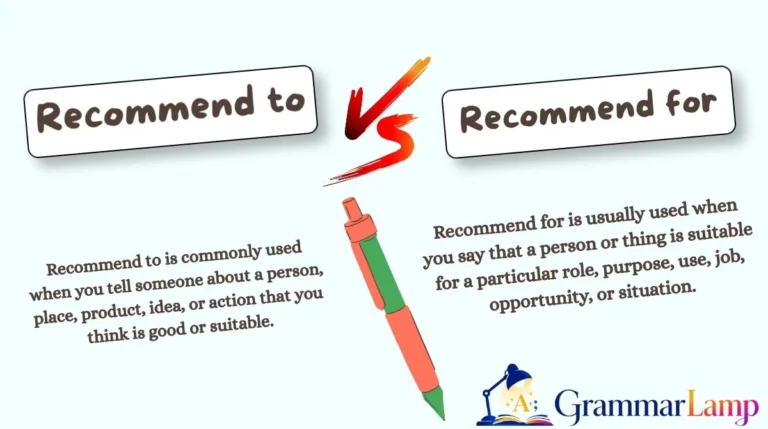
Recommend to is commonly used when you tell someone about a person, place, product, idea, or action that you think is good or suitable.
The word to often points to the person who receives the recommendation.
A very useful basic structure is:
recommend + something/someone + to + person
For example:
I recommended this book to Sara.
Here, this book is the thing being recommended, and Sara is the person receiving the recommendation.
Cambridge Dictionary gives the pattern recommend something to somebody, such as recommending a package to clients. It also explains that recommend can mean suggesting that something is good or suitable.
When should you use “recommend to”?
Use to when you want to show the person, group, or organization that receives your recommendation.
You can recommend:
- a movie to a friend
- a restaurant to a customer
- a book to a student
- a product to a buyer
- a candidate to a manager
- an idea to your team
8 examples with “recommend to”
- I recommended this restaurant to my brother.
- She recommended a good dentist to me.
- Can you recommend a movie to us?
- My teacher recommended this website to the students.
- He recommended a new laptop to his cousin.
- We recommended Sara to the manager.
- I would recommend this book to anyone learning English.
- They recommended the hotel to their friends.
Notice something important: to answers the question “To whom?”
For example:
I recommended this book to Ali.
Ask: “To whom did I recommend it?”
Answer: To Ali.
That simple question can help you choose the correct preposition.
A common confusion with “recommend to”
Many learners know the verb recommend and then try to put to + verb after it:
❌ I recommend to take an umbrella.
That sentence is not the normal standard pattern.
Instead, say:
✅ I recommend taking an umbrella.
Or:
✅ I recommend that you take an umbrella.
Cambridge Grammar specifically notes that when recommend is followed directly by another verb, the verb is not normally put in the infinitive form with to. The usual patterns are recommend + -ing or recommend + clause.
So remember:
❌ recommend to do
✅ recommend doing
✅ recommend that someone do something
This is a different issue from recommend something to someone, where to is perfectly correct.
What Does “Recommend for” Mean?
Recommend for is usually used when you say that a person or thing is suitable for a particular role, purpose, use, job, opportunity, or situation.
A common structure is:
recommend + person + for + position/role/opportunity
For example:
I recommended Ahmed for the job.
This means I said that Ahmed was a good choice for the job.
We also use for with things when we are talking about their purpose or suitable use:
I recommend this book for beginners.
Here, the book is suitable for beginners.
Another useful example is:
This shampoo is recommended for dry hair.
The phrase tells us the situation or type of person the product is suitable for.
Cambridge Dictionary gives examples such as “recommended for promotion,” showing that for commonly introduces the opportunity or position for which someone is being recommended. Merriam-Webster also gives the pattern “recommend a person for a promotion.”
When should you use “recommend for”?
Use for when the next word tells us the purpose, role, position, opportunity, or target group.
Common combinations include:
- recommend someone for a job
- recommend someone for promotion
- recommend someone for an award
- recommend someone for a position
- recommend something for children
- recommend something for beginners
- recommend a product for sensitive skin
- recommend an activity for students
8 examples with “recommend for”
- I recommended Maria for the position.
- The manager recommended Ali for promotion.
- She was recommended for an award.
- We recommend this book for beginners.
- This exercise is recommended for older adults.
- The doctor recommended walking for better fitness.
- This software is recommended for small businesses.
- Our teacher recommended this course for advanced students.
Here, for answers a question such as:
For what?
or
For which person, purpose, role, or situation?
For example:
They recommended Ahmed for the job.
Ask: “For what?”
Answer: For the job.
That is the basic idea.
Difference Between “Recommend to” and “Recommend for”
The easiest way to understand the difference is to look at the job each preposition does.
| Structure | Main idea | Example |
|---|---|---|
| recommend something to someone | The person who receives the recommendation | I recommended the book to John. |
| recommend someone to someone | The person who receives or considers the recommendation | I recommended Sara to my manager. |
| recommend someone for a job/role | The position or opportunity the person is suitable for | I recommended Sara for the job. |
| recommend something for a purpose/group | The purpose or group the thing is suitable for | I recommend this book for beginners. |
The most important distinction is this:
to = receiver of the recommendation
for = purpose, role, opportunity, or suitable use
Look at these sentences:
I recommended this restaurant to my friend.
My friend received the recommendation.
I recommended this restaurant for dinner.
Dinner is the purpose or situation for which I think the restaurant is suitable.
Now compare people:
I recommended Hamza to the manager.
The manager is the person who received or considered my recommendation.
I recommended Hamza for the position.
The position is the role that Hamza is suitable for.
These two sentences can even appear together:
I recommended Hamza to the manager for the position.
That sentence contains both relationships. I told the manager about Hamza, and I said that Hamza was suitable for the position.
The grammar logic
English prepositions often show relationships between words. Here, to and for show different relationships.
With to, think about direction:
recommend → to → receiver
With for, think about suitability:
recommend → for → purpose/role/opportunity
This is why these examples feel different:
She recommended the movie to me.
She recommended the movie for family viewing.
The movie did not change. The information after the preposition changed, so the meaning also changed.
Sentence structure
The two main patterns are:
Pattern 1:
recommend + thing/person + to + receiver
I recommended the course to David.
Pattern 2:
recommend + person/thing + for + purpose/role
I recommended David for the course.
But be careful. The second sentence means David is the person being considered for something. It does not mean David received the recommendation.
That difference is small in form but important in meaning.
Explore More Posts
Non-Restrictive Clauses: Meaning, Rules, Examples & Differences in 2026
In Development vs Under Development: Meaning, Differences, and Examples (2026)
Conform With vs Conform To (2026): What’s the Difference? Easy Grammar Guide for English Learners
Who’s vs Whose (2026): What’s the Difference? Easy Grammar Rules, Examples, and Common Mistakes
Grammar Rules You Must Remember
Rule 1: Use “to” for the person who receives the recommendation
I recommended the restaurant to my sister.
Your sister is the receiver.
Another example:
The teacher recommended a grammar book to me.
Ask, “Who got the recommendation?” The answer is me.
Rule 2: Use “for” for a job, role, purpose, or suitable situation
She was recommended for the promotion.
The promotion is the opportunity.
Another example:
This dictionary is recommended for English learners.
English learners are the target group.
Rule 3: Don’t confuse “recommend to someone” with “recommend to do something”
This is one of the most common problems.
❌ I recommend to visit this museum.
Better:
✅ I recommend visiting this museum.
Or:
✅ I recommend that you visit this museum.
Cambridge Grammar lists recommend doing something and recommend someone does something as standard patterns.
Remember that to can be correct after recommend when it introduces a receiver:
✅ I recommended the museum to my friend.
But it is not normally used before a simple infinitive:
❌ I recommend to visit the museum.
Rule 4: “Recommend for” often appears with careers and opportunities
Use for when someone is being put forward as a suitable candidate.
I recommended John for the position.
She was recommended for promotion.
The committee recommended him for the award.
These examples focus on the opportunity, not the person receiving your advice. This job-related use is also reflected in major dictionary definitions of recommend.
Common Mistakes Students Make
Learners often make these mistakes because they translate directly from their first language. English does not always use prepositions in the same way as other languages.
Mistake 1: Using “for” for a recommendation receiver
❌ I recommended this movie for my friend.
This can sound like the movie is suitable for your friend, which is a different meaning.
If you mean that your friend is the person you told about the movie, say:
✅ I recommended this movie to my friend.
But this sentence is also possible:
✅ I recommended this movie for my friend.
It could mean you selected the movie as something suitable for your friend. Context matters.
That is why a beginner should ask: Am I talking about the receiver or suitability?
Mistake 2: Using “to” for a job or position
❌ I recommended Ahmed to the job.
Normally, a job is not the receiver of the recommendation.
Say:
✅ I recommended Ahmed for the job.
The job is the position Ahmed is suitable for.
Mistake 3: Saying “recommend to do”
❌ My doctor recommended to exercise more.
Better:
✅ My doctor recommended exercising more.
Or:
✅ My doctor recommended that I exercise more.
This pattern is especially important in formal and academic English.
Mistake 4: Forgetting the difference between person and purpose
Look carefully:
I recommended the teacher to the principal.
The principal is the receiver.
I recommended the teacher for the award.
The award is the opportunity.
A quick correction tip is to underline the word after the preposition.
If it is a person receiving the recommendation, think to.
If it is a job, award, role, purpose, or target use, think for.
Easy Trick to Remember the Difference
Here is a simple classroom trick.
Think:
TO = TO WHOM?
FOR = FOR WHAT?
For example:
I recommended this app to Ali.
Ask:
To whom?
→ Ali.
So use to.
Now:
I recommended Ali for the internship.
Ask:
For what?
→ The internship.
So use for.
You can also remember it as:
TO = person
FOR = position or purpose
This is not a rule for every English sentence in existence, but it is a very useful shortcut for the common recommend patterns discussed here.
Try another pair:
She recommended the teacher to me.
Who received the recommendation?
Me.
She recommended the teacher for the award.
What was the opportunity?
The award.
Once you start thinking about the relationship instead of memorizing isolated phrases, the choice becomes much easier.
Daily Life Examples
These examples show how native and proficient English speakers naturally use these patterns in ordinary situations.
1. Talking about a restaurant
A: Where should we eat tonight?
B: I recommend this Italian restaurant to you. The food is excellent.
Here, you are receiving the recommendation.
2. Talking about a movie
I watched a great movie last night, and I recommended it to my brother.
My brother is the receiver.
3. Talking about a job
Sarah is hardworking, so I recommended her for the position.
The position is the opportunity.
4. Talking about an employee
I recommended Ahmed to my supervisor because he has great communication skills.
The supervisor is the person receiving the recommendation.
5. Talking about a book
My English teacher recommended this novel to me.
The teacher suggested the novel to me.
6. Talking about a group
I recommend this podcast to anyone who wants to improve listening skills.
The listeners are the target audience receiving the recommendation.
7. Talking about a product
This cream is recommended for dry skin.
The phrase tells us who or what the product is suitable for.
8. Talking about an award
The principal recommended Maria for the student award.
Maria is the person being considered, and the award is the opportunity.
9. Talking about beginners
I recommend this grammar book for beginners.
The book is suitable for beginners.
10. Combining both patterns
I recommended this course to my cousin because I think it is perfect for beginners.
Now both prepositions are doing different jobs.
To my cousin = receiver.
For beginners = suitable group.
That is exactly why learning the meaning behind each preposition is more useful than simply memorizing a phrase.
Practice Section
Choose the correct option: to or for.
1.
I recommended this website ___ my teacher.
2.
She recommended Ali ___ the manager.
3.
The manager recommended Ali ___ the position.
4.
This book is excellent ___ beginners.
5.
I recommended taking a short break.
Answers:
- to — “my teacher” receives the recommendation.
- to — the manager receives the recommendation.
- for — the position is the opportunity.
- for — beginners are the target group.
- This sentence needs neither to nor for. Recommend + -ing is the correct pattern: “I recommended taking a short break.”
More Helpful posts
Dateline vs Deadline: Meaning, Difference, Examples & Easy Rules (2026)
Do You vs Are You: What’s the Difference? Complete Guide for 2026
Whole vs Hole: Meaning, Difference, Examples, and Easy Rules (2026)
Farther vs Further: The Easy Difference Explained for 2026
FAQs
What is the difference between “recommend to” and “recommend for”?
Recommend to usually identifies the person who receives the recommendation: “I recommended the book to Sam.” Recommend for commonly identifies a job, role, opportunity, purpose, or target group: “I recommended Sam for the job.”
Can we use “recommend to” in questions?
Yes. It is very common.
Who would you recommend this restaurant to?
Would you recommend this book to a student?
In these questions, to identifies the person who receives the suggestion.
Is “recommend for” formal or informal?
Recommend for is normal in both spoken and written English. It is especially common when discussing jobs, promotions, awards, positions, products, and suitable uses.
She was recommended for promotion.
This product is recommended for children.
Can I say “recommend to do something”?
Usually, no. Standard English normally uses recommend doing something or recommend that someone do something.
✅ I recommend checking the instructions.
✅ I recommend that you check the instructions.
Cambridge Grammar specifically warns against the direct pattern recommend to do something.
Can “recommend someone to someone” and “recommend someone for something” both be correct?
Yes, and they can appear in the same sentence.
I recommended Maria to the manager for the position.
The manager is the person receiving or considering the recommendation. The position is the opportunity Maria is being recommended for.
Is “recommend for” only used for jobs?
No. Jobs and promotions are very common, but for can also show purpose or suitability.
This book is recommended for beginners.
This exercise is recommended for older people.
This software is recommended for small businesses.
So the idea is broader than careers.
Conclusion
The difference between recommend to and recommend for becomes much easier once you focus on the relationship between the words.
Use to when you are talking about the person who receives the recommendation:
I recommended the book to Sarah.
Use for when you are talking about the job, role, opportunity, purpose, or group that someone or something is suitable for:
I recommended Sarah for the job.
I recommend this book for beginners.
Also remember an important third pattern: recommend + -ing or recommend + that-clause.
I recommend taking notes.
I recommend that you take notes.
Do not normally say:
❌ I recommend to take notes.
The best way to master these structures is to use them in real sentences. When you see to, ask “To whom?” When you see for, ask “For what purpose, role, or situation?” That small habit can prevent many mistakes.
Keep practicing with everyday examples, and soon these prepositions will start to feel natural rather than confusing.

Liam Derren is a language writer at GrammarLamp, creating simple, helpful content about grammar, words, and everyday English. He makes language learning clear, practical, and easy to understand.
2 thoughts on “Recommend to vs recommend for 2026: Clear Grammar Rules, Examples, and Common Mistakes”