
“Compare to” and “compare with” are two small phrases that cause a surprising amount of confusion. Many English learners know what the verb compare means, but they are not always sure which preposition should come after it.
Should you say, “Compare this phone to that phone”? Or should it be “Compare this phone with that phone”? Both forms are used in English, and that is exactly why the topic can feel difficult.
The good news is that the difference is usually about purpose and meaning, not a complicated grammar formula. Traditionally,
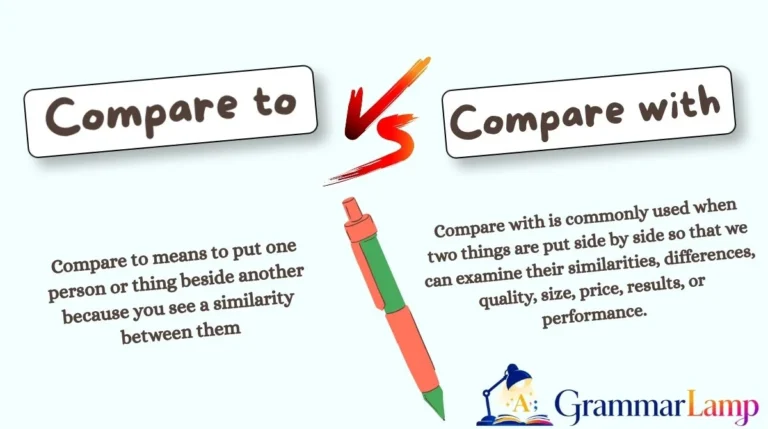
compare to is often used when we point out a similarity or describe one thing as being like another. Compare with is often preferred when we place two or more things side by side to examine their similarities and differences.
However, modern English does not always keep these meanings strictly separate. Major dictionaries recognize both forms in comparison contexts.
This distinction matters in school writing, workplace English, conversations, reviews, shopping, and everyday speech. You may compare two phones, two jobs, two cities, two students, or even two ideas.
By the end, you will understand when to use compare to, when to use compare with, why native speakers sometimes use either one, and how to avoid the most common mistakes.
What Does “Compare to” Mean?
Compare to means to put one person or thing beside another because you see a similarity between them. It can also mean that one thing is being judged in relation to another.
A simple way to think about it is:
Compare A to B = say that A is similar to B or describe A in relation to B.
This use is especially common when the comparison is more like an image, analogy, or general observation.
For example:
- She compared her baby to an angel.
- The teacher compared the human brain to a computer.
- He compared the city to a giant machine.
- The poet compared love to a rose.
- My salary looks small compared to hers.
- This year’s winter is mild compared to last year.
- The new laptop is cheap compared to similar models.
- He compared his first job to a training school.
In the first four examples, the speaker is not necessarily performing a detailed test. The speaker is drawing attention to a likeness or relationship.
When should you use “compare to”?
Use compare to when your main idea is that two things are similar, or when one thing is being described in relation to another.
A very common structure is:
A + compare/compared + to + B
Examples:
- She compared his voice to thunder.
- The child was compared to a little bird.
- The cost is low compared to last year.
- This phone is much lighter compared to my old one.
The phrase compared to is extremely common in everyday English. Merriam-Webster defines it as being in relation to or measured or judged against something else, and it also lists compared with as a variant.
A common learner confusion
Many students learn a rule such as “to is only for similarity,” and then think compare to must always mean exactly the same thing. English is more flexible than that.
For instance:
This car is expensive compared to mine.
The sentence clearly means that the two cars are being judged against each other. It does not necessarily mean they are similar.
So remember: compare to often highlights a relationship, likeness, or general judgment, but it can also be used for ordinary comparisons in modern English.
What Does “Compare with” Mean?
Compare with is commonly used when two things are put side by side so that we can examine their similarities, differences, quality, size, price, results, or performance.
A simple way to think about it is:
Compare A with B = examine A and B together.
This is especially useful when a careful comparison is being made.
Examples:
- Compare this phone with the older model.
- Please compare your answers with the answer key.
- The researcher compared the two groups with each other.
- We compared this year’s sales with last year’s sales.
- Compare the two plans with one another before choosing.
- Her performance was compared with that of the other students.
- I compared the prices with those at another store.
- The report compares the new system with the old system.
Here, the speaker is usually interested in finding out how the things match or differ.
Merriam-Webster gives examples such as “compare your responses with the answers” and “the test was easy compared with the last one.” Its dictionary also explains that compare can mean examining qualities in order to discover similarities or differences.
When should you use “compare with”?
Use compare with when the comparison is more direct, careful, or analytical.
For example:
Compare this laptop with the one you already own.
You might check:
- price
- battery life
- storage
- screen size
- speed
That is a true side-by-side comparison.
A common learner confusion
Some students believe compare with is only formal and compare to is only informal. That is not a reliable rule.
Both can appear in formal and informal English. The better question is:
What kind of comparison am I making?
Also, modern usage frequently allows overlap. Even major dictionaries show examples where compared to and compared with can express nearly the same relationship.
Difference Between Compare to and Compare with
The easiest way to understand the difference is to imagine two situations.
In the first situation, you are saying, “This reminds me of that” or “This is like that.”
That often favors compare to.
In the second situation, you are saying, “Put these two things side by side and examine them.”
That often favors compare with.
| Expression | Main idea | Typical use | Example |
|---|---|---|---|
| compare to | Show similarity or relationship | Analogy, likeness, general judgment | She compared his voice to thunder. |
| compare with | Examine two things together | Similarities and differences | Compare this phone with that phone. |
| compared to | Judged in relation to something else | Everyday comparisons | This room is small compared to mine. |
| compared with | Judged or examined against something else | Careful or direct comparison | Sales increased compared with last year. |
Usage difference
Consider these two sentences:
The poet compared the moon to a silver ball.
The poet is creating an image. The moon is being described as something similar to a silver ball.
Now:
The scientist compared the two samples with each other.
The scientist is performing an examination. The samples are being studied side by side.
That is the traditional distinction.
Grammar logic
The verb compare can have different structures depending on the meaning.
Compare + object + to + object
The teacher compared the student’s handwriting to a printed font.
Compare + object + with + object
The teacher compared the student’s handwriting with the handwriting in the old notebook.
The first creates a resemblance. The second suggests a direct examination.
However, English speakers do not always obey this distinction strictly. Modern English often treats the two prepositions as overlapping choices. Merriam-Webster explicitly lists compare to and compare with within the same general sense of viewing one thing in relation to another.
Meaning comparison
This is important for learners:
Compare to does not always mean “find similarities only.”
Compare with does not always mean “find differences only.”
Both forms can be used to discuss similarities and differences.
For example:
Compare the two phones.
This could mean: find what is similar and what is different.
Likewise:
This phone is better compared to my old one.
This is a judgment between two items.
The surrounding sentence tells you the exact purpose.
Grammar Rules You Must Remember
Rule 1: Use “compare to” for likeness or analogy
When one thing is described as being like another, compare to is a natural choice.
The teacher compared the child’s memory to a camera.
The point is the similarity.
Another example:
She compared his smile to sunshine.
This is an image, not a technical test.
Rule 2: Use “compare with” for a side-by-side examination
When you are carefully checking two things, compare with is a useful choice.
Compare this contract with the original.
You may be checking names, prices, dates, and terms.
Another example:
Compare your answers with mine.
You are directly checking one set of answers against another.
Rule 3: “Compared to” and “compared with” are often interchangeable
This is the rule many textbooks leave out.
In modern English, especially in ordinary speech and writing, both forms are widely used.
For example:
This apartment is expensive compared to the others.
This apartment is expensive compared with the others.
Both can sound natural.
The dictionary evidence supports this overlap. Merriam-Webster gives compared with as a variant of compared to.
Rule 4: Do not force a difference when the meaning is already clear
Sometimes learners waste time asking, “Is to absolutely correct here?”
For many normal comparisons, either preposition may work.
Compared to last month, sales are higher.
Compared with last month, sales are higher.
Both are acceptable in ordinary English.
When writing formal academic work, however, consistency and clarity matter more than trying to create a tiny difference between two forms.
Common Mistakes Students Make
Mistake 1: Thinking “compare to” is always correct
A student may write:
❌ Compare your answers to the answer key.
This is not necessarily wrong in modern English. But if the activity is a direct checking exercise, compare with is often the clearer traditional choice:
✅ Compare your answers with the answer key.
The problem is not that “to” is impossible. The problem is that learners sometimes believe one preposition fits every type of comparison.
Mistake 2: Thinking “compare with” is always formal
Another common belief is:
“With” is formal, so I should only use it in school.
That is not true.
People use compare with in everyday conversations too:
I compared this restaurant with the one downtown.
There is nothing unusually formal about that sentence.
Mistake 3: Using both prepositions together
Do not write:
❌ Compare this phone to with that one.
Choose one.
✅ Compare this phone to that one.
or
✅ Compare this phone with that one.
Mistake 4: Forgetting the object
Learners sometimes produce incomplete sentences:
❌ I compared.
That can be correct if the meaning is already clear.
For example:
We looked at both cars. I compared them before buying one.
But when you are introducing the things being examined, add an object:
✅ I compared the two cars.
Mistake 5: Confusing “compare” with “contrast”
Compare can include both similarities and differences.
Contrast focuses mainly on differences.
For example:
Compare the two cities.
This may ask you to discuss population, climate, cost, transport, and other features.
Contrast the two cities.
This suggests that you should focus on how different they are.
That distinction is useful in school assignments and academic writing.
Easy Trick to Remember the Difference
Here is a simple memory trick:
TO = think “this is like that.”
WITH = think “put them side by side.”
Imagine a teacher holding up a picture of a cloud and saying:
“I compare this cloud to a sheep.”
The teacher is seeing a likeness.
Now imagine the teacher putting two student papers on the desk:
“Compare this paper with that paper.”
The papers are being examined side by side.
That mental picture can help beginners remember the traditional distinction.
But keep one important fact in mind: real English is flexible. Native speakers frequently use both forms for ordinary comparison. So the trick is a guide, not an unbreakable law.
Daily Life Examples
Here are some natural examples you may hear or use in everyday English.
1. Shopping
“Can you compare this laptop with the other one?”
You want to check the features before buying.
2. Talking about prices
“This phone is cheap compared to mine.”
You are judging its price in relation to another phone.
3. Talking about appearance
“She compared the new building to a glass box.”
She is describing how the building looks.
4. School
“Compare your answers with your partner’s.”
You are checking two sets of answers.
5. Sports
“How does this player compare with the best players in the league?”
You are asking about relative ability or performance.
6. Family
“People often compare me to my older brother.”
They are saying the two siblings are similar in some way.
7. Work
“We should compare this year’s results with last year’s.”
The goal is to examine changes in performance.
8. Travel
“Compared to Lahore, this city feels much quieter.”
The speaker is describing one place in relation to another.
9. Food
“This restaurant doesn’t compare with the one we visited yesterday.”
Here, compare with has another useful sense: being equal or similar enough in quality.
Merriam-Webster gives “nothing compares with” as an example of this meaning.
10. Everyday conversation
“Don’t compare yourself to other people.”
The speaker is talking about judging one person against another.
Practice Section
Choose to or with in each sentence.
- The teacher compared the brain ___ a computer.
- Please compare this phone ___ the older model.
- My new job is easy compared ___ my last job.
- She compared her little brother ___ a monkey because he was so active.
- We compared the two test results ___ each other.
Answers
- to — The sentence creates a similarity or analogy.
- with — This is a direct side-by-side comparison.
- to — “Compared to” is very common for general judgment.
- to — The speaker is describing a resemblance.
- with — The two results are being examined together.
Remember, some sentences may allow the other preposition in modern English. The answers above follow the clearest traditional distinction.
FAQs
What is the difference between “compare to” and “compare with”?
Traditionally, compare to is used more often for showing similarity or making an analogy, while compare with is used for examining two things side by side. In modern English, however, the meanings often overlap. Both forms can be correct depending on the sentence.
Can we use “compare to” in questions?
Yes. Compare to can easily appear in questions.
For example:
“How does this phone compare to the older model?”
This asks how the phone measures up in relation to the older model.
Is “compare with” more formal than “compare to”?
Not necessarily. Compare with can be used in everyday speech, while compare to is also common in formal and informal English. The choice is often connected to the kind of comparison being made rather than the level of formality.
Is “compared to” grammatically correct?
Yes. Compared to is a standard English expression. Major dictionaries list it and recognize compared with as a variant.
Can I use “compare with” for similarities?
Yes. Compare with can be used to examine both similarities and differences. The verb compare itself can mean examining qualities to discover what is alike and what is different.
Which is better: “compare to” or “compare with”?
Neither is always better. Use compare to when you want to emphasize a likeness or general relationship. Use compare with when you want to emphasize a direct examination. For many everyday comparisons, either form may sound natural.
Conclusion
The difference between compare to and compare with is easier than it first appears. The traditional rule gives each phrase a slightly different job.
Use compare to when you are highlighting a similarity, resemblance, image, or general relationship. For example, you might compare a person to a star or a city to a machine.
Use compare with when you are putting two things side by side to examine their qualities, differences, or similarities. For example, you might compare two phones, two test results, or two contracts.
But do not become too worried about the preposition. Modern English often uses compare to and compare with in overlapping ways, and trusted dictionaries record that flexibility.
The best way to learn is to notice the pattern in real sentences and then practice it yourself. After a little practice, choosing between to and with will feel much more natural.

Liam Derren is a language writer at GrammarLamp, creating simple, helpful content about grammar, words, and everyday English. He makes language learning clear, practical, and easy to understand.
2 thoughts on “Compare to vs Compare with: Easy Grammar Guide for 2026”