
English learners often get confused by small words such as on and for. Both can connect the word instructions to another word, but they do not always give the same meaning.
You may hear someone say, “I need instructions on how to use this machine,” while another person says, “I need instructions for the new employee.” Both sentences can be correct, but the meaning is slightly different.
The confusion usually happens because instructions can be followed by different prepositions depending on what we want to talk about.
Sometimes we are talking about a topic or subject. At other times, we are talking about the person, thing, task, or purpose connected with the instructions.
This difference is useful in everyday English. You may need to talk about instructions for a phone, instructions on using software, instructions for students, or instructions on completing a form.
The good news is that the basic idea is quite simple. Instructions on usually introduces the subject or activity that the instructions explain.
Instructions for often tells us who or what the instructions are intended for, or what task they are meant to help with.
Once you understand this small difference, choosing the right preposition becomes much easier.
More Helpful posts\
Wreckless or Reckless? Which Spelling Is Correct in 2026?
Brite vs Bright: Meaning, Difference, Spelling & Correct Usage in 2026
I Ordered vs I Have Ordered: What’s the Difference? Simple Grammar Guide (2026)
Timber vs Timbre (2026): Meaning, Differences, Grammar Rules, Examples, and Easy Guide
What Does “Instructions on” Mean?
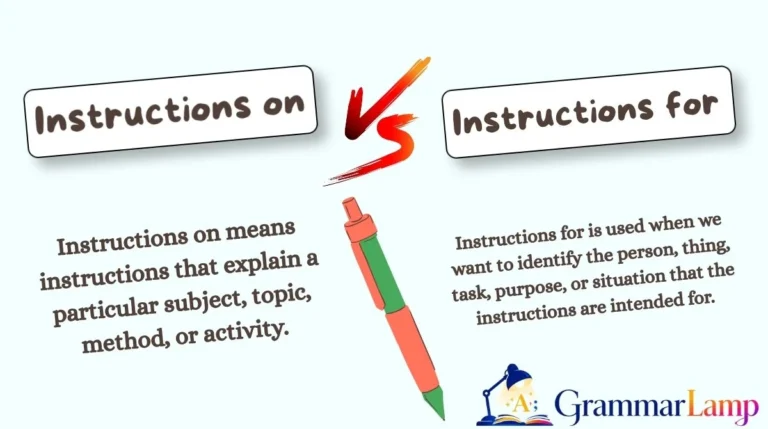
Instructions on means instructions that explain a particular subject, topic, method, or activity.
When we use on after instructions, we usually want to say what the instructions are about.
For example:
- instructions on using a computer
- instructions on how to install the app
- instructions on operating the machine
- instructions on filling out the form
Think of on as meaning “about” in this situation.
When Do We Use “Instructions on”?
We commonly use instructions on when the following words describe a topic or activity.
For example:
The teacher gave us instructions on how to complete the project.
Here, the instructions explain how to complete the project.
Another example:
I found some instructions on using this camera.
The instructions are about using the camera.
We can also use instructions on before a noun phrase:
The company gave employees instructions on workplace safety.
The subject of the instructions is workplace safety.
Grammar Rule for “Instructions on”
A common structure is:
instructions + on + topic/activity
Examples:
instructions on grammar
instructions on computer safety
instructions on using the software
instructions on how to cook the dish
We often use on + -ing when we are talking about an activity.
instructions on installing the program
We can also use:
instructions on how to install the program
Both forms are natural.
Examples of “Instructions on”
- The website provides instructions on how to reset your password.
- The teacher gave us instructions on using the new software.
- I need instructions on how to operate this machine.
- The manual contains instructions on installing the device.
- The company gave workers instructions on workplace safety.
- She watched a video with instructions on making a simple cake.
- The guide includes instructions on caring for the equipment.
- We received instructions on how to complete the application form.
Common Learner Confusion
Many learners think on means only physical position, as in:
The book is on the table.
But on has many uses in English.
In phrases such as instructions on, information on, and a book on, it can mean about.
Compare:
I need information on English grammar.
This means:
I need information about English grammar.
In the same way:
I need instructions on using this machine.
means:
I need instructions about how to use this machine.
So, when you see instructions on, think:
“These instructions explain this subject or activity.”
What Does “Instructions for” Mean?
Instructions for is used when we want to identify the person, thing, task, purpose, or situation that the instructions are intended for.
The word for often gives the idea of purpose or intended use.
For example:
These are instructions for new employees.
The instructions are intended for new employees.
Another example:
I need instructions for the washing machine.
Here, the instructions are intended to help someone use the washing machine.
When Do We Use “Instructions for”?
We commonly use instructions for in several situations.
First, we can use it to identify the person or group who should follow the instructions.
instructions for students
instructions for customers
instructions for employees
instructions for visitors
Second, we can use it to identify the thing or product the instructions belong to.
instructions for the printer
instructions for the new computer
instructions for the washing machine
Third, we can use it to identify a task or purpose.
instructions for completing the form
instructions for making a cake
instructions for applying for the job
Grammar Rule for “Instructions for”
A common structure is:
instructions + for + person/thing/task/purpose
Examples:
instructions for students
instructions for the machine
instructions for completing the form
instructions for making a cake
Notice something important: for can be followed by a noun or an -ing form.
For example:
instructions for beginners
Here, beginners are the intended users.
But:
instructions for installing the software
Here, installing the software is the task.
Examples of “Instructions for”
- The teacher gave us instructions for the final exam.
- These instructions are for new employees.
- I lost the instructions for the washing machine.
- Please read the instructions for completing the form.
- The box contains instructions for assembling the table.
- We received instructions for the emergency procedure.
- This page contains instructions for visitors.
- He looked for instructions for setting up the printer.
Common Learner Confusion
The biggest problem is that for can sometimes be used before an activity, while on can also introduce an activity.
For example:
instructions for installing the software
and
instructions on installing the software
Both can be possible, but they have a slightly different focus.
For installing often presents the instructions as something intended to help with that task.
On installing focuses more directly on the subject or activity being explained.
In everyday English, context often decides which one sounds more natural.
A useful question is:
Are you talking about what the instructions are about, or what they are intended for?
If you mean about the subject, on is often a good choice.
If you mean intended for a person, thing, task, or purpose, for is often a good choice.
Difference Between “Instructions on” and “Instructions for”
The easiest way to understand the difference is to look at the job done by each preposition.
Comparison Table
| Expression | Main idea | Common use | Example |
|---|---|---|---|
| instructions on | about a subject/activity | Topic or method | Instructions on using Excel |
| instructions for | intended for / related to a purpose | Person, thing, task, purpose | Instructions for new employees |
| instructions on how to | explains a method | How something is done | Instructions on how to register |
| instructions for + -ing | intended to help with an activity | Task or purpose | Instructions for registering |
1. “Instructions on” Focuses on the Subject
When you say:
instructions on computer security
you are talking about instructions whose subject is computer security.
The main question is:
What are these instructions about?
Answer:
They are about computer security.
Another example:
The course provides instructions on how to write a good essay.
The subject is how to write a good essay.
2. “Instructions for” Focuses on Purpose or Intended Use
Now consider:
instructions for students
The question is:
Who are these instructions intended for?
Answer:
Students.
Or:
instructions for assembling the chair
The question becomes:
What are these instructions intended to help with?
Answer:
Assembling the chair.
So for often points toward the intended user, object, task, or purpose.
Grammar Logic
Think of the two prepositions this way:
ON = ABOUT
FOR = INTENDED FOR / USED FOR
This is not a rule that works in every English sentence, but it is a very useful guide for this particular expression.
Compare:
I read instructions on using the printer.
The topic is using the printer.
I read instructions for the printer.
The instructions are connected with or intended for the printer.
Both sentences can make sense, but the focus is different.
Sentence Structure Difference
Common patterns include:
instructions on + noun
instructions on safety
instructions on + -ing
instructions on using the machine
instructions on + how to + verb
instructions on how to use the machine
For for, common patterns include:
instructions for + noun
instructions for students
instructions for + noun/object
instructions for the printer
instructions for + -ing
instructions for using the printer
The exact choice depends on what you want to emphasize.
Meaning Comparison
Consider these two sentences:
The website has instructions on using the new system.
The website explains the subject of using the system.
The website has instructions for using the new system.
The instructions are meant to help someone use the system.
The difference can be small. Native speakers may use both naturally depending on context.
That is why learners should not treat on and for as completely opposite words. They often overlap, especially when the phrase is followed by an activity.
Explore More Posts
Formal vs Informal Usage: Complete Guide to English in 2026
Please Advise or Please Advice? The Correct Usage Explained (2026)
See vs Look vs Watch: Easy English Grammar Guide for 2026
Recommend to vs recommend for 2026: Clear Grammar Rules, Examples, and Common Mistakes
Grammar Rules You Must Remember
Rule 1: Use “on” for a subject or topic
When the instructions are mainly about a subject, on is often appropriate.
The book contains instructions on workplace safety.
Think:
instructions on = instructions about
Rule 2: Use “for” for the intended person
When you want to say who should use or follow the instructions, use for.
These instructions are for new employees.
Other examples:
instructions for students
instructions for customers
instructions for visitors
instructions for teachers
Here, for tells us the intended group.
Rule 3: “For” can introduce a task
When the instructions are intended to help someone complete an activity, for + -ing is common.
We need instructions for installing the software.
She found instructions for repairing the device.
He printed instructions for completing the application.
The -ing form describes the activity.
Rule 4: “On” commonly works with “how to”
When you want to explain a method, instructions on how to + verb is very common.
I need instructions on how to change my password.
She gave me instructions on how to use the printer.
The guide contains instructions on how to prepare the file.
This structure is especially useful in formal writing, manuals, guides, and educational material.
Common Mistakes Students Make
Learners often make mistakes because they translate directly from their first language. They may also think that only one preposition can be used with instructions.
The truth is more flexible.
Mistake 1: Using “on” for a person
❌ These instructions are on new employees.
This sounds wrong because new employees are the intended users, not the topic.
Better:
✅ These instructions are for new employees.
Mistake 2: Using “for” when the meaning is clearly “about”
❌ The teacher gave us instructions for workplace safety can be understandable, but if the focus is the subject being explained, this is often clearer:
✅ The teacher gave us instructions on workplace safety.
The word on makes the topic clear.
Mistake 3: Forgetting “how to”
Learners sometimes write:
❌ instructions on how using the machine
The structure should be:
✅ instructions on how to use the machine
After how to, use the base form of the verb.
Mistake 4: Using “to” automatically
Some learners write:
❌ instructions to using the computer
This is not the normal structure.
Use:
✅ instructions on using the computer
or:
✅ instructions for using the computer
Mistake 5: Thinking every sentence has only one possible answer
This is a very important point.
Sometimes both on and for can be grammatically possible, but the focus changes slightly.
For example:
instructions on using the app
instructions for using the app
Both can be understood. The first puts more focus on the subject. The second puts more focus on the purpose or task.
Easy Correction Tip
Before choosing the preposition, ask yourself:
Question 1: What are the instructions about?
If the answer is a subject or topic, on may fit.
Question 2: Who are they for?
Use for.
Question 3: What task are they meant to help with?
For + -ing may fit naturally.
This quick check can prevent many mistakes.
Easy Trick to Remember the Difference
Here is a simple memory trick:
ON = ABOUT
FOR = PURPOSE / PERSON / THING
Imagine a teacher holding a paper.
The teacher says:
“These are instructions on computer safety.”
You ask:
What are they about?
Answer:
Computer safety.
Now the teacher says:
“These are instructions for new students.”
You ask:
Who are they for?
Answer:
New students.
Now imagine:
“These are instructions for installing the program.”
You ask:
What are they for?
Answer:
Installing the program.
So remember:
ON tells you the subject.
FOR tells you the intended person, thing, task, or purpose.
There is another useful trick.
When you can replace on with about, the sentence will often keep the same basic meaning:
instructions on safety
instructions about safety
But with for, try asking:
Who is it for?
What is it for?
For example:
instructions for employees
Who are they for?
Employees.
instructions for assembling the desk
What are they for?
Assembling the desk.
This simple question-and-answer method is very helpful for beginners.
Daily Life Examples (Very Important)
The best way to learn these expressions is to see how people use them in real conversations.
Conversation 1: Using a new phone
Ali: I bought a new phone yesterday.
Hamza: Do you know how to transfer your contacts?
Ali: Not really. I need instructions on transferring my contacts.
Here, Ali uses “on” because he wants information about the process.
Conversation 2: Helping a new employee
Manager: Have you shown Sara how to use the office printer?
Employee: Not yet. I prepared instructions for her.
The phrase “for her” identifies the person who will use the instructions.
Conversation 3: Cooking at home
Ayesha: How did you make this cake?
Sana: I followed instructions on making a chocolate cake.
The instructions explain the process of making the cake.
Conversation 4: School assignment
Student: I don’t understand what we have to do for the project.
Teacher: Please read the instructions for the project again.
The phrase identifies the task the instructions relate to.
Conversation 5: Installing an app
Friend 1: I can’t install this app on my laptop.
Friend 2: Did you read the instructions for installing it?
The phrase introduces the task of installing the app.
Conversation 6: Learning English
Student: I want to improve my English writing.
Teacher: I can give you instructions on writing clear sentences.
The instructions explain a subject or skill.
Conversation 7: Using a washing machine
Mother: Can you wash these clothes?
Son: I don’t know how to use this machine.
Mother: There are instructions for the washing machine in the drawer.
The instructions are intended to help someone use the machine.
Conversation 8: Office safety
Employee: Where can I find the safety guide?
Manager: Check the noticeboard. There are instructions on workplace safety.
The phrase introduces the topic of workplace safety.
Conversation 9: Preparing a report
Team member: Did the manager explain how to prepare the report?
Colleague: Yes, she sent instructions for preparing it.
The instructions are intended to help the team complete the report.
Conversation 10: Helping a beginner
Student: I have never used this software before.
Teacher: Don’t worry. I have simple instructions for beginners.
The phrase tells us who the instructions are designed for.
Practice Section
Choose the correct option to complete each sentence. In some cases, both options may be possible, but choose the one that best fits the meaning.
1. The website has instructions ___ using the new software.onfor
2. These instructions are ___ new students.onfor
3. I need instructions ___ completing this form.onfor
4. The teacher gave us instructions ___ how to write an essay.onfor
5. The box contains instructions ___ the machine.onforCheck answers
Answers and explanations
- On — It introduces the process being explained. “For” is also possible if the focus is on the task.
- For — The instructions are intended for new students.
- For — It introduces the task of completing the form. “On” can also be correct in a different context.
- On — “Instructions on how to” is a common structure.
- For — The instructions are intended to help someone operate the machine.
More Useful posts
Feel vs Felt: Complete Grammar Guide With Examples (2026)
Role Call or Roll Call? The Correct Spelling and Meaning in 2026
Into or Onto: Complete Difference, Rules, and Examples for 2026
Sole vs Soul: What’s the Difference? Easy Guide With Examples 2026
FAQs
1. What is the difference between “instructions on” and “instructions for”?
“Instructions on” usually introduces the topic or process being explained. “Instructions for” often identifies the intended user, purpose, or task. Both expressions can sometimes be used with the same activity, depending on the meaning.
2. Is “instructions on how to” grammatically correct?
Yes, it is correct and commonly used. For example, “I need instructions on how to use this computer.” The words “how to” should be followed by the base form of the verb, such as “use,” “write,” or “complete.”
3. Is “instructions for using” grammatically correct?
Yes. “Instructions for using this machine” is a correct and natural expression. The word “using” is a gerund, which is the -ing form of a verb used as a noun. It introduces the task the instructions help someone perform.
4. Is “instructions on” formal or informal?
“Instructions on” is suitable for both formal and informal English. You can use it in workplace documents, school assignments, manuals, and everyday conversations. The level of formality depends more on the rest of the sentence than on this phrase.
5. Should I say “instructions for the printer” or “instructions on the printer”?
Both can be correct, but the meaning may differ. “Instructions for the printer” usually means directions intended to help someone use the printer. “Instructions on the printer” may mean information about the printer or its operation.
6. Can I use “instructions for” when talking about a topic?
Yes, especially when the topic is also a task or purpose. For example, “instructions for cooking rice” is natural. If you want to introduce the subject being explained, “instructions on cooking rice” is also correct.
Conclusion
The difference between “instructions on” and “instructions for” is easier to understand when you focus on meaning instead of memorizing long grammar rules.
Use “instructions on” when you want to introduce a topic, subject, or process. For example, “instructions on computer safety” tells us what the instructions explain.
Use “instructions for” when you want to identify the intended user, purpose, or task. For example, “instructions for beginners” tells us who the instructions are designed for.
Remember that both expressions can sometimes be correct in the same sentence. “Instructions on using a printer” and “instructions for using a printer” are both natural English. The difference is mainly about focus.
When you are unsure, ask yourself a simple question: Am I talking about the subject, the person, or the task? This small habit can help you choose the right preposition.
Keep practicing with real sentences from books, websites, and daily conversations. The more you notice how these phrases are used, the more natural they will become.
You do not need perfect English overnight. Just keep learning one small thing at a time.

Liam Derren is a language writer at GrammarLamp, creating simple, helpful content about grammar, words, and everyday English. He makes language learning clear, practical, and easy to understand.
3 thoughts on “Instructions on vs Instructions for: Meaning, Difference, and Correct Usage in 2026”