
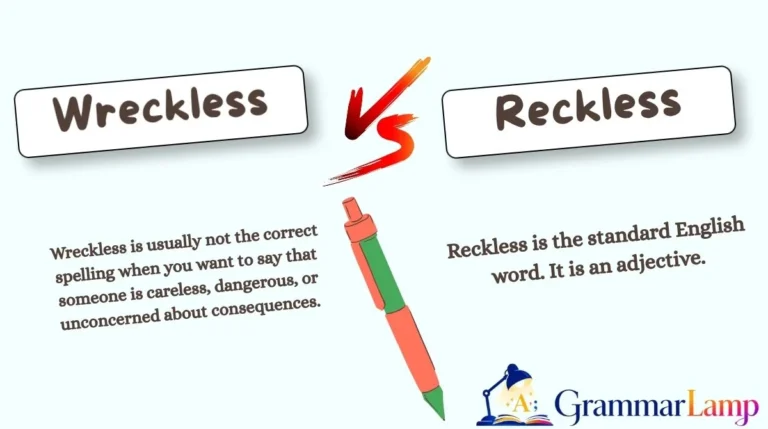
Wreckless or reckless? If you have ever seen both spellings, you may have wondered whether they have different meanings or whether one is simply a spelling mistake.
This confusion is understandable because wreck is a common English word, and we often connect reckless behavior with car wrecks, accidents, and destruction.
However, the standard English word you need in almost every situation is reckless.
Reckless is an adjective that describes someone who does not think carefully about danger or the possible results of an action.
For example, a person who drives very fast without caring about safety may be called a reckless driver. Oxford defines reckless as showing a lack of care about danger and the possible results of your actions.
Wreckless, on the other hand, is generally treated as a misspelling when people use it to mean reckless.
The spelling looks logical because wreck means to damage or destroy something. But the two words actually have different histories, and reckless did not come from wreck.
By the end of this guide, you will know which spelling is correct, why the mistake happens, how to use reckless in sentences, and how to remember the difference easily.
More Useful Posts
Favourite vs Favorite: Meaning, Difference, Spelling & Usage Guide 2026
By Which vs In Which: Easy Difference, Rules, Examples & Practice (2026)
No Thank You vs No, Thank You: Which Is Correct in 2026?
Creek vs Creak: Meaning, Difference, Examples & Easy Rules (2026)
What Does “Wreckless” Mean?
Is “wreckless” a correct English word?
Wreckless is usually not the correct spelling when you want to say that someone is careless, dangerous, or unconcerned about consequences.
For example:
❌ He is a wreckless driver.
The standard form is:
✅ He is a reckless driver.
The same applies to common expressions such as reckless driving, reckless behavior, and reckless abandon.
Dictionary.com explains that wreckless is usually considered a misspelling of reckless. It notes that a person might theoretically use wreckless to mean “without wrecks,” but that meaning is extremely rare and can easily confuse readers.
Why do people write “wreckless”?
The mistake makes sense when you think about the meaning.
A person who drives dangerously might cause a wreck. So it is easy to imagine:
wreck + less = wreckless
A learner may think that wreckless means “not causing a wreck” or simply associate dangerous behavior with wrecks.
But English does not always work by combining words in the most obvious way. Reckless is an older word with a different history. Oxford traces it to Old English reccelēas, connected with a Germanic base meaning “care.”
So, when you mean careless, dangerous, or not concerned about consequences, use reckless.
Examples
Here are some common examples:
- ❌ He was driving in a wreckless way.
✅ He was driving in a reckless way. - ❌ That was a wreckless decision.
✅ That was a reckless decision. - ❌ The police stopped the wreckless driver.
✅ The police stopped the reckless driver. - ❌ She spent her money in a wreckless manner.
✅ She spent her money in a reckless manner. - ❌ His wreckless behavior caused problems.
✅ His reckless behavior caused problems. - ❌ It would be wreckless to ignore the warning.
✅ It would be reckless to ignore the warning. - ❌ They made a wreckless attempt to cross the river.
✅ They made a reckless attempt to cross the river. - ❌ He acted wrecklessly during the race.
✅ He acted recklessly during the race.
Important point
Wreckless is not the normal alternative spelling of reckless.
If you are writing an email, school assignment, article, exam answer, business document, or social media post, use reckless when you mean “careless and dangerous.”
What Does “Reckless” Mean?
Reckless is the standard English word. It is an adjective.
It describes a person, action, decision, or behavior that shows little or no concern for danger or possible consequences.
Oxford gives the basic meaning as showing a lack of care about danger and the possible results of your actions. It also lists rash as a synonym.
In simple English:
Reckless = not thinking or caring enough about what might happen.
A reckless person may take unnecessary risks. The action does not have to result in an accident. The important idea is the lack of care about the possible consequences.
For example:
He was reckless when he drove at 150 km/h.
The sentence does not say that he had an accident. It says that his driving was dangerously careless.
When should you use “reckless”?
Use reckless when you want to describe:
- dangerous behavior
- careless decisions
- unnecessary risks
- irresponsible actions
- behavior that ignores possible consequences
- actions that may harm yourself or other people
It can describe both people and things.
You can say:
- a reckless driver
- a reckless person
- a reckless decision
- reckless behavior
- reckless spending
- reckless driving
- a reckless statement
- a reckless attempt
Grammar rule
Reckless is an adjective, so it normally describes a noun.
For example:
a reckless driver
Here, reckless describes driver.
You can also use it after linking verbs:
The driver was reckless.
Here, reckless describes the subject driver.
You can use it with be, seem, appear, and similar verbs:
His decision was reckless.
She seemed reckless.
Their behavior appeared reckless.
Examples
- He is a reckless driver.
- That was a reckless decision.
- She took a reckless risk.
- Reckless driving can cause serious accidents.
- His reckless behavior worried his parents.
- They made a reckless attempt to climb the mountain.
- It was reckless to ignore the safety instructions.
- He is reckless with his money.
These examples show that reckless is not limited to driving. You can use it for many kinds of behavior.
Reckless does not always mean “foolish”
There is an important difference between being brave and being reckless.
A brave person may understand the danger but decide to act because there is a good reason.
A reckless person may ignore the danger or fail to think about the consequences.
For example:
The firefighter made a brave decision.
This suggests courage.
But:
The firefighter made a reckless decision.
This suggests that the decision was unnecessarily dangerous or careless.
So, reckless usually has a negative meaning.
Difference Between Wreckless and Reckless
The easiest answer is:
Reckless is the correct standard spelling when you mean careless or dangerously unconcerned about consequences.
Wreckless is generally a misspelling of reckless.
Here is a simple comparison:
| Point | Wreckless | Reckless |
|---|---|---|
| Standard spelling? | No, when used to mean careless | Yes |
| Common in standard English? | Very uncommon | Very common |
| Meaning “careless/dangerous”? | Usually incorrect | Correct |
| Part of speech | Not normally used this way | Adjective |
| Example | ❌ wreckless driving | ✅ reckless driving |
| Common phrase | ❌ wreckless behavior | ✅ reckless behavior |
| Related to “wreck”? | Looks related, but normally isn’t | No |
| Best choice for learners | Avoid it | Use it |
Usage difference
Consider these two sentences:
❌ He was a wreckless driver.
✅ He was a reckless driver.
The second sentence is the one you want.
The word reckless tells us that the driver does not show enough concern for safety or consequences.
What about “wreck”?
Wreck is a real English word, but it has a different meaning.
As a verb, wreck can mean to seriously damage or destroy something.
The accident wrecked the car.
As a noun, wreck can refer to something that has been badly damaged or destroyed.
The old car was a complete wreck.
Dictionary.com defines wreck as something reduced to a ruined condition and also as the act of damaging or destroying something.
So these words are different:
wreck = damage or destruction
reckless = careless about danger or consequences
The spelling similarity can cause confusion, but their meanings are not the same.
The Grammar Logic Behind “Reckless”
There is also an interesting reason why reckless is spelled with reck- rather than wreck-.
The word is very old. Oxford traces it to Old English reccelēas, from a Germanic base associated with the idea of care or paying heed.
The ending -less often means “without.”
You can see this pattern in words such as:
- careless = without care
- hopeless = without hope
- harmless = without harm
- useless = without use
In a similar historical sense, reckless developed around the idea of being without care or concern.
It did not develop from the modern word wreck.
That is why adding a w because of the word wreck is incorrect in ordinary modern English.
Sentence Structure Difference
Because reckless is an adjective, it can appear in several common positions.
Before a noun
He is a reckless driver.
That was a reckless decision.
She made a reckless choice.
After a linking verb
He is reckless.
Her behavior was reckless.
The decision seemed reckless.
With “to + verb”
You can also use this structure:
It was reckless to drive so fast.
It would be reckless to ignore the warning.
This is a useful pattern for English learners.
Explore More Posts
Ardor vs Ardour: Meaning, Difference, Spelling & Examples (2026)
Fillet vs Filet: What’s the Difference? Meaning, Spelling, and Examples in 2026
Complaint vs Complain: Meaning, Difference, Grammar Rules & Examples (2026)
Differential vs Deferential: Meaning, Difference, Examples, and Grammar Rules (2026)
Grammar Rules You Must Remember
Rule 1: Use “reckless,” not “wreckless,” for careless or dangerous behavior.
This is the most important rule.
❌ He made a wreckless choice.
✅ He made a reckless choice.
If you are talking about someone ignoring danger or consequences, choose reckless.
Rule 2: “Reckless” is an adjective.
It describes a noun or subject.
a reckless driver
a reckless decision
a reckless statement
The driver was reckless.
Do not treat reckless as a verb.
You cannot say:
❌ He reckless the car.
Instead, use a suitable verb:
He drove recklessly.
Rule 3: The adverb is “recklessly.”
When you want to describe how someone does something, use recklessly.
Compare:
He is reckless.
Here, reckless describes he.
But:
He drove recklessly.
Here, recklessly describes how he drove.
Oxford lists recklessly as the adverb form of reckless.
Rule 4: The noun form is “recklessness.”
When you are talking about the quality or behavior itself, use recklessness.
His recklessness caused the accident.
The police were concerned about his recklessness.
Oxford lists recklessness as an uncountable noun meaning behavior that shows a lack of care about danger or possible results.
So remember this word family:
reckless → recklessly → recklessness
Common Mistakes Students Make
Mistake 1: Writing “wreckless driving”
This is probably the most common mistake because of the connection between driving and wrecks.
❌ He was arrested for wreckless driving.
✅ He was arrested for reckless driving.
Easy tip: The standard phrase is always reckless driving.
Mistake 2: Thinking “wreckless” means “without a wreck”
This is a logical guess, but it is not how the word is normally used.
If you want to say that something did not involve a wreck, simply say:
The journey was without any accidents.
or:
We completed the trip without a crash.
Using wreckless for this purpose can confuse your reader.
Mistake 3: Confusing reckless with brave
These words are not exact synonyms.
She was brave enough to enter the burning building.
This can describe a courageous and necessary action.
But:
She was reckless to enter the burning building without protective equipment.
This suggests unnecessary danger.
Brave often praises someone.
Reckless usually criticizes someone’s judgment.
Mistake 4: Using “reckless” for every mistake
Not every mistake is reckless.
For example:
I forgot my keys.
That is usually just careless or forgetful.
But:
I drove at high speed through a crowded street.
That may be reckless because it involves serious danger.
The word carries a stronger meaning than ordinary carelessness.
Mistake 5: Forgetting the adverb
Some learners write:
❌ He drove reckless.
In standard English, when describing how he drove, use the adverb:
✅ He drove recklessly.
But both are possible in different structures:
He is reckless.
He drives recklessly.
Easy Trick to Remember the Difference
Here is a simple trick:
Reckless = risk + no care
Think:
RECKLESS → no care about consequences
Do not think:
wreck + less
That second idea is what creates the spelling mistake.
Another useful memory sentence is:
A reckless driver may cause a wreck.
Notice the two different words.
Reckless describes the dangerous behavior.
Wreck describes the possible result.
So:
reckless → behavior
wreck → damage
For example:
His reckless driving caused a wreck.
That sentence makes the difference very clear.
The driver behaved recklessly, and the result was a wreck.
Daily Life Examples
The word reckless appears in many everyday situations. Here are some natural examples.
1. Talking about driving
A: Why did the police stop him?
B: He was driving recklessly.
2. Talking about money
Spending all your savings on something you do not need is reckless.
Here, reckless does not involve physical danger. It means the person is ignoring the possible financial consequences.
3. Talking about a decision
That was a reckless decision. You should have thought about the risks first.
4. Talking about a friend
My brother can be reckless sometimes. He never thinks before he acts.
5. Talking about sports
It was reckless to play without warming up properly.
The idea is that the person took an unnecessary risk.
6. Talking about work
Sending an angry email to your manager without reading it again could be reckless.
This does not mean the person will physically get hurt. The possible consequences may be professional or social.
7. Talking about social media
Sharing private information online can be reckless.
Again, the important idea is not considering what may happen afterward.
8. Talking about travel
It would be reckless to travel into the mountains without checking the weather.
9. Talking about a statement
His reckless comment upset several people.
A statement can be called reckless when someone makes it without thinking about its possible effects.
10. Talking about behavior
The teacher warned the students about their reckless behavior.
This is a common formal use of the word.
Practice Section
Choose wreckless or reckless in each sentence.
1. He is a ______ driver.
2. It was ______ to ignore the warning.
3. The company criticized his ______ spending.
4. She drove ______ through the narrow street.
5. His ______ behavior worried everyone.
Answers
1. reckless
He is a reckless driver.
2. reckless
It was reckless to ignore the warning.
3. reckless
The company criticized his reckless spending.
4. recklessly
The sentence needs an adverb because it describes how she drove:
She drove recklessly through the narrow street.
5. reckless
His reckless behavior worried everyone.
Notice that none of these sentences needs wreckless.
More Helpful posts
Feel vs Felt: Complete Grammar Guide With Examples (2026)
Role Call or Roll Call? The Correct Spelling and Meaning in 2026
Into or Onto: Complete Difference, Rules, and Examples for 2026
Sole vs Soul: What’s the Difference? Easy Guide With Examples 2026
FAQs
1. What is the difference between wreckless and reckless?
Reckless is the standard English word meaning careless, dangerous, or unconcerned about possible consequences.
Wreckless is generally considered a misspelling when it is used with this meaning. The two words are not simply alternative spellings.
2. Is “wreckless” a real word?
You may occasionally see wreckless used to mean something like “without wrecks,” but this use is very rare.
When someone writes wreckless to mean careless or dangerous, it is normally treated as a spelling error. For normal English writing, use reckless.
3. Is it “wreckless driving” or “reckless driving”?
The correct standard expression is reckless driving.
✅ He was charged with reckless driving.
Wreckless driving is a common spelling mistake. The word wreck may cause the confusion because dangerous driving can cause a wreck, but that does not change the spelling of reckless.
4. Is “reckless” formal or informal?
Reckless can be used in both everyday and formal English.
You can say:
He is a reckless driver.
You can also see it in formal writing:
The company was accused of reckless behavior.
It is a normal, widely used English adjective. Oxford lists common combinations such as reckless driving, reckless disregard, and reckless with money.
5. Can “reckless” be used in a question?
Yes. There is no problem using reckless in questions.
For example:
Was he being reckless?
Do you think that was reckless?
Why are you driving so recklessly?
Remember that the adjective is reckless, while the adverb is recklessly.
6. What is the opposite of reckless?
The most common opposite is careful.
Other possible opposites include:
- cautious
- sensible
- responsible
- prudent
For example:
He is a reckless driver.
He is a careful driver.
Oxford gives cautious as the opposite of reckless in its American English entry.
Conclusion
When you are choosing between wreckless or reckless, the answer is simple: use reckless when you mean careless, dangerous, or unconcerned about the possible results of an action.
Wreckless is usually a spelling mistake caused by the word wreck. The connection seems natural because reckless actions can sometimes cause wrecks, especially on the road. However, reckless has a different history and is not formed from wreck.
Remember the useful word family:
reckless — adjective
recklessly — adverb
recklessness — noun
You can also remember this simple sentence:
A reckless driver may cause a wreck.
The driver’s behavior is reckless. The accident or damaged vehicle may be a wreck.
Once you separate those two ideas, the spelling becomes much easier. The next time you want to write wreckless driving, stop and remember: the correct phrase is reckless driving. A little practice will make the correct spelling feel natural.

Liam Derren is a language writer at GrammarLamp, creating simple, helpful content about grammar, words, and everyday English. He makes language learning clear, practical, and easy to understand.
1 thought on “Wreckless or Reckless? Which Spelling Is Correct in 2026?”