
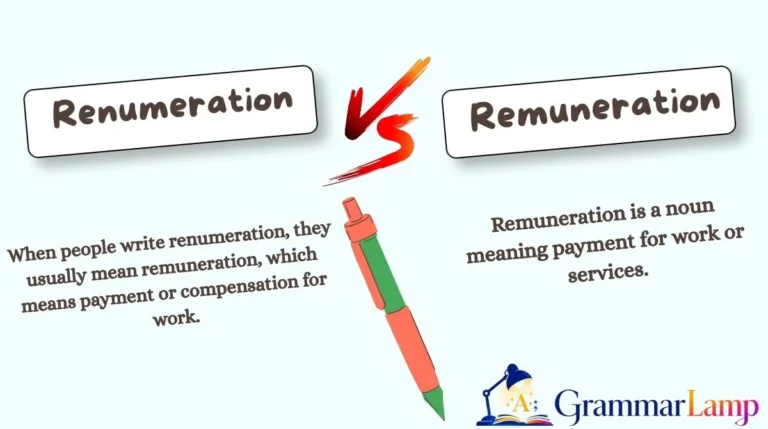
Some English words are confusing because they look almost the same. Renumeration vs remuneration is a good example. The two forms differ by only one letter, so it is easy to type or write the wrong one without noticing.
The confusion becomes even stronger because renumeration looks like it is connected to words such as number, numerical, or enumeration.
That makes the spelling seem logical at first glance. However, when you are talking about money paid for work or services, the standard English word is remuneration.
Cambridge Dictionary defines remuneration as payment for work or services and marks it as a formal noun.
You will often see remuneration in job contracts, company policies, business reports, salary discussions, and other formal writing. It can refer to pay in a broad sense, rather than only a basic salary.
The key point is simple: remuneration is the correct spelling for payment or compensation for work. Renumeration is generally a spelling error when it is used with that meaning.
Once you understand the meaning, spelling, grammar, and pronunciation of remuneration, this confusing pair becomes much easier to remember.
More Useful posts
If There Is Any vs If There Are Any: Meaning, Difference, and Examples (2026)
Also Have or Have Also: Which Is Correct? Complete Grammar Guide 2026
Sneaked vs Snuck: What Is the Difference? 2026 Guide
Wether vs Weather vs Whether: What’s the Difference? 2026 Guide
What Does “Renumeration” Mean?
Is “Renumeration” a correct English word?
When people write renumeration, they usually mean remuneration, which means payment or compensation for work. In standard modern English, however, renumeration is not the spelling you should use for that meaning. Spelling references specifically identify remuneration as the correct form and renumeration as incorrect.
So, if you are writing about an employee’s salary, a freelancer’s payment, an executive’s compensation, or money received for a service, do not write renumeration.
Why does “renumeration” look correct?
The mistake is understandable. The letters n-u-m make many learners think of number, numerical, enumerate, and enumeration. Because money is often connected with numbers, the spelling can feel natural.
But the history of remuneration is different. The word comes through French from Latin and is linked to munus, meaning a gift, service, duty, or reward. It is not built from the idea of “number.”
That is why changing the middle of the word from mun to num creates the common spelling error.
Examples of the common mistake
These sentences show how renumeration may appear in writing. The corrected form is remuneration:
- ❌ The renumeration for the position was not discussed.
✅ The remuneration for the position was not discussed. - ❌ Employees are asking for better renumeration.
✅ Employees are asking for better remuneration. - ❌ The company offers competitive renumeration.
✅ The company offers competitive remuneration. - ❌ His renumeration includes a yearly bonus.
✅ His remuneration includes a yearly bonus. - ❌ We need to agree on the renumeration package.
✅ We need to agree on the remuneration package. - ❌ The contract explains the worker’s renumeration.
✅ The contract explains the worker’s remuneration. - ❌ She received fair renumeration for her services.
✅ She received fair remuneration for her services. - ❌ The job provides good renumeration and benefits.
✅ The job provides good remuneration and benefits.
The easiest correction is simply to replace renumeration with remuneration.
What Does “Remuneration” Mean?
Remuneration is a noun meaning payment for work or services. It is a formal word, so it is especially common in business, employment, legal, and professional contexts. Cambridge gives the simple meaning “payment for work or services” and lists examples such as adequate remuneration and remuneration package.
You can think of remuneration as a broad word for what someone receives in return for work or a service.
It can mean money, but in some contexts it can describe the overall compensation connected with a job. That is why you may hear expressions such as total remuneration, annual remuneration, and executive remuneration in workplace English.
When should you use “remuneration”?
Use remuneration when you are discussing payment in a formal or professional situation.
For example:
- a company discussing employee pay
- a contract describing payment terms
- a business report discussing executive pay
- payment for professional services
- compensation for work completed
In casual conversation, native speakers often choose simpler words such as pay, salary, wages, or money. Remuneration is correct, but it has a more formal tone. Cambridge labels it as formal.
Grammar rule
Remuneration is a noun.
You can use it as the subject or object of a sentence, or after a preposition.
Common patterns include:
remuneration + for + work/service
The consultant received remuneration for her services.
adjective + remuneration
The workers received adequate remuneration.
remuneration + package
The company offered a competitive remuneration package.
annual/monthly/total + remuneration
His annual remuneration increased this year.
Dictionary.com also defines remuneration as pay, reward, or recompense and records both countable and uncountable use.
Examples with “remuneration”
- The company offers fair remuneration for experienced workers.
- She received adequate remuneration for the extra hours she worked.
- The contract clearly states the employee’s remuneration.
- His total remuneration includes salary, bonuses, and other payments.
- The consultant asked for higher remuneration for the additional work.
- The job provides good remuneration and flexible working hours.
- The board reviewed the director’s annual remuneration.
- They were satisfied with the remuneration offered for the project.
These examples show that remuneration normally appears in formal discussions about money, work, and services.
Difference Between Renumeration and Remuneration
The main difference is not a difference in meaning. It is a difference between the standard spelling and a common spelling mistake.
When the intended meaning is payment for work or services, remuneration is the word to use.
| Point | Renumeration | Remuneration |
|---|---|---|
| Standard spelling | ❌ No | ✅ Yes |
| Meaning “payment for work” | ❌ Not standard | ✅ Yes |
| Part of speech | Usually a mistaken form | Noun |
| Formal writing | Avoid it | Appropriate |
| Used for salary/compensation | ❌ | ✅ |
| Common source of confusion | Looks like number | Correct historical spelling |
| Example | ❌ renumeration package | ✅ remuneration package |
Usage difference
There is an important practical rule here:
Do not treat these as two normal words with different meanings.
For employment and payment, the standard word is remuneration.
So:
✅ The employee received fair remuneration.
Not:
❌ The employee received fair renumeration.
This is similar to a spelling error such as writing seperate instead of separate. The wrong spelling may be easy to recognize once someone points it out, but it does not become a separate standard word simply because people sometimes type it.
Grammar logic
The spelling remuneration comes from the older word family connected with remunerate. Cambridge defines remunerate as a formal verb meaning to pay someone for work or services.
Notice the family:
- remunerate — verb
- remuneration — noun
- remunerated — past participle/adjective use
- remunerative — adjective meaning rewarding or profitable
The important part to remember is mun, not num.
Sentence structure
Because remuneration is a noun, it commonly appears after words such as the, fair, adequate, generous, competitive, total, annual, and additional.
For example:
The company offered competitive remuneration.
The employee requested additional remuneration.
His annual remuneration is reviewed every year.
You can also use it after for:
She received remuneration for her services.
This structure is especially useful for learners because it clearly connects the payment with the work or service.
Meaning comparison
There is no useful everyday meaning difference such as “one means X and the other means Y.”
Instead, the practical distinction is:
Remuneration = correct standard spelling for payment or compensation.
Renumeration = common spelling error when the writer means remuneration.
That is the distinction you should remember for school, exams, resumes, business emails, job applications, and professional documents.
Grammar Rules You Must Remember
Rule 1: Use “remuneration” for payment for work or services
When someone receives payment in return for work, remuneration is the correct noun.
Employees should receive fair remuneration for their work.
The word can refer to different forms of compensation, depending on the context. Cambridge’s Business English definition specifically uses it for payment for work already done or services provided.
Rule 2: “Remuneration” is a noun
Do not use remuneration as though it were a verb.
The verb is remunerate.
✅ The company will remunerate the consultant.
✅ The consultant received remuneration.
A simple way to see the difference is:
remunerate = action
remuneration = payment or compensation
Cambridge lists remunerate as a formal transitive verb meaning to pay someone for work or services.
Rule 3: Use “remuneration for” when naming the work or service
A very useful pattern is:
remuneration for + work/service
Examples:
She received remuneration for her services.
They asked for remuneration for the extra work.
The contract includes remuneration for professional advice.
This pattern makes your sentence clear and natural.
Rule 4: Remember “M before N”
The spelling trap is in the middle:
re-MUN-er-ation
not
re-NUM-er-ation
The root history supports the spelling with mun. The word is related to Latin munus, associated with gift, service, duty, or reward.
So remember:
M comes before N in remuneration.
That tiny spelling rule can save you from a very common error.
Explore More Posts
Instructions on vs Instructions for: Meaning, Difference, and Correct Usage in 2026
Role vs Roll: Meaning, Difference, Rules & Examples (2026)
John and I or John and Me? The Easy Grammar Guide for 2026
Formal vs Informal Usage: Complete Guide to English in 2026
Common Mistakes Students Make
Mistake 1: Writing “renumeration” because of “number”
This is probably the biggest reason for the confusion. Learners see numeration and connect it with number and numerical words.
But remuneration is not related to numbering. Its word history comes from Latin forms connected with rewarding or giving.
Wrong:
The job comes with excellent renumeration.
Correct:
The job comes with excellent remuneration.
Mistake 2: Thinking both spellings are acceptable
You may see renumeration online, especially because misspellings can spread through websites, emails, forms, and copied text.
Seeing a spelling often does not prove that it is standard English.
For payment-related writing, choose remuneration. Major dictionary sources define and use remuneration for payment, while spelling references identify renumeration as incorrect for this purpose.
Mistake 3: Using “remuneration” in very casual situations
This is not a grammar error, but it can sound formal.
A friend might naturally say:
How much do they pay you?
A formal business document might say:
What is the remuneration offered for this position?
Both are understandable. The second simply has a more professional tone.
Mistake 4: Confusing “remuneration” with “salary”
These words can overlap, but they are not always identical.
Salary usually means the fixed amount an employee is paid regularly, often monthly or annually.
Remuneration is broader and can refer to payment or overall compensation for work or services.
For example:
Her salary is $3,000 a month.
But:
Her total remuneration includes salary, bonuses, and other benefits.
The exact details depend on the context, so do not automatically replace one word with the other in every sentence.
Easy correction tip
Whenever you type renumeration, stop for one second and check the middle.
Ask yourself:
“Am I talking about a number, or am I talking about payment for work?”
If you mean payment for work, write:
RE-MUN-ER-A-TION
Easy Trick to Remember the Difference
Here is a simple memory trick:
Remuneration = Money for work
Look at this part:
MUN
Think:
M → Money
That is not the real etymology, but it is an easy classroom memory aid.
So:
RE + MUN + ERATION = REMUNERATION
And remember:
M before N.
You can also connect it to the verb:
remunerate → remuneration
Both forms keep mun.
Another helpful trick is to imagine a worker finishing a project and receiving a payment envelope.
The worker says:
“This is my remuneration.”
Not renumeration.
The spelling may look strange at first, but after writing it several times, the correct form starts to feel natural.
Daily Life Examples
Here are some simple examples showing how remuneration can appear in real conversations and workplace situations.
Example 1: Asking about a job
Ali: Does the company offer good remuneration?
Sam: Yes, the pay is competitive, and there is also a yearly bonus.
Example 2: Talking about extra work
Manager: We need you to stay late this week.
Employee: Will there be additional remuneration for the extra hours?
Example 3: Discussing a contract
Sarah: Have you read the contract?
Tom: Yes. The remuneration and working hours are clearly explained.
Example 4: Talking about a consultant
Client: How will the consultant be paid?
Manager: Her remuneration will depend on the work she completes.
Example 5: Discussing a job offer
John: Did you accept the offer?
Mike: Not yet. I’m still discussing the remuneration package.
Example 6: Comparing two jobs
Nadia: Why did you choose the second company?
Hina: The remuneration was better, and the working conditions were also good.
Example 7: Asking for better pay
Worker: We are doing more work than before.
Manager: We understand, and we are reviewing the team’s remuneration.
Example 8: Talking about professional services
Client: What will I have to pay for your advice?
Lawyer: My remuneration for the service is stated in the agreement.
Example 9: Company meeting
Director: We need to review executive remuneration this month.
Manager: I will prepare the relevant figures.
Example 10: Formal writing
The agreement specifies the remuneration payable for the services provided.
Notice that these examples are mostly formal. In everyday speech, pay, salary, or wages are often more natural.
Practice Section
Choose the correct option in each sentence.
1. The employee asked for higher ______.
A. renumeration
B. remuneration
2. The contract explains the consultant’s ______.
A. remuneration
B. renumeration
3. The company offers competitive ______ and benefits.
A. renumeration
B. remuneration
4. She received fair ______ for her services.
A. remuneration
B. renumeration
5. The director’s annual ______ was discussed at the meeting.
A. remuneration
B. renumeration
Answers
1. B — remuneration
2. A — remuneration
3. B — remuneration
4. A — remuneration
5. A — remuneration
The pattern is the same every time: when you mean payment for work or services, use remuneration.
More Helpful posts
Please Advise or Please Advice? The Correct Usage Explained (2026)
See vs Look vs Watch: Easy English Grammar Guide for 2026
Recommend to vs recommend for 2026: Clear Grammar Rules, Examples, and Common Mistakes
Wreckless or Reckless? Which Spelling Is Correct in 2026?
FAQs
What is the difference between renumeration and remuneration?
For the meaning “payment for work or services,” remuneration is the standard correct spelling. Renumeration is generally a spelling mistake caused by confusion with words related to numbers.
Is renumeration a word?
You may occasionally find renumeration in unusual or nonstandard sources, but it should not be used when you mean payment for work. For normal English writing, especially professional writing, use remuneration.
Is remuneration formal or informal?
Remuneration is formal. Cambridge labels it as a formal noun. It is common in business, employment, contracts, and professional writing. In casual conversation, people usually prefer simpler words such as pay or salary.
Can remuneration mean salary?
Yes, depending on context, but remuneration is often broader than salary. It can refer to payment or compensation for work or services as a whole. A remuneration package may include salary and other forms of compensation.
How do you pronounce remuneration?
Cambridge gives pronunciations close to ri-MYOO-nuh-RAY-shun, with some variation between British and American English. The important part for learners is to avoid changing the middle to num.
Is “remuneration package” correct?
Yes. Remuneration package is a standard business expression. It can describe the overall compensation offered to a worker or executive. Cambridge lists a remuneration package as an example of normal usage.
Conclusion
The confusion between renumeration vs remuneration is mainly a spelling problem, not a difference in meaning. When you are talking about payment for work or services, the correct standard word is remuneration.
It is a formal noun commonly used in workplaces, contracts, business writing, and professional discussions.
The easiest mistake to make is switching mun to num. Because num looks like number, the incorrect spelling can seem reasonable. But the word’s history is connected with Latin forms meaning reward, gift, service, or repayment, not counting.
So keep one simple rule in mind:
Remuneration = payment for work.
And remember the letters:
RE-MUN-ER-ATION
Writing this word a few times in your own sentences will help fix the spelling in your memory. Once you know the pattern, you will be much less likely to write renumeration by mistake.

Liam Derren is a language writer at GrammarLamp, creating simple, helpful content about grammar, words, and everyday English. He makes language learning clear, practical, and easy to understand.