
English learners often get confused by “if there is any” and “if there are any.” Both expressions are very common, especially in questions, instructions, emails, conversations, and everyday English. They look almost the same, so it can be difficult to know which one to use.
The good news is that the difference is actually simple. The main thing you need to look at is the noun that comes after “any.”
Is it singular or plural? Is it an uncountable noun? Once you understand this small grammar point, choosing between there is and there are becomes much easier.
For example, we say:
- If there is any problem, call me.
- If there are any problems, call me.
The first sentence talks about one problem or a problem in general. The second talks about two or more possible problems.
You will also see these expressions without a noun, such as “If there is any, let me know” or “If there are any, let me know.” In these cases, the missing noun is understood from the context.
By the end of this guide, you will understand how there is, there are, and any work together.
You will also learn common mistakes, easy memory tricks, everyday examples, and practice questions so you can use these expressions naturally.
More Useful posts
It’s vs Its: Simple Difference, Rules, Examples & Practice (2026)
Enamor vs Enamour: What’s the Difference? Meaning, Usage & Examples in 2026
Breath vs Breathe: Easy Difference, Meaning, Examples & Rules in 2026
No Longer Exist vs No Longer Exists: Which Is Correct? (2026 Guide)
What Does “If There Is Any” Mean?
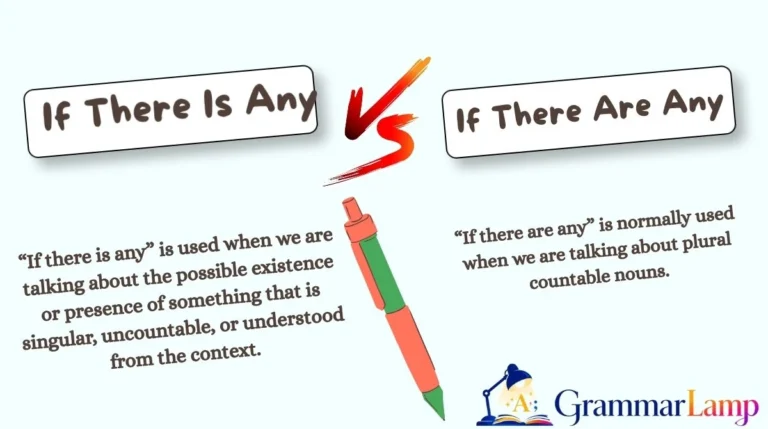
“If there is any” is used when we are talking about the possible existence or presence of something that is singular, uncountable, or understood from the context.
The basic structure is:
If there is any + singular noun/uncountable noun, + …
For example:
- If there is any problem, tell me.
- If there is any water left, put it in the fridge.
- If there is any mistake, please correct it.
- If there is any information missing, let me know.
Here, there is is used because the noun after it is singular or uncountable.
When Do We Use “If There Is Any”?
We commonly use this structure when we are not sure whether something exists or is available.
Imagine your friend is checking a document. You want to tell them that they should tell you if they find a problem.
You can say:
“If there is any problem, let me know.”
You are not saying that there definitely is a problem. You are only talking about the possibility of one.
The same idea works with uncountable nouns:
“If there is any water left, please save it.”
“Water” is uncountable, so we use there is, not there are.
Grammar Rule
Use:
If there is any + singular countable noun
Examples:
- If there is any mistake, tell me.
- If there is any question, ask me.
- If there is any delay, call the office.
- If there is any problem, contact your manager.
You can also use:
If there is any + uncountable noun
Examples:
- If there is any money left, keep it.
- If there is any water left, drink it.
- If there is any information missing, tell me.
- If there is any confusion, ask me.
Examples of “If There Is Any”
- If there is any problem, please call me.
- If there is any mistake in this report, let me know.
- If there is any water left, put it in the bottle.
- If there is any information you need, ask me.
- If there is any delay, I will let you know.
- If there is any chance of rain, take an umbrella.
- If there is any confusion, please ask your teacher.
- If there is any money left after shopping, save it.
What About “If There Is Any” Without a Noun?
Sometimes the noun is not repeated because everyone already understands what you mean.
For example:
“Is there any milk left?”
Someone might answer:
“Yes, if there is any, I will put it in the fridge.”
Here, any means any milk. The noun “milk” is understood, so we do not need to say it again.
Another example:
“Do we have any extra paper?”
“If there is any, it should be in the drawer.”
Here, “any” means any extra paper.
So, when you see “if there is any” by itself, ask yourself:
“What noun is understood here?”
If that noun is singular or uncountable, there is is usually the correct choice.
A Common Learner Confusion
Many learners think that any always needs “are.” That is not true.
They may think:
❌ If there are any problem…
But problem is singular.
The correct sentence is:
✅ If there is any problem…
On the other hand:
✅ If there are any problems…
The important word is not simply any. The important point is the noun that follows it.
What Does “If There Are Any” Mean?
“If there are any” is normally used when we are talking about plural countable nouns.
The basic structure is:
If there are any + plural noun, + …
For example:
- If there are any problems, tell me.
- If there are any questions, ask me.
- If there are any mistakes, correct them.
- If there are any changes, let me know.
The word there are tells us that we are talking about more than one thing.
When Do We Use “If There Are Any”?
Use “if there are any” when the noun is plural and countable.
For example:
“If there are any questions, please ask.”
There could be one question, but the speaker is allowing for the possibility of multiple questions. The plural form questions is used.
Another example:
“If there are any problems, call me.”
This means:
If one or more problems exist, call me.
Grammar Rule
Use:
If there are any + plural countable noun
Examples:
- If there are any questions, ask me.
- If there are any mistakes, tell me.
- If there are any problems, call me.
- If there are any changes, update the document.
- If there are any students outside, send them in.
Examples of “If There Are Any”
- If there are any problems, please call me.
- If there are any questions, raise your hand.
- If there are any mistakes, please correct them.
- If there are any changes, send me an email.
- If there are any students waiting, ask them to sit down.
- If there are any seats available, let me know.
- If there are any messages for me, please write them down.
- If there are any extra copies, give one to Ali.
“If There Are Any” Without a Noun
Just like “if there is any,” we can leave out the noun when it is already clear.
For example:
“Are there any clean shirts?”
Someone might say:
“If there are any, they are in the bedroom.”
Here, any means any clean shirts.
Another example:
“Do we have any extra chairs?”
“If there are any, they are in the storage room.”
The word chairs is not repeated, but we understand it from the conversation.
This is why context is important when using these expressions.
Difference Between “If There Is Any” and “If There Are Any”
The main difference is singular/uncountable vs. plural.
| Expression | Usually used with | Example |
|---|---|---|
| If there is any | Singular noun or uncountable noun | If there is any problem, call me. |
| If there are any | Plural countable noun | If there are any problems, call me. |
| If there is any | Uncountable noun | If there is any water, save it. |
| If there are any | Plural countable noun | If there are any bottles, collect them. |
1. Singular Nouns
When the noun is singular, use there is.
If there is any problem, tell me.
“Problem” is singular.
Compare:
✅ If there is any problem…
❌ If there are any problem…
If you want to use there are, make the noun plural:
✅ If there are any problems…
2. Plural Nouns
When the noun is plural, use there are.
If there are any problems, tell me.
“Problems” is plural.
More examples:
- If there are any questions, ask me.
- If there are any mistakes, correct them.
- If there are any changes, tell us.
- If there are any students outside, call them in.
3. Uncountable Nouns
With uncountable nouns, use there is.
For example:
- If there is any water…
- If there is any money…
- If there is any information…
- If there is any traffic…
- If there is any time…
So:
✅ If there is any information missing, tell me.
Not:
❌ If there are any information missing…
“Information” is uncountable in standard English.
4. The Meaning Can Be Very Similar
Sometimes both structures can express almost the same general idea, but the grammar changes because the noun changes.
Compare:
If there is any problem, call me.
and
If there are any problems, call me.
The first uses singular problem. The second uses plural problems.
In everyday conversation, both can mean something like:
If you have a problem or problems, call me.
The difference is mainly grammatical, although the singular and plural forms can sometimes give slightly different emphasis.
Sentence Structure
The basic patterns are:
If there is any + singular noun + …
Example:
If there is any problem, let me know.
And:
If there is any + uncountable noun + …
Example:
If there is any information missing, let me know.
For plural nouns:
If there are any + plural noun + …
Example:
If there are any problems, let me know.
Explore More Posts
Jewel vs Joule: Meaning, Difference, Examples & Easy Rules (2026)
Foul or Fowl: Meaning, Difference, Examples & Easy Rules for 2026
Dialog vs Dialogue: What’s the Difference? A Simple English Guide for 2026
Learned vs Learnt: What’s the Difference? A Simple Guide for 2026
Grammar Rules You Must Remember
Rule 1: Use “There Is” With a Singular Noun
When the noun is singular, use there is.
✅ If there is any problem, call me.
❌ If there are any problem, call me.
“Problem” is one countable thing, so it is singular.
Another example:
✅ If there is any question, ask me.
Rule 2: Use “There Are” With Plural Countable Nouns
When the noun is plural, use there are.
✅ If there are any problems, call me.
❌ If there is any problems, call me.
“Problems” means more than one problem, so there are is needed.
More examples:
- If there are any questions, ask.
- If there are any errors, tell me.
- If there are any changes, let us know.
Rule 3: Uncountable Nouns Usually Take “There Is”
Uncountable nouns do not normally have a plural form, so use there is.
Examples:
- If there is any water, drink it.
- If there is any money left, save it.
- If there is any information, send it to me.
- If there is any work remaining, finish it.
Remember that words such as information, advice, furniture, money, and equipment are normally uncountable in English.
So:
✅ If there is any information…
❌ If there are any information…
Rule 4: “Any” Does Not Decide Between “Is” and “Are”
This is one of the most important rules.
Do not think:
“I see the word any, so I must use are.”
Instead, look at the noun.
Any + singular noun → there is
Any + plural noun → there are
Any + uncountable noun → there is
Examples:
- If there is any problem…
- If there are any problems…
- If there is any water…
The word any stays the same. The form of there is/there are changes.
Common Mistakes Students Make
Many learners make mistakes because they focus on any instead of the noun.
Mistake 1: Using “Are” With a Singular Noun
❌ If there are any problem, tell me.
This is incorrect because problem is singular.
Correct:
✅ If there is any problem, tell me.
Easy tip: Ask yourself, “Is it one problem or more than one?”
Mistake 2: Using “Is” With a Plural Noun
❌ If there is any problems, tell me.
“Problems” is plural, so we need there are.
Correct:
✅ If there are any problems, tell me.
Mistake 3: Using “Are” With an Uncountable Noun
❌ If there are any information, contact me.
Correct:
✅ If there is any information, contact me.
The noun information does not normally take a plural form in standard English.
You can say:
pieces of information
So:
✅ If there are any pieces of information you need, ask me.
Mistake 4: Thinking “Any” Always Means Plural
The word any can be used with different kinds of nouns.
For example:
- any problem
- any problems
- any water
- any money
- any information
So any itself does not tell you whether to use is or are.
Mistake 5: Saying “If There Are Any” Without Knowing What “Any” Means
Sometimes learners use “if there are any” because they have heard it often.
But if the implied noun is uncountable, there is may be needed.
For example:
“Do we have any milk?”
You can say:
“If there is any, put it in the fridge.”
Not:
❌ If there are any, put it in the fridge.
Here, “any” means any milk, and milk is uncountable.
Easy Trick to Remember the Difference
Here is a simple trick that works well:
Look at the noun, not the word “any.”
Think of these three patterns:
ONE → THERE IS
MANY → THERE ARE
UNCOUTABLE → THERE IS
For example:
One problem
→ If there is any problem.
Many problems
→ If there are any problems.
Water
→ If there is any water.
You can also use the “S” trick.
If the noun has a plural -s, you will often need there are:
- problems → there are
- questions → there are
- mistakes → there are
- changes → there are
If the noun is singular:
- problem → there is
- question → there is
- mistake → there is
- change → there is
This is not a rule for every noun in English, but it is a very useful beginner-friendly way to remember the basic pattern.
Daily Life Examples
These expressions appear all the time in normal conversations.
Example 1: At Work
A: Is the report ready?
B: Almost. If there are any problems, I’ll fix them before sending it.
Here, problems is plural, so we use there are.
Example 2: In Class
Teacher: If there are any questions, please raise your hand.
Student: I have one question about number five.
Here, questions is plural because the teacher is talking about one or more possible questions.
Example 3: Talking About a Problem
A: Everything looks fine.
B: Good. If there is any problem, call me.
Here, problem is singular.
Example 4: Talking About Water
A: Is there any water left?
B: Yes. If there is any left after dinner, I’ll put it in the fridge.
“Water” is uncountable, so there is is used.
Example 5: At a Hotel
Guest: Are there any rooms available?
Receptionist: If there are any available, I’ll check the system for you.
“Rooms” is plural, so there are is correct.
Example 6: Checking a Document
A: Can you check this document?
B: Sure. If there are any mistakes, I’ll tell you.
“Any mistakes” is plural.
Example 7: Asking for Information
A: Do you need anything else?
B: If there is any information missing, I’ll let you know.
“Information” is uncountable, so we use there is.
Example 8: At Home
Mother: Do we have any rice?
Son: If there is any left, it’s in the kitchen.
“Rice” is uncountable.
Example 9: Talking About Changes
A: Is the meeting still at 3 p.m.?
B: Yes. If there are any changes, I’ll send you a message.
“Changes” is plural.
Example 10: Talking About Extra Items
A: Do we have any extra chairs?
B: If there are any, they should be in the storage room.
“Chairs” is plural, so there are is used.
Practice Section
Choose the correct option in each sentence.
1. If ______ any problem, please call me.
A. there is
B. there are
2. If ______ any questions, ask your teacher.
A. there is
B. there are
3. If ______ any water left, put it in the bottle.
A. there is
B. there are
4. If ______ any mistakes in the report, correct them.
A. there is
B. there are
5. If ______ any information missing, let me know.
A. there is
B. there are
Answers
1. A — there is
“If there is any problem” is correct because problem is singular.
2. B — there are
“If there are any questions” is correct because questions is plural.
3. A — there is
“If there is any water” is correct because water is uncountable.
4. B — there are
“If there are any mistakes” is correct because mistakes is plural.
5. A — there is
“If there is any information” is correct because information is uncountable.
More Helpful posts
In the Same Day vs On the Same Day: Which Is Correct? A Simple Guide for 2026
Licence or License: Which Spelling Is Correct in 2026?
I’ve Added vs I Added: Easy Difference, Rules & Examples (2026)
This Is She or This Is Her? The Correct Choice in English in 2026
FAQs
What is the difference between “if there is any” and “if there are any”?
The main difference is the noun that follows any. Use if there is any with a singular or uncountable noun. Use if there are any with a plural countable noun.
For example, “If there is any problem” and “If there are any problems” are both possible, but their noun forms are different.
Can we use “if there is any” in questions?
Yes. The expression can appear in questions, although the exact structure may change depending on the sentence.
For example: “Do you know if there is any water left?” Here, “water” is uncountable, so there is is correct.
Can we use “if there are any” in questions?
Yes. It is very common in questions about plural things.
For example: “Do you know if there are any seats available?” The noun seats is plural, so there are is used.
Is “if there is any” formal or informal?
It is normal English and can be used in both everyday conversation and formal writing. The expression itself is neither strongly formal nor strongly informal.
For example, “If there is any problem, please contact us” can appear in an email, notice, or normal conversation.
Is “if there are any” grammatically correct?
Yes. “If there are any” is grammatically correct when it refers to plural countable things.
For example: “If there are any questions, please ask.” Here, questions is plural, so there are is correct.
Can “any” be used with a singular noun?
Yes. In questions, negatives, and conditional sentences, any can be used with a singular countable noun in certain contexts.
For example: “If there is any problem, call me.” Here, any does not make the noun plural. The noun problem remains singular.
Can “if there is any” and “if there are any” mean the same thing?
Sometimes their overall message can be very similar, especially when talking generally about possible problems or issues.
For example, “If there is any problem, call me” and “If there are any problems, call me” both invite someone to contact the speaker if a problem occurs. The main grammatical difference is singular versus plural.
Which is correct: “If there is any problem” or “if there are any problems”?
Both can be correct.
“If there is any problem” uses the singular noun problem.
“If there are any problems” uses the plural noun problems.
Choose the form based on the noun you want to use.
Conclusion
The difference between “if there is any” and “if there are any” is much easier once you stop focusing only on the word any.
The key is the noun that comes after it, or the noun that is understood from the context.
Use “if there is any” with a singular noun or an uncountable noun:
- If there is any problem…
- If there is any water…
- If there is any information…
Use “if there are any” with a plural countable noun:
- If there are any problems…
- If there are any questions…
- If there are any mistakes…
Remember the simple rule: one or uncountable → there is; plural → there are.
The best way to make this grammar natural is to notice these expressions when you hear or read English.
Then try making your own sentences about work, school, home, and everyday situations. A little practice will make the choice feel automatic.

Liam Derren is a language writer at GrammarLamp, creating simple, helpful content about grammar, words, and everyday English. He makes language learning clear, practical, and easy to understand.
3 thoughts on “If There Is Any vs If There Are Any: Meaning, Difference, and Examples (2026)”