
Have you ever written girly and then wondered whether it should be girlie instead? You are not alone.
These two words look almost the same, sound almost the same, and often appear in very similar sentences.
The confusion becomes even bigger because both girly and girlie are real English words. They can both describe things connected with girls, women, or traditional feminine styles.
However, they do not always have the same grammar or the same tone. Girlie can also be used as a noun or as a casual way to address someone, while girly is most often used as an adjective.
Cambridge lists girlie as another form of girly, while Oxford and Collins also show overlapping meanings with some differences in use.
This matters in everyday English. You might talk about a girly dress, a girlie chat, a girly room, or even say, “Hey, girlie!” These expressions are not always interchangeable.
The good news is that the basic difference is easy to learn. Once you understand the grammar and tone of each word, choosing between them becomes much simpler.
You will also see why expressions such as gym girlie, book girlie, and girly style can sound natural in different situations.
More Useful posts
If There Is Any vs If There Are Any: Meaning, Difference, and Examples (2026)
Also Have or Have Also: Which Is Correct? Complete Grammar Guide 2026
Sneaked vs Snuck: What Is the Difference? 2026 Guide
Wether vs Weather vs Whether: What’s the Difference? 2026 Guide
What Does “Girly” Mean?
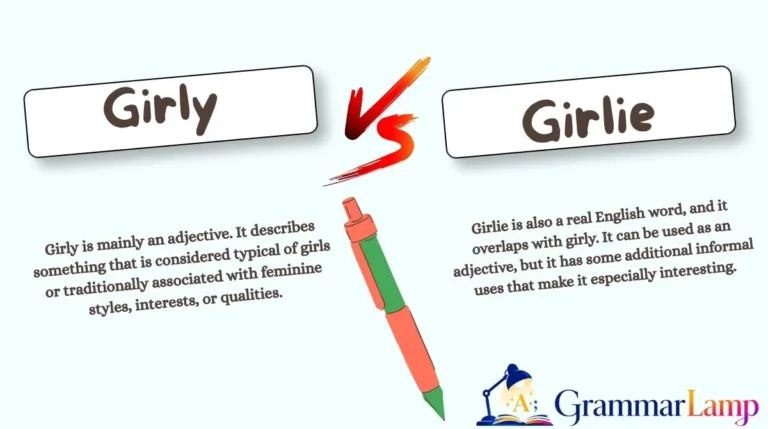
Girly is mainly an adjective. It describes something that is considered typical of girls or traditionally associated with feminine styles, interests, or qualities.
For example, when someone says:
She bought a girly dress.
The word girly describes the dress. It may suggest that the dress has a style traditionally seen as feminine, such as bright colors, flowers, bows, or other decorative details.
Cambridge defines girly as an informal word for things involving girls and women or things considered typical of them. It also notes that the word can describe a person who enjoys things traditionally connected with girls or women.
When should you use “girly”?
Use girly when you want to describe a style, object, activity, appearance, mood, or behavior.
You can use it before a noun:
- a girly dress
- a girly room
- a girly hairstyle
- a girly color
- a girly bag
- a girly movie
It can also appear after a linking verb in informal English:
Her style is very girly.
Here, girly is still describing the subject.
Grammar rule for “girly”
The main grammar point is simple:
Girly is usually an adjective.
It modifies a noun or describes a person, thing, style, or quality.
Here are some examples:
- She wore a very girly pink dress to the party.
- My sister has a cute and girly bedroom.
- She likes girly colors such as pink and lavender.
- That handbag looks a little too girly for me.
- Her writing style is soft and girly.
- They decorated the room with a girly theme.
- I am not really into girly clothes.
- The movie has a fun, girly feel.
Notice how girly works as a describing word in all these examples.
A common confusion about “girly”
Some learners think girly means exactly the same thing as girl plus a suffix. That can lead to awkward sentences.
For example:
She is a girly.
This is not the normal way to use girly in modern standard English. A beginner should usually think of girly as an adjective.
The noun use does exist in dictionaries, but it is informal and may be considered offensive or disrespectful when used for a woman or girl. Oxford marks the noun use as informal and often offensive.
So for safe everyday English, sentences like these are much better:
She is a girly girl.
Her style is girly.
She likes girly clothes.
Another important point is that girly can have different emotional meanings depending on the speaker. It can be positive, neutral, playful, teasing, or slightly negative.
For example:
She loves girly fashion.
This may simply describe her taste.
But:
You are being too girly.
may sound critical, depending on the situation and tone.
What Does “Girlie” Mean?
Girlie is also a real English word, and it overlaps with girly. It can be used as an adjective, but it has some additional informal uses that make it especially interesting.
Cambridge lists girlie as an alternative form of girly and gives examples such as girlie chat, girlie weekend, and girlie girl.
When should you use “girlie”?
You can use girlie to describe something traditionally feminine, just like girly.
For example:
She bought a girlie dress.
We had a girlie weekend.
In these cases, girlie is acting as an adjective.
However, girlie is also commonly used in very informal English as a noun or a casual form of address.
For example:
Hey, girlie! How are you?
Here, girlie is not describing another noun. It is being used to address a girl or woman in a playful or familiar way.
Grammar rule for “girlie”
The word girlie can work in more than one grammatical role.
It can be:
1. An adjective
She wore a girlie dress.
2. A noun
The girlies are meeting after work.
3. A casual form of address
Thanks, girlie!
This flexibility is one of the biggest reasons learners notice girlie in social media, texting, and casual conversation.
Cambridge gives girlie as an informal noun meaning a woman or girl. Collins also records noun uses, but notes that some uses can be patronizing or offensive.
Examples of “girlie”
- She loves wearing girlie dresses.
- We had a really girlie evening at home.
- They went on a girlie weekend together.
- Her room has a very girlie style.
- Hey, girlie, are you free tonight?
- The girlies are going out for coffee.
- Thanks for helping me, girlie!
- She is such a skincare girlie.
The last example shows a newer casual pattern. In modern online English, people often use girlie as an informal label for someone who is very interested in a particular activity, lifestyle, or product category.
You may see phrases such as:
- book girlie
- coffee girlie
- fitness girlie
- travel girlie
- fashion girlie
- skincare girlie
- Pilates girlie
These expressions are informal and especially common in casual online language. They are not the kind of wording you would normally choose for a formal academic essay or business report.
An important meaning to know
Girlie also has some older uses connected with magazines, shows, or images of women wearing little or no clothing. Oxford and Collins record this sense, and both indicate that it is an informal or older usage.
That does not mean every use of girlie has this meaning. Context is very important.
For example:
We are having a girlie weekend.
This simply refers to a casual weekend with female friends.
But in an older expression such as girlie magazine, the meaning is completely different.
For modern learners, the safest approach is to look at the whole sentence rather than judging the word from spelling alone.
Difference Between Girly and Girlie
The easiest way to understand the difference is to remember that girly is usually the straightforward adjective, while girlie has more informal and flexible uses.
| Feature | Girly | Girlie |
|---|---|---|
| Main grammar role | Adjective | Adjective, noun, or informal address |
| Basic meaning | Associated with girls or traditional femininity | Same basic adjective meaning |
| Formality | Informal | Usually informal |
| Common use | Describing style, clothes, behavior, etc. | Describing feminine things or addressing someone casually |
| Example | a girly dress | a girlie dress |
| Noun use | Less common and can be offensive | Common informal noun in some contexts |
| Social-media use | Common | Very common in casual identity labels |
| Older special meanings | Possible | More noticeable in some dictionaries |
1. Usage difference
When you simply want to say that something is traditionally feminine, girly is a very natural choice.
She has a girly style.
I want a girly bedroom.
That color looks very girly.
Girlie can also work:
She has a girlie style.
I want a girlie bedroom.
That dress looks very girlie.
The meaning is close, and both spellings are recognized. Cambridge specifically treats girlie as another form of girly.
Still, the feeling may change slightly. Girlie often sounds more playful, casual, or personal.
2. Grammar logic
This is the biggest useful lesson for beginners.
Girly is normally an adjective:
She bought a girly bag.
Girlie can also be an adjective:
She bought a girlie bag.
But girlie can become a noun:
The girlies are here.
And it can be used directly when speaking to someone:
Hi, girlie!
That means you cannot always replace one word with the other and keep the grammar natural.
For example:
Hi, girly!
This does not normally have the same natural meaning as:
Hi, girlie!
The second one is a casual form of address.
3. Sentence structure difference
Compare these:
She has a girly style.
Here, girly modifies style.
Now look at:
Hey, girlie!
Here, girlie stands alone as the word used to address the person.
Another example:
The girlies are going shopping.
Here, girlies is a plural noun.
So the grammar changes with the role of the word.
4. Meaning comparison
The two words overlap when they describe feminine things:
a girly dress
a girlie dress
Both can mean a dress with a traditionally feminine style.
But girlie has meanings and uses that girly does not share in the same way.
For example:
Thanks, girlie!
This is clearly an informal form of address.
You would not normally use girly there.
The key idea is this: the two spellings are similar, but context decides which one sounds natural.
Explore More Posts
Instructions on vs Instructions for: Meaning, Difference, and Correct Usage in 2026
Role vs Roll: Meaning, Difference, Rules & Examples (2026)
John and I or John and Me? The Easy Grammar Guide for 2026
Formal vs Informal Usage: Complete Guide to English in 2026
Grammar Rules You Must Remember
Rule 1: Use “girly” mainly as an adjective
When you are describing something as traditionally feminine, girly is a simple and useful choice.
Example:
She bought a girly phone case with flowers on it.
Here, girly describes the phone case.
You can use this pattern with many nouns:
girly clothes
girly music
girly room
girly makeup
girly design
Rule 2: “Girlie” can also be an adjective
Do not think that girlie is automatically wrong because it ends in -ie.
It is a recognized English form and can describe feminine things.
Example:
We had a girlie evening with movies and snacks.
Cambridge and Collins both record adjective uses of girlie for things associated with girls or women.
So:
a girly dress
and
a girlie dress
can both be correct.
The difference is often one of style, context, and personal preference rather than basic grammar.
Rule 3: “Girlie” can be a noun in informal English
This is a very useful distinction.
Example:
The girlies are meeting at seven.
Here, girlies means girls or women in an informal way.
Another example:
I am going out with the girlies tonight.
This is casual spoken or online English.
However, be careful with this noun because some dictionary sources warn that referring to women as girlies can sound patronizing or offensive in certain situations.
Use it mainly when the context is clearly friendly and informal.
Rule 4: “Girlie” can be a casual form of address
This is one of the most noticeable differences.
For example:
Hey, girlie! How have you been?
Thanks, girlie!
You look amazing, girlie.
These sentences are casual and friendly in the right relationship.
Still, tone matters. What sounds warm between close friends may sound too familiar or patronizing when said to a stranger.
That is why this word is better suited to casual conversations than formal situations.
Common Mistakes Students Make
Many mistakes happen because the two words sound almost identical. Learners also see different spellings online and assume that one must be incorrect.
Mistake 1: Thinking “girlie” is just a spelling mistake
Wrong idea:
“Girlie” is not a real word.
That is not correct. Dictionaries recognize both forms. Cambridge lists girlie as another form of girly, and Oxford also records the word.
So both spellings exist.
Mistake 2: Using “girly” as a direct form of address
A learner may write:
Hey, girly!
If the goal is to casually address a female friend, girlie is usually the more natural spelling.
Hey, girlie!
The difference is small, but the feeling is different.
Mistake 3: Thinking “girlie” can never describe an object
This is also wrong.
You can say:
She bought a girlie dress.
You can also say:
She bought a girly dress.
Both are possible.
Mistake 4: Using “girlie” in formal writing
Even when grammatically possible, girlie often sounds casual.
For example, in a formal report, instead of:
The company created a girlie design.
you may prefer:
The company created a feminine design.
That sounds more neutral and professional.
Mistake 5: Assuming “girly” is always positive
The word can be neutral, affectionate, playful, or critical depending on the sentence.
Compare:
She loves her girly style.
with:
He thinks the idea is too girly.
The second sentence may express disapproval.
Always pay attention to context and tone.
Easy correction tip
Ask yourself one question:
Am I describing something, or am I talking to a person?
If you are describing a thing, girly is often the easiest choice.
If you are casually talking to a female friend, girlie may be more natural.
Easy Trick to Remember the Difference
Here is a simple memory trick:
Y = describes.
IE = informal “girl” feeling.
Think of girly as a describing word:
girly dress
girly room
girly style
girly color
Now think of girlie as a casual word that can stand on its own:
Hey, girlie!
Thanks, girlie!
The girlies are here.
This is not a rule that covers every possible sentence, because the two words overlap. But it is a very useful shortcut for beginners.
You can also remember this:
Girly = “What is it like?”
Girlie = “Who am I talking to?”
For example:
What is the dress like?
It is girly.
Who are you greeting?
Hey, girlie!
Once this becomes familiar, the spelling choice feels much easier.
Daily Life Examples
Seeing the words in real conversations makes the difference clearer.
Example 1
A: What kind of dress are you looking for?
B: Something cute and girly.
Here, girly describes the kind of dress.
Example 2
A: Hey, girlie! How was your weekend?
B: It was great! I went shopping with my sister.
Here, girlie is a casual form of address.
Example 3
A: Your room looks different.
B: Yeah, I wanted it to look more girly.
Here, girly describes the style of the room.
Example 4
A: Are you going to the spa on Saturday?
B: Yes. We are planning a girlie day.
Here, girlie is used as an adjective meaning a day spent doing traditionally feminine or friendship-based activities.
Example 5
A: Who is going for coffee tonight?
B: Just me and the girlies.
Here, girlies is an informal plural noun.
Example 6
A: Do you like this pink notebook?
B: Yes, but it is a little too girly for me.
Here, girly describes the notebook’s style.
Example 7
A: Thanks for helping me choose my outfit.
B: No problem, girlie!
Here, girlie is used casually between friends.
Example 8
A: What kind of content do you like?
B: I’m really into fashion and beauty. I guess I’m a total fashion girlie.
This is a modern informal identity expression.
Example 9
A: Why did you choose those flowers?
B: I wanted something soft and girly.
Again, girly is an adjective.
Example 10
A: Are you going out tonight?
B: Yes, I’m meeting the girlies for dinner.
Here, girlies means a group of female friends in casual language.
Practice Section
Choose the correct answer: girly or girlie.
1. She decorated her bedroom in a very ___ style.
A. girly
B. girlie
2. Hey, ___! Are you free this evening?
A. girly
B. girlie
3. I’m going out with the ___ tonight.
A. girlys
B. girlies
4. She loves wearing ___ dresses.
A. girly
B. girlie
5. Thanks for your help, ___!
A. girly
B. girlie
Answers
1. A — girly
This is the common adjective used to describe the bedroom style.
2. B — girlie
Here, the word is being used to address someone casually.
3. B — girlies
This is the informal plural noun form.
4. A — girly
Girly dresses is a natural adjective + noun combination.
5. B — girlie
This is a casual form of address.
Remember that girlie can also be an adjective, so not every adjective sentence requires girly. Context and tone matter.
More Helpful posts
Please Advise or Please Advice? The Correct Usage Explained (2026)
See vs Look vs Watch: Easy English Grammar Guide for 2026
Recommend to vs recommend for 2026: Clear Grammar Rules, Examples, and Common Mistakes
Wreckless or Reckless? Which Spelling Is Correct in 2026?
FAQs
What is the difference between girly and girlie?
Both girly and girlie can describe something associated with girls or traditional femininity. Girly is mainly used as an adjective, while girlie has additional informal noun and form-of-address uses.
Is “girly” or “girlie” the correct spelling?
Both spellings are correct English words. Girly is a common adjective, while girlie can also be used as an adjective and has other informal uses. The best choice depends on the sentence and the tone you want.
Can we use “girlie” in questions?
Yes. For example, you can say, “Are you having a girlie weekend?” Here, girlie is describing the weekend. You can also use it when addressing someone, such as “Girlie, are you coming with us?” The second use is highly informal.
Is “girlie” formal or informal?
Girlie is generally informal. It is common in casual speech, friendly conversations, and online language. For formal writing, words such as feminine, female, or a more specific description may be more suitable.
Is “girly” only used for clothes and colors?
No. Girly can describe many things, including rooms, hobbies, styles, behavior, music, designs, and other qualities traditionally associated with girls or women. Its meaning depends on context.
Can “girly” and “girlie” be used in the same sentence?
Sometimes, yes, because they can overlap in meaning. For example, “a girly dress” and “a girlie dress” can both be correct. However, they may have slightly different tones, and girlie has additional noun and address uses that girly does not normally have.
Conclusion
The difference between girlie vs girly is small, but understanding it can make your English sound much more natural.
The easiest starting point is to remember that girly is mainly an adjective. It commonly describes clothes, rooms, colors, styles, activities, or other things traditionally linked with girls or femininity. Girlie can do the same job, but it is often more casual and playful.
The bigger difference appears when girlie is used as a noun or as a form of address. Expressions such as “Hey, girlie!” and “I’m meeting the girlies” are informal.
Tone matters too, because these forms can sound friendly in one situation but too familiar or patronizing in another. Dictionaries also record some older meanings of girlie, so context should always be considered.
For everyday writing, girly is a simple choice when you are describing something. Use girlie when the sentence calls for a playful, informal, or noun-like use.
The best way to remember the difference is to notice the sentences you hear and read. With a little practice, the choice between the two will soon feel natural.

Liam Derren is a language writer at GrammarLamp, creating simple, helpful content about grammar, words, and everyday English. He makes language learning clear, practical, and easy to understand.
2 thoughts on “Girlie vs Girly: What’s the Difference and Which One Should You Use in 2026?”