
“John and I” and “John and me” are both common phrases, but they are not used in the same way.
This small grammar difference causes a lot of confusion, especially for English learners. You may hear someone say, “John and I went to the store,” and then hear, “She called John and me.” Why does the pronoun change?
The good news is that the rule is much easier than it first appears. The real question is not whether the sentence contains John. The important question is what job I or me is doing in the sentence.
I is a subject pronoun. We use it when the person is doing the action. Me is an object pronoun. We use it when the person receives the action or comes after a preposition.
This difference matters in everyday English. You will see these forms in conversations, emails, school assignments, workplace messages, and formal writing.
Once you understand the basic subject-and-object rule, choosing between “John and I” and “John and me” becomes much easier.
There is also a simple trick that can help you check your sentence in seconds. By the end, you will know when to use each form and why.
More Helpful posts
Alternative of vs Alternative for vs Alternative to: Which Is Correct? 2026 Guide
Realise or Realize: Which Spelling Is Correct in 2026?
Berth vs Birth: Meaning, Difference, Examples & Easy Rules for 2026
Insight vs Incite: What’s the Difference? Easy Guide for 2026
What Does “John and I” Mean?
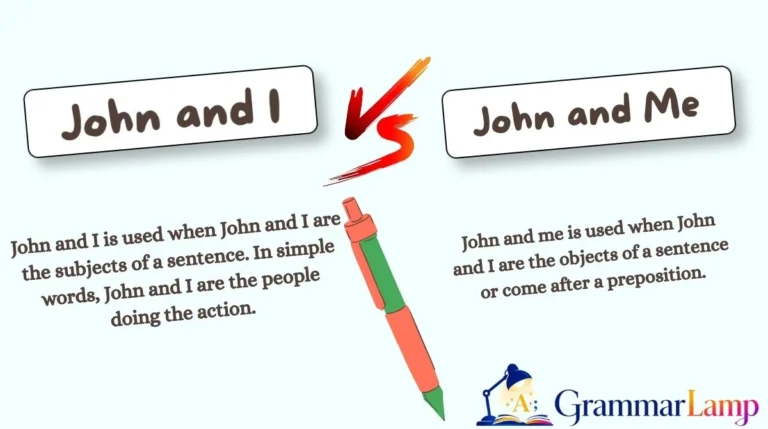
John and I is used when John and I are the subjects of a sentence. In simple words, John and I are the people doing the action.
The word I is a subject pronoun. Other subject pronouns include he, she, we, and they.
For example:
John and I went to school.
Who went to school?
John and I.
So, “John and I” is the subject of the sentence.
The Basic Grammar Rule
Use John and I when the phrase is performing the main action of the sentence.
The basic structure is:
John and I + verb
For example:
- John and I work together.
- John and I went shopping.
- John and I are friends.
- John and I finished the project.
Here, the phrase comes before the verb and performs the action.
Examples of “John and I”
- John and I went to the restaurant.
- John and I are working on the same project.
- John and I played football yesterday.
- John and I visited our teacher.
- John and I live in the same neighborhood.
- John and I finished the homework together.
- John and I talked about the problem.
- John and I will attend the meeting tomorrow.
In all these examples, John and I are doing something.
They went.
They are working.
They played.
They visited.
They finished.
That is why I is correct.
Why Do Learners Get Confused?
Many learners hear people say “John and I” in formal English and start using it everywhere.
This can lead to sentences such as:
❌ She invited John and I.
That sentence is incorrect because “John and I” is receiving the action of invited. The correct version is:
✅ She invited John and me.
Another reason for the confusion is that people sometimes use “I” because it sounds more formal or polite. But grammar is not based on which word sounds more formal.
The position and function of the pronoun matter.
What Does “John and Me” Mean?
John and me is used when John and I are the objects of a sentence or come after a preposition.
The word me is an object pronoun. Other object pronouns include him, her, us, and them.
For example:
She called John and me.
Who did she call?
John and me.
John and me receive the action of the verb called. Therefore, me is correct.
The Basic Grammar Rule
Use John and me when the phrase is the object of a verb or comes after a preposition.
Common structures include:
verb + John and me
and
preposition + John and me
For example:
- She called John and me.
- They invited John and me.
- He spoke to John and me.
- This gift is for John and me.
Examples of “John and Me”
- She invited John and me to dinner.
- The teacher spoke to John and me.
- He gave John and me some useful advice.
- They asked John and me to wait outside.
- This message is for John and me.
- She sat between John and me.
- The manager thanked John and me.
- Nobody told John and me about the change.
Notice what happens in these examples.
The action is done by someone else.
She invited us.
The teacher spoke to us.
He gave something to us.
They asked us.
The manager thanked us.
So me is the correct pronoun.
“Me” Does Not Mean Informal or Incorrect
Some learners think me is less correct because they were taught that “I” is the proper form.
That is not true.
Both I and me are correct pronouns. They simply have different grammatical jobs.
Compare:
John and I went home. ✅
Here, “John and I” are doing the action.
She drove John and me home. ✅
Here, someone else is doing the action to “John and me.”
The difference is grammatical, not about formal versus informal English.
Difference Between John and I and John and Me
The easiest way to understand the difference is to focus on the role of the pronoun.
| Phrase | Grammar role | When to use it | Example |
|---|---|---|---|
| John and I | Subject | When the people do the action | John and I went home. |
| John and me | Object | When the people receive the action | She called John and me. |
| John and I | Subject | Before the main verb | John and I work together. |
| John and me | Object | After a preposition | She spoke to John and me. |
1. “John and I” Usually Comes Before the Verb
When John and you are doing the action, use I.
John and I visited the museum.
The subjects are John and I.
Another example:
John and I need some help.
Who needs help?
John and I.
Therefore:
John and I need some help. ✅
Not:
❌ John and me need some help.
2. “John and Me” Usually Comes After a Verb
When another person performs the action on John and you, use me.
Sarah called John and me.
Sarah is doing the calling.
John and me receive the action.
Therefore:
Sarah called John and me. ✅
Not:
❌ Sarah called John and I.
3. “John and Me” Comes After Prepositions
A preposition often tells us about a relationship involving another word.
Common prepositions include:
to, for, with, from, between, about, by, near, beside
When “John and you” come after one of these prepositions, me is normally used.
Examples:
This present is for John and me.
She went with John and me.
He was talking about John and me.
The teacher stood between John and me.
They came with John and me.
4. The Meaning Does Not Change
“John and I” and “John and me” can refer to the same two people.
The difference is their grammatical role.
Compare:
John and I helped Sarah.
John and I are doing the helping.
Now compare:
Sarah helped John and me.
Sarah is doing the helping.
The people are the same, but their roles in the sentence are different.
Grammar Rules You Must Remember
Rule 1: Use “I” for the Subject
Use I when you are doing the action.
John and I went to the store.
Ask yourself:
Who went to the store?
Answer: John and I.
So I is correct.
Another example:
John and I watched a movie.
Who watched the movie?
John and I.
Rule 2: Use “Me” for the Object
Use me when someone does something to you or when you receive the action.
The teacher praised John and me.
Who did the teacher praise?
John and me.
So me is correct.
Another example:
David invited John and me.
David did the inviting.
John and me received the invitation.
Rule 3: Use “Me” After a Preposition
After words such as to, for, with, between, from, and about, use me.
Examples:
She talked to John and me.
The gift is for John and me.
He came with John and me.
There is a problem between John and me.
A useful pattern is:
preposition + John and me
Rule 4: Remove “John” to Check the Sentence
This is one of the best tricks for learners.
Temporarily remove John from the sentence.
For example:
John and I went to school.
Remove John:
I went to school.
That sounds correct.
So:
John and I went to school. ✅
Now try:
The teacher called John and I.
Remove John:
The teacher called I.
That sounds wrong.
The correct sentence is:
The teacher called me.
Therefore:
The teacher called John and me. ✅
This simple test works in many situations.
Explore More Posts
In the Same Day vs On the Same Day: Which Is Correct? A Simple Guide for 2026
Licence or License: Which Spelling Is Correct in 2026?
I’ve Added vs I Added: Easy Difference, Rules & Examples (2026)
This Is She or This Is Her? The Correct Choice in English in 2026
Common Mistakes Students Make
Mistake 1: Using “I” Everywhere
A common mistake is thinking I is always more correct.
For example:
❌ My friend invited John and I.
Why is this wrong?
Because John and I are not doing the inviting. They are receiving the action.
Correct:
✅ My friend invited John and me.
Mistake 2: Using “Me” as the Subject
Some learners use me because it feels natural in casual speech.
For example:
❌ John and me went shopping.
In standard English, this is incorrect.
Correct:
✅ John and I went shopping.
Why?
Because John and I are doing the action.
Mistake 3: Choosing Based on Formality
Some students think:
“I” = formal
“me” = informal
That is not the rule.
Consider:
The manager spoke to John and me.
This is completely correct in formal English.
And:
John and I attended the business meeting.
This is also correct.
The choice depends on grammar, not formality.
Mistake 4: Forgetting About Prepositions
Learners sometimes say:
❌ She gave the documents to John and I.
But to is a preposition, so we need the object form.
Correct:
✅ She gave the documents to John and me.
Another example:
❌ This is between John and I.
Correct:
✅ This is between John and me.
A Quick Correction Method
When you are unsure, remove John.
For example:
She talked to John and I.
Remove John:
She talked to I. ❌
So use me:
She talked to John and me. ✅
Try another:
John and me finished the work.
Remove John:
Me finished the work. ❌
So use I:
John and I finished the work. ✅
This method is quick and very useful.
Easy Trick to Remember the Difference
Here is a simple classroom trick:
“I” Does. “Me” Receives.
Think of I as the person who does the action.
Think of me as the person who receives the action.
For example:
John and I cooked dinner.
John and I did the cooking.
So we use I.
Now:
Mom thanked John and me.
Mom did the thanking.
John and me received the action.
So we use me.
The One-Person Test
There is another very useful trick.
Remove John and read the sentence.
John and I are going home.
Becomes:
I am going home. ✅
So “John and I” is correct.
Now:
She invited John and me.
Becomes:
She invited me. ✅
So “John and me” is correct.
This trick is especially helpful when a sentence sounds awkward because of two names.
Think About “He” and “Him”
You can also compare I/me with he/him.
We say:
He went to work.
Not:
❌ Him went to work.
But:
She called him.
Not:
❌ She called he.
The same pattern works with I/me:
I went to work.
She called me.
So:
John and I went to work.
She called John and me.
Once you understand he/him, I/me becomes easier.
Daily Life Examples
These examples show how the phrases appear in normal conversations.
Example 1: Talking About School
Ali: Who went to the library?
Sarah: John and I went there after class.
Here, John and I did the action of going.
Example 2: Talking About a Phone Call
Ali: Who did the manager call?
Sarah: She called John and me.
Here, the manager made the call, so John and me are the objects.
Example 3: Making Plans
John: Are you coming to the meeting?
Mike: Yes. John and I will be there at 10.
The two people are doing the action of attending.
Example 4: Receiving an Invitation
Sarah: Who did you invite to dinner?
David: I invited John and me—wait, I mean John and Mike!
This funny example shows why the pronoun depends on the sentence. If David is talking about himself as the person invited, he would say:
I invited John and him.
The pronoun changes according to its role.
Example 5: After “With”
Sarah: Who are you going to the concert with?
Mike: I’m going with John and me.
Actually, this is a good place to notice an important point. In standard English, if Mike is talking about himself and John, the natural sentence is:
I’m going with John and him.
If the speaker is referring to John and another person, then:
I’m going with John and me would only make sense if “me” refers to the speaker and the sentence is structured appropriately, but normally the speaker would say “John and me” only when the phrase itself is the object, such as “They invited John and me.”
The key is to look at who is speaking and what the pronoun represents.
Example 6: Talking About a Project
Manager: Who worked on this project?
Employee: John and I worked on it together.
The phrase is the subject.
Example 7: Receiving Help
Manager: Who did I help yesterday?
Employee: You helped John and me.
The phrase is the object of helped.
Example 8: Talking About a Teacher
Student: Who did the teacher speak to?
Student: She spoke to John and me.
The phrase comes after the preposition to.
Example 9: Talking About a Trip
Friend: Who went on the trip?
Tom: John and I went together.
The phrase performs the action of going.
Example 10: Talking About a Gift
Friend: Who is this gift for?
Tom: It’s for John and me.
The phrase follows the preposition for.
Practice Section
Choose John and I or John and me in each sentence.
1. ______ went to the supermarket yesterday.
2. Sarah invited ______ to her birthday party.
3. The teacher spoke to ______ after class.
4. ______ are working on this project together.
5. The manager thanked ______ for our hard work.
Answers
1. John and I
John and I are doing the action of going.
2. John and me
We receive the action of being invited.
3. John and me
The phrase comes after the preposition to.
4. John and I
The phrase is the subject of are working.
5. John and me
The manager is doing the thanking, so the phrase is the object.
One More Challenge
Try this sentence:
The teacher gave John and me some homework.
Remove John:
The teacher gave me some homework.
That works, so John and me is correct.
Now:
John and I gave the teacher our homework.
Remove John:
I gave the teacher our homework.
That also works, so John and I is correct.
More Useful posts
Jewel vs Joule: Meaning, Difference, Examples & Easy Rules (2026)
Foul or Fowl: Meaning, Difference, Examples & Easy Rules for 2026
Dialog vs Dialogue: What’s the Difference? A Simple English Guide for 2026
Learned vs Learnt: What’s the Difference? A Simple Guide for 2026
FAQs
1. What is the difference between “John and I” and “John and me”?
John and I is used when the two people are the subjects of the sentence.
John and me is used when the two people are objects or come after a preposition.
For example, “John and I went home” is correct, while “She called John and me” is correct.
2. Is “John and I” always correct in formal English?
No. I is not automatically correct just because a sentence is formal.
Use I when it is the subject. Use me when it is the object.
For example, “John and I attended the meeting” and “The manager spoke to John and me” are both correct formal sentences.
3. Can I use “John and me” as the subject?
In standard English, use John and I when the phrase is the subject.
For example:
John and I went to school.
Not:
❌ John and me went to school.
The reason is that I is the subject form.
4. Can “John and me” be used after a preposition?
Yes. This is very common.
Examples include:
She talked to John and me.
The gift is for John and me.
He sat between John and me.
The object pronoun me is used after these prepositions.
5. How can I quickly decide between “John and I” and “John and me”?
Remove John from the sentence.
If I sounds correct, use John and I.
If me sounds correct, use John and me.
For example:
John and I went home → I went home.
She called John and me → She called me.
6. Which is correct: “John and I” or “John and me”?
Both are correct, but they are used in different grammatical situations.
Use John and I as a subject:
John and I work together.
Use John and me as an object:
She hired John and me.
The verb or preposition around the phrase tells you which form you need.
Conclusion
The difference between John and I and John and me is simple once you understand the basic subject-and-object rule.
Use John and I when John and you are doing the action:
John and I went shopping.
Use John and me when someone else is doing the action to John and you, or when the phrase follows a preposition:
She called John and me.
She spoke to John and me.
Remember the easy trick: remove John and see whether I or me sounds right. “I went home” is correct, so “John and I went home” is correct. “She called me” is correct, so “She called John and me” is correct.
Do not think of I as formal and me as informal. Both are correct. They simply have different jobs in a sentence.
With a little practice, choosing between these two forms will start to feel natural.

Liam Derren is a language writer at GrammarLamp, creating simple, helpful content about grammar, words, and everyday English. He makes language learning clear, practical, and easy to understand.