English has many words that sound almost the same but are spelled differently and have different meanings.
Knob vs nob is a good example. These two words can be confusing because they are pronounced very similarly, especially in British English. When you hear someone say either word, you may not know which spelling they mean.
For English learners, this can cause simple writing mistakes. You might want to talk about a door handle and write nob instead of knob. Or you may see the word nob in older British writing and wonder why it does not mean a button or handle.
The two words have different histories and uses. Knob is the normal spelling for a round handle, a control on a machine, a rounded lump, and some other meanings.
Nob, on the other hand, is mainly a British informal and old-fashioned word for a person of high social status or someone from the upper class. Oxford lists this meaning as old-fashioned and British informal.
By the end of this guide, you will know when to use knob, when nob is correct, how their meanings differ, and how to avoid common spelling mistakes in everyday English.
More Useful posts
Girlie vs Girly: What’s the Difference and Which One Should You Use in 2026?
Accept vs Except: Meaning, Difference, Rules, and Examples (2026)
I Would Appreciate vs I Will Appreciate: Clear Difference Explained in 2026
Manor vs Manner vs Manir: Meaning, Difference & Correct Usage in 2026
What Does “Knob” Mean?
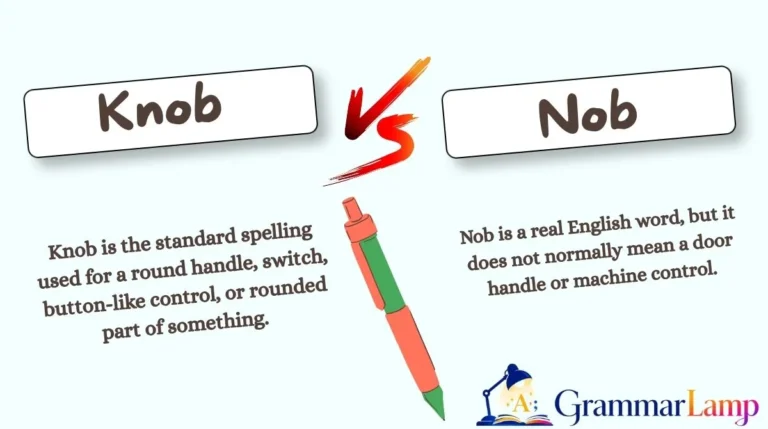
Knob is the standard spelling used for a round handle, switch, button-like control, or rounded part of something. Cambridge defines it as a round handle or a small round device used to control a machine or electrical equipment. It can also mean a round lump or shape.
You will often see knob when people talk about doors, drawers, radios, ovens, washing machines, and other equipment.
When do we use “knob”?
We use knob when we are talking about a physical object that is usually round and can be turned, pulled, or used as a handle.
For example:
Please turn the knob to open the door.
Here, knob means the round part you hold to open the door.
We can also use the word for a control on a machine:
Turn the volume knob to the left.
In this sentence, the knob controls the volume.
Grammar rule for “knob”
Knob is mainly a countable noun.
That means you can say:
- a knob
- one knob
- two knobs
- several knobs
Its plural form is knobs.
Examples:
- The door knob is broken.
- Please turn the knob slowly.
- The oven has several small knobs.
- I pulled the knob, but the drawer did not open.
- She adjusted the volume knob on the radio.
- There is a metal knob on the top of the box.
- The cabinet knob came loose yesterday.
- Put a small knob of butter in the pan.
The last example shows another use. Cambridge also records knob as a word for a small amount of something solid, especially butter.
Another meaning of “knob”
The word can also describe a rounded lump or projection on something.
For example:
There is a small knob on the tree trunk.
Here, it does not mean a handle. It means a rounded part sticking out from the surface.
So, the meaning of knob depends on the sentence, but the spelling stays the same.
Common learner confusion with “knob”
The biggest mistake is simple: learners hear the word and spell it nob.
Because the k is silent, the beginning sounds like n. That can make the spelling difficult for students.
Remember:
knob = round handle or control
The k is written, but you do not pronounce it.
Oxford also lists several common uses, including a round switch, a round door or drawer handle, a rounded shape, and, especially in British English, a small piece of butter.
What Does “Nob” Mean?
Nob is a real English word, but it does not normally mean a door handle or machine control.
Oxford describes nob as an old-fashioned, British, informal noun meaning a person with a high social position or a member of the upper class. Collins similarly records it as a British informal term for a socially important or wealthy person.
This means nob is connected with social class, status, or importance.
For example:
The old story was about a rich nob who lived in a large country house.
The word may sound unusual to modern learners because it is not common in everyday international English.
When do we use “nob”?
Use nob only when the context clearly refers to a socially important, upper-class, or wealthy person, especially in older or distinctly British writing.
Examples:
- The novel describes a young nob from London.
- The servants were waiting for the arrival of the local nobs.
- He was treated like a nob because of his family name.
- The story makes fun of rich nobs and their expensive habits.
- Several nobs attended the formal dinner.
- The old newspaper used the word “nob” for wealthy people.
- In the historical novel, a nob owned a large estate.
- The characters complained about the local nobs.
The word can also appear in the plural nobs, particularly when referring to rich or upper-class people as a group. Collins gives this use as British, informal, and old-fashioned.
Grammar rule for “nob”
Nob is a countable noun when it has the social-class meaning.
You can say:
- a nob
- the nob
- two nobs
- rich nobs
For example:
A local nob invited them to dinner.
The nobs arrived late.
A less common dictionary meaning
There is another historical British meaning of nob connected with the card game cribbage. Collins records nob as a term for the jack of the suit turned up in that game. This is a specialized meaning and is not something most English learners need in ordinary conversation.
So, for everyday English, the important point is:
nob = an old-fashioned British word for a high-status or upper-class person
Common learner confusion with “nob”
Students sometimes assume nob is just a shorter version of knob.
It is not.
They are separate words with separate meanings. In most ordinary sentences about doors, machines, drawers, or controls, the correct spelling is knob, not nob.
Difference Between Knob and Nob
The easiest way to understand the difference is to focus on the meaning first.
| Word | Main meaning | Typical use | Style |
|---|---|---|---|
| knob | A round handle, control, or rounded part | Doors, machines, drawers, objects | Common and standard |
| nob | A person of high social status or upper class | Mainly British social/class contexts | Informal and old-fashioned |
| knob | A small amount of butter or similar solid | Cooking, especially British English | Common enough in context |
| nob | A cribbage term | Card-game context | Specialized |
The most important difference is that knob usually refers to a thing, while nob usually refers to a person in its main modern-dictionary sense. Cambridge and Oxford list several physical meanings for knob, while Oxford defines the main learner-relevant meaning of nob as a person of high social position.
Usage difference
Consider these two sentences:
Turn the knob.
The nob arrived at the party.
The first sentence is about an object. The second is about a person.
You cannot normally switch the words:
Turn the nob. ❌
The knob arrived at the party. ❌
Changing one letter changes the meaning.
Grammar logic
Both words can work as nouns, but they fit into different kinds of sentences.
Knob often appears with words such as:
- door
- oven
- radio
- volume
- control
- cabinet
- drawer
Examples:
door knob
volume knob
oven knob
cabinet knob
Nob is more likely to appear with words connected to people and social class:
- rich nob
- upper-class nob
- local nob
- the nobs
This difference in collocation can help you recognize the correct word quickly.
Sentence structure difference
With knob, common patterns include:
turn + the knob
Turn the knob gently.
open + object + with + the knob
He opened the drawer with the knob.
adjust + the knob
She adjusted the knob on the heater.
With nob, the word normally acts as a noun referring to a person:
a + nob
He was described as a nob.
the + nob
The nob entered the room.
nobs + verb
The nobs were sitting together.
Meaning comparison
Think of the words in two simple categories:
KNOB → object
NOB → person
This is not a rule that covers every historical or specialized dictionary meaning, but it is an excellent guide for normal learner English.
Explore More Posts
Desert vs Dessert: Meaning, Difference, Examples & Easy Trick (2026)
Unsecure vs Insecure (2026): What Is the Difference and Which Word Is Correct?
Addicting vs Addictive: What’s the Difference? Easy Grammar Guide for 2026
Simpler vs More Simple: Which One Is Correct? (2026)
Grammar Rules You Must Remember
Rule 1: Use “knob” for a round handle or control
When you are talking about a physical object that you turn, pull, or use as a handle, write knob.
Turn the knob to start the machine.
The door knob is loose.
Never remove the k just because you cannot hear it.
Rule 2: Use “nob” for a high-status person in British English
When the word means a socially important or upper-class person, use nob.
The old book described him as a nob.
This meaning is mainly British, informal, and old-fashioned, so it is much less common in modern everyday English than ordinary uses of knob.
Rule 3: Remember that the “k” in “knob” is silent
The word knob is pronounced roughly like nob. Cambridge gives the UK pronunciation as /nɒb/ and the US pronunciation as /nɑːb/.
That silent k is one major reason learners make spelling mistakes.
Compare:
know → silent k
knee → silent k
knife → silent k
knob → silent k
The sound does not tell you the spelling. You need to remember the written form.
Rule 4: Do not treat “knob” and “nob” as interchangeable
Even though they sound similar, they are not interchangeable spellings.
The volume knob is broken. ✅
The volume nob is broken. ❌
When you are writing about a door, drawer, radio, oven, or machine, knob is the standard choice.
Common Mistakes Students Make
Many learners make mistakes here because English spelling is not always based on pronunciation.
Mistake 1: Writing “nob” for a door handle
Incorrect:
Please turn the nob.
Correct:
Please turn the knob.
Why? Because the word for a round door handle is knob.
Mistake 2: Thinking the silent “k” should disappear
Students often think:
“I do not hear k, so why should I write k?”
English has many silent letters, so this idea can cause trouble.
Incorrect:
Turn the nob on the radio.
Correct:
Turn the knob on the radio.
Mistake 3: Assuming “nob” is a modern everyday word
Nob does exist, but its main social-class meaning is old-fashioned and mainly British. A learner may see it in a novel and think it is a common word for “important person.” It is better to recognize the meaning without forcing it into normal conversation.
Mistake 4: Confusing pronunciation with spelling
These words are a good reminder that sound alone is not enough.
You may hear:
/nɒb/
But you still need context to know whether the writer means knob or nob.
Easy correction tip
Before writing the word, ask yourself:
Am I talking about a thing I can turn, pull, or use as a handle?
If yes, use knob.
Am I reading old or British writing about a socially important person?
Then nob may be correct.
Easy Trick to Remember the Difference
Here is a simple memory trick:
Think: “K = Keep the k for the control.”
A knob is something you often control by turning it.
So remember:
K → Knob → Control
For example:
knob on a radio
knob on an oven
knob on a door
For nob, think:
NO K → No machine, no handle
It is the less common word, mainly used for a high-status person in British English.
Another useful trick is to remember the two pictures in your head:
KNOB = a round object
NOB = a person
Imagine an oven with a round knob. Then imagine an old rich gentleman being called a nob in a British historical story.
The visual difference makes the spelling easier to remember.
Daily Life Examples
Here are some easy examples that show how these words work in real situations.
Example 1: Opening a door
A: Why is the door not opening?
B: Try turning the knob again.
Here, knob means the round handle on the door.
Example 2: Adjusting the radio
A: The music is too loud.
B: Turn the volume knob down.
The word refers to a control on the radio.
Example 3: Using the oven
A: How do I lower the heat?
B: Turn the oven knob to the left.
Again, this is a physical control.
Example 4: Fixing a drawer
A: The drawer is hard to open.
B: The knob is loose.
The knob is the handle you hold.
Example 5: Reading an old novel
A: Who is that man in the story?
B: He is described as a wealthy nob.
Here, nob refers to a person of high social position.
Example 6: Talking about a historical class
A: Why are the servants upset?
B: They are tired of serving the local nobs.
The plural nobs refers to socially superior or wealthy people in the historical context.
Example 7: Cooking
A: What should I add to the pan?
B: Add a small knob of butter.
Here, knob means a small piece or amount of butter.
Example 8: Broken cabinet
A: I cannot open this cabinet.
B: The knob fell off.
The missing part is the round handle.
Example 9: Historical conversation
A: Why did everyone know his family?
B: They were local nobs with a large estate.
This uses the old-fashioned British social-class meaning.
Example 10: Spelling practice
Teacher: What do we call the round part of a door that you turn?
Student: A knob.
This is the spelling you should remember for normal everyday English.
Practice Section
Choose the correct word: knob or nob.
1. Please turn the ___ to open the door.
A. nob
B. knob
2. The old novel talks about several wealthy ___.
A. knobs
B. nobs
3. The radio ___ is broken.
A. nob
B. knob
4. The historical character was called a local ___.
A. knob
B. nob
5. Add a small ___ of butter to the pan.
A. knob
B. nob
Answers
- knob
- nobs
- knob
- nob
- knob
The best way to learn the difference is not by memorizing a long definition. Notice the context. An object or control usually points to knob. A British social-class reference may point to nob.
More Helpful posts
Bored vs Board: Meaning, Difference, Examples & Grammar Rules in 2026
Sprang vs Sprung: What’s the Difference? Easy Grammar Guide 2026
Accessory vs Accessary 2026: Meaning, Difference, Spelling & Easy Examples
Swifty vs Swiftie: What’s the Difference? Meaning, Usage & Examples in 2026
FAQs
What is the difference between knob and nob?
Knob is the common word for a round handle, control, or rounded part of something. Nob is mainly a British informal and old-fashioned word for a person of high social position or upper-class background.
Can we use “nob” for a door handle?
No. The standard spelling for a round door handle is knob. Cambridge and Oxford both list knob for a round handle on a door or drawer. Writing nob in this context is a spelling mistake.
Is “nob” formal or informal?
Nob is mainly British, informal, and old-fashioned when it means a person of high social position. Because of that, it is not a good everyday replacement for words such as “rich person” or “upper-class person” in modern international English.
Why is the “k” silent in “knob”?
English has many words beginning with kn- where the k is not pronounced. Words such as knee, knife, and know follow the same pattern. Knob is pronounced without a spoken k, but the letter is still part of the correct spelling.
Can “knob” have meanings other than a handle?
Yes. Knob can also mean a round lump or projection, and British English uses it for a small amount of something solid, especially butter. Dictionaries also record some slang meanings, so context is important.
Is “nob” a real English word?
Yes. Nob is a real dictionary word. Its best-known learner-relevant meaning is a British informal and old-fashioned term for a person with high social status or someone from the upper class. It also has specialized historical meanings, including a cribbage term.
Conclusion
The difference between knob vs nob becomes much easier when you focus on meaning instead of pronunciation.
Knob is the normal everyday word. You use it for a round door handle, a control on a radio or oven, a rounded lump, and some other physical meanings. It can also describe a small piece of butter in British English.
Nob is a separate word. Its main meaning is a person of high social position or upper-class background, especially in old-fashioned or informal British English.
The spelling trick is simple: knob has a silent k. Even though you cannot hear the letter, you still need to write it.
So, when you are talking about a door, drawer, oven, or radio, remember knob. When you see nob in British or historical writing, check whether it is referring to a socially important person.
A little attention to context will help you choose the right word every time.

Liam Derren is a language writer at GrammarLamp, creating simple, helpful content about grammar, words, and everyday English. He makes language learning clear, practical, and easy to understand.