English has many words that sound exactly the same but have completely different meanings. Bored and board are a good example.
When you hear them in a conversation, they can be difficult to tell apart because they are pronounced almost the same.
The difference becomes clear when you see how each word is spelled and how it is used in a sentence.
Bored is usually an adjective. It describes a person who feels that something is not interesting, exciting, or enjoyable. For example, you might say, “I am bored at home.” You are talking about your feeling.
Board, on the other hand, has several meanings. It can be a flat piece of wood, a surface where someone writes, a group of people who manage an organization, or the act of getting onto a plane, train, bus, or ship.
For example, “Please write your name on the board” uses board as a noun, while “Passengers are ready to board the plane” uses it as a verb.
This is why many English learners mix these words up. They hear one sound but need to choose between two different spellings and meanings.
Understanding the difference between bored vs board will help you write more accurately, understand spoken English better, and avoid simple spelling mistakes.
Once you connect each word with its meaning, the difference becomes much easier to remember.
More Useful posts
Lieu vs Loo: Meaning, Difference, Usage, and Examples in 2026
Is It Worth It vs Does It Worth It? 2026 Grammar Guide
Good for Me vs Good to Me: Meaning, Difference, and Examples (2026)
Whether It Be vs Whether It Is: Meaning, Difference, and Correct Use in 2026
What Does “Bored” Mean?
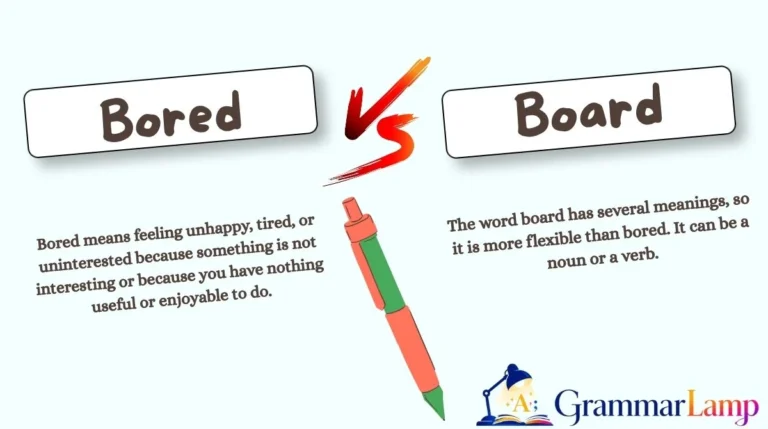
Bored means feeling unhappy, tired, or uninterested because something is not interesting or because you have nothing useful or enjoyable to do. Cambridge Dictionary lists bored as an adjective with this meaning.
It is the word you use when you talk about a person’s feeling.
For example:
I am bored.
This means you do not feel interested or excited. Maybe there is nothing to do, or perhaps the activity you are doing is not interesting.
When Do We Use “Bored”?
We use bored when talking about how a person feels.
You can use it with forms of be, such as:
- I am bored.
- She is bored.
- They were bored.
- We are getting bored.
You can also use it after verbs such as feel, look, seem, become, get, and grow.
For example:
- I feel bored.
- He looks bored.
- She became bored during the lecture.
- We are getting bored.
A useful pattern is:
Subject + be/feel/look/seem + bored
Examples:
- I am bored.
- You look bored.
- He feels bored.
- They seem bored.
“Bored” Is About a Feeling
One of the easiest ways to understand this word is to remember that bored describes the person experiencing the feeling.
Compare these two sentences:
I am bored.
This tells us how I feel.
The movie is boring.
This tells us that the movie causes the feeling.
That difference is very important. Bored describes the person, while boring describes the thing, person, or activity that causes the feeling. Cambridge also distinguishes bored from boring in this way.
Examples of “Bored”
- I am bored because there is nothing to do.
- She was bored during the long meeting.
- The children became bored after playing the same game for hours.
- He looked bored while waiting for the doctor.
- We were bored at home all afternoon.
- Are you bored with this movie?
- I get bored when I have to wait for a long time.
- They were bored because the class ended late.
Common Learner Confusion with “Bored”
A common mistake is using board when the meaning is about feelings.
For example:
❌ I am board.
✅ I am bored.
The first sentence is incorrect if you mean “I feel uninterested.”
Another common problem is confusing bored and boring:
❌ I am boring because this class is difficult.
✅ I am bored because this class is difficult.
The first sentence can mean that you personally are not interesting, which is probably not what you want to say.
Remember:
bored = how you feel
boring = what causes the feeling
That small difference can save you from many common English mistakes.
What Does “Board” Mean?
The word board has several meanings, so it is more flexible than bored. It can be a noun or a verb.
As a noun, board can mean a flat piece of wood or another hard material. It can also mean a writing surface such as a whiteboard or blackboard, a game board, or a group of people who manage an organization.
As a verb, board commonly means to get onto a plane, train, ship, or other vehicle. For example:
We boarded the train at 8:00.
Oxford lists board as a verb meaning to get onto a ship, train, plane, bus, and similar transport.
When Do We Use “Board” as a Noun?
You can use board to talk about many physical objects and groups.
For example:
The teacher wrote the answer on the board.
Here, board means a whiteboard, blackboard, or similar surface.
Another example:
He bought a wooden board for the project.
Here, it means a flat piece of wood.
It can also describe an organization or management group:
The board approved the new plan.
Here, board means a group of people responsible for making decisions.
When Do We Use “Board” as a Verb?
As a verb, board usually means get onto a vehicle.
For example:
- board a plane
- board a train
- board a bus
- board a ship
You may hear this word often at airports and train stations.
For example:
Passengers are now boarding Flight 245.
This means passengers are getting onto the plane.
The verb has regular forms:
- Present: board
- Past: boarded
- Past participle: boarded
- -ing form: boarding
For example:
We boarded the plane at 6:30.
Examples of “Board”
- Please write the answer on the board.
- The old wooden board was lying near the door.
- The teacher cleaned the board after the lesson.
- The company’s board met on Monday.
- We need a cutting board for the kitchen.
- The passengers began to board the plane.
- She boarded the train just before it left.
- The children played a game on the board.
Useful Expressions with “Board”
The word board also appears in common expressions.
On board can mean physically on a plane, train, or ship.
Example:
There were 150 passengers on board.
It can also mean being involved in or supporting a plan.
Example:
The whole team is on board with the new idea.
Another common expression is board of directors, which means a group of people responsible for controlling or making important decisions for a company or organization.
These expressions make board a very common word in everyday English, school English, travel English, and workplace English.
Difference Between Bored and Board
The biggest difference is simple:
Bored describes a feeling.
Board usually refers to an object, group, or the action of getting onto transport.
Even though they sound alike, they belong to different parts of grammar and have different meanings.
Comparison Table
| Feature | Bored | Board |
|---|---|---|
| Part of speech | Usually adjective | Noun or verb |
| Main meaning | Feeling uninterested | Object, group, or getting onto transport |
| Describes | A person’s feeling | A thing, organization, or action |
| Example | I am bored. | Write it on the board. |
| Travel use | Not normally used | Board a plane/train |
| Physical object | No | Yes |
| Sound | Same or very similar | Same or very similar |
| Spelling | b-o-r-e-d | b-o-a-r-d |
Usage Difference
Use bored when someone has lost interest.
I was bored during the lecture.
Use board when you mean a physical surface.
The teacher wrote the question on the board.
Use board as a verb when someone gets onto a vehicle.
We boarded the bus at noon.
Grammar Logic
Bored is normally an adjective in everyday learner sentences. It describes a person’s state or feeling.
Board can work in several grammatical roles.
As a noun:
The board is dirty.
As a verb:
We will board the plane soon.
This is why you should not simply ask, “Which word sounds correct?” Instead, ask:
What do I mean?
If you mean feeling uninterested, choose bored.
If you mean a flat surface, a group, or getting onto a vehicle, choose board.
Sentence Structure Difference
Look at these structures:
Subject + be + bored
I am bored.
Subject + verb + board
She cleaned the board.
Subject + board + object
They boarded the plane.
The grammar changes because the words have different functions.
Meaning Comparison
Consider this pair:
I am bored.
The speaker has a feeling.
I am on board.
The speaker is on a plane, train, ship, or another vehicle, or may be expressing involvement in an idea depending on context.
The two sentences sound similar in part, but their meanings are completely different.
Explore More Posts
EG vs IE: Easy Difference, Meaning, Rules, and Examples in 2026
Dragged vs Drug: What Is the Difference? Easy Guide for 2026
Consult With, To, On or About: Which Is Correct? 2026
Run vs Ran: What Is the Difference? Easy Grammar Guide 2026
Grammar Rules You Must Remember
Rule 1: Use “bored” for a person’s feeling
When you want to describe how someone feels because something is not interesting, use bored.
Correct:
I am bored at home.
Correct:
The students were bored during the long lesson.
Do not use board for this meaning.
❌ I am board.
✅ I am bored.
Rule 2: Use “board” for a writing or physical surface
When you mean a whiteboard, blackboard, noticeboard, or another flat surface, use board.
Correct:
Please write your name on the board.
Correct:
The teacher put the notice on the board.
This meaning has nothing to do with feeling uninterested.
Rule 3: Use “board” as a verb for getting onto transport
When someone gets onto a plane, train, bus, or ship, board can be used as a verb.
Correct:
Passengers are boarding the plane.
Correct:
We boarded the train at 7:15.
You may also see the noun phrase on board:
There were many families on board the ship.
Rule i4: Do not confuse “bored” with “boring”
This rule is slightly different, but it helps prevent another common mistake.
Bored = the feeling of the person.
Boring = the thing that causes the feeling.
Compare:
✅ I am bored.
✅ The movie is boring.
Not:
❌ I am boring when you mean you feel uninterested.
Think about who has the feeling. That person is bored.
Common Mistakes Students Make
These mistakes often happen because bored and board sound the same in English. Oxford specifically lists them as homophones, meaning they have the same pronunciation but different meanings and spellings.
Mistake 1: Writing “board” for a feeling
❌ I am board today.
✅ I am bored today.
Correction tip: Ask yourself, “Am I talking about my feeling?” If yes, use bored.
Mistake 2: Writing “bored” for a classroom board
❌ The teacher wrote the answer on the bored.
✅ The teacher wrote the answer on the board.
Correction tip: If you can point to the object in the classroom, you probably mean board.
Mistake 3: Confusing “board” with “bored” in travel
❌ We bored the plane at 9:00.
✅ We boarded the plane at 9:00.
Notice something important here: the correct past form is boarded, not bored.
Mistake 4: Confusing “bored” with “boring”
❌ The children were boring during the lesson.
✅ The children were bored during the lesson.
The first sentence says the children themselves were uninteresting. The second says they felt uninterested.
Mistake 5: Using “board” because the word sounds right
Sometimes learners write words based only on sound.
For example, if someone says:
“I’m bored.”
A learner may think the spelling could be board because the sounds are the same.
This is why reading and writing practice matter. When speaking, the context helps. When writing, spelling must show which meaning you want.
Easy Trick to Remember the Difference
Here is a simple memory trick:
Bored has “ED” because you FEEL it
Think:
Bored = Feeling
When you feel tired of something or have nothing interesting to do, you are bored.
I feel bored.
The word bored is connected to your emotional state.
Board has “AR” because it is a THING or ACTION
Think of board as something you can see, touch, or do.
A board can be:
- a classroom board
- a wooden board
- a game board
- a cutting board
And you can also board a plane or train.
A simple question can help:
Am I talking about a feeling?
Yes → bored
Am I talking about a thing, group, or getting onto transport?
Yes → board
Try this:
I am ___ because the lesson is too long.
The answer is bored because it describes a feeling.
Now:
Please write the answer on the ___.
The answer is board because it is a classroom object.
This little test works in most everyday situations.
Daily Life Examples
Real conversations make these words easier to understand because you can see how they naturally fit into spoken English.
Example 1: At Home
Ali: What are you doing?
Sara: Nothing. I’m bored.
Ali: Let’s watch a movie.
Here, bored describes Sara’s feeling.
Example 2: In the Classroom
Teacher: Please look at the board.
Student: Should I copy the sentence?
Teacher: Yes, write it in your notebook.
Here, board means the classroom writing surface.
Example 3: At the Airport
Announcement: Passengers for Flight 402 may now board.
Passenger: We should go to the gate.
Friend: Yes, boarding has started.
Here, board means get onto the plane.
Example 4: Waiting at Home
Mother: Why are you so quiet?
Son: I’m bored.
Mother: Why don’t you play outside?
The child is talking about a feeling, so bored is correct.
Example 5: On a Train
Friend 1: Are we on the right train?
Friend 2: Yes. We boarded the train at Platform 3.
Here, boarded is the past tense of board.
Example 6: During a Meeting
Manager: Did everyone understand the plan?
Employee: Yes, we are on board with it.
Here, on board means the employees agree with or support the plan.
Example 7: During a Long Movie
John: How are you enjoying the movie?
Mike: Honestly, I’m getting bored.
John: Same. It is very slow.
Again, the person has the feeling, so use bored.
Example 8: At School
Student: What does the teacher want us to do?
Student: Look at the board. She wrote the instructions there.
Board refers to the writing surface.
Example 9: Before a Flight
Dad: Have you boarded the plane yet?
Son: Not yet. They are calling passengers now.
The verb boarded refers to getting onto the plane.
Example 10: Playing a Game
Child: Where should I put this piece?
Brother: Put it on the board.
Here, board means the surface used for the game.
Practice Section
Choose the correct word: bored or board.
1. I was very ___ during the long speech.
a) board
b) bored
2. Please write the answer on the ___.
a) bored
b) board
3. We ___ the plane just before the doors closed.
a) bored
b) boarded
4. She stayed home because she was ___.
a) bored
b) board
5. The teacher cleaned the ___ after class.
a) board
b) bored
Answers
1. b) bored
You are describing a person’s feeling.
2. b) board
A classroom board is a physical surface.
3. b) boarded
This is the past tense of board, meaning got onto the plane.
4. a) bored
The person feels uninterested or has nothing to do.
5. a) board
The teacher cleans a classroom writing surface.
A useful habit is to explain why each answer is correct, not just memorize it. That helps you use the words naturally in new sentences.
More Helpful posts
It Worth It or Is It Worth It? Which One Is Correct in 2026?
Symbol vs Cymbal 2026: Meaning, Difference, Examples, and Easy Grammar Rules
In My Spare Time or On My Spare Time in 2026? The Correct Expression Explained
May or May Not: Meaning, Grammar Rules, Examples, and Common Mistakes in 2026
FAQs
What is the difference between bored and board?
Bored describes a feeling of being uninterested or having nothing interesting to do.
Board can be a noun meaning a flat surface or a group of people, and it can also be a verb meaning to get onto a plane, train, bus, or ship.
They sound the same but have different meanings and spellings.
Can we use “bored” in questions?
Yes, bored is very common in questions.
For example:
Are you bored?
Why are you bored?
Were you bored during the movie?
These questions ask about someone’s feeling.
Is “board” formal or informal?
Board is a normal English word used in both everyday and formal situations. You may use it when talking about classroom boards, company boards, transportation, and many other things.
For example, board a plane is common in travel English.
Why do bored and board sound the same?
They are homophones in English. Their spelling and meanings are different, but their pronunciation is the same or very similar in standard varieties of English. Oxford lists board and bored as homophones.
This is why listening alone may not always tell you which word someone means.
Is “I am bored” correct English?
Yes. I am bored is a completely correct and very common sentence.
It means you feel uninterested, tired of an activity, or unhappy because you have nothing interesting to do. Cambridge defines bored as an adjective for this feeling.
Is “I am board” ever correct?
It can be grammatically possible in a completely different context, but it does not mean “I feel bored.”
For example, board is often used in the expression on board:
Everyone is on board the train.
For the feeling of having no interest or nothing to do, always use bored.
Conclusion
The difference between bored vs board becomes easy when you focus on meaning instead of sound.
Use bored when you are talking about a person’s feeling. If someone is tired of an activity or has nothing interesting to do, that person is bored. For example, “I am bored at home.”
Use board for a physical surface, a group of people, or the action of getting onto a plane, train, bus, or ship. For example, “Write your answer on the board” and “We boarded the train.”
The two words sound the same, so spelling mistakes are common. The best way to remember them is to connect bored with a feeling and board with a thing or action.
Try making your own sentences with both words today. A little regular practice will make the difference feel natural, especially when you are writing.
Once you remember the meaning, choosing the correct spelling becomes much easier.

Liam Derren is a language writer at GrammarLamp, creating simple, helpful content about grammar, words, and everyday English. He makes language learning clear, practical, and easy to understand.