
Addicting vs addictive is a common English confusion because both words describe something that can make a person want more of it.
You may hear someone say, “This game is addicting,” while another person says, “This game is addictive.” So, which one is correct?
The answer is a little more interesting than simply choosing one word and calling the other wrong.
Addictive is the more common and widely accepted adjective.
It is used to describe something that can cause addiction or create a strong urge to keep using, doing, or having it. For example, you can say, “Social media can be addictive.”
Addicting is also used as an adjective, especially in informal and everyday English. It is often used to describe something that quickly becomes hard to stop using or doing.
For example, “That new puzzle game is addicting.”
This small difference matters because English learners often think that one form must be grammatically correct and the other must be a mistake. That is not quite true.
By the end of this guide, you will understand what addicting and addictive mean, how they work in sentences, when native speakers use each one, and which form is usually safer in formal writing.
You will also see plenty of simple examples from real-life English.
More Useful posts
Feel vs Felt: Complete Grammar Guide With Examples (2026)
Role Call or Roll Call? The Correct Spelling and Meaning in 2026
Into or Onto: Complete Difference, Rules, and Examples for 2026
Sole vs Soul: What’s the Difference? Easy Guide With Examples 2026
What Does “Addicting” Mean?
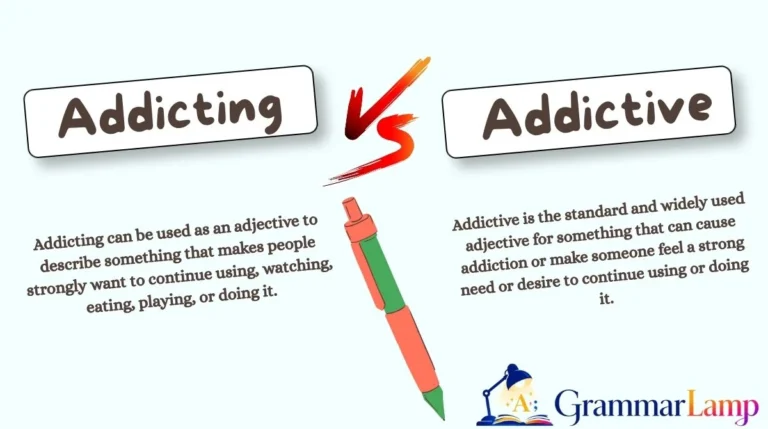
Addicting can be used as an adjective to describe something that makes people strongly want to continue using, watching, eating, playing, or doing it.
In simple words, addicting means very hard to stop once you start enjoying or using something.
For example:
“This show is so addicting.”
The speaker means that the show is so enjoyable or engaging that they keep wanting to watch another episode.
When do we use “addicting”?
Addicting is most often found in casual, conversational English. People commonly use it when talking about things such as:
- games
- TV shows
- social media
- videos
- books
- food
- hobbies
- apps
- online content
It often focuses on the experience of getting hooked on something.
A person might say:
“I played the game for five minutes, and now it’s addicting.”
Here, the speaker is talking about the strong desire to keep playing.
Grammar rule for “addicting”
“Addicting” comes from the verb addict and has the -ing form.
In modern English, it can function as an adjective.
It is also possible to see it used as a participle in structures connected to the verb addict, although this use is much less common in ordinary conversation than the adjective use.
As an adjective, it comes before a noun or after a linking verb.
Before a noun:
“It is an addicting game.”
After a linking verb:
“The game is addicting.”
The second pattern is especially common in spoken English.
8 examples with “addicting”
- This mobile game is really addicting.
- That mystery series is so addicting that I watched it all night.
- These short videos are surprisingly addicting.
- The game becomes more addicting as you unlock new levels.
- I know this show is addicting, but I need to sleep.
- That puzzle app is weirdly addicting.
- The book was so addicting that I finished it in one day.
- This snack is addicting—I keep going back for more.
Notice that these examples are mostly casual. A speaker is often describing something that pulls them back for more.
Why do learners get confused about “addicting”?
The confusion usually comes from the ending -ing.
English has many adjectives ending in -ing, such as:
- boring
- exciting
- interesting
- confusing
- relaxing
So learners naturally think addicting must work in exactly the same way.
It can work as an adjective, but there is another issue: addictive is much more established and common in standard English.
That means you may hear “addicting” often in casual speech, while “addictive” is usually the safer choice when you are writing formally.
What Does “Addictive” Mean?
Addictive is the standard and widely used adjective for something that can cause addiction or make someone feel a strong need or desire to continue using or doing it.
In simple English, addictive means:
something that is difficult to stop because it creates a strong desire to have or do it again.
For example:
“Nicotine is highly addictive.”
Here, the word describes the ability of nicotine to produce dependence and a strong desire for continued use.
But addictive is not limited to substances. In everyday English, people also use it for activities and entertainment.
You can say:
“That game is addictive.”
This means the game is so engaging that players may keep wanting to play.
When do we use “addictive”?
Addictive is useful in both everyday and formal English.
It can describe:
- substances
- medicines or drugs in appropriate contexts
- games
- food
- social media
- shopping
- television
- habits
- apps
- entertainment
- activities
The exact meaning depends on context.
When talking about a substance, addictive can have a serious meaning related to addiction and dependence.
When talking about a video game, it may simply mean very hard to stop playing.
Grammar rule for “addictive”
Addictive is an adjective.
It can appear before a noun:
“It is an addictive game.”
It can also appear after a linking verb:
“The game is addictive.”
You can use it with words such as very, highly, extremely, and deeply, depending on the context.
For example:
“The game is highly addictive.”
“The series is extremely addictive.”
8 examples with “addictive”
- This game is surprisingly addictive.
- Chocolate can be addictive for some people.
- That TV series is so addictive that I watched six episodes.
- Social media can become addictive if you use it constantly.
- The new app has an addictive design.
- I find crossword puzzles strangely addictive.
- The song has a very addictive beat.
- Some online games can be addictive.
Common confusion about “addictive”
Some learners think addictive should only be used for drugs or harmful substances. That is not true.
In everyday English, people regularly use addictive in a broader sense.
For example:
“This podcast is addictive.”
Nobody is saying that listening to a podcast is exactly the same as substance addiction. The speaker is using the word to express a strong feeling of wanting more.
So, always look at the context.
Difference Between Addicting and Addictive
The biggest question is whether addicting and addictive have different meanings.
In many everyday situations, their meanings are very close.
Both can describe something that causes a strong desire to continue.
However, there is a difference in usage, style, and how common the words are.
Comparison Table
| Feature | Addicting | Addictive |
|---|---|---|
| Part of speech | Adjective | Adjective |
| Basic meaning | Causing a strong desire to continue | Likely to cause addiction or difficult-to-stop behavior |
| Common in casual speech | Yes | Yes |
| Common in formal writing | Less common | Very common |
| Standard adjective choice | Less preferred | Usually preferred |
| Can describe games and shows | Yes | Yes |
| Can describe substances | Possible, but less usual | Yes |
| Overall usage | Informal and conversational | Standard and widely accepted |
Usage difference
When talking about a game, both may sound natural:
“This game is addicting.”
“This game is addictive.”
The second sentence is generally more common and is the safer choice across different types of writing.
The first sentence may sound more casual and conversational.
Grammar logic
There is also an interesting pattern behind the two forms.
The ending -ive often appears in adjectives that describe a quality or effect:
- attractive
- creative
- effective
- addictive
The ending -ing can also be used in English to create adjectives from verbs or participles:
- exciting
- tiring
- confusing
- annoying
That is why addicting can make sense as an English adjective.
Still, grammar is not only about whether a word can be formed logically. Usage matters too.
A word may be grammatically possible but much less common in standard English. That is the main issue with addicting.
Sentence structure difference
Both words can be used after be:
The game is addicting.
The game is addictive.
Both can also come before a noun:
an addicting game
an addictive game
But an addictive game is more familiar to most readers and is generally a better choice for formal or educational writing.
Meaning comparison
The meanings often overlap, but addictive can sound stronger or more established when discussing actual addiction.
Compare:
“This app is addicting.”
This usually sounds casual. The speaker probably means the app is very engaging.
Now compare:
“This substance is addictive.”
This can describe a serious risk of addiction.
So, although the words can overlap, addictive has a wider and more established use, especially in serious contexts.
Explore More Posts
Ardor vs Ardour: Meaning, Difference, Spelling & Examples (2026)
Fillet vs Filet: What’s the Difference? Meaning, Spelling, and Examples in 2026
Complaint vs Complain: Meaning, Difference, Grammar Rules & Examples (2026)
Differential vs Deferential: Meaning, Difference, Examples, and Grammar Rules (2026)
Grammar Rules You Must Remember
Rule 1: “Addictive” is the safer standard choice
When you are unsure which word to use, addictive is usually the better choice.
For example:
Correct and widely preferred: This game is addictive.
“Addicting” is not automatically a grammar mistake, but addictive is more established in standard English.
Rule 2: Both words can describe games, shows, food, and activities
Do not think that addictive is only for drugs or harmful substances.
You can say:
This game is addictive.
That show is addictive.
These cookies are addictive.
The puzzle is addictive.
In these sentences, the word simply expresses a strong urge to continue.
Rule 3: “Addicting” is more common in casual speech
You may hear native or fluent speakers use addicting in conversations, especially when talking about entertainment.
For example:
“That game is totally addicting.”
This sounds casual and natural to many speakers.
However, for schoolwork, articles, business writing, or professional communication, addictive is normally the better option.
Rule 4: Context determines how serious the meaning is
The word can describe anything from a fun game to a serious substance.
Compare:
“This puzzle is addictive.”
and
“The substance is addictive.”
The first sentence is casual. The second carries a serious meaning about addiction.
Do not assume that every use of addictive means a medical diagnosis or physical dependence. Context is important.
Common Mistakes Students Make
Mistake 1: Saying “Addicting is always wrong”
This is one of the most common misunderstandings.
Some learners are taught that addictive is correct and addicting is incorrect in every situation.
That is too simple.
Addicting is used as an adjective in real English, especially in informal contexts. However, it is less established and less preferred in many formal situations.
A better way to remember it is:
Addictive = standard, common, and safe choice
Addicting = informal, less common, but used
Mistake 2: Thinking “addictive” only relates to drugs
Example:
“This game is addictive.”
Some students think this sounds wrong because a game is not a drug.
But English speakers commonly use addictive in a wider, everyday sense.
You can describe a TV show, game, hobby, song, or even certain foods as addictive when they create a strong desire for more.
Mistake 3: Using “addicting” in formal writing without thinking about style
Suppose you are writing a school essay:
“Social media apps are addicting.”
The sentence may be understood, but addictive is usually a safer and more standard choice:
“Social media apps can be addictive.”
The second version fits formal writing better.
Mistake 4: Using the word without considering the strength of the meaning
Consider:
“This book is addictive.”
This can simply mean you cannot stop reading it.
But:
“This drug is addictive.”
has a much more serious meaning.
Students should learn to look at the noun and the context before deciding how the word sounds.
Wrong vs Correct Examples
| Less preferred / informal | Standard or preferred |
|---|---|
| This game is addicting. | This game is addictive. |
| That show is addicting. | That show is addictive. |
| The app is really addicting. | The app is really addictive. |
| This habit can be addicting. | This habit can be addictive. |
The left-side sentences are not best treated as automatic grammar errors. They are simply less standard or more conversational in many contexts.
Easy correction tip
When writing for a teacher, website, exam, workplace, or professional audience, choose addictive.
When quoting or reporting casual speech, you may hear addicting.
That one simple habit will help you avoid most problems.
Easy Trick to Remember the Difference
Here is a simple memory trick:
Addictive = the safe choice
Think of -ive as the form that describes a lasting quality.
The game is addictive.
The app is addictive.
The show is addictive.
This is the form you should normally choose when writing.
Addicting = the casual choice
Think of -ing as describing the thing that is pulling you in.
This game is addicting!
That show is addicting!
It can sound more like a personal reaction in conversation.
Another easy trick is this:
Formal = addictive
Casual = addicting
This is not an absolute rule for every speaker or every variety of English, but it is a useful guide for learners.
Real-life logic
Imagine your friend recommends a new game.
Your friend might say:
“Bro, this game is addicting!”
That sounds like excited everyday speech.
But if you are writing an English-learning article, you would normally write:
“This game is addictive.”
The meaning is nearly the same. The main difference is the level of standardness and style.
Daily Life Examples (Very Important)
Here are some natural examples you may hear in everyday English.
1. Talking about a video game
Ali: Have you tried that new racing game?
Sam: Yes! It’s really addictive.
Ali: I know. I played for three hours yesterday.
2. Talking about a TV show
Sara: Why are you still watching that series?
Mina: Because it’s so addictive. I need to know what happens next.
3. Casual conversation
Tom: How’s that new phone game?
Jake: Honestly, it’s addicting.
Tom: That sounds dangerous for my free time.
4. Talking about social media
Aisha: I only checked one video.
Nadia: And then?
Aisha: Then I watched twenty more. These apps can be addictive.
5. Talking about food
Mike: Try these chips.
John: Wow. These are really good.
Mike: I know. They’re addictive.
6. Talking about a book
Emma: Have you started the new mystery novel?
Lily: Yes. It’s addictive. I read half of it last night.
7. Talking about a hobby
Dan: Why did you buy another puzzle?
Chris: Because puzzles are addicting!
Dan: I think you have a point.
8. Talking about music
Sara: Have you heard this song?
Nora: Yes, and the beat is addictive. It has been stuck in my head all day.
9. Talking about an app
David: How do you like the new fitness app?
Omar: I love it. The daily challenges are addictive.
10. Talking casually with a friend
Ben: You said you would play for ten minutes.
Leo: I know.
Ben: It has been two hours.
Leo: What can I say? The game is addicting!
Practice Section
Choose addicting or addictive to complete each sentence. Remember that some answers may be possible in casual English, but think about the most standard choice.
1. This TV show is so ______ that I watched five episodes.
2. The doctor explained that the substance can be highly ______.
3. That phone game is really ______. I cannot stop playing it.
4. Social media can become ______ when someone uses it all day.
5. This puzzle app is surprisingly ______.
Answers
1. addictive
2. addictive
3. addictive
4. addictive
5. addictive
In casual conversation, some speakers may use addicting in several of these sentences, especially for games, shows, or apps.
For learners who want one dependable standard form, addictive is the easiest answer.
More Helpful posts
Favourite vs Favorite: Meaning, Difference, Spelling & Usage Guide 2026
By Which vs In Which: Easy Difference, Rules, Examples & Practice (2026)
No Thank You vs No, Thank You: Which Is Correct in 2026?
Creek vs Creak: Meaning, Difference, Examples & Easy Rules (2026)
FAQs
What is the difference between addicting and addictive?
Both words can describe something that makes you want to continue using or doing it. Addictive is the more common and standard adjective. Addicting is also used, especially in informal English.
Is “addicting” grammatically correct?
It can be used as an adjective in modern English, particularly in casual speech. However, it is less established than addictive in many formal contexts. For general writing, addictive is usually the safer choice.
Is “addictive” only used for drugs?
No. Addictive can describe substances, but it is also commonly used for games, television shows, food, apps, hobbies, and other activities. The meaning depends on the context.
Can I say “This game is addicting”?
Yes, many speakers use this sentence in informal English. It is understandable and can sound natural in casual conversation. For formal writing, This game is addictive is generally the better choice.
Is “addicting” informal?
It is commonly used in informal and conversational English. It appears often when people talk about games, shows, social media, apps, and similar things. Addictive works well in both casual and formal settings.
Which is better: “addicting” or “addictive”?
For English learners, addictive is usually the safer word to choose. It is widely recognized, common in standard English, and suitable for both everyday and formal writing. Addicting may be used in casual speech, but it is less preferred for formal contexts.
Conclusion
The difference between addicting vs addictive is mainly about common usage and style rather than a simple right-or-wrong grammar rule.
Addictive is the standard adjective and the form you should usually choose in school writing, professional English, formal articles, and other careful writing.
It can describe substances, games, shows, food, apps, habits, and many other things that create a strong desire for more.
Addicting is also used as an adjective, especially in casual conversation. You may hear people say, “This game is addicting” or “That show is addicting.” It is not necessary to treat every use of the word as a grammar mistake.
For a simple learner rule, remember:
Addictive = standard and widely preferred
Addicting = more casual and less common
The easiest way to build confidence is to read and listen to real English. Soon, you will start to notice where each form sounds natural. With regular practice, choosing between them will become much easier.

Liam Derren is a language writer at GrammarLamp, creating simple, helpful content about grammar, words, and everyday English. He makes language learning clear, practical, and easy to understand.
1 thought on “Addicting vs Addictive: What’s the Difference? Easy Grammar Guide for 2026”