
English has many words that sound the same but have completely different meanings. These words are called homophones, and they often confuse learners.
One common pair is timber and timbre. Since both words are pronounced almost the same, many students believe they can be used in the same way. However, they have very different meanings.
You may see timber in books about construction, forests, or woodworking. On the other hand, timbre appears in music, singing, and sound-related topics.
If you mix them up, your sentence can sound strange or even incorrect.
Learning the difference between these two words is useful because both appear in newspapers, books, exams, and everyday conversations.
If you enjoy reading, studying English, listening to music, or writing clearly, understanding these words will help you avoid common mistakes.
The good news is that the difference is easy once you know what each word means.
With simple explanations, grammar tips, comparison tables, and plenty of examples, the confusion quickly disappears.
By the end of this guide, you will know when to use timber, when to use timbre, how to remember the difference, and how to use both words naturally in real-life English.
Better Understand vs Understand Better: Meaning, Grammar, and Correct Usage (2026)
Hear vs Here: Meaning, Difference, Grammar Rules & Examples in 2026
Hasn’t vs Haven’t: Easy Grammar Rules, Examples & Differences in 2026
Smooth vs Smoothe: Which Spelling Is Correct? Complete Guide for 2026
What Does “Timber” Mean?
Simple Definition
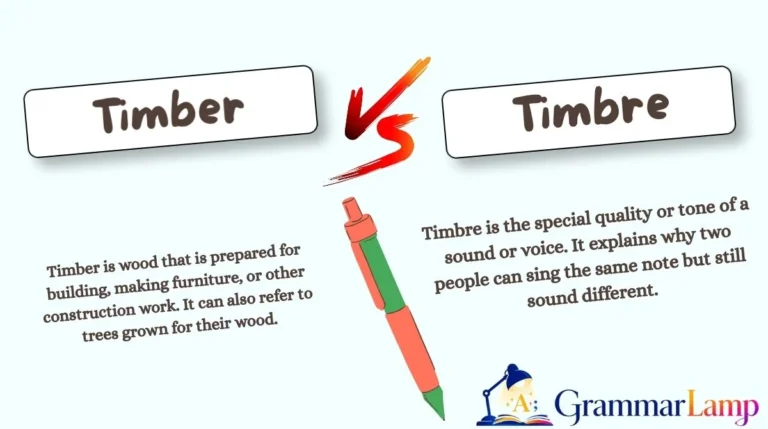
Timber is wood that is prepared for building, making furniture, or other construction work. It can also refer to trees grown for their wood.
In another meaning, “Timber!” is a warning shouted when a tree is falling.
When to Use Timber
Use timber when talking about:
- Wood used for building
- Forest products
- Construction materials
- Furniture making
- Trees cut for wood
- Warning about a falling tree
Grammar Rule
Timber is mainly a noun.
Structure:
- Timber + verb
- The + timber
- Some timber
- Timber industry
- Timber market
It is usually an uncountable noun when talking about wood in general.
Example:
- The house was built from timber.
Sometimes it refers to a type of wood or a supply of wood.
Example Sentences
- The workers carried heavy timber to the building site.
- My grandfather made this table from oak timber.
- The country exports high-quality timber.
- We bought timber for the new fence.
- The bridge is made of strong timber.
- The carpenter measured the timber carefully.
- Someone shouted, “Timber!” before the tree fell.
- The forest provides valuable timber every year.
Common Learner Confusion
Many learners think timber has something to do with music because it sounds like timbre. Remember that timber always relates to wood, trees, or construction, not sound.
What Does “Timbre” Mean?
Simple Definition
Timbre is the special quality or tone of a sound or voice. It explains why two people can sing the same note but still sound different.
It is often called the color or character of a sound.
When to Use Timbre
Use timbre when talking about:
- Singing
- Musical instruments
- Human voices
- Sound quality
- Audio production
Grammar Rule
Timbre is a noun.
It usually appears with words like:
- warm timbre
- rich timbre
- bright timbre
- unique timbre
- pleasant timbre
- vocal timbre
Example Sentences
- Her voice has a warm timbre.
- Every guitar has its own timbre.
- The singer’s timbre impressed everyone.
- I love the soft timbre of the piano.
- His deep timbre makes him easy to recognize.
- The violin produced a beautiful timbre.
- Different instruments have different timbres.
- The teacher explained how timbre changes musical sound.
Common Learner Confusion
Students often spell timbre as timber because both words sound nearly identical.
A simple reminder:
Timbre = Sound
Timber = Wood
Difference Between Timber and Timbre
Although they sound almost the same, their meanings are completely different.
| Feature | Timber | Timbre |
|---|---|---|
| Meaning | Wood used for building | Quality of sound |
| Topic | Construction, forests | Music, voices |
| Part of Speech | Noun | Noun |
| Related Words | Wood, trees, lumber | Voice, tone, sound |
| Used in Building? | Yes | No |
| Used in Music? | No | Yes |
| Pronunciation | Nearly same | Nearly same |
Usage Difference
Use timber when discussing physical materials.
Example:
- The carpenter ordered more timber.
Use timbre when discussing sounds.
Example:
- Her voice has a gentle timbre.
Grammar Logic
Both words are nouns, but they belong to different subjects.
Construction → Timber
Music → Timbre
They cannot replace each other.
Correct:
- The house is built from timber.
Incorrect:
- The house is built from timbre.
Correct:
- I love the timbre of your voice.
Incorrect:
- I love the timber of your voice.
Sentence Structure Difference
Timber usually appears with:
- cut timber
- buy timber
- timber house
- timber floor
- timber bridge
Timbre usually appears with:
- rich timbre
- warm timbre
- vocal timbre
- unique timbre
- beautiful timbre
Meaning Comparison
Think about these questions.
Are you talking about wood?
Use timber.
Are you talking about sound?
Use timbre.
In the Morning vs On the Morning: Complete Grammar Guide for 2026
Inside of vs Inside: The Easy Difference Explained in 2026
Attend vs Tend: Meaning, Differences, Grammar Rules & Examples (2026)
In the Morning vs On the Morning: Complete Grammar Guide for 2026
Grammar Rules You Must Remember
Rule 1: Timber Means Wood
Correct:
- The cabin was made from timber.
Wrong:
- The cabin was made from timbre.
Rule 2: Timbre Describes Sound
Correct:
- The singer has a lovely timbre.
Wrong:
- The singer has lovely timber.
Rule 3: Both Words Are Nouns
Correct:
- The timber is expensive.
- The timbre is unique.
Neither word is normally used as a verb in everyday English.
Rule 4: Context Helps You Choose
If the topic is:
- Forests
- Furniture
- Houses
Choose timber.
If the topic is:
- Singing
- Music
- Voices
- Instruments
Choose timbre.
Common Mistakes Students Make
Because both words sound almost identical, learners often spell the wrong one.
Mistake 1
Wrong:
- I like her voice’s timber.
Correct:
- I like her voice’s timbre.
Mistake 2
Wrong:
- The carpenter bought timbre.
Correct:
- The carpenter bought timber.
Mistake 3
Wrong:
- The piano has beautiful timber.
Correct:
- The piano has beautiful timbre.
Mistake 4
Wrong:
- They built the bridge with timbre.
Correct:
- They built the bridge with timber.
Why Do These Mistakes Happen?
There are three common reasons.
- The pronunciation is almost identical.
- The spelling is very similar.
- Many learners have never studied the musical word timbre.
Easy Correction Tips
Ask yourself one question.
“Am I talking about wood or sound?”
Wood → Timber
Sound → Timbre
This quick check prevents most mistakes.
Easy Trick to Remember the Difference
Memory tricks make learning much easier.
Trick 1
Timber has “B”.
Think:
B = Building
Timber → Building wood
Trick 2
Timbre ends with “re”.
Think:
Music has many strange French words.
Timbre is one of them.
Whenever you see the unusual spelling, remember music and sound.
Trick 3
Picture two scenes.
Scene One:
A carpenter carries large wooden boards.
Think:
Timber.
Scene Two:
A singer performs beautifully.
Think:
Timbre.
The picture stays in your memory much longer than a definition.
Daily Life Examples
These examples sound natural in everyday English.
- We bought timber to repair the roof.
- This chair is made from strong timber.
- My uncle works in the timber industry.
- The carpenter measured every piece of timber.
- Your voice has a warm timbre.
- I like the timbre of acoustic guitars.
- The violin’s timbre sounds soft and emotional.
- Every singer has a different timbre.
- The old bridge was built with heavy timber.
- The teacher explained how timbre changes the sound of instruments.
Practice Section
Choose the correct word.
1.
The cabin was built from ______.
A. timber
B. timbre
2.
Her singing has a beautiful ______.
A. timber
B. timbre
3.
The workers unloaded the ______ from the truck.
A. timber
B. timbre
4.
Each violin has its own ______.
A. timber
B. timbre
5.
The company sells high-quality ______.
A. timber
B. timbre
Answers
- Timber
- Timbre
- Timber
- Timbre
- Timber
I’m vs I Am: Complete Difference, Rules, Examples & Usage Guide 2026
Sun vs Son: Meaning, Difference, Rules, and Examples (2026)
A Majority of vs The Majority of: Easy Grammar Guide for 2026
Tomatoes or Tomatos: Which Spelling Is Correct? [2026]
Frequently Asked Questions
1. What is the difference between timber and timbre?
Timber refers to wood used in construction or woodworking. Timbre refers to the unique quality of a sound or voice. Even though they sound almost the same, they belong to completely different topics.
2. Why are timber and timbre pronounced almost the same?
English contains many homophones. These words developed from different language histories, but over time their pronunciation became nearly identical while their meanings stayed different.
3. Can I use timber when talking about music?
No. Timber is never used to describe voices or musical sounds. In music, the correct word is timbre.
4. Is timbre a formal word?
Yes. Timbre is more common in music lessons, singing, sound engineering, and academic writing. Music teachers and musicians use it regularly, but it also appears in everyday discussions about voices.
5. Is timber countable or uncountable?
When talking about wood in general, timber is usually an uncountable noun. However, in some contexts people may speak of different timbers or timber products.
6. How can I remember which word to use?
Think about the topic. If it is about wood, trees, or building materials, choose timber. If it is about voices, instruments, or sound quality, choose timbre. Associating B in timber with building is an easy memory aid.
Conclusion
Although timber and timbre sound almost identical, their meanings are completely different. Timber belongs to the world of wood, forests, carpentry, and construction.
Timbre belongs to music, voices, and the unique character of sound. Once you connect each word with its topic, choosing the correct one becomes much easier.
The best way to remember the difference is through regular practice. Read books, listen to conversations, and create your own sentences using both words.
Over time, the correct spelling and meaning will feel natural. Small habits like checking the context—wood or sound—can prevent common mistakes.
Every new pair of confusing English words you master makes your vocabulary stronger and your writing more accurate.
Keep practicing, stay curious, and don’t worry if you make mistakes along the way. Every mistake is another chance to learn and become a more confident English speaker.

Liam Derren is a language writer at GrammarLamp, creating simple, helpful content about grammar, words, and everyday English. He makes language learning clear, practical, and easy to understand.