
Many English learners feel confused when they have to choose between “I ordered” and “I have ordered.”
At first, both sentences seem to have the same meaning because they both talk about ordering something. However, native English speakers use them in different situations.
This difference comes from English verb tenses. “I ordered” is in the simple past tense, while “I have ordered” is in the present perfect tense.
Choosing the correct one depends on whether the time is finished or whether the action still has a connection to the present.
This grammar point appears in everyday conversations. You may use it when ordering food, shopping online, talking to customer service, speaking at work, or chatting with friends.
If you use the wrong tense, people will usually understand you, but your English may sound less natural.
Once you understand the simple rules behind these two expressions, the confusion disappears. You will know exactly when to use each one, how native speakers think about time, and why one sentence sounds better than the other in different situations.
By the end of this guide, you will confidently choose the correct expression in both spoken and written English.
Honor or Honour: What Is the Difference? A Simple Guide for 2026
Collaborate vs Corroborate: Meaning, Difference, and Examples in 2026
Sleeve vs Sleave: Which Is Correct? Meaning, Difference, and Examples in 2026
Time off vs time-off: The Complete Grammar Guide for 2026
What Does “I Ordered” Mean?
Simple Definition
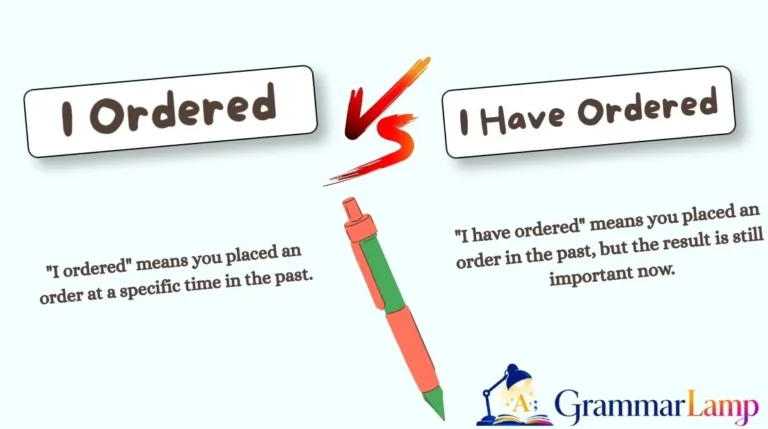
“I ordered” means you placed an order at a specific time in the past.
The action is finished, and the speaker usually knows when it happened or is talking about a completed past event.
When to Use It
Use “I ordered” when:
- The action happened yesterday, last week, last month, or another finished time.
- You mention the exact time.
- You are simply telling a story about the past.
Grammar Rule
Subject + Past Form of the Verb
I + ordered
The verb order changes to ordered, which is the simple past form.
Examples
- I ordered pizza last night.
- I ordered a new laptop yesterday.
- I ordered coffee before work.
- I ordered a blue shirt last week.
- I ordered the wrong size.
- I ordered flowers for my mother.
- I ordered dinner at seven o’clock.
- I ordered everything online during the sale.
Common Learner Confusion
Many students think they should always use “I have ordered” because it sounds more advanced.
That is not true.
If you mention a finished time like yesterday, last week, two hours ago, or in 2024, you should normally use the simple past.
✅ I ordered a phone yesterday.
❌ I have ordered a phone yesterday.
What Does “I Have Ordered” Mean?
Simple Definition
“I have ordered” means you placed an order in the past, but the result is still important now.
The exact time is either unknown or not important.
When to Use It
Use “I have ordered” when:
- The order still affects the present.
- You are waiting for delivery.
- You are informing someone that the action has already been completed.
- The exact time does not matter.
Grammar Rule
Subject + have + past participle
I + have + ordered
“Ordered” is both the simple past and the past participle of the verb “order.”
Examples
- I have ordered a new phone.
- I have ordered lunch already.
- I have ordered the tickets.
- I have ordered your birthday gift.
- I have ordered everything you asked for.
- I have ordered another copy.
- I have ordered the book online.
- I have ordered the replacement item.
Common Learner Confusion
Students often ask why they cannot say:
“I have ordered it yesterday.”
The answer is simple.
The present perfect tense does not normally go with finished time expressions like:
- yesterday
- last night
- last year
- two days ago
Instead, say:
✅ I ordered it yesterday.
Difference Between “I Ordered” and “I Have Ordered”
Although both sentences describe placing an order, they focus on different ideas.
| I Ordered | I Have Ordered |
|---|---|
| Simple Past | Present Perfect |
| Finished past action | Past action connected to now |
| Often includes a time | Usually no finished time |
| Story about the past | Present result matters |
| Yesterday, last week | Already, just, yet |
Usage Difference
Imagine these situations.
Situation 1
“What did you do yesterday?”
“I ordered a new computer.”
The conversation is about yesterday.
Situation 2
“Have you bought the computer?”
“Yes, I have ordered it.”
The important thing is that the order has already been placed.
Grammar Logic
Simple Past
Past event → Finished → No present connection needed.
Present Perfect
Past event → Still important now.
Sentence Structure
Simple Past
Subject + Past Verb
I ordered dinner.
Present Perfect
Subject + have + Past Participle
I have ordered dinner.
Meaning Comparison
“I ordered dinner.”
This tells us what happened.
“I have ordered dinner.”
This tells us dinner has already been ordered, so there is no need to order again.
Afterward or Afterwards? Meaning, Difference, and Correct Usage in 2026
A MA or an MA Degree? The Correct Grammar Rule in 2026
A or an: Easy Rules, Examples, and Common Mistakes in 2026
From My End or From My Side? Which Is Correct in English? (2026 Guide)
Grammar Rules You Must Remember
Rule 1: Use the Simple Past with Finished Time
Finished time words require the simple past.
Examples:
- I ordered coffee yesterday.
- I ordered shoes last month.
- I ordered food two hours ago.
Rule 2: Use Present Perfect When Time Is Not Important
If the time is unknown or unnecessary, use the present perfect.
Examples:
- I have ordered lunch.
- I have ordered the tickets.
- I have ordered another book.
Rule 3: Present Perfect Shows a Present Result
The action happened before now, but the result still matters.
Examples:
- I have ordered a taxi. It will arrive soon.
- I have ordered your medicine.
- I have ordered dinner, so we do not need to cook.
Rule 4: Do Not Mix Present Perfect with Finished Time Expressions
Incorrect:
❌ I have ordered it yesterday.
Correct:
✅ I ordered it yesterday.
Common Mistakes Students Make
Mistake 1
❌ I have ordered it last week.
✅ I ordered it last week.
Reason:
“Last week” is a finished time.
Mistake 2
❌ I ordered already.
Better:
✅ I have already ordered.
Reason:
“Already” often works naturally with the present perfect.
Mistake 3
❌ I have ordered yesterday evening.
✅ I ordered yesterday evening.
Mistake 4
❌ I ordered it. It is on the way now.
This sentence is possible, but if you want to emphasize the current situation, native speakers often prefer:
✅ I have ordered it. It is on the way now.
Easy Correction Tip
Ask yourself one question.
Am I talking about when it happened?
Yes → Use I ordered.
No. I only care that it is done → Use I have ordered.
Easy Trick to Remember the Difference
Think about a delivery package.
“I Ordered”
Imagine looking backward.
You remember the day you clicked the “Buy Now” button.
The focus is on the past event.
“I Have Ordered”
Now imagine checking your tracking number.
The package is still coming.
The order affects the present.
A simple memory trick is this:
Past event = I ordered
Present result = I have ordered
This trick works for many English verbs.
Daily Life Examples
These are the kinds of sentences you will hear every day.
- I ordered coffee before coming here.
- I have ordered lunch, so let’s wait.
- I ordered those shoes last Friday.
- I have ordered your birthday cake.
- I ordered a taxi this morning.
- I have ordered another charger because the first one broke.
- I ordered a new phone during the sale.
- I have ordered the documents you requested.
- I ordered the wrong item by mistake.
- I have ordered everything we need for the party.
Short Conversation 1
A: Have you bought the movie tickets?
B: Yes, I have ordered them online.
Short Conversation 2
A: When did you buy that laptop?
B: I ordered it last month.
Short Conversation 3
A: Shall I cook dinner?
B: No, I have ordered pizza.
Short Conversation 4
A: Why are you checking your email?
B: I have ordered a package, and I’m waiting for the delivery update.
Practice Section
Choose the correct answer.
1.
I ______ the book yesterday.
A. ordered
B. have ordered
2.
I ______ lunch already.
A. ordered
B. have ordered
3.
I ______ my ticket last week.
A. ordered
B. have ordered
4.
I ______ everything you asked for.
A. ordered
B. have ordered
5.
I ______ dinner two hours ago.
A. ordered
B. have ordered
Answers
- A
- B
- A
- B
- A
Upmost vs Utmost: Meaning, Difference, and Correct Usage in 2026
To Discuss or Discuss About: Which Is Correct? | Easy Grammar Guide 2026
Seam vs Seem: Difference, Meaning, Examples & Grammar Rules (2026)
All the Time vs Every Time: Meaning, Difference, Rules & Examples (2026)
Frequently Asked Questions
What is the difference between “I ordered” and “I have ordered”?
“I ordered” talks about a finished action in the past. “I have ordered” talks about a past action that is still connected to the present. The difference is mainly about time and present relevance.
Can I use “I have ordered” with yesterday?
No.
Say:
“I ordered yesterday.”
The present perfect is normally not used with finished time expressions like “yesterday” or “last week.”
Is “I have ordered” formal?
No.
It is common in both formal and informal English. People use it every day in conversations, emails, customer service, and business communication.
Which tense is more common in spoken English?
Both are common.
Native speakers choose the tense based on the situation, not because one is more natural than the other.
Can I use “already” with both tenses?
Yes, but “already” is much more common with the present perfect.
Example:
“I have already ordered dinner.”
How can I remember the difference easily?
Think about time.
If the conversation focuses on when something happened, use the simple past.
If the conversation focuses on the result now, use the present perfect.
Conclusion
Understanding the difference between “I ordered” and “I have ordered” is easier than many learners think. The secret is not the word ordered itself but the idea behind the tense.
Use “I ordered” when you are talking about a completed action at a finished time. Words like yesterday, last week, or two hours ago usually point to the simple past.
Use “I have ordered” when the order is connected to the present. Maybe you are waiting for the package, telling someone the job is done, or explaining that there is no need to order again.
The more you notice these patterns in movies, books, and everyday conversations, the more natural they will become.
Practice by making your own sentences about food, online shopping, travel, and daily life. Before long, choosing the correct tense will become automatic, and your English will sound much more fluent and confident.

Liam Derren is a language writer at GrammarLamp, creating simple, helpful content about grammar, words, and everyday English. He makes language learning clear, practical, and easy to understand.