
Honor and honour look almost the same, and they mean the same thing. The only real difference is where the spelling is normally used.
If you use American English, you will usually write honor. If you use British English, you will usually write honour. The same difference appears in related words, such as honorable/honourable, honored/honoured, and honoring/honouring.
This small spelling difference can confuse English learners because both forms appear on websites, in books, at school, and in international communication.
A student may see honor in an American textbook and honour in a British newspaper and wonder whether one is correct and the other is wrong.
The good news is that both are correct.
As a verb, it can mean to show respect, to give recognition, or to keep a promise or agreement.
By the end of this guide, you will know exactly when to use honor and honour, how their grammar works, which spelling fits American or British English, and how to avoid common mistakes.
What Does “Honor” Mean?
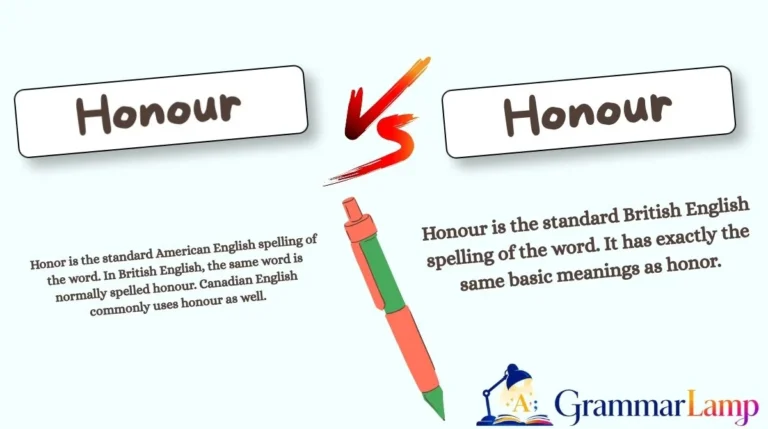
Honor is the standard American English spelling of the word. In British English, the same word is normally spelled honour. Canadian English commonly uses honour as well.
As a noun, honor can mean great respect or admiration for someone. It can also describe something that makes you feel proud because you have received respect or an important opportunity.
For example:
- It is a great honor to meet you.
- She was treated with honor and respect.
- He is a man of honor.
- The award was a great honor for her.
- We held a dinner in honor of our teacher.
- It was an honor to represent my school.
- The soldier received the highest honor for his bravery.
- He always keeps his word because he values honor.
The word can also refer to a person’s honesty, good character, and strong moral standards. Someone who keeps promises and behaves fairly may be described as a person of honor. Cambridge defines honor as a quality connected with respect, pride, and honesty.
Honor as a noun
When honor is a noun, it often appears in these structures:
honor + of + -ing
It was an honor to meet the author.
in honor of + person/thing
We organized a dinner in honor of our coach.
a great/special honor
Receiving the prize was a great honor.
a person/man/woman of honor
She is known as a woman of honor.
Honor as a verb
Honor can also be a verb. As a verb, it means to show respect, recognize someone’s achievement, or do what you promised to do.
Examples:
- The school honored the winning students.
- We honor our teachers for their hard work.
- The city honored the firefighter with an award.
- The ceremony honored the memory of the victims.
- She always honors her promises.
- The company agreed to honor the contract.
- He was honored for his excellent work.
- I felt honored to receive the invitation.
Oxford lists three important verb meanings: showing respect, giving public praise or an award, and doing what you have agreed or promised to do.
A common learner confusion
Some students think honor and respect are always interchangeable. They are related, but they are not always identical.
For example:
I respect my teacher.
This simply means I have a positive opinion of my teacher and value them.
But:
It was an honor to meet my teacher.
Here, the speaker feels proud and privileged because of the meeting.
So, honor can express respect plus a feeling of pride, privilege, or moral value.
What Does “Honour” Mean?
Honour is the standard British English spelling of the word. It has exactly the same basic meanings as honor.
British English uses honour in both noun and verb forms.
For example:
- It is a great honour to meet you.
- He is a man of honour.
- The medal was a great honour.
- They held a ceremony in honour of the teacher.
- She received the highest honour for her work.
- The school honoured the students.
- We should honour our promises.
- I would be honoured to accept the invitation.
Notice that the meaning has not changed. Only the spelling has changed.
Honour as a noun
As a noun, honour can mean respect, admiration, a privilege, moral character, or an award.
For example:
It was a great honour to speak at the event.
Here, honour means a special privilege.
He is a man of honour.
Here, it refers to good moral character.
She received a national honour.
Here, it means an award or official recognition.
Honour as a verb
As a verb, honour can mean to show respect or to recognize someone’s achievement.
The university honoured the scientist.
It can also mean to keep a promise or agreement:
The company agreed to honour the contract.
The verb forms follow the British spelling:
- honour
- honours
- honoured
- honouring
The American forms are:
- honor
- honors
- honored
- honoring
Oxford specifically lists these British verb forms and gives honor as the US English form.
A common learner confusion
Do not think the extra u makes honour more formal.
It does not.
For example, these two sentences have the same level of formality:
It is a great honor to meet you.
It is a great honour to meet you.
The first follows American spelling. The second follows British spelling.
Difference Between Honor and Honour
The simplest answer is this:
Honor = American English spelling
Honour = British English spelling
They have the same pronunciation and the same meaning in normal English use. The spelling difference comes from different English spelling traditions.
| Point | Honor | Honour |
|---|---|---|
| Main variety | American English | British English |
| Meaning | Respect, privilege, moral character, award, etc. | Same |
| Pronunciation | Same basic pronunciation | Same basic pronunciation |
| Noun | honor | honour |
| Verb | honor | honour |
| He/she/it | honors | honours |
| Past tense | honored | honoured |
| -ing form | honoring | honouring |
| Related adjective | honorable | honourable |
| Common in US writing | Yes | No, normally |
| Common in UK writing | Less common | Yes |
The important point is that you should choose one spelling system and use it consistently.
For example, if you are writing an essay in American English, write:
The school honored the student.
Do not suddenly change to:
The school honoured the student.
If you are following British English, use:
The school honoured the student.
Oxford identifies honor as the US spelling and honour as the British spelling.
Usage difference
There is no difference in meaning between the two forms.
Compare:
It is an honor to be here.
It is an honour to be here.
Both mean that the speaker feels proud or privileged to be there.
Another pair:
They honored the teacher.
They honoured the teacher.
Both mean that they showed respect or gave recognition to the teacher.
Grammar logic
The spelling does not change the part of speech.
Honor can be a noun:
It was an honor.
It can also be a verb:
We honor our teachers.
Honour can be a noun:
It was an honour.
It can also be a verb:
We honour our teachers.
So the choice is about spelling variety, not grammar.
Sentence structure
The sentence structures are also the same.
Noun:
It is an honor/honour to meet you.
Verb:
We honor/honour our parents.
In honor/honour of:
They held a ceremony in honor/honour of the winner.
Honored/honoured for:
She was honored/honoured for her work.
Grammar Rules You Must Remember
Rule 1: Use “honor” for American English
If your writing follows American English, use honor.
The president honored the scientist.
American English also uses:
honored
honoring
honors
honorable
The American spelling removes the u.
Rule 2: Use “honour” for British English
If your writing follows British English, use honour.
The president honoured the scientist.
British English uses:
honoured
honouring
honours
honourable
The extra u remains in these related forms.
Rule 3: Do not mix spelling systems without a reason
Consistency is important in formal writing.
For example, this looks inconsistent:
The school honoured the student and described his work as honorable.
If you are using British English, write:
The school honoured the student and described his work as honourable.
If you are using American English:
The school honored the student and described his work as honorable.
Rule 4: “Honor/honour” can be both a noun and a verb
As a noun:
It was a great honor.
As a verb:
We honor our heroes.
In British English:
It was a great honour.
We honour our heroes.
This is important because learners sometimes think the word can only be used as a noun.
Common Mistakes Students Make
Mistake 1: Thinking “honour” is wrong
Some American English learners see the extra u and assume it is a spelling mistake.
It is not.
❌ Honour is always wrong.
✅ Honour is standard British English.
Similarly, British English learners should not think honor is incorrect.
❌ Honor is not English.
✅ Honor is standard American English.
Mistake 2: Mixing American and British forms
A student may write:
The actor was honoured for his honorable work.
This mixes British honoured with American honorable.
Choose one style:
British: The actor was honoured for his honourable work.
American: The actor was honored for his honorable work.
Mistake 3: Forgetting the spelling change in related words
If you choose British English, the extra u also appears in related forms.
British:
- honour
- honoured
- honouring
- honours
- honourable
American:
- honor
- honored
- honoring
- honors
- honorable
Mistake 4: Using “honor” when you mean “respect” in every situation
Although the meanings can overlap, the words are not always exact substitutes.
I respect my parents.
This is a normal statement about your feelings toward your parents.
It is an honor to represent my country.
This expresses pride and privilege.
Easy correction tip
First ask:
“Am I writing American English or British English?”
Then stay with that spelling throughout the piece.
If your school, employer, client, or website follows a particular style guide, follow that style.
Easy Trick to Remember the Difference
Here is the easiest trick:
US = Honor
UK = Honour
Think of the U as a clue for the traditional British spelling.
honour = British
honor = American
You can also remember the pattern by comparing a few related words:
American:
color, favor, labor, honor
British:
colour, favour, labour, honour
The same spelling pattern appears in several words.
There is one important point, though: do not use the memory trick to decide which spelling is “better.” Neither one is better. They simply belong to different English spelling systems.
If you are writing for an American audience, honor will usually look natural. If you are writing for a British audience, honour will usually look natural.
Daily Life Examples
Here are some natural examples you may hear or use in everyday English.
1. Meeting someone important
It is an honor to meet you.
This is common in American English.
British English:
It is an honour to meet you.
2. Receiving an invitation
I would be honored to attend your wedding.
The speaker means, “I would feel very happy and proud to attend.”
British spelling:
I would be honoured to attend your wedding.
3. Talking about a teacher
We should honor our teachers for their hard work.
British:
We should honour our teachers for their hard work.
4. A special ceremony
The school held a ceremony in honor of the retired principal.
British:
The school held a ceremony in honour of the retired principal.
The expression in honor/honour of means that something is done to show respect for someone or something.
5. Keeping a promise
He always honors his promises.
This means he does what he has promised to do.
British:
He always honours his promises.
6. Receiving an award
She was honored for her years of service.
British:
She was honoured for her years of service.
7. Talking about someone’s character
My grandfather was a man of honor.
British:
My grandfather was a man of honour.
Here, the word refers to honesty, good character, and moral standards.
8. Accepting an invitation
“Would you like to give the opening speech?”
“I’d be honored.”
British spelling:
“I’d be honoured.”
9. A special event
“Why are they having a dinner tonight?”
“It’s in honor of the new manager.”
British:
“It’s in honour of the new manager.”
10. Formal recognition
The university honored her achievements.
British:
The university honoured her achievements.
In this sentence, the verb means that the university gave her public recognition or respect for what she achieved.
Practice Section
Choose honor or honour based on the English variety mentioned.
1. American English
It was a great ______ to receive the award.
2. British English
She was ______ for her work with children.
3. American English
The ceremony was held in ______ of the teacher.
4. British English
He always ______ his promises.
5. American English
I would be ______ to speak at the event.
Answers
- honor
- honoured
- honor
- honours
- honored
Remember that the answers would change spelling if you switched from American English to British English.
FAQs
What is the difference between honor and honour?
There is no difference in basic meaning. Honor is the usual American English spelling, while honour is the usual British English spelling. Both can be nouns and verbs, and both can mean respect, privilege, recognition, or moral character.
Can we use honor in British English?
You may see honor in British writing, especially when an American source, name, quotation, or American style is being used. However, standard British spelling normally uses honour. If you are writing in British English, honour is the safer choice.
Can we use honour in American English?
Honour is understandable to American readers, but honor is the normal American spelling. If you are writing for a US audience, use honor to match American spelling conventions.
Is honor formal or informal?
Honor can be used in both everyday and formal English. Expressions such as “It is an honor to meet you” are polite and fairly formal. In casual conversation, people may simply say “Nice to meet you.”
Is honour a different word from honor?
No. They are spelling variants of the same word. Their meanings, pronunciation, and grammar are essentially the same. The main difference is regional spelling: honor is American, while honour is British.
Which spelling should students use: honor or honour?
Use the spelling required by the English variety you are studying. For American English, use honor. For British English, use honour. If your teacher, school, exam, or publication follows a particular style, follow that standard consistently.
Conclusion
The difference between honor and honour is much simpler than it first appears.
Honor is the standard American English spelling, while honour is the standard British English spelling. The meaning does not change.
Both words can describe respect, pride, privilege, good character, or an award.
They can also work as verbs meaning to show respect, recognize someone’s achievements, or keep a promise.
The most useful rule is easy to remember:
American English → honor
British English → honour
Also remember the related forms. American English uses honored, honoring, honors, honorable, while British English uses honoured, honouring, honours, honourable.
If you are a student, do not worry when you see the other spelling in a book or online. It is not a spelling error. It simply belongs to another variety of English.
Choose the style you need, stay consistent, and keep practicing. Once you connect honor with American English and honour with British English, this common spelling question becomes very easy.

Liam Derren is a language writer at GrammarLamp, creating simple, helpful content about grammar, words, and everyday English. He makes language learning clear, practical, and easy to understand.
3 thoughts on “Honor or Honour: What Is the Difference? A Simple Guide for 2026”