
Have you ever written “canceled” and then wondered whether it should be “cancelled” instead? You are not alone.
This is one of those small English spelling differences that can confuse even learners who already know a lot of grammar.
The reason is simple: both “canceled” and “cancelled” are correct spellings. The main difference is the type of English being used.
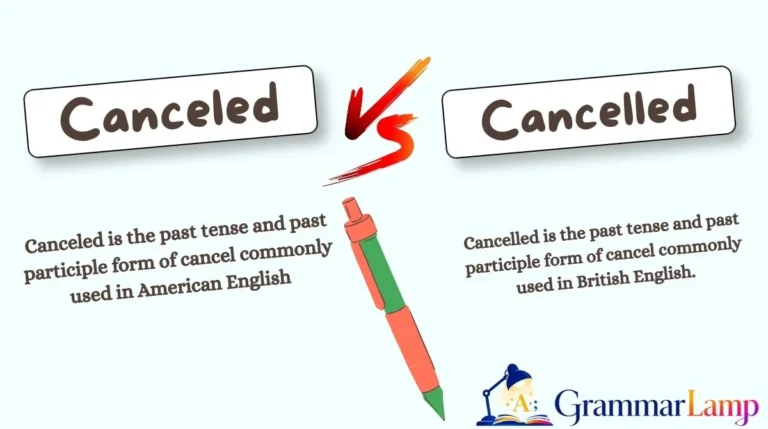
Canceled is the usual spelling in American English, while cancelled is the usual spelling in British English. Cambridge and Oxford both recognize these different forms.
The word itself has the same meaning in both forms. To cancel something means to decide that a planned event, meeting, trip, order, or service will not happen or will stop.
For example, you can cancel a flight, cancel a meeting, cancel a subscription, or cancel a reservation.
This spelling difference matters in emails, school writing, websites, business messages, and everyday communication. Once you understand the regional rule, the choice becomes much easier.
By the end, you will know when to use canceled, when to use cancelled, how the forms work in sentences, what common mistakes to avoid, and how to remember the difference without checking a dictionary every time.
More Useful posts
May or May Not: Meaning, Grammar Rules, Examples, and Common Mistakes in 2026
Peaked vs Peeked vs Piqued: Meaning, Differences, Examples, and Grammar Rules (2026)
If There Is Any vs If There Are Any: Meaning, Difference, and Examples (2026)
Also Have or Have Also: Which Is Correct? Complete Grammar Guide 2026
What Does “Canceled” Mean?
Canceled is the past tense and past participle form of cancel commonly used in American English. It means that something planned has been stopped, called off, or no longer needs to happen. Oxford lists canceled as the American English past form of cancel.
The meaning does not change because there is only one l.
For example:
- The meeting was canceled.
- Our flight was canceled because of bad weather.
- She canceled her appointment.
- The school canceled the game.
- I canceled my subscription yesterday.
- The concert has been canceled.
- He canceled his order before it was shipped.
- They canceled their dinner plans.
In all of these sentences, something that had been planned will no longer happen.
When should you use “canceled”?
Use canceled when you are writing in American English or when the style guide or publication you are following uses American spelling.
You will often see this spelling in American newspapers, websites, school materials, business communication, and software interfaces.
For example:
The company canceled the meeting because the manager was sick.
This sentence sounds completely natural in American English.
What is the grammar rule?
The base verb is:
cancel
Its common forms are:
- Present: cancel
- Third-person singular: cancels
- Past tense: canceled
- Past participle: canceled
- -ing form: canceling
American English usually keeps one l when adding these endings to cancel. Oxford specifically lists canceled and canceling as the American forms.
The pronunciation is not meaningfully changed by the spelling difference. Both canceled and cancelled are forms of the same verb and are pronounced in essentially the same way.
Common learner confusion
Many learners think one spelling must be wrong because English often has fixed spelling rules. Here, however, the difference comes from regional spelling conventions, not from a difference in grammar or meaning.
So:
The event was canceled. ✅
The event was cancelled. ✅
Both sentences are grammatically correct. The best choice depends on the variety of English you are using.
Another common mistake is to think that canceled is an informal version of cancelled. It is not. In American English, canceled is the normal spelling, including in formal writing.
What Does “Cancelled” Mean?
Cancelled is the past tense and past participle form of cancel commonly used in British English. It has exactly the same meaning as canceled. Cambridge lists cancelled as the past simple and past participle of cancel, while its learner dictionary distinguishes the British and US spellings.
The key visual difference is simple:
cancelled = c-a-n-c-e-l-l-e-d
There are two l’s before -ed.
Examples:
- The train was cancelled this morning.
- Our appointment was cancelled.
- The match was cancelled because of rain.
- She cancelled her hotel booking.
- The teacher cancelled the class.
- The flight has been cancelled.
- They cancelled the event at the last minute.
- He cancelled his newspaper subscription.
The meaning stays the same in every example.
When should you use “cancelled”?
Use cancelled when you are writing in British English or following a spelling system based on British English.
This is especially useful when writing for a British audience, a British school, or a publication that follows British spelling.
For example:
The football match was cancelled because of heavy rain.
That spelling is completely normal in British English.
What is the grammar rule?
The base form is still:
cancel
But British English usually uses these forms:
- Present: cancel
- Third-person singular: cancels
- Past tense: cancelled
- Past participle: cancelled
- -ing form: cancelling
Oxford lists cancelled and cancelling as the standard forms, while showing canceled and canceling as US English forms.
Notice that this spelling pattern appears in both the -ed form and the -ing form:
- British: cancelled
- British: cancelling
- American: canceled
- American: canceling
Common learner confusion
A learner may see cancelled on a British website and canceled on an American website and assume that one writer made a spelling error.
That is not necessarily true.
The spelling can tell you something about the variety of English being used.
For example:
The meeting was canceled.
American English
The meeting was cancelled.
British English
The message is the same.
This is similar to other spelling differences such as color/colour and center/centre. English has different spelling traditions in different regions.
Difference Between Canceled and Cancelled
The most important thing to remember is this:
There is no difference in meaning.
Both forms are the past tense and past participle of cancel. The main difference is spelling by English variety. Cambridge describes cancel with -ll- and says that US English usually uses -l-.
| Feature | Canceled | Cancelled |
|---|---|---|
| Main variety | American English | British English |
| Meaning | Same | Same |
| Past tense | canceled | cancelled |
| Past participle | canceled | cancelled |
| Number of l’s | One | Two |
| -ing form | canceling | cancelling |
| Correct spelling? | Yes | Yes |
| Formality | Not less formal | Not more formal |
Usage difference
The real difference is regional usage, not grammar.
Consider this sentence:
The flight was canceled.
An American reader will find this completely normal.
Now look at:
The flight was cancelled.
A British reader will usually find this completely normal.
Neither version changes the meaning of the sentence.
Grammar logic
Both spellings come from the same verb:
cancel → canceled/cancelled
The verb still follows the same grammar rules.
For example:
Present:
They cancel the meeting.
Past:
They canceled the meeting.
They cancelled the meeting.
Present perfect:
They have canceled the meeting.
They have cancelled the meeting.
Past perfect:
They had canceled the meeting.
They had cancelled the meeting.
Passive voice:
The meeting was canceled.
The meeting was cancelled.
The spelling changes, but the grammar does not.
Sentence structure difference
There is no sentence structure difference between the two forms.
You can use either form after was, were, has, have, had, and other helping verbs when the grammar calls for the past participle.
For example:
The doctor canceled my appointment.
The doctor cancelled my appointment.
Both have the same structure:
Subject + past-tense verb + object
Another example:
The trip was canceled because of the storm.
The trip was cancelled because of the storm.
Both use the passive structure:
Subject + was + past participle
Meaning comparison
There is also no meaning difference between:
The show was canceled.
and
The show was cancelled.
Both mean that the show will not happen.
So do not search for a hidden difference in meaning. The extra l does not make the action stronger, more formal, more serious, or more complete.
Explore More Posts
Sneaked vs Snuck: What Is the Difference? 2026 Guide
Wether vs Weather vs Whether: What’s the Difference? 2026 Guide
Instructions on vs Instructions for: Meaning, Difference, and Correct Usage in 2026
Role vs Roll: Meaning, Difference, Rules & Examples (2026)
Grammar Rules You Must Remember
Rule 1: American English usually uses “canceled”
When writing in American English, use canceled for the past tense and past participle.
Example:
The company canceled the meeting.
American English dictionaries and learner resources list this as the usual US form.
Rule 2: British English usually uses “cancelled”
When writing in British English, use cancelled.
Example:
The company cancelled the meeting.
Cambridge and Oxford both give this spelling as the standard British form.
Rule 3: The meaning stays the same
Do not try to give the two spellings different meanings.
Canceled and cancelled both mean that something planned has been stopped or will not happen.
For example:
We canceled the reservation.
We cancelled the reservation.
The meaning is identical.
Rule 4: Keep your spelling style consistent
If you are using American English, it is usually better to write canceled consistently.
If you are using British English, write cancelled consistently.
For example, do not randomly switch between different regional spelling styles in the same formal piece of writing.
Consistency makes your English look cleaner and more natural.
Common Mistakes Students Make
Many spelling mistakes happen because learners are trying to memorize English words one by one instead of noticing spelling patterns.
Mistake 1: Thinking “canceled” is wrong
A student may learn British English first and see:
The meeting was cancelled.
Later, they see:
The meeting was canceled.
They may think the second sentence contains a spelling mistake.
That is not correct. Canceled is the usual American English form.
Mistake 2: Thinking “cancelled” is always more correct
Some learners believe that two l’s must be the “proper” spelling.
Again, that is not true.
Canceled is a standard spelling in American English. It is not a careless or shortened form.
Mistake 3: Mixing forms
A learner may write:
The event was canceled, but the organizers are cancelling future events.
This is not necessarily impossible to understand, but it mixes the common American past form with the common British-style -ing spelling.
For consistent American English, write:
The event was canceled, but the organizers are canceling future events.
For consistent British English, write:
The event was cancelled, but the organizers are cancelling future events.
Mistake 4: Adding an extra “l” because of “cancelled”
A learner who knows cancelled may write:
cancellled ❌
That has three l’s, which is incorrect.
Remember:
cancelled = two l’s
Not one. Not three.
Mistake 5: Using the wrong word form
Another problem is confusing the verb with the noun.
For example:
The cancellation was unexpected.
Here, cancellation is a noun.
But:
They cancelled the meeting.
Here, cancelled is the verb.
Oxford defines cancellation as the act or decision of stopping something that was planned, such as an event or agreement.
Easy correction tip
Before writing, ask yourself:
“Which English spelling am I using?”
Then choose:
American English → canceled
British English → cancelled
That tiny habit can prevent many spelling problems.
Easy Trick to Remember the Difference
Here is a simple memory trick.
Think of the extra L in cancelled as the British L.
So:
British → cancelled → LL
American → canceled → L
You do not need to memorize a complicated spelling rule.
Just remember:
US = one L
UK = two L’s
There is another useful trick.
Look at these pairs:
- canceled / cancelled
- canceling / cancelling
The British forms keep the extra l, while American forms usually use only one l. Oxford lists exactly this distinction for both the past and -ing forms.
Imagine a person saying:
“British English likes an extra L.”
That little sentence can help you remember the pattern.
Real-life logic
Imagine that you work for an American company.
Your manager sends an email:
The meeting has been canceled.
You should not change it to cancelled simply because you learned the British spelling at school.
Now imagine that you are writing for a British audience:
The meeting has been cancelled.
The second spelling fits that variety better.
The important lesson is not “Which one is right?”
The better question is:
“Which spelling matches the English variety I am using?”
Daily Life Examples
These examples show how both forms work in normal conversations.
1. Talking about a flight
A: Are we still flying tomorrow?
B: No. The airline canceled the flight because of bad weather.
British spelling:
B: No. The airline cancelled the flight because of bad weather.
2. Talking about a meeting
A: Is the team meeting still happening?
B: No, the manager canceled it.
British English:
B: No, the manager cancelled it.
3. Talking about a doctor’s appointment
A: Why are you free this afternoon?
B: The doctor canceled my appointment.
British English:
B: The doctor cancelled my appointment.
4. Talking about a concert
A: Are you going to the concert tonight?
B: No. It has been canceled.
British English:
B: No. It has been cancelled.
5. Talking about school
A: Why are the students going home early?
B: The school canceled the last class.
British English:
B: The school cancelled the last class.
6. Talking about a restaurant booking
A: Did you keep our table?
B: No, I canceled the reservation.
British English:
B: No, I cancelled the reservation.
7. Talking about travel plans
A: Are you still going on the trip?
B: No, we canceled our plans.
British English:
B: No, we cancelled our plans.
8. Talking about an online subscription
A: Why did you stop using that service?
B: I canceled my subscription.
British English:
B: I cancelled my subscription.
9. Talking about an event
A: What happened to the sports event?
B: They canceled it at the last minute.
British English:
B: They cancelled it at the last minute.
10. Talking about future plans
A: Are you coming to dinner tonight?
B: Sorry, I have to cancel. Something came up.
This sentence uses the base form cancel, so there is no spelling difference between American and British English.
That is an important point: the regional spelling difference mainly appears in forms such as canceled/cancelled and canceling/cancelling.
Practice Section
Choose the correct option for the English variety shown.
1. American English
The airline ______ my flight.
a) cancelled
b) canceled
2. British English
The school has ______ the football match.
a) canceled
b) cancelled
3. American English
She ______ her appointment yesterday.
a) canceled
b) cancelled
4. British English
The concert was ______ because of heavy rain.
a) canceled
b) cancelled
5. Which statement is true?
a) Canceled and cancelled have different meanings.
b) Only cancelled is correct.
c) Both are correct, but they are commonly used in different varieties of English.
Answers
1. b) canceled
American English usually uses the one-L spelling.
2. b) cancelled
British English normally uses the two-L spelling.
3. a) canceled
This follows the common American spelling pattern.
4. b) cancelled
This follows the common British spelling pattern.
5. c) Both are correct, but they are commonly used in different varieties of English.
More Helpful posts
John and I or John and Me? The Easy Grammar Guide for 2026
Formal vs Informal Usage: Complete Guide to English in 2026
Please Advise or Please Advice? The Correct Usage Explained (2026)
See vs Look vs Watch: Easy English Grammar Guide for 2026
FAQs
What is the difference between canceled and cancelled?
The main difference is spelling, not meaning. Canceled is the usual American English spelling, while cancelled is the usual British English spelling. Both are past tense and past participle forms of cancel.
Can we use “canceled” in questions?
Yes. Canceled can be used in questions just like any other past participle or past-tense form.
For example:
Did you cancel the meeting?
For a question using the past participle:
Has the meeting been canceled?
British English commonly writes the second example as:
Has the meeting been cancelled?
Is “cancelled” more formal than “canceled”?
No. The number of l’s does not make one spelling more formal. The difference is mainly regional.
Canceled is normal in formal American English, while cancelled is normal in formal British English. Choose the spelling that matches your audience and writing style.
Is “canceled” correct in British English?
Canceled is recognized and understandable, but cancelled is the usual British spelling. Cambridge gives -ll- as the British pattern and notes that US English usually uses -l-.
For British English writing, cancelled is generally the safer standard choice.
Is “cancelled” correct in American English?
You may see cancelled in American contexts, but canceled is the usual American spelling. Oxford’s American English entry lists canceled as the US past form, while showing cancelled as a Canadian English form in its verb information.
For standard American English, use canceled.
Do canceled and cancelled have the same pronunciation?
Yes. The spelling difference does not create a different meaning or a major pronunciation difference.
When speaking, you normally cannot hear whether the writer would spell the word canceled or cancelled. The difference becomes visible in writing.
Conclusion
Canceled and cancelled are both correct. The difference is mainly based on regional English spelling.
Use canceled when following American English. Use cancelled when following British English. The meaning stays the same: both forms mean that something planned was stopped, called off, or no longer going to happen.
The easiest memory trick is:
American English → canceled → one L
British English → cancelled → two L’s
Also remember that this pattern appears in the -ing form:
canceling in American English and cancelling in British English.
Most importantly, do not worry when you see the other spelling. It does not automatically mean someone made a mistake.
Choose one spelling style, use it consistently, and keep practicing. Once you connect one L with American English and two L’s with British English, this common spelling problem becomes much easier.

Liam Derren is a language writer at GrammarLamp, creating simple, helpful content about grammar, words, and everyday English. He makes language learning clear, practical, and easy to understand.
1 thought on “Canceled vs Cancelled: Which Spelling Is Correct in 2026?”