
Many English learners come across the word trek when reading about hiking, mountains, travel, or long journeys. But when they hear the word spoken, they may wonder whether it should be written as trek or treck.
The two forms look very similar, and both seem like they could be correct English spellings.
This confusion often happens because trek is pronounced simply as /trek/. When learners hear the sound, they may naturally add a second c and write treck.
However, standard English spelling uses trek, not treck. Major English dictionaries list trek as the standard word for a long or difficult walk or journey.
Knowing the correct spelling matters in everyday writing. You may need this word when talking about a mountain trip, describing a difficult walk, writing a travel post, or explaining that a place is far away.
The word trek can work as both a noun and a verb. As a noun, it means a long or difficult walk or journey. As a verb, it means to walk a long distance, often over land such as hills, mountains, or forests.
By the end, you will know exactly when to use trek, why treck is usually incorrect, and how to remember the correct spelling easily.
More Useful posts
In the Books vs On the Books: Meaning, Difference & Examples (2026)
Promulgate vs Propagate: Meaning, Difference & Examples (2026 Guide)
Sneek vs Sneak: Which Spelling Is Correct in 2026?
In vs Into vs On vs Onto: Easy Grammar Rules and Examples in 2026
What Does “Trek” Mean?
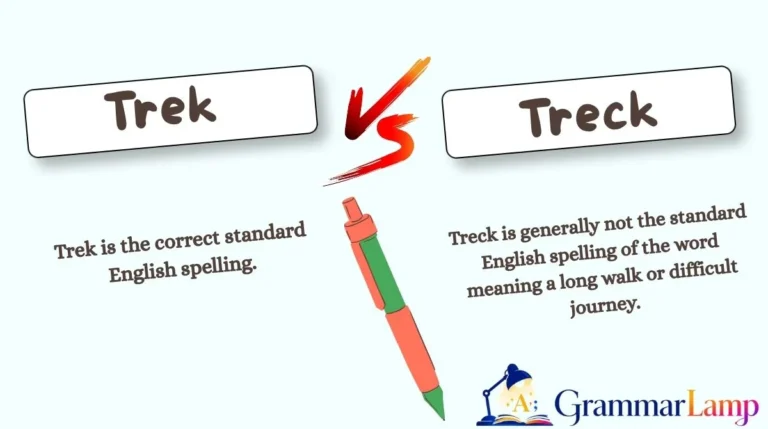
Trek is the correct standard English spelling.
As a noun, a trek is a long walk or journey, especially one that is difficult or takes a lot of time. It is often used for walking through mountains, forests, hills, or other natural areas. Oxford defines it as a long, hard walk that can last several days or weeks, especially in the mountains. Cambridge also gives the broader meaning of a long walk over land such as hills, mountains, or forests.
As a verb, trek means to walk a long way or make a long and difficult journey. It is commonly followed by words such as through, across, over, up, or to.
Trek as a noun
When trek is a noun, it normally names the journey or walk itself.
For example:
- The trek to the top of the mountain took six hours.
- We went on a long trek through the forest.
- They completed a difficult trek across the valley.
- It was a tiring trek through the hills.
- Our trek ended near a small village.
- The group prepared carefully for the three-day trek.
- That trek was one of the hardest trips I have ever taken.
- It is quite a trek from the station to our hotel.
Notice that the word does not always have to describe an adventure in the mountains. In informal English, trek can also describe an ordinary journey that feels long, tiring, or difficult.
For example:
The supermarket is only two miles away, but it is a long trek in this heat.
Here, the speaker is not talking about mountain climbing. The word simply emphasizes that the journey is long or tiring. Cambridge specifically notes this informal use for a long or difficult walk that makes you tired.
Trek as a verb
When trek is a verb, it describes the action of walking a long distance or making a difficult journey.
Examples:
- We trekked through the forest all morning.
- They trekked across the desert for several days.
- She trekked up the steep hill to reach the village.
- The hikers trekked through heavy snow.
- We plan to trek in the mountains next summer.
- He trekked all the way home after missing the bus.
- The travelers trekked across the valley before sunset.
- They spent the afternoon trekking through the countryside.
Oxford lists trek as an intransitive verb when it means making a long or difficult journey, especially on foot. It also lists go trekking for walking in mountains and similar places for pleasure or interest.
A common learner confusion
The most common problem is simple:
Trek ✅
Treck ❌
Learners sometimes write treck because English has many words with -ck, such as back, track, black, and pick. Since trek ends with the /k/ sound, adding c may feel natural.
But spelling is not always predictable from pronunciation. In standard English, the word is spelled t-r-e-k.
Another point that may confuse learners is the past form:
trek → trekked
There is a second k in trekked, but there is no c. The spelling changes because the final consonant is doubled before -ed.
5. What Does “Treck” Mean?
Treck is generally not the standard English spelling of the word meaning a long walk or difficult journey.
For normal English writing, use trek.
So if you want to say that someone walked through the mountains for several days, write:
They went on a trek through the mountains. ✅
Not:
They went on a treck through the mountains. ❌
This is important because treck is usually the result of a spelling mistake rather than a standard alternative spelling in ordinary modern English. Major learner dictionaries such as Cambridge and Oxford list trek for this meaning.
Why do people write “treck”?
There are a few simple reasons.
First, the pronunciation ends with a clear /k/ sound. A learner may think the spelling should work like back or truck, where ck represents the /k/ sound.
Second, English contains many spelling patterns that are difficult to predict. Learners often use a spelling they already know and apply it to a new word.
Third, typing quickly can create spelling errors. A person who already knows the word trek may still accidentally type treck.
The key point is that seeing a spelling online does not automatically mean it is standard English. For formal writing, school work, articles, emails, and professional communication, trek is the form to choose.
Examples using the correct form
Here are some examples that show how trek should appear in sentences:
- Our trek began early in the morning.
- The trek through the forest was beautiful.
- We trekked for eight hours before reaching the camp.
- She loves to trek in the Himalayas.
- The final trek up the mountain was exhausting.
- It was a long trek from the parking area to the waterfall.
- They went trekking during their holiday.
- The team finished the trek before dark.
You should notice something useful here: the basic word always begins with trek, even when the form changes.
trek → trekked → trekking → trekker → trekking
Cambridge lists trekked as the past form and trekking as the activity form.
6. Difference Between Trek and Treck
The difference is mainly a matter of correct spelling.
Trek is the standard English word. Treck is generally an incorrect spelling when you mean a long walk or difficult journey.
Comparison Table
| Feature | Trek | Treck |
|---|---|---|
| Standard English spelling | ✅ Yes | ❌ No |
| Meaning: long walk/journey | ✅ Yes | ❌ Not as a standard spelling |
| Used as a noun | ✅ Yes | ❌ No in standard usage |
| Used as a verb | ✅ Yes | ❌ No in standard usage |
| Past form | trekked | — |
| -ing form | trekking | — |
| Common in dictionaries | ✅ Yes | ❌ Not for this meaning |
| Best choice for writing | ✅ Trek | ❌ Avoid |
Oxford and Cambridge both recognize trek as a noun and a verb. Oxford gives meanings connected with long, difficult journeys and walking for pleasure, while Cambridge describes it as walking a long distance, often over hills, mountains, or forests.
Usage difference
There is no real meaning difference such as the difference between affect and effect.
You are not choosing between two different words with two different meanings.
Instead, the normal choice is simply:
Use trek.
For example:
We went on a trek through the mountains. ✅
We went on a treck through the mountains. ❌
Grammar logic
The word trek has two main grammatical jobs.
As a noun:
a trek
As a verb:
to trek
Compare:
The trek was difficult.
Here, trek is a noun.
We trekked through the forest.
Here, trekked is a verb.
This makes the word useful in many different sentence structures.
Sentence structure
When trek is a noun, common patterns include:
go on + a trek
a trek + through/across/over + place
a long/difficult/tiring + trek
Examples:
We went on a trek through the hills.
The trek across the valley was tiring.
When trek is a verb, common patterns include:
trek + through + place
trek + across + place
trek + up/down + place
trek + to + destination
Examples:
They trekked through the forest.
She trekked up the mountain.
We trekked across the open land.
Meaning comparison
The word can describe a planned adventure, but it can also describe an everyday journey that feels long.
Adventure meaning:
They went on a five-day trek in the mountains.
Everyday meaning:
It’s a long trek from my house to the nearest bus stop.
So remember that trek does not always mean an extreme adventure. Context tells you how serious or difficult the journey is.
Explore More Posts
Couple of Hours vs Couple Hours: Which Is Correct in 2026?
Canceled vs Cancelled: Which Spelling Is Correct in 2026?
Ambiance vs Ambience: Meaning, Difference, Usage & Examples in 2026
Compared To vs As Compared To (2026): Meaning, Difference & Correct Usage
Grammar Rules You Must Remember
Rule 1: Use “trek” as the standard spelling
When you mean a long walk or difficult journey, write trek.
Correct: We went on a trek through the forest.
Incorrect: We went on a treck through the forest.
This is the most important rule. If you remember only one thing, remember this: trek has no c.
Rule 2: Trek can be a noun or a verb
As a noun, it names the journey:
The trek was very tiring.
As a verb, it describes the action:
We trekked through the mountains.
The surrounding words usually make the grammar clear.
Rule 3: The past form is “trekked”
When you use the past tense, write:
trekked ✅
not:
treked ❌
For example:
We trekked for five hours yesterday.
The final k is doubled before -ed.
This follows a common English spelling pattern in short words ending in a single consonant after a short vowel sound. Similar examples include stop → stopped and plan → planned.
Rule 4: The -ing form is “trekking”
The correct spelling is:
trekking ✅
not:
treking ❌
For example:
They are trekking through the mountains.
The final k is doubled before -ing, just as it is in trekked.
A useful spelling family is:
trek → trekked → trekking
Seeing these forms together makes the pattern easier to remember.
8. Common Mistakes Students Make
The biggest mistake is adding c:
Treck ❌
This usually happens because learners focus on the sound rather than the spelling.
They hear:
/trek/
Then they think:
“The final sound is /k/, so maybe it should be written -ck.”
That idea is understandable, but English spelling does not always follow one simple sound rule.
Mistake 1: Writing “treck”
Wrong: We went on a treck yesterday.
Correct: We went on a trek yesterday.
Mistake 2: Writing “treked”
Wrong: They tre ked through the valley.
Correct: They trekked through the valley.
The final k is doubled in the past form.
Mistake 3: Writing “treking”
Wrong: We are treking in Nepal.
Correct: We are trekking in Nepal.
Again, the k is doubled before -ing.
Mistake 4: Using “trek” when “trekked” is needed
Wrong: Yesterday, we trek through the forest.
Correct: Yesterday, we trekked through the forest.
Because yesterday shows that the action happened in the past, the past form is needed.
Easy correction tip
Whenever you type the word, quickly check the first four letters:
T-R-E-K
There is no C.
Then remember the forms:
Trek
Trekked
Trekking
The word family keeps the k, not a c.
9. Easy Trick to Remember the Difference
Here is a very simple memory trick:
TREK = Travel + K
Think of the word as a short travel word that ends with K.
You can imagine a hiker saying:
“I’m going on a TREK.”
The final letter is always K in the basic word.
Another trick is to remember this sentence:
“Take a trek, not a treck.”
The two words sound similar, but only trek is the standard spelling for this meaning.
You can also remember the word as part of a family:
trek → trekking → trekked
Once you remember trek, the other forms become much easier.
Real-life logic
Imagine writing a travel caption:
“Tomorrow, we are going on a trek in the mountains.”
You would not want to write treck in a school assignment, travel blog, or professional post.
So every time you think about hiking, a long walk, or a difficult journey, connect the idea with:
mountains → walking → trek
That small mental connection can stop the spelling mistake before you make it.
10. Daily Life Examples
Here are some natural examples that you may hear or use in everyday English.
Example 1
A: How far is the waterfall?
B: It’s about an hour’s trek from here.
Here, trek is a noun describing a long walk.
Example 2
A: What are you doing this weekend?
B: We are going trekking in the hills.
Here, trekking describes the activity.
Example 3
A: Was the mountain trip difficult?
B: Yes. The trek to the top was really tiring.
The word describes the journey itself.
Example 4
A: Did you drive all the way there?
B: No, we trekked through the forest for several hours.
Here, trekked is the past-tense verb.
Example 5
A: Is the village close?
B: Not really. It’s quite a trek from here.
This is the informal everyday use of trek for a long or tiring journey. Cambridge gives this kind of usage as an informal meaning.
Example 6
A: Are you ready for tomorrow?
B: Yes. We’ve packed everything for the trek.
The noun refers to the planned walk.
Example 7
A: Why are your shoes covered in mud?
B: We were trekking through the forest.
The verb describes the activity.
Example 8
A: How long did you walk?
B: We trekked for almost seven hours.
The past-tense form is trekked, with two k letters.
Example 9
A: I thought the campsite was nearby.
B: So did I, but it turned out to be a long trek.
This use does not require mountains. It simply means the journey was long and tiring.
Example 10
A: Have you ever trekked in the Himalayas?
B: No, but I’d love to try it one day.
This is a natural way to use the verb in conversation.
11. Practice Section
Choose the correct option in each sentence.
1. We went on a ______ through the mountains.
A) treck
B) trek
2. They ______ across the valley yesterday.
A) treked
B) trekked
3. She enjoys ______ through forests.
A) treking
B) trekking
4. It’s a long ______ from the station to the village.
A) trek
B) treck
5. We are going ______ next weekend.
A) trekking
B) trecking
Answers
1. B — trek
2. B — trekked
3. B — trekking
4. A — trek
5. A — trekking
A quick review shows the spelling pattern clearly:
trek ✅
trekked ✅
trekking ✅
The forms with treck, treked, or trecking should be avoided in standard English writing.
More Helpful posts
Gone to Soon vs Gone Too Soon: Which Is Correct? (2026 Guide)
Stayed vs Staid: Meaning, Difference, Examples & Easy Rules in 2026
Newfound vs New-Found: Which Is Correct in 2026?
Over Time vs Overtime: Meaning, Difference, Examples & Rules in 2026
FAQs
What is the difference between trek and treck?
Trek is the standard English spelling for a long or difficult walk or journey. Treck is generally a spelling mistake when used with this meaning. Both Oxford and Cambridge list trek as the standard word.
Can we use “trek” in questions?
Yes. Trek can be used naturally in questions as either a noun or a verb.
For example: “How long is the trek?” or “Have you ever trekked in the mountains?”
The correct form depends on the sentence and the time of the action.
Is “trek” formal or informal?
Trek can be used in normal standard English and is common in travel, hiking, and outdoor contexts. It can also have an informal meaning for a long or tiring everyday walk, such as “It’s quite a trek to the station.”
Is “treck” a correct English word?
For ordinary English, treck is not the standard spelling of the word meaning a long walk or journey. When you want this meaning, use trek. This is the form recognized by major learner dictionaries.
Why is trek spelled with K instead of CK?
English spelling does not always give a simple reason that learners can predict from pronunciation alone. Although trek ends with a /k/ sound, its standard spelling is trek. It is best learned as a whole word and remembered with its forms trekked and trekking.
What is the past tense of trek?
The past tense is trekked.
For example:
We trekked through the forest yesterday.
The spelling has two k letters because the final consonant is doubled before -ed. The past participle is also trekked.
13. Final Conclusion
The choice between trek and treck is actually quite simple once you know the correct spelling. Trek is the standard English word for a long or difficult walk or journey.
It can be used as both a noun and a verb. For example, you can go on a trek, or you can trek through the mountains.
Treck is generally not the spelling you should use for this meaning. It is usually a mistake caused by the way the word sounds.
Also remember the related forms: trekked and trekking. Both double the final k.
A simple memory line can help:
Trek has K. Trekked and trekking keep K, too.
The best way to make the spelling natural is to use the word in your own sentences. Write a few examples about travel, hiking, or a long journey. After a little practice, trek will start to look familiar, and treck will look wrong.

Liam Derren is a language writer at GrammarLamp, creating simple, helpful content about grammar, words, and everyday English. He makes language learning clear, practical, and easy to understand.