
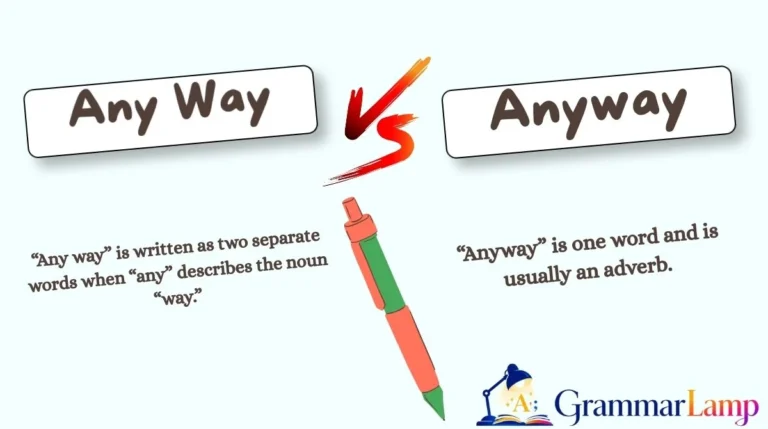
“Any way” and “anyway” look almost the same, so it is easy to think they have the same meaning.
Many English learners use them interchangeably, especially when writing quickly or chatting online. However, there is an important difference between these two expressions.
The main difference is simple: “any way” is usually a phrase made of two separate words, while “anyway” is one adverb.
Because the spelling is so similar, learners often choose the wrong form without realizing that the meaning of the sentence has changed.
For example, compare these sentences:
- Is there any way to fix this problem?
- I was tired, but I went anyway.
In the first sentence, “any way” means any method, option, or manner. In the second sentence, “anyway” means something like despite that, in spite of that, or regardless.
Understanding this small difference can make your English much clearer. You will see both forms in everyday conversations, emails, text messages, school writing, and online communication.
By the end of this guide, you will know when to write any way as two words and when to write anyway as one word.
You will also learn simple grammar rules, common mistakes, useful conversation examples, and an easy memory trick that can help you choose the correct form quickly.
Upmost vs Utmost: Meaning, Difference, and Correct Usage in 2026
Seam vs Seem: Difference, Meaning, Examples & Grammar Rules (2026)
All the Time vs Every Time: Meaning, Difference, Rules & Examples (2026)
Afterward or Afterwards? Meaning, Difference, and Correct Usage in 2026
What Does “Any Way” Mean?
“Any way” is written as two separate words when “any” describes the noun “way.” Here, “way” usually means a method, choice, possibility, route, or manner of doing something.
The word any is a determiner. It can describe a noun when we are talking about one or more possible choices without naming a specific one.
The word way is a noun.
So, the basic structure is:
any + way + to-infinitive
For example:
Is there any way to contact him?
Here, “any way” means any possible method of contacting him.
You can often replace “any way” with phrases such as any method, any method possible, or any possible way.
When should you use “any way”?
Use any way when you are talking about a method or possibility.
For example:
- Is there any way to solve this problem?
- Do you know any way to get there faster?
- Can you find any way to open this door?
- Is there any way I can help you?
- We need to find any way possible to finish the work.
- Is there any way to change the booking?
- She tried any way she could think of to reach him.
- There must be any way to make this easier.
The most common pattern is a question:
Is there any way + to do something?
Examples:
- Is there any way to get a refund?
- Is there any way to change my password?
- Is there any way to avoid traffic?
- Is there any way to make this computer faster?
A useful grammar test
Try replacing “any way” with “any method.”
If the sentence still makes sense, you probably need two words.
For example:
Is there any way to fix it?
You can say:
Is there any method to fix it?
The second sentence sounds less natural, but the basic meaning is still clear. You are asking about a method.
That tells you that any way is functioning as a noun phrase.
Common learner confusion
A common mistake is writing:
Is there anyway to solve this?
That is incorrect when you mean “any method.”
The correct sentence is:
Is there any way to solve this?
Remember that anyway has a different grammatical job. It is an adverb, not a noun phrase meaning “any method.”
What Does “Anyway” Mean?
“Anyway” is one word and is usually an adverb. It has several related meanings, but in everyday English it often means despite that, regardless, in any case, or moving back to the main point.
For example:
It was raining, but we went anyway.
This means:
It was raining, but we went despite the rain.
Here, “anyway” does not mean “any method.” It gives information about the action of going.
“Anyway” is also very common in spoken English. Speakers use it when they want to return to the main subject, finish a conversation, or show that something does not change their decision.
Examples of “anyway”
- I was tired, but I finished the work anyway.
- It was expensive, but I bought it anyway.
- Anyway, what were you saying?
- I don’t really like coffee, but I’ll have one anyway.
- He didn’t listen anyway.
- We missed the bus, so we walked anyway.
- Anyway, let’s talk about something else.
- I knew it would be difficult, but I tried anyway.
“Anyway” at the beginning of a sentence
In conversations, anyway often appears at the beginning of a sentence.
For example:
Anyway, how was your trip?
Here, “anyway” helps the speaker return to the main topic or introduce a new point.
You might also hear:
Anyway, I have to go now.
This can mean something like:
“In any case, I have to go now.”
It is very natural in everyday speech.
“Anyway” at the end of a sentence
“Anyway” can also come at the end of a sentence:
I wasn’t going to buy it anyway.
This means the speaker had already decided not to buy it.
Another example:
She didn’t want to come anyway.
The word adds the idea that her not coming was not surprising or did not matter to the speaker’s point.
Common learner confusion
Learners sometimes write “anyway” whenever they hear the words pronounced close together.
For example:
Is there anyway I can help?
If the intended meaning is “Is there any method or possibility that I can help?”, the correct form is:
Is there any way I can help?
The two forms may sound similar in fast speech, but their grammar and meaning are different.
Difference Between “Any Way” and “Anyway” — Detailed Comparison
The easiest way to understand the difference is to look at their grammatical roles.
| Feature | Any way | Anyway |
|---|---|---|
| Spelling | Two words | One word |
| Grammar | Determiner + noun | Adverb |
| Main meaning | Any method, option, or manner | Despite that, regardless, in any case |
| Usually talks about | A possible method or choice | An action, situation, or conversation |
| Common structure | Any way + to do something | Verb + anyway |
| Example | Is there any way to help? | I helped anyway. |
Meaning difference
Consider these two sentences:
Is there any way to repair my phone?
This asks about a possible method.
Now compare:
My phone was badly damaged, but I repaired it anyway.
This means the person repaired the phone despite the difficulty.
The first sentence asks how something can be done.
The second sentence says something happened despite a problem or reason not to do it.
Grammar difference
In any way, the word “way” is a noun.
For example:
There must be any way to solve this.
The phrase refers to a possible method.
In anyway, the whole word works as an adverb:
She solved the problem anyway.
It describes the situation or action and means something like “despite everything” or “regardless.”
Sentence structure
“Any way” commonly appears in structures such as:
Is there any way + to + verb?
Examples:
- Is there any way to save money?
- Is there any way to fix this?
- Is there any way to contact her?
It can also appear with a clause:
- Is there any way I can help?
- Is there any way we can change the date?
“Anyway” is more flexible:
- I went anyway.
- Anyway, let’s begin.
- She wasn’t interested anyway.
- It was difficult, but he continued anyway.
A simple comparison
Think of the meanings like this:
Any way = any possible method
Anyway = despite that / regardless / in any case
That one idea solves most “any way vs anyway” questions.
Everything vs Every Thing: Easy Difference, Rules, Examples & Practice (2026)
All Is vs All Are: Which One Is Correct? Complete Grammar Guide for 2026
At the Weekend or On the Weekend? 2026 Guide to British and American English
To Discuss or Discuss About: Which Is Correct? | Easy Grammar Guide 2026
Grammar Rules You Must Remember
Rule 1: Use “any way” when “way” means a method
If you can understand “way” as method, use two words.
Example:
Is there any way to learn English faster?
You are asking for a method.
Another example:
Is there any way to contact the manager?
You are asking whether there is a possible method of contacting the manager.
Rule 2: Use “anyway” when you mean “despite that” or “regardless”
When something happens even though there is a reason, problem, or obstacle, anyway is often the correct choice.
Example:
It was raining, but we went anyway.
The meaning is:
It was raining, but we went despite that.
Another example:
I didn’t feel well, but I went to work anyway.
Rule 3: Use “anyway” to return to a topic
In conversation, anyway can help you move back to the main subject.
Example:
Anyway, what time should we leave?
Here, “anyway” does not mean a method. It simply helps the speaker move the conversation forward.
You may hear this frequently in natural spoken English.
Rule 4: “Any way” can often be followed by “to + verb”
A very common pattern is:
any way + to + base verb
Examples:
- any way to improve
- any way to fix
- any way to learn
- any way to contact
- any way to save
For example:
Is there any way to improve my pronunciation?
This structure is a strong clue that you need any way, not anyway.
Common Mistakes Students Make
Many mistakes happen because the two forms sound almost identical in everyday speech.
Mistake 1: Writing “anyway” when asking about a method
Wrong:
Is there anyway to solve this problem?
Correct:
Is there any way to solve this problem?
Why?
Because the speaker is asking for a method.
Correction tip: Ask yourself, “Am I asking how something can be done?” If yes, use any way.
Mistake 2: Writing “any way” when you mean “regardless”
Wrong:
I was tired, but I went any way.
Correct:
I was tired, but I went anyway.
Here, the speaker means “despite being tired.”
Mistake 3: Confusing “anyway” with “any way possible”
Consider:
We need to finish this any way possible.
Here, any way is correct because it means any method possible.
You can also say:
We need to finish this in any way possible.
The noun “way” is clearly referring to a method or manner.
Mistake 4: Thinking “anyway” always means “any method”
It does not.
For example:
Anyway, I have to leave.
This does not mean “any method.” It means something closer to in any case or regardless of everything discussed.
A quick check can help: if “any method” sounds strange, you probably need anyway.
Easy Trick to Remember the Difference
Here is a simple classroom trick:
Any way = any method
If you can put “method” in the sentence, write any way.
Is there any way to fix it?
Think:
Is there any method to fix it?
So:
Any way = any method
Now remember:
Anyway = regardless
I was tired, but I went anyway.
Think:
I was tired, but I went regardless.
So:
Anyway = regardless
This gives you two easy memory words:
ANY WAY → METHOD
ANYWAY → REGARDLESS
There is another useful trick. Look at the word after the expression.
If you see:
any way to + verb
there is a good chance that you need two words.
Examples:
- any way to learn
- any way to improve
- any way to fix
- any way to reach
But if the word is showing that an action happened despite something:
went anyway
stayed anyway
bought it anyway
tried anyway
use anyway as one word.
Daily Life Examples
Here are some natural examples you may hear or use in everyday English.
Example 1
A: I forgot my password.
B: Is there any way to reset it?
Here, “any way” means any possible method.
Example 2
A: The weather is terrible.
B: I know, but we’re going anyway.
Here, “anyway” means despite the bad weather.
Example 3
A: I don’t know how to reach the airport.
B: Is there any way to get there by bus?
The speaker is asking about a method of transportation.
Example 4
A: Did you enjoy the movie?
B: Not really. Anyway, what are we doing tomorrow?
Here, “anyway” helps the speaker change or return to the topic.
Example 5
A: The restaurant was expensive.
B: Yes, but the food was great anyway.
The meaning is “despite the price.”
Example 6
A: Can you help me carry this box?
B: Sure. Is there any way I can make it easier?
The speaker is asking about a possible method.
Example 7
A: He didn’t invite me.
B: I wasn’t planning to go anyway.
The speaker means that going was not part of the plan regardless.
Example 8
A: We are running late.
B: Anyway, let’s hurry.
“Anyway” is used naturally to move the conversation forward.
Example 9
A: Is there any way to get a cheaper ticket?
The speaker is asking about a possible option.
Example 10
A: It was a difficult exam, but I finished it anyway.
The exam was difficult, but the person finished it despite the difficulty.
Practice Section
Choose any way or anyway in each sentence.
1. Is there ______ to solve this problem?
2. I didn’t want to go, but I went ______.
3. ______, let’s talk about your homework.
4. Do you know ______ to contact the company?
5. She was tired, but she continued ______.
Answers
1. any way
“Is there any way to solve this problem?” asks about a method.
2. anyway
“I went anyway” means “I went despite not wanting to.”
3. Anyway
Here, it is used to return to the subject or move the conversation forward.
4. any way
The speaker is asking about a possible method of contacting the company.
5. anyway
The person continued despite being tired.
If you can explain why each answer is correct, you have understood the main difference.
Work Alongside You vs Work Alongside With You (2026): Which One Is Correct in English?
Lets vs Let’s (2026): What’s the Difference? Easy Grammar Guide with Examples
Based Out of vs Based In (2026): What’s the Difference? Easy Grammar Guide with Examples
Crews vs Cruise (2026): What’s the Difference? Easy Grammar Guide with Examples
FAQs
What is the difference between “any way” and “anyway”?
Any way is two words and usually means any method, option, or manner.
Anyway is one word and usually means regardless, despite that, or in any case.
For example, “Is there any way to help?” asks about a method, while “I helped anyway” means “I helped despite the situation.”
Can we use “any way” in questions?
Yes. In fact, any way is very common in questions.
Examples include:
- Is there any way to fix this?
- Is there any way to contact him?
- Is there any way we can change the date?
In these sentences, “way” means a possible method or option.
Is “anyway” formal or informal?
“Anyway” can be used in both formal and informal English, but it is especially common in everyday conversation.
At the beginning of a sentence, it can sound conversational:
Anyway, let’s continue.
In formal writing, the exact wording may depend on the context. However, anyway itself is a normal standard English word.
Is “any way” always two words?
When way is being used as a noun meaning a method, route, option, or manner, it is written separately from any.
For example:
Is there any way to improve this?
However, “anyway” is a separate adverb with a different meaning. The two forms should not be combined simply because they sound similar.
Can “anyway” be used at the beginning of a sentence?
Yes. This is very common, especially in spoken English.
For example:
Anyway, I need to go now.
It can help the speaker return to the main topic, introduce another point, or bring a conversation toward an ending.
Is “anyway” the same as “in any way”?
No. They can sometimes look similar, but their grammar and meaning are different.
In any way usually means by any method or in any manner:
I don’t want to hurt you in any way.
Anyway often means regardless or in any case:
I didn’t want to go anyway.
The surrounding sentence tells you which meaning is intended.
Conclusion
The difference between any way and anyway is small in spelling but important in meaning.
Use any way as two words when way means a method, option, route, or manner. For example:
Is there any way to fix this?
Use anyway as one word when you mean regardless, despite that, or in any case:
I was tired, but I finished the work anyway.
The easiest memory trick is:
Any way = any method.
Anyway = regardless.
When you are unsure, look at the meaning rather than the sound. Ask yourself whether you are talking about a possible method or saying that something happened despite a situation.
These two words appear often in everyday English, so learning the difference will help you write more accurately and speak with greater confidence.
A little practice is enough to make the choice feel natural. The more examples you read and use, the easier it becomes to tell any way and anyway apart.

Liam Derren is a language writer at GrammarLamp, creating simple, helpful content about grammar, words, and everyday English. He makes language learning clear, practical, and easy to understand.