
English learners often get confused by “similar to” and “similarly to.” The two expressions look almost the same, and both contain the word similar.
However, they do different jobs in a sentence. One describes how two people or things are alike, while the other describes an action or idea that happens in a similar way.
This small difference can cause many mistakes. For example, a student may write, “My phone is similarly to yours,” when the correct sentence is, “My phone is similar to yours.”
Another learner may use “similar to” when they actually want to explain that someone did something in the same way as another person.
Understanding this difference is useful in school writing, emails, conversations, essays, and everyday English. It also helps your sentences sound natural instead of translated directly from another language.
The good news is that the difference is quite easy once you understand the grammar behind the two expressions.
Similar to normally describes a person, thing, idea, or situation. Similarly to normally modifies an action or compares the way something happens, although native speakers often prefer similarly or in a similar way to.
By the end, you will know when to use each expression, which sentence structures are correct, which mistakes to avoid, and how to remember the difference without memorizing complicated grammar rules.
It’s vs Its: Simple Difference, Rules, Examples & Practice (2026)
Enamor vs Enamour: What’s the Difference? Meaning, Usage & Examples in 2026
Breath vs Breathe: Easy Difference, Meaning, Examples & Rules in 2026
No Longer Exist vs No Longer Exists: Which Is Correct? (2026 Guide)
What Does “Similar to” Mean?
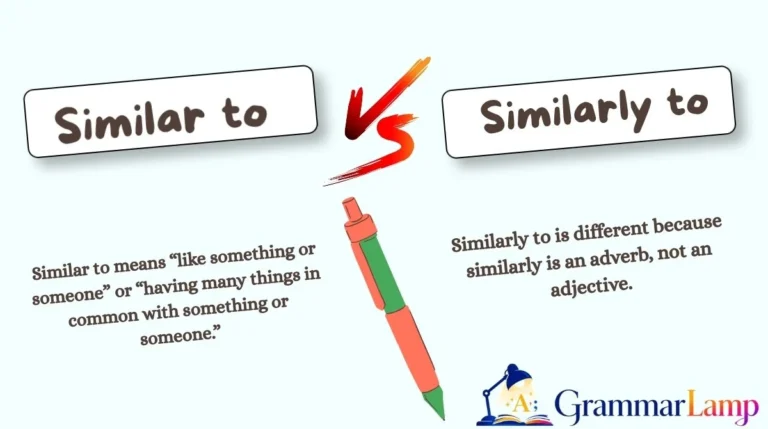
Similar to means “like something or someone” or “having many things in common with something or someone.”
The word similar is an adjective. When we use it to compare two things, it is commonly followed by to.
The basic pattern is:
Subject + be + similar to + person/thing
For example:
- My new laptop is similar to my old one.
- This shirt is similar to the one you bought.
- Your idea is similar to mine.
- The two houses look similar to each other.
Here, similar describes the subject. It tells us that two things have qualities, features, appearances, or characteristics in common.
When should you use “similar to”?
Use similar to when you are talking about a person, object, idea, place, situation, or experience that has something in common with another person, object, idea, place, situation, or experience.
For example:
- Your car is similar to mine.
Both cars may have a similar design, size, or color. - This problem is similar to the one we had yesterday.
The two problems have something in common. - Sarah is similar to her sister.
Sarah and her sister may have similar personalities or habits. - This restaurant is similar to the one near my house.
The restaurants may have similar food, prices, or atmosphere. - His answer is similar to mine.
The two answers contain similar ideas. - The weather today is similar to yesterday’s weather.
The weather conditions are alike. - This design is similar to the original design.
The two designs share important features. - My experience was similar to yours.
The experiences had important similarities.
Notice that similar to does not mean that two things are exactly the same. They simply have some qualities in common.
Common learner confusion
A common mistake is to say “similar with” instead of “similar to.”
❌ This phone is similar with mine.
✅ This phone is similar to mine.
For standard English, use similar to when making this type of comparison.
Another common mistake is using similarly to after be:
❌ My bag is similarly to yours.
✅ My bag is similar to yours.
Why? Because similar is an adjective that describes the bag. Similarly is an adverb, so it does not work in that structure.
What Does “Similarly to” Mean?
Similarly to is different because similarly is an adverb, not an adjective.
The word similarly means “in a similar way” or “in much the same way.”
When similarly to is used, it can compare the way an action, process, or behavior happens with another action, process, or behavior.
For example:
Similarly to his brother, John works hard.
This means:
In a way similar to his brother, John works hard.
However, there is an important point for English learners: similarly to is much less common and often sounds more formal or awkward than other choices. Native speakers frequently use similarly, in a similar way, or like instead.
Consider these examples:
- Similarly to her mother, Anna enjoys gardening.
- Similarly to other students, he found the exam difficult.
- The new system works similarly to the old system.
- The second machine operates similarly to the first one.
- The company responded similarly to its competitors.
- Similarly to last year, sales increased in June.
- The children reacted similarly to the news.
- This process works similarly to the previous method.
Some of these sentences are grammatically possible, but several can sound more natural when rewritten.
For example:
Similarly to her mother, Anna enjoys gardening.
A more natural version may be:
Like her mother, Anna enjoys gardening.
Or:
Anna enjoys gardening, just like her mother.
Another example:
Similarly to last year, sales increased in June.
A smoother version is:
As in previous years, sales increased in June.
So, although similarly to exists, you should not automatically use it whenever you see the word similar.
“Similarly” by itself is very common
In everyday and academic English, similarly is often used at the beginning of a sentence to connect two ideas.
For example:
- John loves football. Similarly, his brother watches every match.
- The first test was difficult. Similarly, the second test was challenging.
- Maria studies every evening. Similarly, her friend follows a strict study routine.
Here, similarly means that the second person or situation is like the first one.
A comma normally follows similarly when it begins a sentence.
Difference Between “Similar to” and “Similarly to”
The easiest way to understand the difference is to remember their parts of speech.
Similar is an adjective.
Similarly is an adverb.
That one grammar fact explains most of the difference.
| Feature | Similar to | Similarly to |
|---|---|---|
| Main word | Similar | Similarly |
| Part of speech | Adjective | Adverb |
| Basic meaning | Having qualities in common | In a similar way |
| Main job | Describes a person or thing | Describes an action, behavior, or comparison |
| Commonness | Very common | Less common |
| Typical structure | be + similar to + noun/pronoun | verb + similarly to + noun |
| Example | This car is similar to mine. | The machine works similarly to the old one. |
| Natural alternative | — | similarly / in a similar way to |
Usage difference
Look at these two sentences:
My computer is similar to yours.
Here, similar describes the computer. The sentence says that the two computers have common features.
Now look at:
My computer works similarly to yours.
Here, similarly describes works. It tells us that the two computers operate in a similar way.
This is the key difference.
Compare:
The two machines are similar to each other.
The machines themselves have similar features.
The two machines operate similarly.
Their method of operation is alike.
Sentence structure difference
The most common structure with similar to is:
Subject + be + similar to + noun/pronoun
Examples:
- The two books are similar to each other.
- This answer is similar to yours.
- My situation is similar to his.
Another structure is:
Noun + be + similar to + noun
Example:
- This design is similar to the original design.
With similarly, the structure often involves a verb:
Subject + verb + similarly
Example:
- The two machines operate similarly.
Or:
Subject + verb + similarly to + noun
Example:
- This machine operates similarly to the old model.
This difference is important because changing similar to similarly can change the grammatical role of the word.
Meaning comparison
Think of similar to as answering:
“What is this like?”
Think of similarly as answering:
“How does this happen?”
For example:
Your dress is similar to mine.
What is your dress like?
It is similar to mine.
You dressed similarly to me.
How did you dress?
In a similar way to me.
That simple question-and-answer method can help you choose the correct expression quickly.
Jewel vs Joule: Meaning, Difference, Examples & Easy Rules (2026)
Foul or Fowl: Meaning, Difference, Examples & Easy Rules for 2026
Dialog vs Dialogue: What’s the Difference? A Simple English Guide for 2026
Learned vs Learnt: What’s the Difference? A Simple Guide for 2026
Grammar Rules You Must Remember
Rule 1: Use “similar to” after forms of “be”
When you want to describe two people or things as alike, similar to is normally the correct choice.
Correct:
- This book is similar to that one.
- Her voice is similar to her mother’s.
- Their opinions are similar to ours.
Incorrect:
- This book is similarly to that one.
- Her voice is similarly to her mother’s.
Remember: similar is an adjective, so it can describe the subject after is, are, was, or were.
Rule 2: Use “similarly” to describe an action or manner
When you want to say that something happens in a similar way, use similarly.
For example:
- The two students answered the question similarly.
- Both companies reacted similarly.
- The machines operate similarly.
Here, the word describes the action.
You can ask:
How did they react?
They reacted similarly.
That is why an adverb is needed.
Rule 3: “Similarly to” is possible, but it is not always the most natural choice
Some learners think that if similar to is correct, they can simply change similar into similarly in every sentence.
That does not work.
Similarly to can be grammatical in certain structures:
- The new model works similarly to the old model.
- The second group behaved similarly to the first group.
But often, a native speaker may prefer:
- The new model works like the old model.
- The second group behaved in a similar way to the first group.
So don’t use similarly to just because you want to sound formal.
Natural English is more important than complicated English.
Rule 4: “Similarly” can connect two sentences or ideas
Similarly is also useful as a linking adverb.
For example:
Tom enjoys reading. Similarly, his sister loves books.
The word connects the second idea to the first.
Another example:
The first plan was expensive. Similarly, the second plan required a large budget.
Here, similarly means that the second situation is comparable to the first.
This use is very common in essays, reports, and formal writing.
Common Mistakes Students Make
Many mistakes happen because similar, similarly, and same look or sound related. Students may also translate the expressions directly from their first language.
Mistake 1: Using “similarly” after “is”
❌ My phone is similarly to yours.
✅ My phone is similar to yours.
The word phone is being described, so we need the adjective similar.
Mistake 2: Using “similar” to describe an action
❌ The two students answered the question similar.
✅ The two students answered the question similarly.
The word describes answered, which is an action. Therefore, the adverb similarly is needed.
You could also say:
✅ The two students gave similar answers.
Notice how changing the sentence changes the grammar.
Mistake 3: Using “similar with”
❌ This problem is similar with mine.
✅ This problem is similar to mine.
For normal comparisons, remember the fixed expression similar to.
Mistake 4: Thinking “similar” means “exactly the same”
Similar does not mean identical.
If two shirts are similar, they may have the same color or style, but they are not necessarily the exact same shirt.
For example:
These two phones are similar, but they have different cameras.
They share some features, but they are not identical.
Mistake 5: Using “similarly to” when “like” sounds better
❌ Similarly to my father, I enjoy tea.
This is possible in some contexts, but it sounds formal and less natural for ordinary conversation.
More natural:
✅ Like my father, I enjoy tea.
Or:
✅ I enjoy tea, just like my father.
A good correction tip is this: if like sounds natural and you are speaking casually, you probably do not need similarly to.
Easy Trick to Remember the Difference
Here is a simple memory trick:
Similar = describes a thing.
Similarly = describes an action.
Think of the endings:
-ar → similar
-ly → similarly
Words ending in -ly are often adverbs. Adverbs commonly describe verbs or actions.
For example:
The cars are similar.
The word similar describes the cars.
The cars move similarly.
The word similarly describes how the cars move.
Another easy trick is to ask yourself a question.
If your sentence answers:
“What is it like?”
Use similar to.
My jacket is similar to yours.
If your sentence answers:
“How did it happen?”
Use similarly.
We reacted similarly.
You can also remember this pair:
similar = alike
similarly = in an alike way
This is not a perfect dictionary replacement in every sentence, but it is a useful learning shortcut.
Daily Life Examples
Here are some natural examples from situations you may hear or use every day.
1. Talking about clothes
A: I like your jacket.
B: Thanks! It looks similar to yours.
The jackets have similar features.
2. Talking about phones
A: Is your new phone different from your old one?
B: Not much. It is quite similar to my old phone.
Here, similar to compares two phones.
3. Talking about behavior
A: How did both children react?
B: They reacted similarly.
Here, similarly explains how they reacted.
4. Talking about family
A: You sound like your father.
B: People often say my voice is similar to his.
The voice is being compared, so similar to works naturally.
5. Talking about work
A: Does the new computer work like the old one?
B: Yes. It works similarly to the old one.
Here, similarly describes the way the computer works.
6. Talking about opinions
A: What do you think about the new school rule?
B: My opinion is similar to yours.
The two opinions are alike.
7. Talking about two people
A: Do Ali and Hamza have similar personalities?
B: Yes, they are very similar to each other.
The adjective similar describes the people.
8. Talking about reactions
A: Did the customers complain about the delay?
B: Yes. Most customers reacted similarly.
The adverb tells us how they reacted.
9. Talking about food
A: Does this soup taste like the one at that restaurant?
B: Yes, the flavor is similar to it.
A more natural version may be:
Yes, the flavor is similar to the restaurant’s soup.
10. Talking about studying
A: How do you study for exams?
B: I study similarly to my brother. We both review our notes every night.
In casual conversation, you could make this more natural:
I study in a similar way to my brother.
This example shows why in a similar way to can sometimes be clearer than similarly to.
Practice Section
Choose similar to or similarly to/similarly in each sentence.
1.
My new school bag is ______ my old one.
2.
The two students answered the questions ______.
3.
This machine works ______ the previous model.
4.
Her opinion is ______ mine.
5.
The two brothers behaved ______ during the meeting.
Answers
1. similar to
“My new school bag is similar to my old one.”
2. similarly
“The two students answered the questions similarly.”
3. similarly to
“This machine works similarly to the previous model.”
4. similar to
“Her opinion is similar to mine.”
5. similarly
“The two brothers behaved similarly during the meeting.”
A useful exercise is to create your own pairs of sentences. For example:
My shoes are similar to yours.
We walk similarly.
This lets you practice the adjective and adverb at the same time.
In the Same Day vs On the Same Day: Which Is Correct? A Simple Guide for 2026
Licence or License: Which Spelling Is Correct in 2026?
I’ve Added vs I Added: Easy Difference, Rules & Examples (2026)
This Is She or This Is Her? The Correct Choice in English in 2026
FAQs
What is the difference between “similar to” and “similarly to”?
Similar to is an adjective phrase used to say that two people or things have qualities in common. Similarly to uses the adverb similarly and refers to doing something in a similar way. In many situations, similarly or in a similar way to sounds more natural.
Can we use “similar to” in questions?
Yes. Similar to is very common in questions.
For example:
- “Is this phone similar to yours?”
- “Is your new job similar to your old job?”
- “What is this problem similar to?”
The expression works normally in questions because similar is an adjective.
Is “similarly to” formal or informal?
Similarly to tends to sound more formal and is less common in everyday conversation. Native speakers often choose like, similarly, or in a similar way to, depending on the sentence. It is not wrong simply because it is less common.
Is “my car is similarly to yours” correct?
No. The natural sentence is:
My car is similar to yours.
The adjective similar describes the car. Similarly is an adverb and cannot replace the adjective in this structure.
Can “similarly” be used without “to”?
Yes, and this is actually very common.
For example:
My brother likes football. Similarly, I enjoy watching football.
You can also say:
The two machines work similarly.
In these sentences, similarly means “in a similar way” or “in a way like the first situation.”
Is “similar to” the same as “the same as”?
No. Similar to means that two things have some qualities in common. The same as normally means that they are identical or exactly alike in the relevant way.
For example:
My phone is similar to yours.
They may look alike but still be different phones.
My phone is the same as yours.
This suggests that they are the identical model or otherwise exactly the same in the context.
Conclusion
The difference between similar to and similarly to becomes much easier when you focus on grammar instead of trying to memorize long definitions.
Similar is an adjective. Use similar to when you describe a person, thing, idea, or situation that has something in common with another one.
My answer is similar to yours.
Similarly is an adverb. Use it when you describe an action or explain that something happens in a similar way.
We answered the question similarly.
Similarly to can be grammatically correct when it connects an action or process with another person, thing, or process, but it is less common. In many everyday sentences, like, similarly, or in a similar way to may sound more natural.
The easiest rule is simple: similar describes; similarly explains how. Once you start noticing that difference in real conversations, books, and your own writing, choosing the right expression will become almost automatic.
Keep practicing with short sentences, and this common grammar confusion will soon disappear.

Liam Derren is a language writer at GrammarLamp, creating simple, helpful content about grammar, words, and everyday English. He makes language learning clear, practical, and easy to understand.