
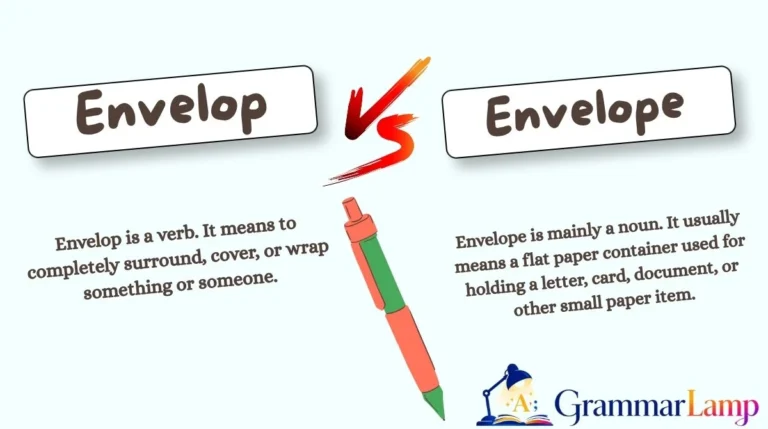
English has many words that look almost the same but have completely different meanings. Envelop vs envelope is a good example.
These two words are easy to confuse because they contain almost the same letters. However, they are not the same word, and they are used in very different ways.
The word envelop is a verb. It means to completely cover, surround, or wrap something. For example, you can say, “Dark clouds enveloped the mountain.” Here, the clouds surrounded the mountain.
The word envelope, on the other hand, is usually a noun. It is the paper covering that you use for a letter, card, or document. For example, “Please put the letter in the envelope.”
The confusion often happens because the spelling is very similar, and the pronunciation can also cause problems for English learners.
Many students see “envelope” and think it is simply another form of “envelop.” It is not.
Knowing the difference is useful in school, work, emails, writing, and everyday conversations. After learning these two words, you will know exactly when to use envelop and when to use envelope.
You will also learn their grammar rules, common mistakes, pronunciation, and some easy tricks to remember the difference.
More Useful posts
Choose vs Chose: Difference, Meaning, Rules & Examples (2026)
At the Weekend or On the Weekend then? Which Is Correct in 2026?
Similar to vs Similarly to: Meaning, Grammar, and Examples (2026)
Is It Correct to Say “Repeat Again”? 2026 Grammar Guide
What Does “Envelop” Mean?
Envelop is a verb. It means to completely surround, cover, or wrap something or someone.
When something envelops another thing, it goes around it so that the thing inside is surrounded or covered.
For example:
The fog enveloped the town.
This means the fog completely surrounded or covered the town.
The word can be used for physical things, such as fog, smoke, darkness, or flames. It can also be used for feelings or situations. For example, fear can envelop a person, meaning that the person becomes completely affected by fear.
When Do We Use “Envelop”?
We use envelop when we want to describe an action of surrounding or covering something.
It is often used with things such as:
- fog
- smoke
- darkness
- fire
- clouds
- water
- silence
- fear
- sadness
- warmth
The basic sentence pattern is:
Subject + envelop/envelops/enveloped + object
For example:
- The fog enveloped the road.
- Darkness enveloped the village.
- The smoke enveloped the building.
Because envelop is a verb, it can change according to tense.
Present tense
Thick fog envelops the valley every morning.
Past tense
The fog enveloped the valley yesterday.
Future tense
Darkness will envelop the city after sunset.
Notice that envelop behaves like other regular verbs.
8 Examples of “Envelop”
- A thick fog enveloped the city.
- Darkness slowly enveloped the room.
- Smoke enveloped the building after the fire started.
- The warm blanket enveloped the baby.
- Silence enveloped the small village at night.
- The clouds enveloped the mountain peak.
- Fear enveloped him when he heard the news.
- The beautiful music seemed to envelop the audience.
In each example, the meaning is connected to surrounding or covering something.
Common Confusion About “Envelop”
Many learners see the word envelop and think it means the paper item used for letters. That is incorrect.
For example:
❌ Put the letter in the envelop.
This is wrong if you mean the paper covering.
The correct sentence is:
✅ Put the letter in the envelope.
Remember that envelop is an action. It means surround or cover.
What Does “Envelope” Mean?
Envelope is mainly a noun. It usually means a flat paper container used for holding a letter, card, document, or other small paper item.
For example:
I put the invitation inside an envelope.
Here, envelope is the physical object that holds the invitation.
You probably see envelopes often in daily life. People use them for letters, greeting cards, invitations, bills, official documents, and sometimes money.
When Do We Use “Envelope”?
Use envelope when you are talking about the paper covering used to hold something.
Common expressions include:
- a letter envelope
- a brown envelope
- a white envelope
- a sealed envelope
- an empty envelope
- a business envelope
- a wedding invitation envelope
You can also use envelope as a verb in some special contexts, but for normal beginner English, it is best to first remember it as a noun.
The most common sentence pattern is:
Subject + verb + the/a/an + envelope
For example:
She opened the envelope.
He put the card in an envelope.
8 Examples of “Envelope”
- I received a letter in the mail today.
- Please put the document in this envelope.
- She opened the envelope carefully.
- The envelope has your name on it.
- He sealed the envelope before leaving.
- I need a larger envelope for these papers.
- She put the birthday card inside an envelope.
- There was a small note inside the envelope.
In all these examples, envelope refers to a container or covering, usually made of paper.
Common Confusion About “Envelope”
The most common mistake is leaving out the final -e.
❌ I put the letter in an envelop.
✅ I put the letter in an envelope.
If you mean the paper container for a letter, always use envelope.
Another common problem is pronunciation. English learners may pronounce the two words too similarly because their spelling is almost identical. It helps to learn the meaning together with the pronunciation.
Difference Between Envelop and Envelope
The easiest way to understand envelop vs envelope is to remember their parts of speech and meanings.
| Word | Part of Speech | Main Meaning | Example |
|---|---|---|---|
| Envelop | Verb | To surround or cover completely | Fog enveloped the road. |
| Envelope | Noun | A paper container for a letter | I put the letter in an envelope. |
The biggest difference is simple:
Envelop = surround or cover
Envelope = paper container
1. Difference in Grammar
Envelop is normally a verb.
That means it describes an action.
The fog enveloped the village.
The word enveloped tells us what the fog did.
Envelope is normally a noun.
That means it names a thing.
The letter is inside the envelope.
Here, envelope names the object.
This grammar difference is extremely important. If you need an action, envelop may be the correct choice. If you need the name of the paper container, use envelope.
2. Difference in Meaning
The meanings are completely different even though the spellings are similar.
Envelop means:
- surround
- cover
- wrap around
- completely surround
Envelope means:
- a paper container
- a covering for a letter or document
Compare these sentences:
Darkness enveloped the house.
The darkness surrounded or covered the house.
The letter was inside the envelope.
The envelope is the paper container.
3. Difference in Sentence Structure
Because envelop is a verb, it can appear after a subject.
Subject + envelop + object
The fog enveloped the mountain.
Because envelope is a noun, it can appear after articles and adjectives.
Article/adjective + envelope
an envelope
a white envelope
the sealed envelope
You can also use it after prepositions:
in the envelope
inside the envelope
on the envelope
behind the envelope
4. One Extra Letter Changes the Word
There is only one small spelling difference, but it changes the meaning.
envelop → verb
envelope → noun
The final e in envelope can help you remember that it is the paper object.
This is not a grammar rule that works for every English word, but it is a useful memory trick for these two words.
Explore More Posts
I Ordered vs I Have Ordered: What’s the Difference? Simple Grammar Guide (2026)
Timber vs Timbre (2026): Meaning, Differences, Grammar Rules, Examples, and Easy Guide
On a Call or In a Call (2026): What’s the Difference? Easy Grammar Guide with Examples
Any Way vs Anyway: What’s the Difference? Complete Guide for 2026
Grammar Rules You Must Remember
Rule 1: Use “envelop” for the action of surrounding
When something completely covers or surrounds another thing, use envelop.
Thick smoke enveloped the room.
The smoke surrounded the room.
Another example:
Darkness enveloped the street.
The darkness covered the street.
Rule 2: Use “envelope” for the paper container
When you mean the paper item used to hold a letter or document, use envelope.
Please put the bill in the envelope.
Here, envelope is the name of an object.
Another example:
I bought ten envelopes for the invitations.
Rule 3: Remember that “envelop” is a verb
Because it is a verb, it can change with tense.
Present:
Clouds envelop the mountain.
Past:
Clouds enveloped the mountain.
Future:
Clouds will envelop the mountain.
The word changes depending on the tense, just like other regular verbs.
Rule 4: Remember that “envelope” is usually a noun
You can put articles and adjectives before envelope.
an envelope
a large envelope
the blue envelope
a sealed envelope
You can also make it plural:
one envelope
two envelopes
several envelopes
For everyday English, this is the form learners will use most often.
Common Mistakes Students Make
The main reason students confuse these words is their spelling. They look almost identical, so the brain often treats them as the same word.
But their meanings are different.
Mistake 1: Using “envelop” for a letter container
❌ I put the letter in the envelop.
✅ I put the letter in the envelope.
If you are talking about the paper container, you need envelope.
Mistake 2: Using “envelope” when you mean “surround”
❌ The fog envelope the city.
✅ The fog enveloped the city.
The action of surrounding is envelop.
Because the sentence is in the past tense, we use enveloped.
Mistake 3: Forgetting the final “e”
❌ She gave me an envelop.
✅ She gave me an envelope.
The noun for the paper container is spelled envelope.
That final e matters.
Mistake 4: Confusing the word with “develop”
Some learners remember the spelling incorrectly because envelop looks like other words ending in -velop.
It is useful to learn the word as a complete unit instead of trying to guess its spelling.
Think:
envelop = surround
envelope = letter container
Easy Correction Tip
Whenever you write one of these words, ask yourself:
“Am I talking about an action or an object?”
If it is an action of surrounding, choose envelop.
If it is the paper object that holds a letter, choose envelope.
That one question can prevent most mistakes.
Easy Trick to Remember the Difference
Here is a very simple memory trick.
Envelop = Wrap Around
Think about envelop as an action.
Imagine fog moving around a car.
The fog enveloped the car.
The fog is wrapping or surrounding the car.
So:
Envelop = surround
Envelope = Letter Holder
Now imagine a letter sitting inside a paper envelope.
The letter is in the envelope.
So:
Envelope = letter holder
You can remember it like this:
Envelop → action
Envelope → object
Another useful trick is to notice the final e:
envelope has an extra e, just like the word represents a physical thing you can hold.
This is only a memory trick, not a grammar rule. But simple tricks like this can make confusing words much easier to remember.
Daily Life Examples
These examples show how native and fluent English speakers may use the words in normal situations.
Example 1: At the Post Office
Ali: Did you buy an envelope?
Ahmed: Yes. I bought three envelopes.
Here, envelope means the paper container.
Example 2: Talking About Weather
Sara: Why can’t I see the road?
Mina: Thick fog has enveloped the area.
Here, enveloped means completely surrounded or covered.
Example 3: Sending a Letter
Tom: Where should I put this letter?
John: Put it in the envelope and seal it.
Here, envelope is the object that holds the letter.
Example 4: Talking About Darkness
Mom: Why is the room so dark?
Son: The darkness has enveloped the whole room.
Here, enveloped means surrounded or covered.
Example 5: At Work
Manager: Can you send these documents today?
Employee: Sure. I’ll put them in an envelope first.
The employee is talking about a physical paper container.
Example 6: Describing Smoke
Firefighter: The smoke quickly enveloped the building.
Reporter: Was everyone able to leave?
Here, enveloped means the smoke completely surrounded or covered the building.
Example 7: Sending a Birthday Card
Aisha: Did you mail the birthday card?
Hina: Yes. I put it in an envelope and sent it yesterday.
The noun envelope refers to the paper covering.
Example 8: Describing a Mountain
David: Why can’t we see the top of the mountain?
James: The clouds have enveloped the peak.
Here, clouds are surrounding or covering the peak.
Example 9: Talking About a Feeling
Emma: Why did he leave the room?
Lucy: He was enveloped by sadness after hearing the news.
Here, enveloped is used in a more figurative way. It means the feeling completely affected or surrounded him.
Example 10: At Home
Dad: Where is the electricity bill?
Son: It’s inside the envelope on the table.
Here, envelope is simply a container for the bill.
Practice Section
Choose the correct word: envelop or envelope.
1. Please put the invitation in the ______.
a) envelop
b) envelope
2. Thick smoke began to ______ the house.
a) envelop
b) envelope
3. She opened the ______ carefully.
a) envelop
b) envelope
4. Darkness ______ the village after sunset.
a) enveloped
b) envelope
5. I need an ______ for this document.
a) envelop
b) envelope
Answers
1. b) envelope
The word means a paper container for the invitation.
2. a) envelop
The smoke surrounds or covers the house.
3. b) envelope
The person opens a physical paper container.
4. a) enveloped
This is the past form of envelop, meaning darkness surrounded the village.
5. b) envelope
The document goes inside a paper container.
More Helpful posts
See vs Look vs Watch: Easy English Grammar Guide for 2026
Recommend to vs recommend for 2026: Clear Grammar Rules, Examples, and Common Mistakes
Wreckless or Reckless? Which Spelling Is Correct in 2026?
Brite vs Bright: Meaning, Difference, Spelling & Correct Usage in 2026
FAQs
What is the difference between envelop and envelope?
Envelop is mainly a verb meaning to surround or cover something completely. Envelope is mainly a noun meaning a paper container used for a letter or document.
For example, “Fog enveloped the road,” but “The letter is in the envelope.”
Can “envelop” be used in a sentence?
Yes. Envelop is a verb, so it can describe the action of surrounding or covering something.
For example:
Dark clouds enveloped the mountain.
It can be used with both physical things and ideas or feelings.
Is envelope a noun or a verb?
Envelope is most commonly used as a noun in everyday English. It means a paper container for a letter, card, document, or similar item.
For example:
She put the letter inside the envelope.
There are also specialized uses of envelope as a verb, but the noun is the meaning beginners are most likely to need.
How do you use envelope in a sentence?
Use envelope when you are talking about the paper container that holds something.
For example:
I put the check in the envelope.
You can also use it with adjectives:
She gave me a white envelope.
Is “envelop” the same as “envelope”?
No. They look very similar, but they have different meanings.
Envelop means to surround or cover.
Envelope usually means a paper container.
For example:
Fog enveloped the town.
The letter is inside the envelope.
How can I easily remember envelop and envelope?
Remember these two simple meanings:
Envelop = surround or cover
Envelope = paper container
If you are talking about fog, smoke, darkness, clouds, or something surrounding another thing, think envelop.
If you are talking about a letter, card, or document holder, think envelope.
Conclusion
The difference between envelop vs envelope becomes easy once you connect each word with its meaning.
Envelop is mainly a verb. It means to surround, cover, or wrap something completely. You can use it with things such as fog, smoke, darkness, clouds, and even feelings.
Envelope is mainly a noun. It usually means the paper container used to hold a letter, card, bill, or document.
The spelling is very similar, which is why many English learners make mistakes with these words. The easiest way to remember them is to focus on the meaning rather than the spelling.
When something surrounds something else, think envelop.
When you are talking about the paper container for a letter, think envelope.
A little practice will make the difference feel natural. Try writing a few sentences with both words, and you will soon stop mixing them up.

Liam Derren is a language writer at GrammarLamp, creating simple, helpful content about grammar, words, and everyday English. He makes language learning clear, practical, and easy to understand.