
English has many words that sound exactly the same but have completely different meanings. These words can be confusing, especially for beginners and people who are learning English as a second language.
Sore and soar are two good examples. They have the same pronunciation, but their meanings, spellings, and uses are very different.
If you hear someone say, “My feet are sore,” and another person says, “The bird can soar high,” you may notice that both sentences contain words that sound alike.
However, they describe two completely different things. One is about pain or discomfort, while the other is about flying or moving high through the air.
The confusion usually happens because English learners depend on pronunciation when choosing the correct spelling. Unfortunately, pronunciation alone is not always enough. You also need to understand the meaning and grammar of each word.
Knowing the difference is important in everyday conversations, school assignments, emails, and writing. Using the wrong word can change the meaning of your entire sentence.
The good news is that these two words are not difficult to remember once you understand their meanings. One is commonly connected with pain, irritation, or something that feels uncomfortable. The other describes rising, flying, or increasing quickly.
By the end of this guide, you will understand when to use each word, how they work in sentences, their grammar rules, common mistakes, and simple ways to remember the difference.
More Useful posts
Similar to vs Similarly to: Meaning, Grammar, and Examples (2026)
Is It Correct to Say “Repeat Again”? 2026 Grammar Guide
John and Me vs Me and John: Which Is Correct? 2026 Grammar Guide
As Soon As vs As Early As: Easy Difference, Rules & Examples in 2026
What Does “Sore” Mean?
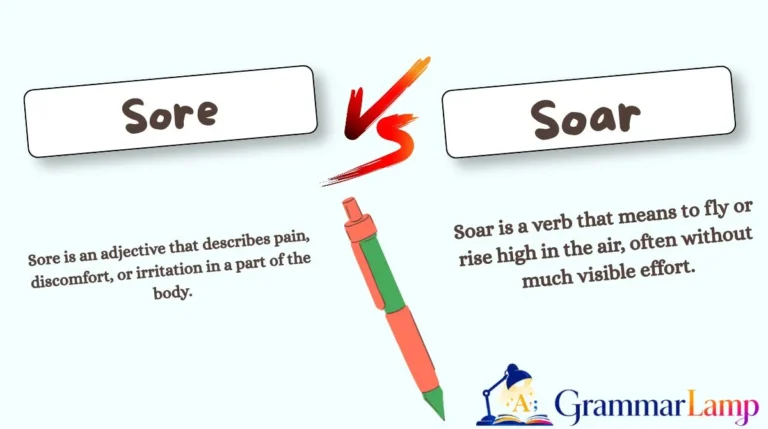
Sore is an adjective that describes pain, discomfort, or irritation in a part of the body. It is commonly used when something hurts, feels tender, or becomes uncomfortable.
For example, after running for a long time, your legs may feel sore. If you have a sore throat, it means your throat hurts or feels irritated.
The word can describe physical pain, but it can also describe emotional hurt or anger in certain situations. For example, someone may feel sore after losing a competition or hearing an upsetting comment.
When Should You Use Sore?
Use this word when you want to talk about:
- Pain in a part of your body.
- Muscles that hurt after exercise.
- A throat that feels painful or irritated.
- An injury or tender area.
- Emotional hurt or disappointment.
- Feelings of anger after an unpleasant experience.
It is a common word in everyday spoken and written English. You can use it when talking to friends, family members, teachers, or doctors.
Grammar Rule for Sore
Sore is an adjective. An adjective describes a noun or tells us more about a person, place, or thing.
It often appears before a noun or after a linking verb such as “be,” “feel,” or “seem.”
Common sentence structures:
- Subject + be + sore.
- Subject + feel + sore.
- Sore + noun.
For example:
- My back is sore.
- My legs feel sore.
- She has a sore throat.
Notice that the word describes a condition rather than an action.
8 Examples of Sore in Sentences
- My feet are sore after walking for three hours.
- She has a sore throat and cannot speak clearly.
- His shoulders feel sore after carrying heavy bags.
- My brother’s knees were sore after playing football.
- I woke up with a sore neck this morning.
- Her eyes became sore after looking at the computer screen for too long.
- He was a sore loser after his team lost the match.
- My muscles are still sore from yesterday’s workout.
These examples show that the word is useful in many everyday situations. Most of the time, it describes physical pain or discomfort.
Different Uses of Sore
Although physical pain is its most common meaning, there are a few other expressions worth learning.
1. Sore throat
This expression describes pain or irritation in your throat.
Example: I have a sore throat, so I will stay home today.
2. Sore muscles
This expression describes muscles that hurt, often after exercise or physical activity.
Example: My arms are sore after lifting weights.
3. Sore loser
A sore loser is someone who becomes angry or behaves badly after losing a game or competition.
Example: Don’t be a sore loser. Congratulate the winning team.
4. A sore point
A sore point is a subject that makes someone feel upset or uncomfortable.
Example: His failure in the exam is still a sore point for him.
Understanding these expressions will help you recognize the word in different conversations.
What Does “Soar” Mean?
Soar is a verb that means to fly or rise high in the air, often without much visible effort. It is commonly used when describing birds, aircraft, and other things that move high above the ground.
For example, an eagle can soar above mountains while using air currents to stay in the sky.
However, this word is not limited to flying. It can also describe something that increases quickly or reaches a very high level.
For example, prices may soar during a period of high demand. A person’s confidence may also soar after receiving good news.
When Should You Use Soar?
Use this word when you want to describe:
- A bird flying high in the sky.
- An aircraft rising into the air.
- A person or object moving upward.
- Prices increasing quickly.
- Business profits growing rapidly.
- Confidence, hopes, or excitement increasing.
- Something reaching a very high level.
It is especially useful in descriptive writing, news reports, stories, and everyday conversations.
Grammar Rule for Soar
Unlike its sound-alike partner, soar is a verb. A verb describes an action or state.
It can be used in different tenses depending on when the action happens.
Common forms:
- Base form: soar
- Third-person singular: soars
- Past tense: soared
- Present participle: soaring
Common sentence structures:
- Subject + soar.
- Subject + soar + high.
- Subject + soar + above + something.
- Subject + be + soaring.
For example:
- Birds soar above the trees.
- The plane soared into the sky.
- Prices are soaring.
The word describes movement, growth, or an increase rather than physical pain.
8 Examples of Soar in Sentences
- The eagle began to soar above the mountains.
- The airplane continued to soar through the clear blue sky.
- Food prices may soar during difficult economic times.
- Her confidence soared after she won the competition.
- The kite soared high above the houses.
- The company’s profits soared last year.
- Hot-air balloons soar gently over the countryside.
- His hopes soared when he received the good news.
As you can see, the word can describe both physical movement and a sudden increase.
Different Uses of Soar
Learning its different meanings will make your English more natural.
1. Soar through the sky
This means to fly high in the air.
Example: The birds soar through the sky every morning.
2. Soar in price
This means that something becomes much more expensive.
Example: The price of fuel soared last month.
3. Soar to new heights
This expression means reaching a much higher level of success or achievement.
Example: Her career soared to new heights after the award.
4. Spirits soar
This means that someone becomes very happy or excited.
Example: My spirits soared when I heard that my friend was coming home.
5. Soar in popularity
This means that something becomes popular very quickly.
Example: The new mobile game soared in popularity among teenagers.
These expressions are common in English, especially in conversations and news stories.
Difference Between Sore and Soar (Detailed Explanation)
The main difference is simple: sore describes pain or discomfort, while soar describes flying high or increasing quickly.
Although they sound the same, they are not interchangeable. Choosing the wrong spelling can completely change the meaning of your sentence.
For example:
- My legs are sore after running.
- The bird can soar above the trees.
In the first sentence, the word describes physical discomfort. In the second sentence, it describes an action.
Comparison Table
| Feature | Sore | Soar |
|---|---|---|
| Meaning | Pain or discomfort | Fly high or rise quickly |
| Part of speech | Adjective | Verb |
| Main use | Describing pain or irritation | Describing movement or increase |
| Pronunciation | /sɔːr/ | /sɔːr/ |
| Physical example | My back is sore. | Birds soar in the sky. |
| Common expression | Sore throat | Soar high |
| Past tense | Not applicable as an adjective | Soared |
| Present participle | Not applicable as an adjective | Soaring |
| Opposite idea | Comfortable or pain-free | Fall or descend |
1. Difference in Meaning
The first important difference is their meaning.
Sore is connected with something that hurts. It can describe your body, muscles, throat, or even emotional feelings.
For example:
- My feet are sore.
- His throat is sore.
- She felt sore after the argument.
Soar is connected with rising, flying, or increasing.
For example:
- The eagle can soar.
- The plane soared above the clouds.
- Their sales soared this year.
A simple way to understand the difference is to remember that one describes a condition, while the other describes an action or increase.
2. Difference in Grammar
These words also have different grammatical roles.
Sore is an adjective. It describes a noun and commonly follows linking verbs such as “is,” “was,” and “feel.”
Examples:
- My shoulder is sore.
- Her legs feel sore.
- He has a sore back.
Soar is a verb. It describes what someone or something does.
Examples:
- The birds soar over the lake.
- The plane soared into the sky.
- Prices are soaring.
This grammar difference is important because you cannot simply exchange one word for the other.
3. Difference in Sentence Structure
The sentence structure can help you choose the correct spelling.
When describing pain, you can use:
Subject + be + sore
Example: My arms are sore.
You can also use:
Subject + have + a + sore + body part
Example: She has a sore throat.
When describing flight or an increase, you can use:
Subject + soar + adverb or prepositional phrase
Example: The eagle soared high above the trees.
Another example:
Subject + be + soaring
Example: Food prices are soaring.
Looking at the role of the word in a sentence often makes the correct choice clear.
4. Difference in Everyday Usage
Sore is commonly used in conversations about health, exercise, injuries, and feelings.
For example, you might tell a friend, “My legs are sore after playing cricket.”
Soar is often used when discussing flying, prices, business growth, success, and excitement.
For example, someone might say, “The company’s sales soared last year.”
Both words are useful, but they belong to different situations.
5. Difference in Word Forms
Another useful difference is how the words change.
Sore can be used as an adjective in different sentence structures. It does not take ordinary verb endings such as -ed or -ing when used with its pain-related meaning.
Soar is a regular verb, so it changes according to tense.
- Present: The birds soar.
- Third-person singular: The bird soars.
- Past: The bird soared.
- Present continuous: The bird is soaring.
This is an easy way to recognize which word belongs in a sentence.
Explore More Posts
On a Call or In a Call (2026): What’s the Difference? Easy Grammar Guide with Examples
Any Way vs Anyway: What’s the Difference? Complete Guide for 2026
Choose vs Chose: Difference, Meaning, Rules & Examples (2026)
At the Weekend or On the Weekend then? Which Is Correct in 2026?
Grammar Rules You Must Remember
Understanding a few simple rules can help you avoid spelling and grammar mistakes.
Rule 1: Use Sore When Talking About Pain
Use sore when describing a painful or uncomfortable part of your body.
It is an adjective, so it tells us how something feels.
Correct examples:
- My back is sore.
- His feet are sore.
- I have a sore throat.
Incorrect: My legs soar after running.
Correct: My legs are sore after running.
Remember that pain and discomfort are connected with this adjective.
Rule 2: Use Soar When Something Flies High
When a bird, plane, kite, or another object moves high through the air, use soar.
Correct examples:
- The eagle soared above the forest.
- The airplane is soaring through the clouds.
- The kite soared into the sky.
Incorrect: The eagle is sore above the forest.
Correct: The eagle is soaring above the forest.
The important point is that flying and upward movement require the verb.
Rule 3: Use Soar for Rapid Increases
The word does not only describe flying. It can also describe something that increases quickly or reaches a high level.
Correct examples:
- Prices soared during the summer.
- Her confidence soared after the interview.
- The company’s profits are soaring.
Incorrect: The price of food is sore.
Correct: The price of food is soaring.
Think about whether the sentence describes an increase. If it does, soar may be the correct choice.
Rule 4: Check the Grammar of the Sentence
Before choosing either word, look at how it works in your sentence.
If you need an adjective to describe a painful condition, choose sore.
If you need a verb to describe flying, rising, or increasing, choose soar.
Compare:
- My shoulders feel sore.
- The bird can soar.
The first sentence describes a feeling. The second sentence describes an action.
This small grammar check can prevent many common mistakes.
Common Mistakes Students Make
Many English learners confuse these words because they sound identical. When people hear them in conversations, they cannot always tell which spelling the speaker intends.
This is called a homophone problem. Homophones are words that have the same pronunciation but different meanings and spellings.
Here are some common mistakes and easy ways to correct them.
Mistake 1: Using Soar for Physical Pain
Incorrect: My feet are soar after walking.
Correct: My feet are sore after walking.
Why?
The sentence describes pain in the feet. It needs an adjective, not a verb.
Correction tip: Whenever you talk about pain, check whether you need the word that describes discomfort.
Mistake 2: Using Sore for Flying
Incorrect: The eagle can sore high in the sky.
Correct: The eagle can soar high in the sky.
Why?
The sentence describes an action. The eagle is flying high, so you need the verb.
Correction tip: Think about birds, airplanes, and flying. These situations usually require soar.
Mistake 3: Confusing Their Meaning in Writing
Incorrect: The company’s profits became sore last year.
Correct: The company’s profits soared last year.
Why?
Profits can increase, but they cannot experience physical pain. The sentence needs a verb that describes rapid growth.
Correction tip: Ask yourself whether the subject is experiencing pain or increasing in value.
Mistake 4: Forgetting the Verb Forms
Incorrect: The birds is soar above the lake.
Correct: The birds are soaring above the lake.
Why?
The sentence uses the present continuous tense. It needs the helping verb “are” followed by the -ing form of the main verb.
Correction tip: Remember the regular verb forms: soar, soars, soared, and soaring.
Mistake 5: Depending Only on Pronunciation
Incorrect: I wrote “soar throat” because that is how I heard it.
Correct: I wrote “sore throat” because it describes pain.
Why?
The pronunciation is the same, so listening alone cannot help you choose the spelling.
Correction tip: Always understand the meaning of the sentence before writing the word.
Easy Trick to Remember the Difference
Remembering these words becomes much easier when you connect each one with a simple picture in your mind.
Here is a quick memory trick:
SORE = PAIN
Think about your sore feet after a long walk or your sore throat when you have a cold.
Whenever you talk about something hurting, remember the spelling with an E.
Examples:
- Sore muscles.
- Sore throat.
- Sore back.
SOAR = FLY HIGH
Think about an eagle spreading its wings and flying high above the mountains.
Whenever you describe flying, rising, or increasing, remember the spelling with an A.
Examples:
- Eagles soar.
- Planes soar.
- Prices soar.
A Simple Real-Life Memory Trick
Imagine that you have just finished playing a long cricket match.
Your legs hurt because you have been running for several hours. You tell your friend:
“My legs are sore!”
Now imagine that you look up and see an eagle flying high above the cricket ground.
You say:
“Look! The eagle is soaring!”
This small story connects both words with different situations.
You do not need to memorize complicated grammar explanations every time you write them. Just remember the two pictures: painful legs and a flying eagle.
Daily Life Examples of Sore and Soar
The best way to learn confusing English words is to see how people use them in normal conversations.
Here are ten simple examples that show both words in everyday situations.
Example 1: After Exercise
Ali: Why are you walking so slowly today?
Ahmed: My legs are sore after yesterday’s workout.
Here, sore describes physical pain caused by exercise.
Example 2: Talking About a Cold
Sara: Why aren’t you talking much?
Ayesha: I have a sore throat today.
The word describes irritation or pain in the throat.
Example 3: Watching Birds
Father: Look at that beautiful eagle!
Son: It is soaring above the mountains.
Here, soar describes the bird’s movement through the sky.
Example 4: After Playing Football
Friend: Are you feeling okay?
Ali: My shoulders are sore because I carried a heavy bag.
Sore describes discomfort in the shoulders.
Example 5: Talking About Prices
Customer: Why is everything so expensive?
Shopkeeper: Food prices have soared recently.
Soared means that prices have increased quickly.
Example 6: Watching an Airplane
Child: Where is that airplane going?
Mother: It is soaring high above the clouds.
The word describes the aircraft moving through the air.
Example 7: After a Competition
Friend: How do you feel after winning the match?
Player: My confidence has soared!
Here, soar describes a big increase in confidence.
Example 8: Talking About an Injury
Doctor: Does your arm hurt?
Patient: Yes, it is still sore.
The word describes pain or tenderness.
Example 9: Talking About Business
Manager: How is the company doing this year?
Employee: Our sales have soared since January.
Soared means that sales have increased significantly.
Example 10: Watching a Kite
Brother: Your kite is very high!
Sister: Yes! It is soaring above the houses.
The word describes the kite moving high in the air.
These examples show how context helps you choose the correct spelling, even when both words sound exactly alike.
Practice Section: Test Your Understanding
Now it is time to check what you have learned. Read each sentence carefully and choose the correct word.
Remember:
- Sore = pain or discomfort.
- Soar = fly high or increase quickly.
Choose the correct option:
- My feet are very (sore / soar) after walking all day.
- The eagle can (sore / soar) above the mountains.
- Food prices began to (sore / soar) last month.
- I have a (sore / soar) throat and cannot sing today.
- The airplane (sore / soared) high into the sky.
Answers and Explanations
- Sore – The sentence describes pain in the feet.
- Soar – The eagle is flying high above the mountains.
- Soar – The sentence describes an increase in food prices.
- Sore – A sore throat means that the throat hurts or feels irritated.
- Soared – This is the past tense of soar because the airplane moved into the sky in the past.
If you answered all five correctly, you understand the main difference. If you made a mistake, read the memory trick again and try the sentences one more time.
More Helpful posts
Wreckless or Reckless? Which Spelling Is Correct in 2026?
Brite vs Bright: Meaning, Difference, Spelling & Correct Usage in 2026
I Ordered vs I Have Ordered: What’s the Difference? Simple Grammar Guide (2026)
Timber vs Timbre (2026): Meaning, Differences, Grammar Rules, Examples, and Easy Guide
FAQs
1. What is the difference between sore and soar?
Sore is an adjective that describes pain, discomfort, or irritation. Soar is a verb that means to fly high or increase quickly. Both words have the same pronunciation, but their meanings and spellings are different.
2. Do sore and soar sound the same?
Yes, these two words are homophones. They are pronounced the same way in standard English, although their spelling and meanings are different. You must use the meaning of the sentence to choose the correct word.
3. Is sore a noun or a verb?
Sore is usually an adjective when it describes pain or discomfort. For example, “My back is sore.” It can also appear as a noun in certain uses, such as “a sore” meaning a painful or irritated area on the skin.
4. Can soar be used in a sentence about money?
Yes. Soar is often used to describe a rapid increase in prices, profits, costs, or sales. For example, “The price of petrol soared last year.” It means that the price increased quickly.
5. What is the past tense of soar?
The past tense of soar is soared. It is a regular verb, so you add -ed to form the past tense. For example, “The bird soared above the trees.” The past participle is also soared.
6. Is it correct to say “My legs are soar”?
No, that sentence is incorrect when you mean that your legs hurt. The correct sentence is “My legs are sore.” Use soar when describing flying, rising, or increasing, not physical pain.
Conclusion
Understanding the difference between sore and soar is easier than it may seem. Although these two words sound exactly alike, they have different meanings, spellings, and grammatical roles.
Remember that sore is an adjective that describes pain, discomfort, or irritation. You can use it when talking about sore muscles, a sore throat, or an uncomfortable part of your body.
On the other hand, soar is a verb that describes flying high, rising, or increasing quickly. Birds soar through the sky, prices soar during difficult times, and confidence can soar after a great achievement.
The easiest way to remember the difference is to connect sore with pain and soar with flying high.
Try using both words in your own sentences whenever you get the chance. Pay attention to their meanings when reading English books, watching videos, or having conversations.
With a little practice, you will stop confusing these homophones and use the correct spelling naturally. Keep learning, keep practicing, and remember that small improvements can make your English much stronger.

Liam Derren is a language writer at GrammarLamp, creating simple, helpful content about grammar, words, and everyday English. He makes language learning clear, practical, and easy to understand.