
English has many words that look similar or are closely related, but they do not always work the same way in a sentence.
Sell and sale are two good examples. Both words are connected to buying and selling things, so it is easy to mix them up. However, each word has a different job in English grammar.
Imagine you want to sell your old phone. You might tell a friend, “I want to sell my phone.” Now imagine you visit a shop and see a sign that says, “Big Sale Today!”
The first sentence talks about an action, while the second uses a word that describes an event or a period when goods are offered for sale, often at lower prices.
This small difference is important in everyday English. You will see these words in shops, advertisements, online marketplaces, business emails, and daily conversations. Using the wrong word can make your sentence sound confusing, even when the reader understands what you mean.
The good news is that the difference is easy to learn once you understand how each word works. Sell is a verb, while sale is a noun. This basic grammar rule will help you choose the right word in most situations.
By the end of this guide, you will understand the meaning of each word, learn how to use it correctly, recognize common mistakes, and practice with simple examples. You will also learn useful expressions such as for sale, on sale, and sell out so you can use them naturally in real-life conversations.
More Useful posts
Role vs Roll: Meaning, Difference, Rules & Examples (2026)
John and I or John and Me? The Easy Grammar Guide for 2026
Formal vs Informal Usage: Complete Guide to English in 2026
Please Advise or Please Advice? The Correct Usage Explained (2026)
What Does “Sell” Mean?
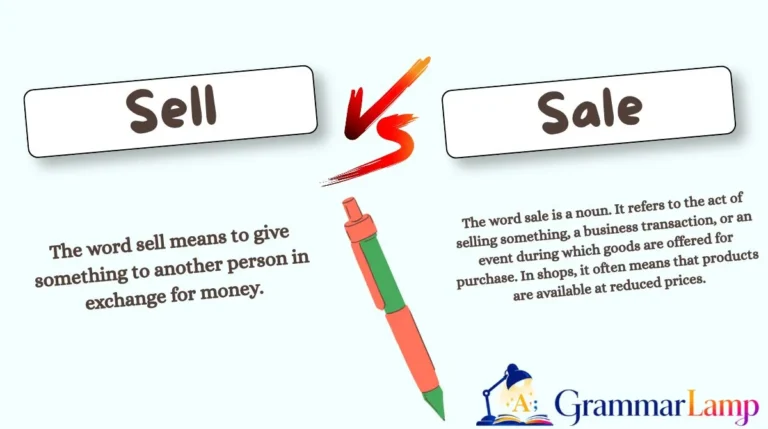
The word sell means to give something to another person in exchange for money. It describes an action performed by a person, shop, company, or business.
For example, when a shopkeeper gives you a shirt and you pay for it, the shopkeeper sells the shirt to you. When you offer your old bicycle to someone for money, you are trying to sell it.
In simple words, sell tells us what someone does when they exchange goods or services for money.
When should you use “sell”?
Use sell when you are talking about the action of selling something. It can refer to everyday items, houses, cars, food, clothes, services, and even business products.
Here are some common situations:
- A person wants to sell an old phone.
- A shop sells clothes and shoes.
- A farmer sells fresh vegetables.
- A company sells products online.
- An artist sells paintings to customers.
The word can also be used in a less literal way. For example, a person may try to sell an idea to a team. This means they are trying to persuade others to accept or support that idea.
Grammar rules for “sell”
Sell is a verb. A verb expresses an action or state. Because it is a verb, its form changes depending on the tense and the subject of the sentence.
The main forms of sell are:
| Verb form | Example |
|---|---|
| Base form: sell | I sell handmade bags. |
| Third-person singular: sells | She sells handmade bags. |
| Past tense: sold | She sold a handmade bag yesterday. |
| Past participle: sold | She has sold ten bags. |
| -ing form: selling | She is selling handmade bags. |
Notice that the past tense is sold, not selled. This is because sell is an irregular verb.
You can use sell in several common sentence patterns:
- Subject + sell + object: They sell fresh fruit.
- Subject + want to sell + object: I want to sell my car.
- Subject + be + selling + object: He is selling his laptop.
- Subject + have/has + sold + object: We have sold all the tickets.
Remember that after to, the base form is normally used when to introduces an infinitive. For example, “I want to sell my bike” is correct, while “I want to sold my bike” is incorrect.
Examples of “sell” in sentences
Here are eight examples that show how to use sell correctly.
1. I want to sell my old laptop.
The speaker wants to exchange the laptop for money.
2. This shop sells fresh bread every morning.
The shop offers bread to customers in exchange for money.
3. My uncle sold his car last week.
The action happened in the past.
4. They are selling tickets for the concert.
The action is happening now or during the current period.
5. She has sold all her handmade bags.
The sentence uses the present perfect tense to describe a completed sale with a present result.
6. Farmers sell fresh vegetables at the local market.
This describes a regular activity.
7. We plan to sell our house next year.
The sentence describes a future plan.
8. The manager tried to sell his idea to the team.
Here, sell means to persuade people to accept an idea.
Common confusion about “sell”
Many learners think sell and sale are interchangeable because both relate to money and products. However, their grammatical roles are different.
For example:
- Correct: I want to sell my phone.
- Incorrect: I want to sale my phone.
The sentence needs a verb after want to, so sell is the correct choice.
Another common mistake is using selled instead of sold. Since sell is irregular, its past form is sold.
- Correct: He sold his bike yesterday.
- Incorrect: He selled his bike yesterday.
Once you remember that sell describes an action, choosing the correct form becomes much easier.
What Does “Sale” Mean?
The word sale is a noun. It refers to the act of selling something, a business transaction, or an event during which goods are offered for purchase. In shops, it often means that products are available at reduced prices.
For example, a clothing store might advertise a summer sale. This means the store is offering products for customers to buy, often with discounts.
In simple English, sale is the name of an event, transaction, or commercial activity. It does not normally express the action by itself in a sentence.
When should you use “sale”?
Use sale when you are talking about the selling transaction, a special shopping event, or something that is available to buy.
You will commonly see it in advertisements, shops, property listings, and business documents.
Common expressions include:
- For sale: Available for someone to buy.
- On sale: Available to buy; in shopping contexts, often available at a reduced price.
- Sale price: The price offered during a discount or special offer.
- End-of-season sale: A shopping event held near the end of a season.
- House sale: The sale transaction involving a house, or, depending on context, an event where a house is sold.
- Final sale: A sale on terms that may mean the item cannot be returned or exchanged, depending on the seller’s policy.
Be careful with for sale and on sale. They are not always interchangeable.
If a house is advertised as “for sale,” it means someone is offering it for purchase. If a jacket is “on sale,” it often means the shop is selling it at a lower price than usual. However, context matters, and on sale can also simply mean available to buy.
Grammar rules for “sale”
Sale is a countable noun in many common uses. It can appear with articles such as a and the, and it can be pluralized as sales.
For example:
- A sale: The store is having a sale.
- The sale: The sale starts tomorrow.
- Sales: Online sales increased this month.
- Sale price: The sale price is lower than the original price.
Because sale is a noun, it can appear after an article or adjective.
Examples:
- a big sale
- a summer sale
- the final sale
- an online sale
You can also use sale after certain prepositions:
- The house is for sale.
- These shoes are on sale.
- The store is preparing for a sale.
- The item is not available for sale yet.
A useful grammar pattern is:
Subject + be + for sale
For example, “The old furniture is for sale.”
Another common pattern is:
Subject + have/hold + a sale
For example, “The store will hold a sale next weekend.”
Examples of “sale” in sentences
1. The store is having a big sale this weekend.
Sale refers to a shopping event.
2. This house is for sale.
The house is available for someone to buy.
3. I bought these shoes during the summer sale.
The sentence refers to a special shopping event.
4. The sale price is much lower than the original price.
Sale price means the price offered during a discount or special promotion.
5. The company reported an increase in online sales.
Here, sales refers to selling activity or the amount of goods sold.
6. The sale of the property was completed yesterday.
Sale refers to the transaction itself.
7. These jackets are on sale at the moment.
The jackets are available to buy, often at reduced prices.
8. The charity organized a book sale to raise money.
Sale refers to an event where books are sold.
Common confusion about “sale”
A common mistake is using sale where a verb is required.
For example:
- Incorrect: I want to sale my bicycle.
- Correct: I want to sell my bicycle.
However, sale is correct when you need a noun.
- Correct: The sale of my bicycle was easy.
- Incorrect: The sell of my bicycle was easy.
In standard everyday English, the sale of my bicycle is the natural noun phrase.
Learners may also confuse sale with sell because both appear in shopping advertisements. Look at the grammar of the complete sentence rather than choosing a word based only on its meaning.
Difference Between Sell and Sale
The main difference is simple: sell is a verb, and sale is a noun. Both words are connected to the exchange of goods or services for money, but they serve different purposes in a sentence.
Use sell when you describe the action. Use sale when you name the transaction or an event related to selling.
Sell vs sale comparison table
| Feature | Sell | Sale |
|---|---|---|
| Part of speech | Verb | Noun |
| Main meaning | To give something in exchange for money | The act or transaction of selling; a shopping event |
| Describes | An action | A thing, event, or transaction |
| Past form | Sold | No verb tense; plural is sales |
| Example | I sell books online. | The book sale starts today. |
| Common phrase | Sell a car | For sale |
| Another common phrase | Sell products | On sale |
| Question it can answer | What does the person do? | What event or transaction is being discussed? |
1. Usage difference
Consider these two sentences:
- I want to sell my phone.
- My phone is for sale.
Both sentences relate to the same phone, but the meaning and structure are different.
In the first sentence, sell describes what the speaker wants to do. In the second, sale appears in the expression for sale, which tells us that the phone is available to buy.
Here is another pair:
- The shop sells shoes.
- The shop is having a shoe sale.
The first sentence describes the shop’s usual business activity. The second describes a particular event.
2. Grammar logic
English sentences usually need the correct part of speech in each position. A verb often tells us what the subject does, while a noun names a person, place, thing, event, or idea.
Compare:
- They sell furniture.
- They organized a furniture sale.
In the first sentence, sell is the main verb. In the second, organized is the main verb, and sale is the noun that names the event.
This explains why you cannot normally replace one word with the other just because they have related meanings.
You can say “The shop sells clothes,” but you cannot say “The shop sale clothes” in standard English. The second sentence is missing the correct verb form.
Likewise, you can say “The sale begins tomorrow,” but “The sell begins tomorrow” is not the natural standard expression when you mean a shopping event.
3. Sentence structure difference
The word sell can be the main verb in a sentence.
Common patterns include:
- Subject + sell + object: I sell handmade candles.
- Subject + sells + object: She sells handmade candles.
- Subject + sold + object: They sold their old furniture.
- Subject + will sell + object: We will sell the car.
The word sale usually works as a noun.
Common patterns include:
- Article + sale: A sale begins tomorrow.
- Adjective + sale: The annual sale starts next week.
- Noun + for sale: The apartment is for sale.
- Sale + of + noun: The sale of the building is complete.
Learning these patterns helps you build sentences correctly without memorizing every possible example.
4. Meaning comparison in everyday English
Imagine you run a small online shop.
You might say, “I sell handmade bags.” This tells people what your business does.
If you announce, “I am having a sale this Friday,” you are telling customers about a special shopping event.
If a customer asks, “Is this bag for sale?” they want to know whether the bag is available to buy.
If you say, “I sold ten bags yesterday,” you are describing a completed action in the past.
All four sentences relate to selling, but each word has a different role. The context helps you understand the message, while grammar tells you which word to choose.
Explore More Posts
Also Have or Have Also: Which Is Correct? Complete Grammar Guide 2026
Sneaked vs Snuck: What Is the Difference? 2026 Guide
Wether vs Weather vs Whether: What’s the Difference? 2026 Guide
Instructions on vs Instructions for: Meaning, Difference, and Correct Usage in 2026
Grammar Rules You Must Remember
You do not need to learn complicated grammar terms to use these words correctly. Keep these four rules in mind, and you will avoid most common errors.
Rule 1: Use “sell” for an action
When someone performs the action of exchanging goods or services for money, use sell or the correct form of this verb.
Examples:
- I sell clothes online.
- She sells cakes from home.
- They sold their old car.
The form changes with the subject and tense, but the basic verb remains sell.
Rule 2: Use “sale” for a transaction or shopping event
When you name the event or transaction, use sale.
Examples:
- The sale starts at 9 a.m.
- We went to the winter sale.
- The sale of the house is complete.
Remember that sale is a noun. You can describe it with words such as big, annual, online, or summer.
Rule 3: After “to,” use “sell” when you mean the action
When to introduces an infinitive, use the base form of the verb.
Correct examples:
- I want to sell my bike.
- He plans to sell his business.
- We need to sell these old books.
Do not write “I want to sale my bike.” In this sentence, the word after to must be the verb sell.
Rule 4: Learn “for sale” and “on sale” as common expressions
Both expressions use the noun sale, but their usual meanings differ.
For sale means available to buy.
Example: “The house next door is for sale.”
On sale often means offered at a reduced price in a shop, although it can also mean available to buy.
Example: “These shoes are on sale for $30.”
Pay attention to the context. A house advertised as for sale is available to buy, while a shop advertising shoes on sale usually wants customers to notice a special price.
Common Mistakes Students Make
Learners often confuse these words because they have similar meanings. The best way to correct mistakes is to check what the sentence needs: an action word or a naming word.
Mistake 1: Using “sale” instead of “sell”
Incorrect: I want to sale my laptop.
Correct: I want to sell my laptop.
Why? The phrase want to is followed by the base form of a verb. Since the sentence describes an action, sell is correct.
Easy tip: If you can replace the word with an action such as buy, give, or trade, you probably need a verb.
Mistake 2: Using “sell” instead of “sale”
Incorrect: The shop is having a big sell.
Correct: The shop is having a big sale.
Why? The sentence refers to a shopping event. The word needed here is a noun, not the verb sell.
Easy tip: Before using a, the, or an adjective such as big to name a shopping event, check whether you need the noun sale.
Mistake 3: Writing “selled” instead of “sold”
Incorrect: He selled his old car last month.
Correct: He sold his old car last month.
Why? Sell is an irregular verb. Its simple past form is sold, not selled.
Easy tip: Remember this small group of verb forms: sell, sold, sold.
Mistake 4: Confusing “for sale” with “on sale”
Incorrect for the intended discount meaning: These shoes are for sale for 50% off.
More natural: These shoes are on sale at 50% off.
Why? For sale simply tells us that something is available to buy. On sale is often used when a shop offers a discount.
Easy tip: Think of for sale as an availability message and on sale as a common shopping promotion phrase. The exact meaning still depends on the context.
Mistake 5: Using the wrong word in a question
Incorrect: How much do you sale this bag for?
Correct: How much do you sell this bag for?
A more natural question in many shopping situations is: “How much are you selling this bag for?”
Why? The question asks about the action or price involved in selling the bag, so it needs a verb form of sell.
Easy tip: Read the sentence aloud and identify the main action. If the sentence needs a verb, do not use the noun sale.
Mistake 6: Using “sale” as a verb in business writing
Incorrect: Our company sales furniture to hotels.
Correct: Our company sells furniture to hotels.
Why? In the incorrect sentence, sales is being used as if it were a verb. The correct third-person singular form of sell is sells.
However, sales is correct as a noun in a sentence such as “Our company’s sales increased this year.”
Easy tip: Ask whether the word describes what the company does or names the amount or activity of selling. The first usually needs sells; the second may need sales.
Easy Trick to Remember the Difference
Here is a simple memory trick:
Sell = action. Sale = event or transaction.
Imagine you have an old bicycle that you no longer need.
You decide to sell it. You take a picture, post an advertisement, and find a buyer. The action you perform is sell.
Now imagine a local shop advertises a weekend sale. Customers visit the shop to buy products, and some items have lower prices. The shopping event is a sale.
You can use this same idea in many situations:
- Sell a phone; a phone sale.
- Sell a car; a car sale.
- Sell clothes; a clothing sale.
- Sell books; a book sale.
Another helpful trick is to look at the words around the blank in a sentence.
If the sentence says “I want to ___ my car,” you need an action word, so choose sell.
If it says “The store is having a big ___,” you need a noun that names an event, so choose sale.
You do not have to think about every grammar rule each time you write. First ask yourself, “Am I describing an action, or am I naming an event or transaction?” That one question will solve most of the confusion.
Daily Life Examples: Sell vs Sale
These examples show how the two words appear in natural conversations. Read both the sentences and the short explanations to see why each word fits.
1. Selling an old phone
Ali: Are you keeping your old phone?
Hamza: No, I want to sell it.
Sell is correct because Hamza is talking about an action he wants to take.
2. Shopping for clothes
Customer: Why are so many people in this shop today?
Friend: They are having a big sale.
Sale names the shopping event that has attracted customers.
3. Asking about a house
Sara: Is that house available to buy?
Ahmed: Yes, it is for sale.
The expression for sale tells Sara that the house is available to purchase.
4. Talking about a business
Mina: What does your brother do?
Ayesha: He sells computers online.
Sells is the correct verb form because the sentence describes what her brother does.
5. Finding a discount
Customer: Are these shoes cheaper this week?
Shop assistant: Yes, they are on sale.
On sale is used here to describe the discounted price.
6. Talking about yesterday
Usman: Did you find a buyer for your bicycle?
Bilal: Yes, I sold it yesterday.
Sold is the past tense of sell, so it describes an action completed yesterday.
7. Planning a store event
Manager: When should we offer the discounts?
Employee: We could have a sale next weekend.
Sale is a noun because it names the proposed shopping event.
8. Asking about handmade products
Customer: Do you sell these bags yourself?
Seller: Yes, I make and sell them from home.
Sell describes what the seller does with the bags after making them.
9. Talking about property
Friend A: What happened to your family’s old house?
Friend B: We put it up for sale last month.
For sale means the family made the house available for buyers.
10. Discussing business results
Manager: How did the company perform last month?
Employee: Our sales increased after we launched the new product.
Sales is a noun referring to selling activity or the amount of goods sold. It is not the verb sell.
Practice Section
Test your understanding with these five short sentences. Choose either sell or sale, using the correct form when needed.
1. I want to ___ my old bicycle.sellsale
2. The store is having a summer ___.sellsale
3. My uncle ___ fresh fruit at the market.sellsells
4. That beautiful house is for ___.sellsale
5. They ___ their old car last week.soldsale
Check answers
More Helpful posts
In My Spare Time or On My Spare Time in 2026? The Correct Expression Explained
May or May Not: Meaning, Grammar Rules, Examples, and Common Mistakes in 2026
Peaked vs Peeked vs Piqued: Meaning, Differences, Examples, and Grammar Rules (2026)
If There Is Any vs If There Are Any: Meaning, Difference, and Examples (2026)
FAQs
1. What is the difference between sell and sale?
Sell is a verb that describes the action of giving something in exchange for money. Sale is a noun that refers to a selling transaction or a shopping event. For example, “I sell shoes” describes an action, while “The shoe sale starts today” names an event.
2. Is “sale” a verb or a noun?
Sale is a noun in standard modern English. You can use it in expressions such as a sale, the sale of a house, for sale, and on sale. When you want to describe the action of selling something, use the verb sell instead.
3. Can we use “sell” in questions?
Yes, you can use sell in questions. For example, “Do you sell fresh bread?” and “What do you want to sell?” are correct. You can also use other forms, such as “Did you sell your car?” and “Are you selling your laptop?”
4. Is “for sale” the same as “on sale”?
Not always. For sale means that something is available to buy. On sale often means that an item is being offered at a reduced price, especially in shops. In some contexts, on sale can simply mean available for purchase, so the surrounding sentence matters.
5. Is “selled” correct English?
No. Sell is an irregular verb, so its simple past form is sold. Its past participle is also sold. For example, say “I sold my old phone yesterday” and “I have sold my old phone,” not “I selled my old phone.”
6. Should I write “the sell” or “the sale”?
In most everyday sentences, the sale is correct when you mean a selling transaction or event. For example, “The sale of the house took two weeks.” The phrase the sell is not normally used with this meaning, although sell can appear as a noun in specialized expressions or informal business language.
Conclusion
Understanding the difference between sell and sale can make your English clearer and more natural. Although the two words are closely related, they have different grammatical roles.
Sell is a verb, which means to exchange something for money. Sale is a noun, which refers to the selling transaction or an event where products are offered for purchase.
Use sell when talking about an action, as in “I want to sell my old phone.” Use sale when naming an event or transaction, as in “The store is having a big sale.” Remember that sold is the past form of sell, while sales is the plural noun used to talk about selling activity or the amount of goods sold.
It is also helpful to learn common expressions such as for sale and on sale. They appear frequently in advertisements, shops, and online listings.
The easiest way to remember the difference is to ask yourself whether your sentence needs an action or a noun.
Practice with your own examples, read signs and advertisements carefully, and use both words in everyday conversations. With a little practice, choosing the right word will soon feel natural.

Liam Derren is a language writer at GrammarLamp, creating simple, helpful content about grammar, words, and everyday English. He makes language learning clear, practical, and easy to understand.