
English has many phrases that look almost the same but are used in slightly different ways. Continuing success and continued success are good examples.
Both phrases talk about success that does not stop. Both are common in professional messages, business emails, school reports, and everyday conversations. However, there is a small difference in how they describe success.
Many English learners find these expressions confusing because the words continuing and continued come from the same verb, continue.
They both relate to something lasting over time, so it is easy to think they can always replace each other. In many situations, they can express a similar idea, but they may create a slightly different feeling or focus.
For example, a company may talk about its continuing success when it wants to highlight success that is still happening. A manager may wish an employee continued success when congratulating them or hoping they achieve more good results in the future.
Understanding this difference can help you write better emails, give polite wishes, and speak more naturally at work or school. It can also help you choose the right phrase for a greeting card, a business announcement, or a congratulatory message.
By the end of this guide, you will understand the meaning of both expressions, how their grammar works, when to use each one, and which phrase sounds more natural in different situations. You will also learn from practical examples and short exercises.
More Useful posts
A Majority of vs The Majority of: Easy Grammar Guide for 2026
Sun vs Son: Meaning, Difference, Rules, and Examples (2026)
I’m vs I Am: Complete Difference, Rules, Examples & Usage Guide 2026
Time off vs time-off: The Complete Grammar Guide for 2026
What Does “Continuing Success” Mean?
Simple Definition
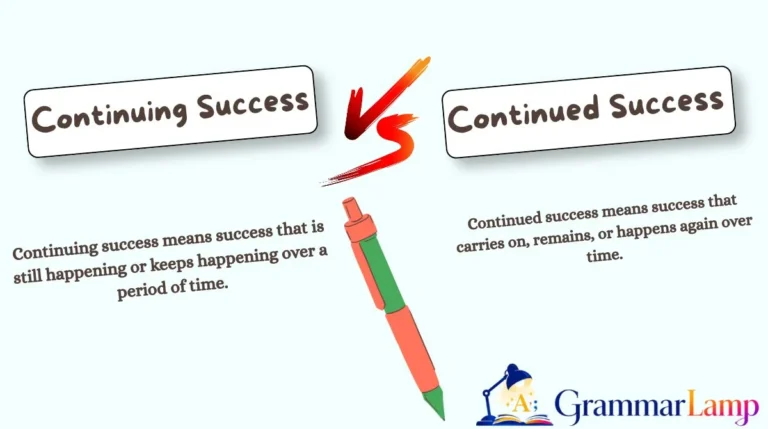
Continuing success means success that is still happening or keeps happening over a period of time. It focuses on the ongoing nature of success rather than treating it as a single event.
The word continuing comes from the verb continue, which means to keep doing something or to carry on without stopping. When we use continuing before the noun success, we describe success that remains active or ongoing.
For example:
The school is enjoying continuing success in its science competitions.
This sentence means the school has been successful and continues to achieve good results. Its success has not stopped.
When Should You Use “Continuing Success”?
Use continuing success when you want to describe success that is still taking place, especially when you are discussing an ongoing activity, situation, or achievement.
It can be useful in business reports, news stories, educational writing, and discussions about long-term progress. The phrase often describes a pattern of positive results that remains active.
Consider a business that has gained new customers for several years. If it continues to attract customers and earn profits, someone might describe this as its continuing success.
Similarly, a student who regularly earns good grades may be said to enjoy continuing success in school.
Grammar Rule for “Continuing Success”
The word continuing is the present participle of the verb continue. In this expression, it works as a modifier that describes the noun success.
The basic structure is:
Continuing + noun
Examples include:
- Continuing success
- Continuing growth
- Continuing support
- Continuing progress
- Continuing improvement
In each example, continuing tells us that the situation or activity is ongoing.
Although continuing ends in -ing, it does not mean that the phrase must use a continuous verb tense. In continuing success, it describes the noun success.
For example, in the sentence “The company is enjoying continuing success,” the verb phrase is is enjoying. The words continuing success describe what the company is enjoying.
Examples of “Continuing Success”
Here are eight examples that show how this phrase works in real situations.
- The company is proud of its continuing success in the local market.
The company continues to perform well in its market. - Her continuing success in school has made her parents very happy.
She keeps achieving good academic results. - We hope the project brings continuing success to the entire team.
The speaker hopes the project will lead to success that lasts. - The restaurant’s continuing success is the result of excellent service.
The restaurant remains successful because it serves customers well. - The charity depends on continuing success to support more families.
The charity needs its positive results to carry on. - His continuing success as a writer has attracted many new readers.
He continues to do well in his writing career. - The school celebrated its continuing success in national competitions.
The school has kept achieving good results in those competitions. - Continuing success requires patience, effort, and a willingness to learn.
Lasting progress often depends on ongoing work.
Common Confusion About “Continuing Success”
Some learners think continuing success means success that is guaranteed to last forever. That is not correct. The phrase simply describes success that is ongoing or continuing at the time being discussed.
It does not promise that success will never stop.
Another common mistake is assuming that continuing success always means future success. It can refer to success happening now, or to success that is expected to carry on. The surrounding sentence tells us which meaning is intended.
For instance, “The company is enjoying continuing success” describes an ongoing situation. “We wish you continuing success” expresses a hope for success to carry on.
What Does “Continued Success” Mean?
Simple Definition
Continued success means success that carries on, remains, or happens again over time. It often expresses the idea that a person or organization will keep doing well.
The word continued comes from the verb continue. It is the past participle of the verb and can also work as an adjective before a noun.
In this phrase, continued describes success that is maintained or carried forward. It does not necessarily mean that the success belongs only to the past.
For example:
We wish you continued success in your new position.
This is a polite way to say that you hope the person keeps achieving good results in the future.
When Should You Use “Continued Success”?
Use continued success when you want to describe success that carries on or express a wish that someone will remain successful.
This phrase is especially common in congratulations, business correspondence, farewell messages, professional announcements, and formal greetings.
Imagine that a colleague has been promoted. You might write, “Congratulations on your promotion. I wish you continued success in your career.”
You are not only recognizing the person’s previous achievements. You are also wishing them further success in the future.
The expression is also suitable when describing an existing pattern of success. For example, “The team’s continued success depends on strong communication.” Here, it means the team must maintain its good results.
Grammar Rule for “Continued Success”
The word continued is the past participle of continue. It can describe a noun by showing that something is maintained or carried forward.
The basic structure is:
Continued + noun
Examples include:
- Continued success
- Continued support
- Continued growth
- Continued progress
- Continued cooperation
In these expressions, continued describes something that carries on.
Remember that the word continued does not automatically make the whole sentence past tense. For example, “We wish you continued success” is a present-tense statement expressing a wish for the future.
Similarly, “The project’s continued growth is encouraging” describes growth that is still happening.
Examples of “Continued Success”
The following sentences show common uses of the expression.
- We wish you continued success in your professional career.
We hope you keep doing well at work. - Congratulations on your promotion, and best wishes for continued success.
The speaker celebrates an achievement and wishes the person well in the future. - The team’s continued success depends on everyone’s hard work.
The team needs to keep working well to maintain its results. - Her continued success in business has inspired many young people.
She has remained successful over time. - Thank you for your continued support and continued success in your work.
The sentence expresses thanks and good wishes, although the two ideas could be phrased more smoothly depending on the context. - The school is proud of its continued success in helping students learn.
The school has maintained its positive results. - We look forward to your continued success in the coming years.
The speaker hopes the person’s success will carry on into the future. - Continued success will depend on careful planning and teamwork.
Maintaining good results will require planning and cooperation.
Common Confusion About “Continued Success”
The main confusion is the idea that continued must refer to something that has already ended because it is the past participle of a verb. In this phrase, that is not how it works.
For example, “I wish you continued success” does not mean that the person’s success has ended. It means that the speaker hopes it will carry on.
Another mistake is thinking that continued success can only be used in formal English. It is especially common in professional writing, but it can also appear in everyday speech.
You can say, “Good luck with your new business. I wish you continued success.” That is polite, natural English.
Difference Between Continuing Success and Continued Success
Both expressions describe success that carries on over time. The difference is mainly one of emphasis, style, and context. They are often interchangeable, but one may sound more natural than the other in a particular sentence.
Comparison Table
| Feature | Continuing Success | Continued Success |
|---|---|---|
| Main idea | Success that is ongoing | Success that carries on or is maintained |
| Word form | Present participle of continue | Past participle of continue |
| Common focus | The ongoing process or current situation | Maintaining success or wishing for future success |
| Common use | Reports, descriptions, and discussions of ongoing results | Congratulations, wishes, and professional messages |
| Example | The business is enjoying continuing success. | We wish the business continued success. |
| Tone | Neutral and descriptive | Often polished and conventional in formal wishes |
| Can refer to the future? | Yes | Yes |
| Can describe current success? | Yes | Yes |
1. Difference in Meaning
The main difference is the focus of the description.
Continuing success often draws attention to success as an ongoing process. It highlights the fact that positive results are still happening.
For example:
“The organization is seeing continuing success in its education programs.”
This sentence emphasizes the ongoing pattern of positive results.
Continued success often highlights the idea of maintaining success or keeping it going. It is especially natural when someone wants to wish another person well.
For example:
“We wish the organization continued success in its education programs.”
This sentence expresses a good wish that the organization will remain successful.
However, the difference is not absolute. You can describe a current situation using continued success, and you can use continuing success in a wish. The context and the writer’s preferred wording matter.
2. Difference in Usage
The phrase continuing success is useful when reporting on an ongoing situation.
For example:
“The company has achieved continuing success through its focus on customer service.”
The sentence describes a pattern of success that continues over time.
The phrase continued success is especially common in messages of congratulations and goodwill.
For example:
“Congratulations on your achievement. I wish you continued success.”
This sounds natural because the speaker is wishing the person more success after an achievement.
You may also see continued success in business reports:
“The company’s continued success depends on customer satisfaction.”
Here, the expression refers to maintaining good results, not simply to offering a polite wish.
3. Grammar Logic
Both continuing and continued come from the verb continue, but they are different verb forms.
Continuing is the present participle. It often highlights an action or process that is in progress.
Continued is the past participle. It can describe something that is maintained or carried on.
When they appear before a noun, both can function as modifiers:
- The continuing success of the project surprised everyone.
- The continued success of the project surprised everyone.
Both sentences are grammatically correct. They also have very similar meanings. The first may place slightly more focus on success as an ongoing process, while the second may place slightly more focus on success being sustained over time.
There is no strict grammar rule that says one phrase is always correct and the other is always wrong.
4. Difference in Sentence Structure
Both phrases can appear in similar sentence patterns.
Pattern A: Adjective + noun + verb
- Continuing success brings new opportunities.
- Continued success brings new opportunities.
Pattern B: Wish + person + phrase
- We wish you continuing success.
- We wish you continued success.
Both sentences in Pattern B are grammatically possible, but We wish you continued success is the more established and natural choice for a professional greeting.
Pattern C: Possessive noun + phrase + verb
- The company’s continuing success depends on innovation.
- The company’s continued success depends on innovation.
Both versions work well. The difference in meaning is subtle, so you should choose the one that best fits the tone and context.
5. Which Phrase Is More Natural?
If you are writing a congratulatory message, continued success is usually the safer and more familiar choice.
For example:
“Congratulations on your new role. Wishing you continued success!”
This is a common professional expression.
If you are describing an ongoing pattern of achievement, either phrase may work:
“The company has enjoyed continuing success in the region.”
“The company has enjoyed continued success in the region.”
Both sentences are correct. The second may sound a little more conventional in many business contexts, but the first is also understandable and grammatical.
The best choice depends on the sentence, not simply on which word form you prefer.
Explore More Posts
Sleeve vs Sleave: Which Is Correct? Meaning, Difference, and Examples in 2026
Time off vs time-off: The Complete Grammar Guide for 2026
I’m vs I Am: Complete Difference, Rules, Examples & Usage Guide 2026
Sun vs Son: Meaning, Difference, Rules, and Examples (2026)
Grammar Rules You Must Remember
Rule 1: Both Phrases Are Grammatically Correct
Do not think that one expression is correct and the other is incorrect. Both continuing success and continued success are standard English phrases.
For example:
- The team’s continuing success has impressed its fans.
- The team’s continued success has impressed its fans.
Both sentences are correct. The writer can choose either expression according to the intended emphasis.
Rule 2: Use “Continued Success” for Conventional Good Wishes
When congratulating someone or writing a professional message, continued success is usually the more natural expression.
For example:
“Congratulations on completing your degree. I wish you continued success in your career.”
This sounds polite and professional. It is suitable for emails, greeting cards, farewell messages, and formal congratulations.
Rule 3: Use “Continuing Success” to Emphasize an Ongoing Process
When you want to highlight success that is still taking place, continuing success can be a good choice.
For example:
“The program’s continuing success shows that students benefit from the new teaching methods.”
This sentence focuses on the program’s ongoing positive results.
Remember, though, that continued success can also describe an ongoing situation. This rule is a guide to emphasis, not a strict grammar restriction.
Rule 4: The Word Form Does Not Decide the Sentence Tense
The words continuing and continued do not determine the tense of the whole sentence when they modify a noun.
For example:
- We hope for continued success.
- The company is enjoying continuing success.
- Their continued success will depend on teamwork.
The main verbs—hope, is enjoying, and will depend—show the tense or structure of each sentence. The phrases describe the kind of success being discussed.
Common Mistakes Students Make
Even advanced English learners sometimes confuse these expressions. Most errors happen because the two phrases have similar meanings and share the same root verb.
Mistake 1: Thinking “Continued” Means the Success Has Ended
Incorrect understanding: “I wish you continued success” means your success is over.
Correct understanding: The speaker hopes your success will carry on.
Example:
- Correct: “Thank you for your help. I wish you continued success.”
- Also correct: “We hope for continuing success in the years ahead.”
The word continued does not mean that success must have ended. Look at the complete sentence to understand the meaning.
Mistake 2: Assuming “Continuing Success” Is Always Better
Some learners believe that continuing must be used because success is still happening.
However, continued success is also widely used to describe success that remains ongoing.
For example:
- Correct: “The business has enjoyed continued success.”
- Correct: “The business has enjoyed continuing success.”
Both sentences are acceptable. In business writing, the first may sound more conventional, but the second is not grammatically wrong.
Mistake 3: Using the Wrong Phrase in a Professional Wish
A learner might write:
“Congratulations on your award. I wish you continuing success.”
This is understandable and grammatically possible, but it is not the most conventional wording for a congratulatory message.
A more natural version is:
“Congratulations on your award. I wish you continued success.”
Tip: When writing a short professional wish, remember the familiar expression continued success.
Mistake 4: Adding Unnecessary Words
Some writers use too many words to express a simple wish.
For example:
- Less natural: “I wish you to continue having success in your future life and career.”
- More natural: “I wish you continued success in your life and career.”
The shorter version is clear, polite, and easy to read.
Mistake 5: Treating “Continuing” and “Continued” as Different Tenses in Every Sentence
The forms come from different parts of the verb, but their role in these phrases is to describe the noun success.
Compare:
- “The continuing success of the team is encouraging.”
- “The continued success of the team is encouraging.”
Both sentences describe the team’s success. Neither phrase automatically makes the sentence present or past tense.
Easy correction tip: First identify the main verb in the sentence. Then look at continuing or continued to understand how it describes success.
Easy Trick to Remember the Difference
Here is a simple memory trick:
Continuing = focus on success carrying on.
Continued = success maintained, or a wish for it to carry on.
Think about a student who has received excellent grades for several terms.
If you say, “The student’s continuing success is impressive,” you are describing the student’s ongoing achievements.
If you say, “I wish the student continued success,” you are expressing a hope that the student will keep doing well.
The expressions overlap in meaning, so do not try to remember them as completely separate ideas. Instead, think about the situation in which you are using them.
Are you describing an ongoing pattern of positive results? Continuing success may fit.
Are you congratulating someone, sending good wishes, or talking about maintaining good results? Continued success is often a natural choice.
One useful tip is to remember the common expression “Wishing you continued success.” It works well in professional emails, graduation cards, business messages, and congratulations.
Daily Life Examples
These everyday situations will help you understand how both expressions sound in natural English.
Example 1: Congratulating a Colleague
Ali: I heard you got promoted. Congratulations!
Sara: Thank you! I’m really excited.
Ali: You deserve it. I wish you continued success in your career.
Here, continued success expresses a polite wish for Sara’s future achievements.
Example 2: Talking About a Business
Manager: Our sales have improved for the third year in a row.
Employee: That’s great news.
Manager: Yes, our continuing success shows that customers trust our products.
The phrase describes the company’s ongoing positive results.
Example 3: Writing a Farewell Message
“I have enjoyed working with you. Best wishes for continued success in your new job.”
This is a natural message for a colleague who is leaving for another position.
Example 4: Discussing a School
“Our school’s continuing success in sports has brought the students together.”
This sentence highlights the school’s ongoing achievements in sports.
Example 5: Congratulating a Friend
“Congratulations on opening your own shop! I wish you continued success.”
The speaker hopes the friend’s new business will do well over time.
Example 6: Writing a Business Report
“The company’s continued success depends on its ability to understand customer needs.”
Here, continued success means maintaining positive results in the future.
Example 7: Talking About a Student
“Her continuing success in mathematics comes from regular practice.”
The phrase describes a pattern of achievement that is still happening.
Example 8: Sending a Formal Email
“Thank you for your partnership. We look forward to continued success in our future projects.”
This is suitable for a business email because it expresses goodwill and hopes for future cooperation.
Example 9: Discussing a Community Project
“The project’s continuing success has encouraged more volunteers to join.”
This sentence focuses on positive results that are still being achieved.
Example 10: Giving Someone Encouragement
“You have worked hard to reach this point. Keep learning, and I wish you continued success.”
The phrase offers encouragement and expresses hope for future achievements.
Practice Section
Choose the correct option for each sentence. In some cases, both phrases may be grammatically possible, but choose the one that sounds most natural in the context.
Questions
1. Congratulations on your graduation. I wish you ______ in your career.
a) continuing success
b) continued success
2. The school’s ______ in national competitions has attracted attention.
a) continuing success
b) continued success
3. We look forward to your ______ in your new position.
a) continued success
b) continued successes
4. The company’s ______ depends on good customer service.
a) continuing success
b) continued success
5. Thank you for working with us. We wish you ______ in all your future plans.
a) continued success
b) continuing successes
Answers and Explanations
1. b) continued success
This is the more conventional expression for a polite wish after graduation.
2. a) continuing success
This is a natural choice because the sentence highlights an ongoing pattern of achievement. Continued success would also be correct.
3. a) continued success
This phrase is commonly used when expressing good wishes for someone’s new role.
4. Both a and b are correct.
Both phrases can describe success that carries on. The best choice depends on the writer’s preferred emphasis.
5. a) continued success
This is the familiar expression for wishing someone well in future plans. Success is normally uncountable in this general meaning, so continuing successes is not the natural choice here.
More Helpful posts
A Majority of vs The Majority of: Easy Grammar Guide for 2026
Tomatoes or Tomatos: Which Spelling Is Correct? [2026]
In the Morning vs On the Morning: Complete Grammar Guide for 2026
Inside of vs Inside: The Easy Difference Explained in 2026
FAQs
1. What Is the Difference Between Continuing Success and Continued Success?
Both expressions describe success that lasts over time. Continuing success can emphasize the ongoing process, while continued success often emphasizes maintaining success or wishing someone well. In many sentences, the meanings overlap, and both expressions are grammatically correct.
2. Is “Continued Success” Correct English?
Yes, continued success is correct and widely used. It is especially common in congratulatory messages, professional emails, and business writing. For example, “I wish you continued success in your career” is a natural and polite sentence.
3. Is “Continuing Success” Grammatically Correct?
Yes, continuing success is also correct English. It describes success that is ongoing or keeps happening. For example, “The team’s continuing success has impressed its supporters” is a correct sentence.
4. Can I Use “Continuing Success” in a Congratulatory Message?
Yes, you can use it, and people will understand your meaning. However, continued success is generally the more familiar choice in congratulatory messages. “Congratulations on your promotion. I wish you continued success” sounds natural and professional.
5. Is “Continued Success” Formal or Informal?
The phrase is suitable for both formal and everyday communication, although it is especially common in professional settings. You can use it in business emails, farewell notes, graduation messages, and friendly conversations. It sounds polite without being overly complicated.
6. Which Is Better: “Wishing You Continuing Success” or “Wishing You Continued Success”?
Both expressions are understandable, but “Wishing you continued success” is the more conventional and natural choice. It is widely used in professional greetings and congratulatory messages. When you are unsure, choose continued success for this purpose.
Conclusion
The difference between continuing success and continued success is small, but understanding it can make your English sound more natural. Both phrases describe success that carries on over time, and both are grammatically correct.
Continuing success often highlights an ongoing pattern of achievement. You might use it when talking about a company’s results, a student’s progress, or a school’s performance. Continued success often focuses on maintaining success and is especially common when congratulating someone or wishing them well.
Remember that these are useful guidelines, not strict rules. Both expressions can describe ongoing success, and the best choice depends on the sentence and the meaning you want to express.
If you are writing a professional email, a farewell message, or a congratulatory note, “I wish you continued success” is a safe and natural option. When describing an ongoing situation, you can often use either phrase.
The best way to learn the difference is to notice how these expressions appear in real messages and writing. Try using them in your own sentences, and soon you will feel more confident choosing the right phrase.

Liam Derren is a language writer at GrammarLamp, creating simple, helpful content about grammar, words, and everyday English. He makes language learning clear, practical, and easy to understand.
1 thought on “Continuing Success vs Continued Success (2026): Meaning, Differences, and Examples”