
English grammar can sometimes feel confusing, especially when two words seem to fit the same sentence.
One common question among English learners is whether to use “people do” or “people does.”
You may have heard both expressions in conversations, watched English videos, or seen them in online posts. If you are learning English, it is natural to wonder which one is correct.
The good news is that the rule is simple. “People do” is correct in standard English when people is the subject of a sentence. We use do because people refers to more than one person. The word does usually goes with singular subjects such as he, she, and it.
This small grammar rule matters in everyday English. You need it when asking questions, talking about daily habits, explaining what people like, and discussing what groups do at work or school. Using the correct verb also helps your English sound more natural and clear.
By understanding the difference between do and does, you can avoid common mistakes and build stronger sentences. You will also learn how to use these words in questions, negative sentences, and daily conversations.
More Useful posts
Inside of vs Inside: The Easy Difference Explained in 2026
Attend vs Tend: Meaning, Differences, Grammar Rules & Examples (2026)
Better Understand vs Understand Better: Meaning, Grammar, and Correct Usage (2026)
Hear vs Here: Meaning, Difference, Grammar Rules & Examples in 2026
What Does “People Do” Mean?
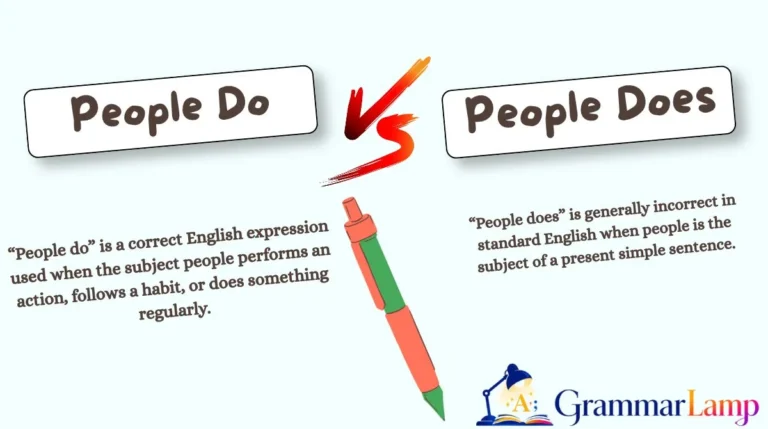
“People do” is a correct English expression used when the subject people performs an action, follows a habit, or does something regularly.
The word people is the plural form commonly used for person. It refers to two or more individuals. Because it is plural, it takes the base form of the verb do in the present simple tense.
For example:
- People do different jobs.
- People do what they believe is right.
- People do exercise to stay healthy.
In each sentence, people refers to more than one person. Therefore, we use do, not does.
When Should You Use “People Do”?
Use “people do” when talking about the actions, habits, choices, or responsibilities of people in general.
You can use this expression in statements, questions, and negative sentences. The exact sentence structure changes depending on what you want to say.
1. To talk about general habits
We often use people do to describe things that people regularly do.
Examples:
- People do their homework after school.
- People do exercise to improve their health.
- People do their shopping on weekends.
- People do different things in their free time.
These sentences describe actions or habits that may be common among groups of people.
2. To describe actions or responsibilities
You can also use the expression when explaining what people are responsible for doing.
Examples:
- People do their jobs to earn money.
- People do their best when they care about something.
- People do the work assigned to them.
- People do many things to help their families.
3. To ask questions
When people is the subject of a present simple question, use do before it.
Examples:
- Do people understand this rule?
- Do people work here on Sundays?
- Do people like this restaurant?
- Why do people make this mistake?
Notice that do comes before people in these questions. This is the normal word order for present simple questions with a plural subject.
Grammar Rule for “People Do”
The main rule is:
Plural subject + do + rest of the sentence
For example:
- People do their work carefully.
- People do many different activities.
- People do what they think is necessary.
In questions, the structure changes to:
Do + people + base verb + rest of the sentence?
For example:
- Do people live near this school?
- Do people speak English in that area?
In negative sentences, use do not or don’t.
Examples:
- People do not always agree.
- People don’t understand every situation.
- People do not need expensive things to be happy.
Common Confusion About “People Do”
Some learners think that people is singular because it refers to a group. However, in standard English, people is normally a plural count noun.
Compare these sentences:
- One person does the work.
- Two people do the work.
The subject changes from singular to plural, so the verb changes too.
Remember that people is different from a singular collective noun such as team or family, which can take singular or plural agreement depending on the variety of English and the intended meaning.
What Does “People Does” Mean?
“People does” is generally incorrect in standard English when people is the subject of a present simple sentence.
The confusion comes from the fact that does is a correct form of the verb do. We use does with third-person singular subjects, including he, she, and it, as well as singular nouns such as the boy, my friend, and the teacher.
For example:
- He does his homework every evening.
- She does a great job.
- My friend does the shopping on Fridays.
- The teacher does extra work after class.
All these subjects are singular, so does is correct.
However, when the subject is people, the correct form is do.
Incorrect: People does their homework.
Correct: People do their homework.
Why Do Learners Say “People Does”?
There are several reasons why this mistake happens.
1. Confusion about singular and plural subjects
Learners sometimes think about people as one group instead of focusing on the fact that the word refers to multiple individuals.
For example:
Incorrect: People does many different jobs.
Correct: People do many different jobs.
The verb must agree with the grammatical subject, not simply with the idea that the group acts together.
2. Mixing up “he does” and “they do”
English learners often remember the phrase he does and begin using does with other subjects.
Compare:
- He does his work.
- She does her work.
- They do their work.
- People do their work.
The last two examples use do because they and people are plural.
3. Confusion caused by questions
Sometimes learners hear does in a question and assume it can be used with any subject.
For example:
- Does he like coffee?
- Do people like coffee?
Both questions are correct, but the helping verb changes according to the subject.
Is “People Does” Ever Correct?
In standard English, you should not use people does when people is the subject and the verb is in the present simple tense.
However, the two words can appear next to each other in a different grammatical structure.
For example:
– What people does the company hire?
Here, people is the object of the verb hire, not the subject of does. The subject is the company, which is singular. Therefore, does is correct.
Another example:
– The manager does what people ask him to do.
In this sentence, the manager is the subject of does, while people is the subject of the clause people ask him.
These examples show why you should look at the entire sentence instead of deciding based only on the words next to each other.
Difference Between “People Do” and “People Does”
The main difference is grammatical agreement. People do is the correct form when people is the subject of a present simple sentence. People does is normally incorrect in that position.
Comparison Table
| Feature | People Do | People Does |
|---|---|---|
| Correct as a subject-verb combination | Yes | No |
| Subject type | Plural | Would require a singular subject |
| Standard grammar | Correct | Incorrect |
| Example | People do their work. | People does their work. |
| Correct alternative | People do their work. | He does his work. |
| Used in questions | Do people agree? | Does he agree? |
1. Usage Difference
Use people do when you are talking about people in general or about multiple individuals.
Examples:
- People do strange things sometimes.
- People do their best to solve problems.
- People do not always share the same opinion.
Do not use people does in these sentences because the subject is plural.
To use does correctly, change the subject to a singular noun or pronoun.
Examples:
- A person does strange things sometimes.
- He does his best to solve problems.
- She does not always share the same opinion.
The action may remain similar, but the subject determines which verb form you need.
2. Grammar Logic
In the present simple tense, English verbs follow a basic agreement rule.
With most subjects, we use the base form of the verb. With third-person singular subjects, we usually add -s or -es to the main verb.
For the verb do, the forms are:
- I do
- You do
- We do
- They do
- People do
- He does
- She does
- It does
This is why people do is correct. The word people behaves like a plural subject, similar to they.
Consider this example:
- People work hard.
- People do hard work.
The first sentence uses the main verb work. The second uses do as the main verb. In both cases, the verb agrees with the plural subject.
3. Sentence Structure Difference
The difference becomes especially clear when you compare statements, questions, and negative sentences.
Statements
- People do their homework.
- He does his homework.
Questions
- Do people live here?
- Does he live here?
Negative sentences
- People do not live here.
- He does not live here.
Notice an important point: after does in a question or negative sentence, the main verb uses its base form.
Correct: Does he work here?
Incorrect: Does he works here?
The same rule applies to do in questions and negatives.
Correct: Do people work here?
Incorrect: Do people works here?
4. Meaning Comparison
The expressions people do and people does do not normally have different meanings. Instead, one follows standard grammar and the other does not when used as a subject-verb combination.
For example:
- People do good things.
- People does good things.
Both sentences seem to communicate the same idea, but only the first is grammatically correct in standard English.
If you want to talk about one individual, use a singular subject:
- A person does good things.
- My brother does good things.
If you want to talk about multiple individuals, use people do:
- People do good things.
- My brothers do good things.
Choosing the right subject and verb together makes your meaning clear and your English more natural.
Explore More Posts
- Hasn’t vs Haven’t: Easy Grammar Rules, Examples & Differences in 2026
- Mine as Well or Might as Well? The Correct Phrase Explained in Simple English (2026)
- Smooth vs Smoothe: Which Spelling Is Correct? Complete Guide for 2026
- Alternative of vs Alternative for vs Alternative to: Which Is Correct? 2026 Guide
Grammar Rules You Must Remember
Learning four simple rules will help you use do and does correctly in everyday English.
Rule 1: Use “Do” With “People”
The word people is plural, so use do when it is the subject of a present simple sentence.
Examples:
- People do many things to save money.
- People do their work in different ways.
- People do not always understand each other.
Remember: People = they = do.
Rule 2: Use “Does” With Singular Third-Person Subjects
Use does with he, she, it, and singular nouns in the present simple tense.
Examples:
- He does his homework before dinner.
- She does the cleaning on Saturdays.
- The student does well in class.
- My father does the shopping.
Do not confuse the singular noun person with the plural noun people.
- One person does the work.
- Many people do the work.
Rule 3: Use “Do” and “Does” as Helping Verbs in Questions
When asking a present simple question, place do or does before the subject.
Use do with people:
- Do people eat breakfast here?
- Do people need a ticket?
- Why do people leave early?
Use does with a singular subject:
- Does your brother eat breakfast here?
- Does the shop need a ticket?
- Why does your friend leave early?
After the helping verb, use the base form of the main verb.
Correct: Does your brother work here?
Incorrect: Does your brother works here?
Rule 4: Use “Do Not” or “Does Not” in Negative Sentences
To make a present simple sentence negative, use do not or does not before the base form of the main verb.
With people:
- People do not know everything.
- People don’t always agree.
- People do not need to follow every trend.
With singular subjects:
- He does not know everything.
- She doesn’t always agree.
- My friend does not follow every trend.
In everyday speech, don’t and doesn’t are very common. Both are acceptable in informal conversations and in many forms of writing.
Common Mistakes Students Make
Even learners who know the basic rule sometimes make mistakes when speaking quickly. The best way to improve is to notice the pattern and practice correcting it.
Mistake 1: Using “Does” With “People”
Incorrect: People does not understand me.
Correct: People do not understand me.
Why is it wrong?
The subject people is plural. Use do not or don’t with it, not does not or doesn’t.
Easy tip: Replace people with they. If they do sounds right, use people do.
Mistake 2: Using “Does” in a Question About People
Incorrect: Does people work here?
Correct: Do people work here?
Why is it wrong?
Questions in the present simple use do with plural subjects. Since people is plural, the question must begin with do.
Try comparing these:
- Do people work here?
- Does that person work here?
The subject tells you which helping verb to choose.
Mistake 3: Adding “S” to the Main Verb After “Do”
Incorrect: People do likes this food.
Correct: People do like this food.
Why is it wrong?
When do acts as a helping verb, the main verb stays in its base form. Do not add -s to like, work, need, or want after do.
More examples:
- Correct: People do need help sometimes.
- Correct: People do want better opportunities.
- Correct: People do enjoy spending time with friends.
In ordinary positive statements, you can often leave out do when it is not needed for emphasis.
For example: People like this food.
Mistake 4: Confusing “People” With “Person”
Incorrect: One people does the work.
Correct: One person does the work.
Correct: Many people do the work.
Why is it wrong?
Person is the usual singular form, while people is the usual plural form. If you are talking about one individual, use person and does. If you are talking about several individuals, use people and do.
Mistake 5: Using “Does” After “Do”
Incorrect: Do people does their homework?
Correct: Do people do their homework?
Why is it wrong?
The first do is the helping verb. The second do is the main verb. After the helping verb, use the base form of the main verb.
This pattern is also correct:
- Do people do this every day?
- Does he do this every day?
It may look repetitive, but it is grammatically correct.
How to Correct These Mistakes Quickly
Before you choose do or does, ask yourself two questions:
- What is the subject?
- Is the subject singular or plural?
If the subject is people, use do in the present simple. If the subject is he, she, it, or a singular noun, use does in questions and negative sentences, and use does as the main verb where appropriate.
A few minutes of daily practice can help you remember this rule without stopping to think every time you speak.
Easy Trick to Remember the Difference
Here is a simple memory trick:
People = They = Do
You already know that we say they do, not they does. Since people is plural, you can use the same rule.
For example:
- They do their homework.
- People do their homework.
- They do not understand.
- People do not understand.
- Do they live here?
- Do people live here?
The structure stays the same because both subjects are plural.
Now compare this with a singular subject:
He = Does
- He does his homework.
- He does not understand.
- Does he live here?
This simple comparison works for many present simple sentences.
Use Real-Life Logic
Imagine a teacher asking about a classroom full of students.
The teacher asks, “Do people understand the lesson?”
The question refers to several people, so do is correct.
Now imagine the teacher asking about one student: “Does the student understand the lesson?”
Because the student is singular, does is correct.
You do not need to memorize hundreds of separate examples. Just learn the subject-verb pattern and apply it whenever you speak or write.
Daily Life Examples
Here are ten examples that show how to use people do naturally in everyday situations.
1. Talking About Habits
A: Why do people wake up early?
B: Many people do it because they have work or school.
The question uses do because people is plural. In the answer, do it refers to the action of waking up early.
2. Talking About Food
A: Do people eat spicy food in your country?
B: Yes, many people do.
The second speaker uses do to avoid repeating the phrase eat spicy food.
3. Talking About Work
A: What do people do in this office?
B: They help customers and answer questions.
Use do in the question because the subject is people.
4. Talking About Learning
A: Why do people make grammar mistakes?
B: People do make mistakes when they are learning something new.
Here, do make adds emphasis. It means that making mistakes is something that really happens.
5. Talking About Money
A: Do people save money every month?
B: Some people do, but others spend most of their income.
The expression some people do avoids repeating the full action.
6. Talking About Technology
A: Do people use smartphones for learning English?
B: Yes, many people do.
This is a natural question-and-answer pattern for daily conversation.
7. Talking About Opinions
A: Why do people disagree with each other?
B: People do not always have the same opinions.
The negative form do not is correct because the subject is plural.
8. Talking About Exercise
A: Do people exercise every day?
B: Some people do, but others exercise only a few times a week.
The helping verb do makes the question. It can also replace a repeated verb phrase in the answer.
9. Talking About Shopping
A: When do people usually go shopping?
B: Many people do their shopping on weekends.
The question asks about the habits of people in general, so do is the correct form.
10. Talking About Helping Others
A: Do people help strangers?
B: Yes, many people do, especially in emergencies.
This example shows how the expression can fit naturally into a short conversation.
Practice Section
Test your understanding with these five sentences. Choose do or does to complete each one.
1. People ___ different things in their free time.
- A. do
- B. does
2. ___ people work here on Sundays?
- A. Do
- B. Does
3. My brother ___ his homework after dinner.
- A. do
- B. does
4. People ___ not always agree with each other.
- A. do
- B. does
5. Why ___ that person leave early?
- A. do
- B. does
Answers and Explanations
- A. do — People is plural, so use do.
- A. Do — Present simple questions with the plural subject people use do.
- B. does — My brother is a singular subject, so use does.
- A. do — The correct negative form is do not because people is plural.
- B. does — That person is singular, so use does in the question.
If you answered all five correctly, you understand the main rule. If you made a mistake, review the memory trick and try writing five of your own sentences.
More Helpful posts
Realise or Realize: Which Spelling Is Correct in 2026?
Berth vs Birth: Meaning, Difference, Examples & Easy Rules for 2026
Insight vs Incite: What’s the Difference? Easy Guide for 2026
In the Same Day vs On the Same Day: Which Is Correct? A Simple Guide for 2026
FAQs
1. Is “people do” or “people does” correct?
“People do” is correct when people is the subject of a present simple sentence. The word people is plural, so it takes do. For example, “People do their best” is correct, while “People does their best” is incorrect in standard English.
2. Why do we say “people do” instead of “people does”?
We use do because people refers to more than one person. In the present simple tense, plural subjects such as people and they take do. Singular subjects such as he and she take does in questions and negative sentences.
3. Can we use “do” with people in questions?
Yes. Use do when asking present simple questions with people. For example, “Do people live nearby?” and “Why do people make mistakes?” are both correct. Do not use “Does people” in standard English.
4. Is “people does” ever grammatically correct?
It is incorrect when people is the subject directly connected to does in the present simple. However, the two words can appear together in a sentence when they have different grammatical roles. For example, “What people does the company hire?” is correct because the company is the subject of does.
5. Do we say “people don’t” or “people doesn’t”?
Say “people don’t.” The word don’t is the short form of do not, which agrees with the plural subject people. For example, “People don’t always understand the rules” is correct. “People doesn’t always understand the rules” is incorrect in standard English.
6. What is the difference between “people do” and “a person does”?
People do refers to more than one individual, while a person does refers to one individual. The subject determines the verb form. For example, “People do the work” and “A person does the work” are both correct because each verb agrees with its subject.
Conclusion
The difference between people do and people does is easy to understand once you learn how English verbs agree with their subjects.
In standard English, people do is the correct form when people is the subject of a present simple sentence. This is because people is plural, just like they.
Use does with singular subjects such as he, she, it, or a person. For questions and negative sentences, remember that do goes with plural subjects, while does goes with third-person singular subjects.
For example, say “Do people work here?” but “Does your brother work here?” Also remember to use the base form of the main verb after do or does.
The easiest way to remember the rule is to think: people do, they do, he does. Practice these patterns in your daily conversations, write a few sentences of your own, and correct your mistakes when you notice them. With regular practice, choosing the right form will soon feel natural.

Liam Derren is a language writer at GrammarLamp, creating simple, helpful content about grammar, words, and everyday English. He makes language learning clear, practical, and easy to understand.