
English has many phrases that look almost the same but work differently in a sentence. Sometimes, changing one small word can make a sentence sound natural or confusing.
“Result in” and “result to” are a good example of this problem. English learners often wonder which phrase is correct when they want to explain a cause, an effect, or the outcome of an action.
You may want to say that heavy rain caused a flood, poor planning caused a delay, or regular practice helped a student improve. In these situations, choosing the correct phrase helps you express your meaning clearly.
If you use the wrong preposition, your sentence may sound unnatural, even if the reader can understand what you mean.
The main point is simple: “Result in” is the standard phrase used to describe an outcome or effect. For example, “Heavy rain resulted in flooding.” The rain was the cause, and the flooding was the result.
On the other hand, “result to” is generally not correct when you want to express the same cause-and-effect relationship. Many learners use it because they think the word “to” can introduce the result. However, standard English normally uses “in” for this meaning.
After understanding this difference, you will be able to choose the right phrase in everyday conversations, school assignments, emails, and professional writing. You will also learn related expressions, common mistakes, grammar rules, and simple examples that make the correct usage easier to remember.
More Useful posts
See vs Look vs Watch: Easy English Grammar Guide for 2026
Recommend to vs recommend for 2026: Clear Grammar Rules, Examples, and Common Mistakes
Wreckless or Reckless? Which Spelling Is Correct in 2026?
Brite vs Bright: Meaning, Difference, Spelling & Correct Usage in 2026
What Does “Result In” Mean?
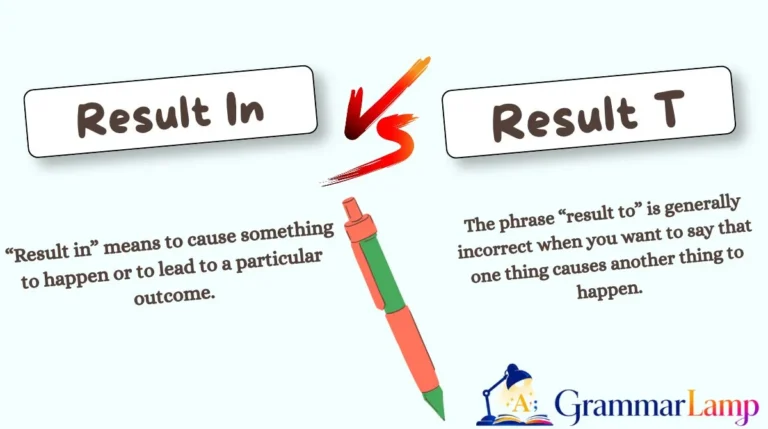
“Result in” means to cause something to happen or to lead to a particular outcome. We use this phrase when an action, event, situation, or decision produces a result.
The result may be good, bad, or neutral. For example, regular exercise can result in better health, while careless driving can result in an accident. The phrase itself does not tell us whether the outcome is positive or negative. It simply connects a cause with its effect.
When Should You Use “Result In”?
Use “result in” when you want to explain what happened because of something else. It is common in everyday English, academic writing, news reports, business communication, and scientific explanations.
Consider this sentence:
“Poor communication resulted in several mistakes.”
Here, poor communication is the cause, and several mistakes are the result. The phrase connects the two ideas naturally.
You can also use it when talking about future possibilities. For example, “Skipping regular maintenance may result in expensive repairs.” This means that skipping maintenance could cause expensive repairs later.
Grammar Rule for “Result In”
The basic sentence structure is:
Cause + result in + effect
Examples:
- Heavy rain resulted in flooding.
- Lack of sleep can result in tiredness.
- The new policy resulted in major changes.
You can also use different forms of the verb “result,” depending on the tense.
- Present: Poor planning results in delays.
- Past: Poor planning resulted in delays.
- Future: Poor planning may result in delays.
- Present perfect: Poor planning has resulted in delays.
Notice that “result” is followed by “in” when introducing the outcome. The word after “in” is often a noun or noun phrase, such as delays, better health, or serious problems.
A verb ending in -ing can also follow the phrase because it can work as a noun.
For example: “The storm resulted in several roads being closed.”
8 Examples of “Result In”
- Regular exercise can result in better health.
Exercise is the cause, and better health is the possible outcome. - The heavy rain resulted in a flood.
The rain caused the flood. - His careless driving resulted in an accident.
The accident happened because he drove carelessly. - Poor communication often results in confusion.
When people do not communicate clearly, confusion may follow. - The company’s new strategy resulted in higher sales.
The strategy helped produce an increase in sales. - Eating too much sugar may result in dental problems.
Too much sugar can lead to problems with the teeth. - The mistake resulted in a delay.
The mistake caused something to happen later than planned. - Years of practice have resulted in significant improvement.
Practice has helped produce a noticeable improvement.
Common Confusion About “Result In”
Some learners think “in” refers only to a place or location. For example, they know that we say “in the room” or “in the office,” so they may wonder why we use “in” to describe an outcome.
However, prepositions have different uses in English. In the phrase “result in,” the word “in” introduces the outcome produced by a cause. It does not describe a physical location.
Remember that the cause comes before “result in,” and the effect normally follows it.
For example:
“Hard work resulted in success.”
Hard work is the cause. Success is the result.
This pattern is one of the most useful ways to explain cause and effect in English.
What Does “Result To” Mean?
The phrase “result to” is generally incorrect when you want to say that one thing causes another thing to happen. In standard English, we normally use “result in” for that meaning.
For example, this sentence is not natural in standard English:
“Poor planning resulted to a delay.”
The correct version is:
“Poor planning resulted in a delay.”
The problem is the preposition. The verb “result” normally combines with “in” when it introduces an outcome.
Why Do Learners Say “Result To”?
There are several reasons for this common mistake.
First, learners may translate a phrase directly from their first language. The preposition that introduces an outcome in one language may not be the same preposition used in English.
Second, students may confuse “result in” with other expressions that use “to.” For example, English speakers say “lead to a problem,” “contribute to a change,” and “cause something to happen.”
These expressions have different grammatical patterns:
- Poor planning results in delays.
- Poor planning leads to delays.
- Poor planning causes delays.
All three can describe a cause and an effect, but their structures are not identical.
Third, some learners believe that “to” must be used because the result comes after the cause. However, English prepositions do not follow this kind of simple logical rule. The correct choice depends on the expression being used.
Is “Result To” Ever Correct?
In ordinary modern English, you should not use “result to” as a replacement for “result in” when describing an outcome.
However, the word “result” can appear near “to” in other grammatical structures. For example:
- The result is important to us.
- The result was announced to the students.
- The team presented the result to the manager.
These sentences are correct, but they do not use the expression “result to” to mean “cause an outcome.”
In the first example, “to us” means that the result matters to us. In the second, “to the students” identifies the people who received the announcement. In the third, it identifies the person who received the information.
The preposition “to” belongs to a different part of the sentence. It does not connect a cause to its effect.
8 Examples That Show the Correct Alternative
The following examples show how to replace the incorrect cause-and-effect use of “result to” with natural English.
- Incorrect: The storm resulted to flooding.
Correct: The storm resulted in flooding. - Incorrect: Lack of sleep may result to poor concentration.
Correct: Lack of sleep may result in poor concentration. - Incorrect: His mistake resulted to a serious problem.
Correct: His mistake resulted in a serious problem. - Incorrect: The new rules resulted to many changes.
Correct: The new rules resulted in many changes. - Incorrect: The delay resulted to extra costs.
Correct: The delay resulted in extra costs. - Incorrect: Poor preparation resulted to failure.
Correct: Poor preparation resulted in failure. - Incorrect: The accident resulted to road closures.
Correct: The accident resulted in road closures. - Incorrect: Regular practice resulted to better performance.
Correct: Regular practice resulted in better performance.
Common Learner Confusion
The biggest source of confusion is the difference between “result in” and “lead to.” Both expressions can describe a cause and an effect, but they use different prepositions.
Compare these sentences:
- Regular practice results in better performance.
- Regular practice leads to better performance.
Both are correct. The first uses “result in,” while the second uses “lead to.”
You should learn these expressions as complete phrases instead of trying to choose a preposition by translating each word separately.
Difference Between “Result In” and “Result To”
The main difference is that “result in” is the standard expression for describing an outcome, while “result to” is generally not used for that purpose in standard English.
The two phrases are not interchangeable. If you want to explain that something caused an effect, choose “result in.”
Comparison Table
| Feature | Result in | Result to |
|---|---|---|
| Standard cause-and-effect usage | Correct | Generally incorrect |
| Main meaning | To produce an outcome | Not the standard expression for this meaning |
| Common structure | Cause + result in + effect | Avoid this structure |
| Example | The rain resulted in flooding. | The rain resulted to flooding. |
| Natural in formal writing | Yes | No, for this meaning |
| Natural in everyday speech | Yes | Usually sounds incorrect |
| Better alternative | Result in | Result in or lead to, depending on the sentence |
1. Usage Difference
“Result in” is used when the focus is on the outcome of an action or event.
For example:
“The company’s poor decisions resulted in financial losses.”
This sentence tells us what happened because of the company’s decisions. The expression is suitable for business reports, essays, and normal conversation.
By contrast, “The company’s poor decisions resulted to financial losses” sounds incorrect in standard English. You should replace “to” with “in.”
If you want to use “to,” you can change the verb instead:
“The company’s poor decisions led to financial losses.”
This is a natural sentence because “lead to” is another established cause-and-effect expression.
2. Grammar Logic
English verbs often combine with specific prepositions. These combinations are sometimes called verb-preposition patterns.
For example:
- Depend on someone.
- Believe in something.
- Listen to music.
- Result in an outcome.
- Lead to an outcome.
You cannot freely exchange these prepositions just because the overall meaning seems similar. Each expression has its own accepted pattern.
This is why “result in” and “lead to” are correct, but “result to” is generally not correct when you want to describe an effect.
The best approach is to learn the complete expression with examples. With practice, the correct preposition will become easier to remember.
3. Sentence Structure Difference
The normal structure for “result in” is:
Subject + result + in + noun phrase
Examples:
- The error resulted in confusion.
- The treatment resulted in improvement.
- The new system results in fewer mistakes.
The subject identifies the cause, and the noun phrase after “in” identifies the outcome.
Now compare the structure of “lead to”:
Subject + lead + to + noun phrase
Examples:
- The error led to confusion.
- The treatment led to improvement.
- The new system leads to fewer mistakes.
Both expressions can introduce a noun phrase describing an outcome, but their prepositions differ. The correct preposition depends on the verb phrase you choose.
4. Meaning Comparison
“Result in” and “lead to” are close in meaning, but their focus can be slightly different.
“Result in” often presents something as the outcome of a cause. It is especially useful when describing the effect that actually occurred.
Example: “The policy resulted in lower costs.”
“Lead to” often emphasizes the path from one situation to another. It can describe an outcome that is possible, expected, or likely.
Example: “Better planning can lead to lower costs.”
This is a general tendency, not a strict rule. Both expressions can describe actual outcomes and possible future outcomes.
The important point is to use the correct expression and preposition.
Explore More Posts
I Ordered vs I Have Ordered: What’s the Difference? Simple Grammar Guide (2026)
Timber vs Timbre (2026): Meaning, Differences, Grammar Rules, Examples, and Easy Guide
On a Call or In a Call (2026): What’s the Difference? Easy Grammar Guide with Examples
Any Way vs Anyway: What’s the Difference? Complete Guide for 2026
Grammar Rules You Must Remember
Learning four simple rules can help you avoid most mistakes with these phrases.
Rule 1: Use “Result In” to Introduce an Outcome
When a cause produces an effect, use “result in.”
Correct: “The power failure resulted in a delay.”
Incorrect: “The power failure resulted to a delay.”
The phrase “result in” connects the cause with the outcome. The outcome can be an event, a condition, a change, or a situation.
More examples:
- The accident resulted in traffic delays.
- His hard work resulted in success.
- The sudden change resulted in confusion.
Whenever you use “result” to explain what happened because of something else, “in” is the normal choice.
Rule 2: Change the Verb Tense, Not the Preposition
The verb “result” changes according to the tense and the subject, but the preposition remains “in” when you introduce an outcome.
Examples:
- Present: Poor planning results in mistakes.
- Past: Poor planning resulted in mistakes.
- Future possibility: Poor planning may result in mistakes.
- Present perfect: Poor planning has resulted in mistakes.
Do not change “in” to “to” when you change the tense.
For example, “The decision will result to problems” is incorrect for the intended meaning. Say, “The decision will result in problems.”
Rule 3: Learn “Result In” and “Lead To” Separately
These expressions are similar in meaning, but they follow different patterns.
Correct:
- The delay resulted in extra costs.
- The delay led to extra costs.
Incorrect:
- The delay resulted to extra costs.
- The delay led in extra costs.
A helpful learning method is to remember each verb with its preposition. Instead of learning only the word “result,” remember the complete phrase “result in.” In the same way, learn “lead to” as a complete phrase.
This habit can improve your grammar in both writing and speaking.
Rule 4: A Noun or an “-ing” Form Can Follow “Result In”
The word or phrase after “in” often names the outcome.
Examples with nouns:
- The storm resulted in damage.
- The change resulted in success.
- The mistake resulted in confusion.
Examples with “-ing” forms:
- The discussion resulted in finding a solution.
- The investigation resulted in discovering new evidence.
- The changes resulted in reducing unnecessary costs.
In these examples, the words ending in “-ing” work as nouns or noun-like forms after the preposition “in.”
You can also use a longer noun phrase, such as “the closure of several roads,” after the expression.
Example: “The accident resulted in the closure of several roads.”
Common Mistakes Students Make
Many students make this mistake because they know the meaning they want to express but are unsure which preposition belongs with the verb.
The solution is to study common sentence patterns and practise correcting full sentences.
Mistake 1: Using “To” Instead of “In”
Incorrect: “The heavy rain resulted to a flood.”
Correct: “The heavy rain resulted in a flood.”
Why? The verb “result” normally takes “in” when it introduces an outcome.
Correction tip: Whenever you write “result to” to describe a cause and effect, check whether you should replace it with “result in.”
Mistake 2: Mixing “Result In” With “Lead To”
Incorrect: “The new rule resulted to better results.”
Correct: “The new rule resulted in better results.”
Another correct version is:
“The new rule led to better results.”
Why? “Result in” and “lead to” are separate expressions. Their prepositions cannot be exchanged.
Correction tip: Memorize the two complete phrases together, but practise them in separate example sentences.
Mistake 3: Using the Wrong Verb Form
Incorrect: “The change result in many problems yesterday.”
Correct: “The change resulted in many problems yesterday.”
Why? The word “yesterday” indicates a past event, so the past-tense form “resulted” is needed.
Correction tip: Check the time of the event. Use “results” for a present-tense singular subject, “result” for a plural subject or certain other present-tense subjects, and “resulted” for the past.
Mistake 4: Forgetting the Effect After “Result In”
Incomplete: “The accident resulted in.”
Complete: “The accident resulted in serious injuries.”
Why? In this sentence, “result in” needs an outcome to complete the intended meaning. Without that information, the reader does not know what happened because of the accident.
Correction tip: After writing “result in,” ask yourself, “What was the outcome?” Then add the noun phrase or suitable “-ing” phrase.
Mistake 5: Assuming “To” Is Always Wrong Near “Result”
Incorrect explanation: “You must never use the word ‘to’ in a sentence containing ‘result.’”
Better explanation: “Do not use ‘result to’ to express the usual cause-and-effect meaning.”
Examples:
- The result is important to the team.
- The teacher explained the result to the class.
- The mistake resulted in confusion.
Why? The word “to” is correct in the first two examples because it serves a different grammatical purpose.
Correction tip: Do not ban a word completely. Instead, learn which words belong together in each expression.
Easy Trick to Remember the Difference
Here is a simple memory trick:
Result IN = the outcome that comes INto the picture because of a cause.
This is only a memory aid, not the historical reason for the grammar rule. Its purpose is to help you remember the standard expression.
Think about a real-life example.
You forget to charge your phone. As a result, the battery runs out, and you miss an important call.
You can say:
“Not charging my phone resulted in a missed call.”
The cause is not charging the phone. The effect is the missed call. The phrase “resulted in” connects these two ideas.
Now imagine that you want to use “to.” Think of the phrase “lead to” instead.
“Not charging my phone led to a missed call.”
This sentence is also correct because “lead to” is a standard English expression.
A second useful trick is to remember two pairs:
- Result in a problem.
- Lead to a problem.
Both are natural. Mixing the prepositions is what creates the problem.
You can use this method with many other examples:
- Lack of sleep results in tiredness.
- Lack of sleep leads to tiredness.
- Careless driving results in accidents.
- Careless driving leads to accidents.
Read these sentences aloud a few times. You will start to recognize the natural patterns without having to think about every preposition separately.
Daily Life Examples
These everyday examples show how to use the correct phrase in normal conversations.
Example 1: At School
Ali: Why did so many students fail the test?
Sara: They did not prepare well. That resulted in poor marks.
Here, “resulted in” connects poor preparation with poor marks.
Example 2: At Work
Manager: Why was the project late?
Employee: There was a problem with the schedule, and it resulted in a delay.
The phrase explains the effect of the scheduling problem.
Example 3: Talking About Health
Friend A: Why are you feeling so tired?
Friend B: I’ve been sleeping only four hours a night. That can result in tiredness during the day.
The sentence describes a possible effect of not getting enough sleep.
Example 4: Discussing Money
Ali: How did the shop increase its profits?
Ahmed: Better planning resulted in lower costs.
The planning helped produce an improvement in the business.
Example 5: Talking About Traffic
Driver A: Why is the road closed?
Driver B: A serious accident resulted in the road being closed.
The phrase connects the accident with the road closure.
Example 6: Talking About Studying
Student A: How did you improve your English?
Student B: Daily practice resulted in better speaking skills.
The sentence explains the outcome of regular practice.
Example 7: Discussing Technology
Coworker A: Why is the computer so slow?
Coworker B: Too many programs are running. That may result in slower performance.
The word “may” shows that the effect is possible rather than certain.
Example 8: Talking About a Mistake
Friend A: Why did you have to pay extra?
Friend B: I booked the wrong ticket, and that resulted in extra charges.
The wrong booking caused additional costs.
Example 9: Talking About Weather
Person A: Why are there so many puddles outside?
Person B: The heavy rain resulted in water collecting on the roads.
The sentence describes the effect of heavy rain.
Example 10: Discussing Teamwork
Team Member A: How did we finish the task so quickly?
Team Member B: Good teamwork resulted in faster progress.
The phrase shows how teamwork helped produce a particular outcome.
In each example, “result in” introduces the effect. If you accidentally use “result to” in these sentences, replace “to” with “in.”
Practice Section
Test what you have learned. Choose the correct word or phrase in each sentence.
1. Heavy rain resulted ___ flooding in the village.
- A. to
- B. in
2. Poor communication may result ___ serious mistakes.
- A. in
- B. to
3. Regular practice resulted ___ an improvement in her English.
- A. to
- B. in
4. The accident led ___ a long traffic jam.
- A. in
- B. to
5. The company’s new plan has resulted ___ higher sales.
- A. to
- B. in
Answers and Explanations
1. B — in
“Result in” is the standard expression for introducing an outcome. The flooding was caused by heavy rain.
2. A — in
The correct phrase is “result in serious mistakes.” The word “may” does not change the required preposition.
3. B — in
The improvement was the outcome of regular practice, so “resulted in” is correct.
4. B — to
The verb in this sentence is “led,” not “resulted.” The correct expression is “lead to.”
5. B — in
The present perfect form “has resulted” still takes “in” when introducing an outcome.
If you answered all five correctly, you understand the main rule. If you made a mistake, review the comparison table and read the examples aloud again.
More Helpful posts
Choose vs Chose: Difference, Meaning, Rules & Examples (2026)
At the Weekend or On the Weekend then? Which Is Correct in 2026?
Similar to vs Similarly to: Meaning, Grammar, and Examples (2026)
Is It Correct to Say “Repeat Again”? 2026 Grammar Guide
FAQs
1. What is the difference between “result in” and “result to”?
“Result in” is the standard English expression used to show that something causes an outcome. For example, “The delay resulted in extra costs.” “Result to” is generally incorrect when used with this meaning. Use “result in” instead.
2. Is “result to” grammatically correct?
Not usually when you want to describe a cause-and-effect relationship. Standard English uses “result in” to introduce the effect. However, “to” can appear elsewhere in a sentence containing the noun “result,” as in “The result is important to us.”
3. Can I use “result in” in a question?
Yes. You can use it in direct and indirect questions. For example, “Did the mistake result in a delay?” and “Can poor planning result in failure?” Both sentences are grammatically correct.
4. Is “result in” formal or informal?
“Result in” is suitable for both formal and informal English. You can use it in school essays, business reports, emails, conversations, and explanations. It may sound more formal than some everyday alternatives, such as “cause,” but it is common in many types of writing.
5. What is another way to say “result in”?
You can often use “lead to,” “cause,” or “bring about,” depending on the sentence. For example, “The mistake resulted in a delay” can become “The mistake caused a delay” or “The mistake led to a delay.” Remember that each alternative follows its own grammar pattern.
6. Which is correct: “resulted in” or “resulted to”?
“Resulted in” is correct when you want to say that something caused a particular outcome. For example, “The new rules resulted in several changes.” “Resulted to” is not the standard form for this meaning, so replace “to” with “in.”
Conclusion
Understanding the difference between “result in” and “result to” is easier when you focus on the way English expressions work.
The main rule is simple: use “result in” when explaining the outcome of an action, event, or situation. For example, “Lack of preparation resulted in poor marks.”
In standard English, “result to” is generally incorrect when you want to express the same cause-and-effect meaning. If you want to use the preposition “to,” you can often choose another expression, such as “lead to.” For instance, “Lack of preparation led to poor marks” is also correct.
Remember that the preposition belongs to the expression you choose. You cannot freely switch “in” and “to” just because the sentences have similar meanings.
The best way to improve is to practise with short, everyday examples. Describe what causes delays, mistakes, success, or changes in your own life. Each time you write a sentence, check whether you need “result in” or another expression.
With regular practice, you will use these phrases more naturally and feel more confident in both spoken and written English.

Liam Derren is a language writer at GrammarLamp, creating simple, helpful content about grammar, words, and everyday English. He makes language learning clear, practical, and easy to understand.