
When writing a formal letter or professional email, the words you use at the end matter. A small grammar mistake can make your message look less professional, even when the rest of your writing is clear. One common mistake is writing “your sincerely” instead of “yours sincerely.”
The correct expression is “yours sincerely.” It is a polite closing used at the end of a formal letter or email. “Your sincerely” is grammatically incorrect when used as a letter closing because the word “your” does not fit the structure of this expression.
However, the reason behind this rule is not always clear to English learners. Both “your” and “yours” are common English words, and they are closely related in meaning. This can make it difficult for students to remember which one belongs at the end of a letter.
Understanding the difference is useful for students, job seekers, office workers, business owners, and anyone who writes professional emails.
For example, you may need to contact a teacher, apply for a job, ask a company for information, or send a formal request. Using the correct closing helps your message look neat and professional.
By learning how these words work, you can avoid a common writing mistake and feel more confident when ending formal messages.
You will also understand how “your” and “yours” work in other sentences, so you can use them correctly beyond letter writing.
More Useful posts
All Is vs All Are: Which One Is Correct? Complete Grammar Guide for 2026
At the Weekend or On the Weekend? 2026 Guide to British and American English
To Discuss or Discuss About: Which Is Correct? | Easy Grammar Guide 2026
Upmost vs Utmost: Meaning, Difference, and Correct Usage in 2026
What Does “Yours Sincerely” Mean?
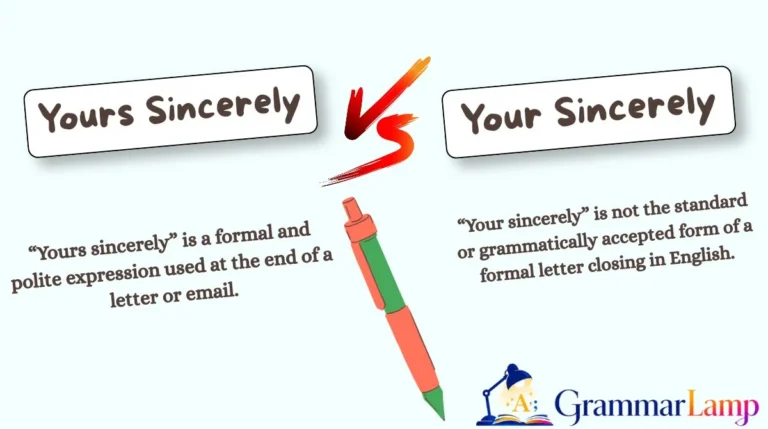
“Yours sincerely” is a formal and polite expression used at the end of a letter or email. It shows respect toward the person receiving your message. It is especially common in British English and is widely taught as a traditional formal letter closing.
The expression does not mean that you literally belong to the person receiving the letter. Instead, it is a conventional way to end a written message politely before writing your name.
For example, if you write an email to a school principal about an important matter, you might finish your message with “Yours sincerely” followed by your full name.
When Should You Use “Yours Sincerely”?
Use this expression when writing formal letters or emails, especially when you know the name of the person you are addressing.
It can be suitable for:
- Letters to teachers, principals, or university staff.
- Job applications and professional correspondence.
- Emails to managers and business clients.
- Formal requests to companies or organizations.
- Letters to people you know by name but with whom you have a professional relationship.
In traditional British letter-writing conventions, “Yours sincerely” is generally used when the letter begins with the recipient’s name, such as “Dear Mr. Smith” or “Dear Ms. Ahmed.”
If the letter begins with “Dear Sir or Madam” because you do not know the recipient’s name, traditional British usage usually favors “Yours faithfully.” Modern email practices vary, so the best closing can also depend on the organization and the tone of the message.
Grammar Rule for “Yours Sincerely”
The word “yours” is a possessive pronoun. It can show possession without needing a noun after it.
For example:
- This book is yours.
- The decision is yours.
- The responsibility is yours.
The word “your,” on the other hand, is a possessive determiner. It normally comes before a noun.
For example:
- Your book is on the table.
- Your message was helpful.
- Your application has been received.
In “yours sincerely,” the word “yours” belongs to a traditional closing expression. The word “sincerely” is an adverb that expresses the idea of speaking or writing honestly and genuinely.
Although the phrase has a traditional form, you do not need to analyze every word each time you write a letter. The easiest approach is to learn “Yours sincerely” as a complete expression.
Examples of “Yours Sincerely”
Here are eight examples showing how to use the expression correctly.
- Yours sincerely,
Ahmed Khan - Yours sincerely,
Sarah Williams - Dear Mr. Brown,
Thank you for considering my application.
Yours sincerely,
Ali Hassan - Dear Ms. Ahmed,
I am writing to ask about the available position.
Yours sincerely,
Hamza Malik - Dear Professor James,
I appreciate your time and guidance.
Yours sincerely,
Fatima Noor - Dear Mr. Wilson,
Please find my completed application attached.
Yours sincerely,
Usman Ali - Dear Mrs. Taylor,
Thank you for your response to my request.
Yours sincerely,
Ayesha Khan - Dear Dr. Smith,
I look forward to hearing from you.
Yours sincerely,
Bilal Ahmed
Notice that the expression appears near the end of the message, before the writer’s name. It is not normally used as the opening of a letter or as part of the main message.
Common Confusion About “Yours Sincerely”
Many learners believe that “your sincerely” should be correct because they are addressing another person. They may think the writer is saying that the message belongs to the reader.
However, formal closings follow established expressions. You cannot change “yours sincerely” to “your sincerely” simply because the letter is addressed to someone else.
Remember that “your” usually needs a noun after it, while “yours” can stand alone. In this closing, the established form is “Yours sincerely.”
What Does “Your Sincerely” Mean?
“Your sincerely” is not the standard or grammatically accepted form of a formal letter closing in English. If you are ending a professional letter, you should write “Yours sincerely,” not “Your sincerely.”
The confusion comes from the fact that “your” is a correct English word. It is used every day to talk about something connected with another person. The problem is not the word itself. The problem is using it in a place where the standard expression requires “yours.”
For example, these sentences are correct:
- Your email was very helpful.
- Your answer is correct.
- Your name is written on the form.
- Your sincerely is not the standard form of a formal closing.
In the last example, the words “your sincerely” are being discussed as a phrase. The sentence is grammatically possible because the phrase is being treated as the subject of the sentence, but the phrase itself remains incorrect as a letter closing.
When Do People Write “Your Sincerely”?
People usually write “your sincerely” by mistake when ending formal letters, school applications, emails, or other professional messages.
This mistake often happens for three reasons.
First, learners confuse “your” and “yours.” Both words are related to possession, so beginners may think they can replace one with the other.
Second, students may translate directly from their first language. A phrase that sounds natural in one language may not follow the same grammatical pattern in English.
Third, learners may remember the sound of the expression but not its spelling. They know that a letter should end with a polite phrase, but they are unsure whether it contains “your” or “yours.”
Grammar Rule for “Your”
“Your” is a possessive determiner. It normally appears before a noun to show that something belongs to, relates to, or is associated with the person being addressed.
For example:
- Your pen is on my desk.
- Your teacher is waiting outside.
- Your suggestion was useful.
- Your application needs one more document.
- Your email arrived this morning.
- Your brother called you yesterday.
In each sentence, “your” comes before a noun: pen, teacher, suggestion, application, email, or brother.
This is the main pattern to remember:
Your + noun
Examples include “your name,” “your book,” “your idea,” and “your sincerely” as a letter closing is not a standard use of this pattern.
Examples of the Incorrect Closing
The following examples show common mistakes and their corrections.
- Incorrect: Your sincerely, Ahmed Khan
Correct: Yours sincerely, Ahmed Khan - Incorrect: Dear Mr. Brown, thank you for your time. Your sincerely, Ali.
Correct: Dear Mr. Brown, thank you for your time. Yours sincerely, Ali. - Incorrect: I have attached my CV. Your sincerely, Hamza Malik.
Correct: I have attached my CV. Yours sincerely, Hamza Malik. - Incorrect: Your sincerely, Sarah Williams
Correct: Yours sincerely, Sarah Williams - Incorrect: Thank you for your reply. Your sincerely, Fatima Noor.
Correct: Thank you for your reply. Yours sincerely, Fatima Noor. - Incorrect: Dear Dr. Smith, I look forward to your response. Your sincerely, Usman Ali.
Correct: Dear Dr. Smith, I look forward to your response. Yours sincerely, Usman Ali. - Incorrect: Your sincerely, Ayesha Khan
Correct: Yours sincerely, Ayesha Khan - Incorrect: I hope to hear from you soon. Your sincerely, Bilal Ahmed.
Correct: I hope to hear from you soon. Yours sincerely, Bilal Ahmed.
These examples show that the correction is simple. You do not need to rewrite the entire message. Just replace “your sincerely” with “yours sincerely.”
Difference Between “Yours Sincerely” and “Your Sincerely”
The main difference is that “yours sincerely” is the correct traditional formal closing, while “your sincerely” is an incorrect form when used for that purpose.
Both expressions contain familiar English words, but only one follows the established letter-writing convention.
Comparison Table
| Feature | Yours sincerely | Your sincerely |
|---|---|---|
| Correct formal closing | Yes | No |
| Standard in formal letters | Yes | No |
| Word used before “sincerely” | Yours | Your |
| Grammar role | Traditional closing expression | Incorrect substitution in this context |
| Suitable for job applications | Yes, when appropriate | No |
| Suitable for formal emails | Yes, when appropriate | No |
| Recommended for learners | Yes | No |
1. Usage Difference
“Yours sincerely” is used to finish a formal letter or email. It appears after the main message and before the writer’s name.
For example:
Dear Mr. Ahmed,
Thank you for giving me the opportunity to attend the interview. I look forward to hearing from you.
Yours sincerely,
Ali Hassan
This is a suitable traditional closing when the recipient is addressed by name.
“Your sincerely” should not be used in the same position. If you see it in a letter, it is usually a spelling or grammar mistake.
2. Grammar Logic
The difference becomes easier to understand when you learn how “your” and “yours” work.
“Your” normally comes before a noun. For example, you can say “your letter,” “your decision,” or “your opinion.”
“Yours” can stand alone. For example, you can say “The choice is yours” or “This seat is yours.”
The expression “Yours sincerely” is a conventional closing, so it uses “yours,” not “your.” Although “sincerely” is an adverb, the entire phrase should be learned as a standard expression rather than rebuilt using the normal possessive determiner pattern.
3. Sentence Structure Difference
The correct expression follows this standard pattern:
Yours sincerely, + your name
For example:
Yours sincerely,
Hassan Ali
The incorrect pattern is:
Your sincerely, + your name
This is not accepted as the standard closing because “your” does not fit the established phrase.
In ordinary sentences, however, “your” is completely correct when it comes before a noun.
For example:
- Your letter was excellent.
- Your sincerely is incorrect as a formal closing.
The second sentence is discussing the phrase itself, not using it to close a letter.
4. Meaning Comparison
“Yours sincerely” communicates a polite and formal ending. It signals that the message has finished and the writer is signing off respectfully.
“Your sincerely” has no accepted meaning as a formal closing. A reader will probably understand what you intended, but the mistake may make your writing look less polished.
This matters when you are applying for a job, contacting a university, or communicating with a company. A correct closing is a small detail, but it helps create a professional impression.
Explore More Posts
Work Alongside You vs Work Alongside With You (2026): Which One Is Correct in English?
Based Out of vs Based In (2026): What’s the Difference? Easy Grammar Guide with Examples
Crews vs Cruise (2026): What’s the Difference? Easy Grammar Guide with Examples
Everything vs Every Thing: Easy Difference, Rules, Examples & Practice (2026)
Grammar Rules You Must Remember
You can avoid this mistake by learning four simple rules. They will help you write formal messages correctly and understand the difference between possessive words.
Rule 1: Use “Yours Sincerely” as the Traditional Closing
When ending a traditional formal letter addressed to a named person, use “Yours sincerely.”
Example:
Dear Ms. Wilson,
Thank you for reviewing my application. I appreciate your consideration.
Yours sincerely,
Ahmed Khan
Do not change the expression to “Your sincerely.” Learn the complete phrase and use it consistently.
Rule 2: Use “Your” Before a Noun
The word “your” normally comes before a noun. It tells the reader that something belongs to or relates to the person being addressed.
Examples:
- Your book is on the desk.
- Your answer is correct.
- Your meeting starts at nine.
- Your application has been approved.
A useful pattern is “your + noun.” If you are not placing a noun after “your,” check whether you need another form.
Remember, though, that English has special expressions that should be learned as complete phrases. Do not apply a single grammar pattern without considering the expression you are using.
Rule 3: Use “Yours” When It Stands Alone
“Yours” is a possessive pronoun. It can replace a possessive phrase when the noun is understood.
Examples:
- This bag is yours.
- The final decision is yours.
- Is this notebook yours?
- The responsibility is yours.
You do not normally need to add the noun after “yours” because the word can stand alone.
This is one reason “yours sincerely” is the standard closing. The expression uses “yours” as part of a fixed, traditional phrase.
Rule 4: Match the Closing to the Letter’s Opening
In traditional British English letter-writing, the opening and closing often follow a pattern.
- Dear Mr. Khan → Yours sincerely
- Dear Ms. Brown → Yours sincerely
- Dear Sir or Madam → Yours faithfully
This is a traditional convention, not a universal rule for every modern email. In many workplaces, “Kind regards,” “Best regards,” or “Best wishes” may be more natural.
For example, if you email a colleague you work with regularly, “Kind regards” may be more suitable than a traditional formal closing.
The important point is to choose a closing that matches the person, purpose, and level of formality.
Common Mistakes Students Make
English learners often make small mistakes when writing formal letters because they focus on the main message and forget to check the ending. A closing may contain only two words, but those words are still part of the message.
Here are some common errors and simple ways to correct them.
Mistake 1: Writing “Your Sincerely”
Incorrect: Your sincerely,
Ahmed Khan
Correct: Yours sincerely,
Ahmed Khan
Why does this happen? Learners know the word “your” but may not remember that the established expression uses “yours.”
Correction tip: Save “Yours sincerely” as a phrase in your notes. Read it a few times before writing a formal letter.
Mistake 2: Writing “Yours Sincere”
Incorrect: Yours sincere,
Sarah Williams
Correct: Yours sincerely,
Sarah Williams
The word “sincere” is an adjective. It describes a person, feeling, or statement that is honest and genuine.
“Sincerely” is an adverb. It is the word used in the traditional closing.
Compare these examples:
- She gave a sincere apology.
- He sincerely thanked his teacher.
Correction tip: Remember that the formal closing ends with “sincerely,” not “sincere.”
Mistake 3: Writing “Your Sincerely” in a Job Application
Incorrect:
Dear Hiring Manager,
I am interested in the advertised position.
Your sincerely,
Ali Hassan
Correct:
Dear Hiring Manager,
I am interested in the advertised position.
Yours sincerely,
Ali Hassan
A job application is a professional document, so spelling and grammar are important. Even when the reader understands your meaning, correct writing shows attention to detail.
Correction tip: Check the greeting, main message, closing, and name before sending your application.
Mistake 4: Using “Yours Sincerely” in Every Email
“Yours sincerely” is correct, but it is not always the most natural choice for every message.
For example, if you write a quick email to a coworker about lunch plans, a formal closing may sound too serious.
Instead, you could write:
“Thanks,
Ali”
Or:
“Best,
Ali”
For a formal message to a named recipient, “Yours sincerely” may be suitable. For everyday work emails, choose a closing that matches the tone.
Correction tip: Correct grammar matters, but natural tone matters too.
Mistake 5: Forgetting the Comma
A traditional letter closing is often written with a comma after it.
Example:
Yours sincerely,
Ahmed Khan
The comma is a common convention in letter writing. Some modern email styles use different punctuation or no comma, depending on the style guide. In school assignments and formal letters, using the comma is a safe choice.
Correction tip: Follow the format your teacher, employer, or organization expects.
Mistake 6: Confusing “Yours Sincerely” With “Yours Faithfully”
These expressions are both used as formal closings, but traditional British conventions distinguish between them.
“Yours sincerely” is generally used when you address the recipient by name.
“Yours faithfully” is traditionally used when you begin with “Dear Sir or Madam” or another greeting that does not name the recipient.
Correction tip: Check your greeting before choosing your closing.
Easy Trick to Remember the Difference
Here is a simple trick you can use whenever you write a formal letter.
Remember the complete phrase: “Yours sincerely.”
Do not try to create the phrase from scratch each time. Treat it as one unit, just like “Good morning,” “Thank you,” or “Best regards.”
You can also use this memory trick:
- Your + noun: your letter, your name, your application.
- Yours alone: this book is yours, the choice is yours.
- Formal closing: Yours sincerely.
Imagine that you have just finished writing an email to a university teacher. You write the greeting, explain your question, and thank the teacher for their time. At the end, you need a polite closing.
Instead of thinking, “Should I write your or yours?” remember the complete expression you have already learned:
Yours sincerely,
Your full name
Notice that “yours” is used in the closing, while “your” appears in the phrase “your full name” because “name” is a noun.
This example helps you see both words in the same context.
The more you use the correct phrase, the easier it becomes to remember. After writing a few formal emails, you will probably stop thinking about the rule because the correct expression will feel natural.
Daily Life Examples
The following examples show how the correct closing can appear in real-life writing situations. These are written examples rather than spoken phrases because “Yours sincerely” is mainly used in letters and emails.
Example 1: Contacting a Teacher
Dear Mr. Ahmed,
I would like to ask about the homework deadline. Could you please confirm the submission date?
Yours sincerely,
Hamza Ali
Example 2: Applying for a Job
Dear Ms. Brown,
I am writing to apply for the sales assistant position. I have attached my CV for your review.
Yours sincerely,
Sarah Khan
Example 3: Asking a University for Information
Dear Admissions Officer,
Could you please tell me which documents are required for admission?
Yours sincerely,
Ali Hassan
Example 4: Writing to a Manager
Dear Mr. Wilson,
Thank you for explaining the new office policy. I will follow the updated instructions.
Yours sincerely,
Fatima Noor
Example 5: Contacting a Customer Service Department
Dear Ms. Taylor,
Thank you for looking into my request. I appreciate your help and look forward to your response.
Yours sincerely,
Usman Malik
Example 6: Requesting a Meeting
Dear Dr. Ahmed,
Would it be possible to arrange a short meeting next week to discuss my research project?
Yours sincerely,
Ayesha Khan
Example 7: Sending a Formal Thank-You Message
Dear Professor Smith,
Thank you for your guidance during the semester. Your advice has helped me improve my work.
Yours sincerely,
Bilal Ahmed
Example 8: Following Up on an Application
Dear Ms. Wilson,
I am writing to follow up on my application submitted last week. I would be grateful for any updates.
Yours sincerely,
Hassan Ali
Example 9: Requesting a Document
Dear Mr. Brown,
Could you please send me a copy of the confirmation letter when you have a chance?
Yours sincerely,
Maryam Khan
Example 10: Writing to an Organization
Dear Sir or Madam,
I would like to request further information about your registration process.
Yours faithfully,
Ahmed Raza
The final example uses “Yours faithfully” because the greeting does not name the recipient. This is the traditional British English convention. It is included to show that choosing a formal closing also depends on how the letter begins.
Practice Section
Test what you have learned. Choose the correct word or phrase for each sentence.
1. Which is the correct traditional closing for a letter addressed to Mr. Ahmed by name?
A. Your sincerely
B. Yours sincerely
2. Choose the correct phrase.
“_____ application has been received.”
A. Your
B. Yours
3. Complete the sentence.
“This book belongs to you. It is _____.”
A. your
B. yours
4. Which closing is traditionally used with “Dear Sir or Madam” in British English?
A. Yours faithfully
B. Your faithfully
5. Complete the formal letter ending.
“Thank you for considering my request.
_____,
Ali Hassan”
A. Your sincerely
B. Yours sincerely
Answers and Explanations
- B — Yours sincerely. This is the standard traditional closing when the recipient is addressed by name.
- A — Your. The word “your” comes before the noun “application.”
- B — Yours. The word can stand alone because the noun does not need to follow it.
- A — Yours faithfully. This is the traditional British English closing for a letter that does not address a named person.
- B — Yours sincerely. This is the correct form of the closing phrase.
If you answered all five correctly, you understand the main difference. If you made a mistake, review the examples and try the exercise again.
More Helpful posts
Compare to vs Compare with: Easy Grammar Guide for 2026
Apportion vs Portion vs Proportion: Meaning, Differences, and Easy Examples (2026)
Case in Point vs Case and Point: Which Is Correct? (2026)
Lets vs Let’s (2026): What’s the Difference? Easy Grammar Guide with Examples
FAQs
1. What is the difference between “yours sincerely” and “your sincerely”?
“Yours sincerely” is the correct traditional formal letter closing. “Your sincerely” is not accepted as the standard closing. The difference comes from the use of “yours” in the established expression. When ending a formal letter to a named person, use “Yours sincerely.”
2. Is “your sincerely” grammatically correct?
It is not correct when used as a formal letter closing. The word “your” normally comes before a noun, such as “your name” or “your letter.” The standard closing uses “yours sincerely.” You may discuss the words “your sincerely” in a sentence, but that does not make them a correct sign-off.
3. Is “yours sincerely” formal or informal?
“Yours sincerely” is a formal or fairly formal closing. It is commonly associated with traditional British English letters and professional correspondence. It can be suitable for job applications, university emails, and messages to people addressed by name. In casual emails, “Thanks” or “Best” may sound more natural.
4. Can I use “yours sincerely” in an email?
Yes. You can use “Yours sincerely” in a formal email, especially when writing to a teacher, employer, manager, or other professional contact. It usually appears after the final paragraph and before your name. In less formal workplace emails, “Kind regards” or “Best regards” may be a better choice.
5. Should I write “yours sincerely” or “yours faithfully”?
In traditional British English, use “Yours sincerely” when you address the recipient by name, such as “Dear Mr. Khan.” Use “Yours faithfully” when the greeting is “Dear Sir or Madam.” These conventions vary across regions and organizations, so follow the style expected by your school or workplace.
6. Should “Yours Sincerely” be capitalized?
Capitalization depends on the style guide and where the phrase appears. In traditional letter writing, “Yours sincerely,” with a capital “Y” at the beginning and lowercase “sincerely,” is common. Some organizations use different capitalization styles. For most formal letters and emails, “Yours sincerely,” is a safe and widely accepted format.
Conclusion
The difference between “yours sincerely” and “your sincerely” is simple once you learn the correct expression. “Yours sincerely” is the standard traditional closing for a formal letter addressed to a named person, while “your sincerely” is incorrect when used as a sign-off.
The word “your” normally comes before a noun, as in “your name,” “your book,” or “your application.” The word “yours” can stand alone, as in “This book is yours.” In the traditional letter closing, the correct form is “Yours sincerely.”
When writing formal letters, remember to check your greeting as well. If you address someone by name, “Yours sincerely” is traditionally appropriate in British English. If you use “Dear Sir or Madam,” “Yours faithfully” is the traditional choice.
You do not need to memorize many complicated grammar rules to avoid this mistake. Learn the correct phrase, read examples, and use it whenever the situation calls for it. With a little practice, choosing the right closing will become easy and natural.

Liam Derren is a language writer at GrammarLamp, creating simple, helpful content about grammar, words, and everyday English. He makes language learning clear, practical, and easy to understand.